Primordial Era
The universe’s birth and first transformation. Energy cools into matter, laws stabilise, and darkness follows light’s first release. Everything that will shine later is prepared here.
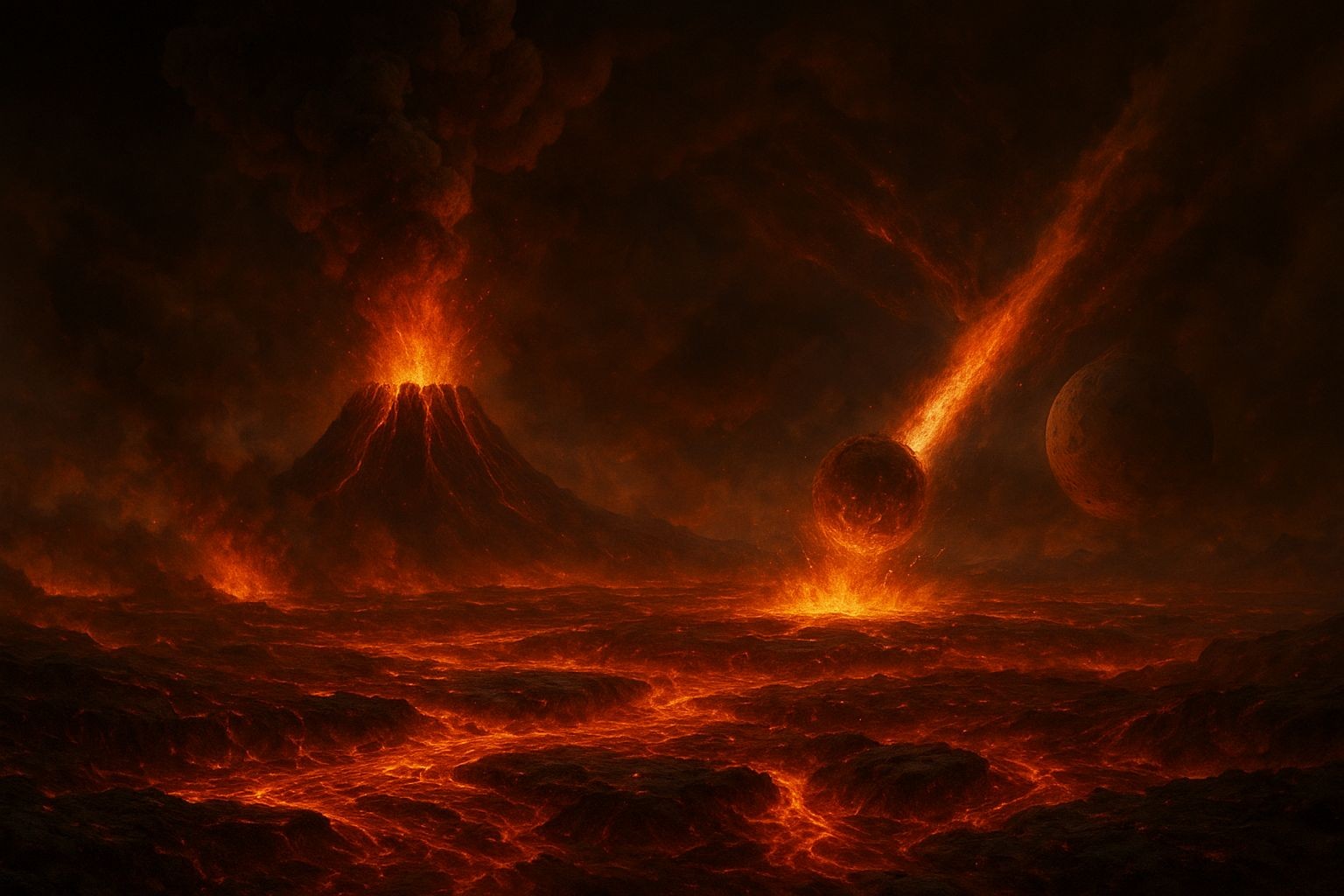
The primordial era refers to the earliest phase of the universe , beginning with the Big Bang around 13.8 billion years ago. During this time , the universe was extremely hot and dense, filled with a rapidly expanding mix of energy and fundamental particles. As it cooled these particles combined to form simple atoms, laying the foundation for the first stars and galaxies, this era set the stage for all cosmic evolution that followed.
By Harleah Fonteyn
The Big Bang
The Big Bang marks the beginning of the universe as a physical process. In its earliest moment, all energy, space, time, and forces exist in an undifferentiated state beyond the reach of known physics. There is no…
Quark-Gluon Plasma Epoch
At first, just after the Big Bang, there were no particles. Everything was pure energy in a hot, dense soup. As the universe cooled slightly, energy turned into matter. The first 'players' showed up. In that early…
Hadron Epoch
As the universe continues to cool, quarks can no longer move freely. They bind together, forming protons and neutrons. For the first time, matter gains stable composite particles. Most quarks and antiquarks annihilate…
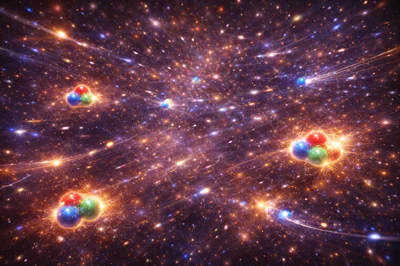
Lepton Epoch
With most hadrons formed, the universe is dominated by leptons, especially electrons and neutrinos. These lightweight particles carry much of the remaining energy and interact frequently with radiation. Protons and…
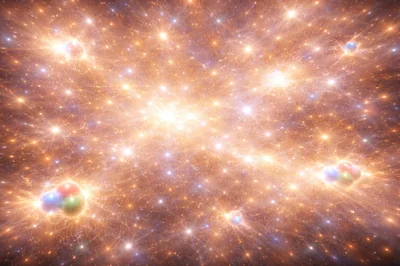
Photon Epoch
Radiation now dominates the universe. Photons scatter constantly off charged particles, preventing light from travelling freely. The universe is opaque, filled with a hot, glowing plasma. During this epoch, protons and…
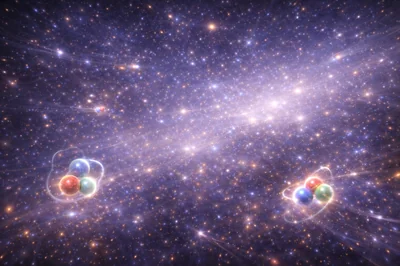
Recombination
Recombination marks the moment when the universe becomes transparent. As expansion continues, temperatures fall enough for electrons to bind permanently to atomic nuclei, forming the first neutral atoms. Once electrons…
Dark Ages
The cosmic dark ages begin after recombination, when electrons bind to nuclei and the universe becomes filled with neutral hydrogen and helium. With no stars, galaxies, or other light sources yet formed, the universe is…
Pre-Stellar Epoch
The pre-stellar Epoch was the period after the Big Bang when no stars yet existed. The universe was filled with cooling hydrogen and helium gas that slowly clumped together under gravity. These growing gas clouds…