The Universe
Time
Primordial Era
Stelliferous Era
The Big Bang
Quark-Gluon Plasma Epoch
Hadron Epoch
Lepton Epoch
Photon Epoch
Recombination
Dark Ages
Pre-Stellar Epoch
Population III Epoch
Reionisation Epoch
Peak Star-Formation Epoch
Declining Star-Formation Epoch
Red-Dwarf Dominance Epoch
The Universe
Time
Primordial Era
Stelliferous Era
The Big Bang
Quark-Gluon Plasma Epoch
Hadron Epoch
Lepton Epoch
Photon Epoch
Recombination
Dark Ages
Pre-Stellar Epoch
Population III Epoch
Reionisation Epoch
Peak Star-Formation Epoch
Declining Star-Formation Epoch
Red-Dwarf Dominance Epoch
The Universe
Time
Primordial Era
Stelliferous Era
The Big Bang
Quark-Gluon Plasma Epoch
Hadron Epoch
Lepton Epoch
Photon Epoch
Recombination
Dark Ages
Pre-Stellar Epoch
Population III Epoch
Reionisation Epoch
Peak Star-Formation Epoch
Declining Star-Formation Epoch
Red-Dwarf Dominance Epoch

Recombination

Electrons bind to nuclei, forming neutral atoms and allowing light to travel freely.
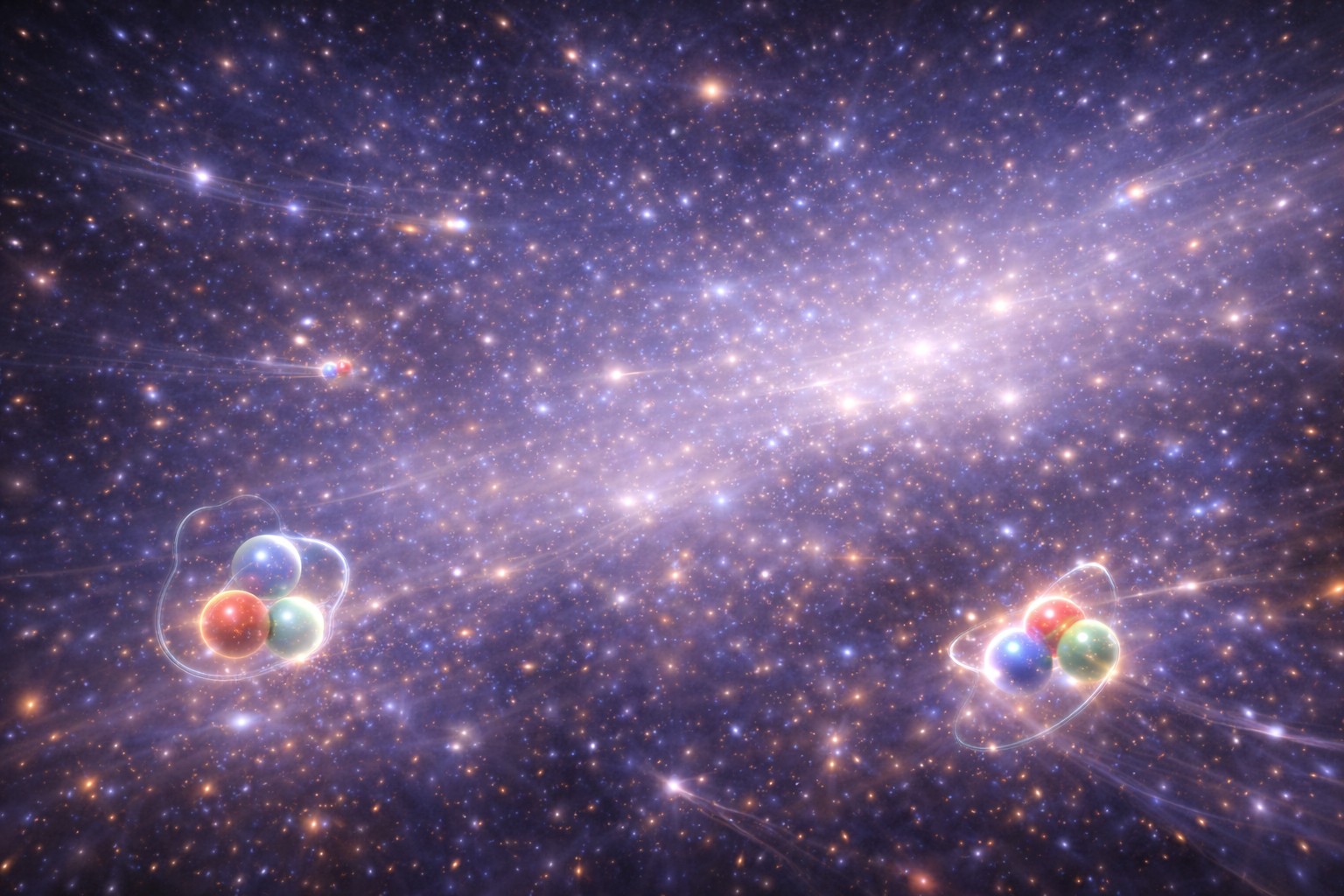
Recombination

Recombination marks the moment when the universe becomes transparent. As expansion continues, temperatures fall enough for electrons to bind permanently to atomic nuclei, forming the first neutral atoms.

Once electrons are no longer free, photons stop scattering constantly. Light decouples from matter and begins travelling freely through space for the first time. This released radiation persists today as the cosmic microwave background.

With light no longer trapped, the universe rapidly dims. No stars or galaxies yet exist, but matter now behaves calmly, dominated by neutral hydrogen and helium. Structure can begin to grow without interference from radiation pressure.

Recombination ends the luminous primordial phase and opens the long cosmic dark ages that follow.

PUBLIC