The Universe
Time
Primordial Era
Stelliferous Era
The Big Bang
Quark-Gluon Plasma Epoch
Hadron Epoch
Lepton Epoch
Photon Epoch
Recombination
Dark Ages
Pre-Stellar Epoch
Population III Epoch
Reionisation Epoch
Peak Star-Formation Epoch
Declining Star-Formation Epoch
Red-Dwarf Dominance Epoch
The Universe
Time
Primordial Era
Stelliferous Era
The Big Bang
Quark-Gluon Plasma Epoch
Hadron Epoch
Lepton Epoch
Photon Epoch
Recombination
Dark Ages
Pre-Stellar Epoch
Population III Epoch
Reionisation Epoch
Peak Star-Formation Epoch
Declining Star-Formation Epoch
Red-Dwarf Dominance Epoch
The Universe
Time
Primordial Era
Stelliferous Era
The Big Bang
Quark-Gluon Plasma Epoch
Hadron Epoch
Lepton Epoch
Photon Epoch
Recombination
Dark Ages
Pre-Stellar Epoch
Population III Epoch
Reionisation Epoch
Peak Star-Formation Epoch
Declining Star-Formation Epoch
Red-Dwarf Dominance Epoch

Photon Epoch

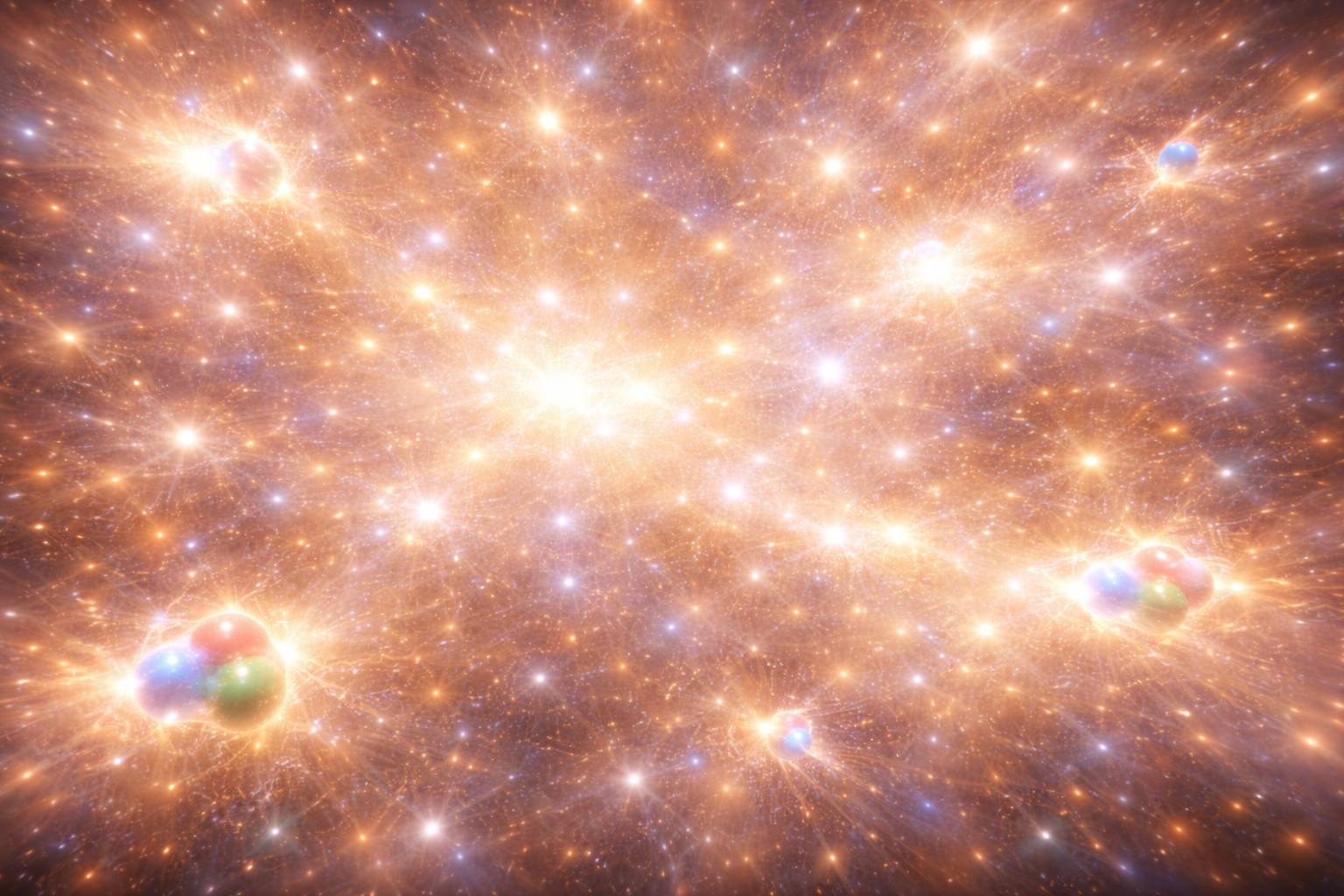
Radiation dominates the universe. Light and matter remain tightly coupled in a hot, glowing fog.
Photon Epoch

Radiation now dominates the universe. Photons scatter constantly off charged particles, preventing light from travelling freely. The universe is opaque, filled with a hot, glowing plasma.

During this epoch, protons and neutrons fuse into the first atomic nuclei in a process known as primordial nucleosynthesis. Hydrogen and helium form in abundance, with trace amounts of lithium.

Light and matter remain tightly coupled. The photon epoch ends only when the universe cools enough for electrons to bind to nuclei, allowing photons to finally move unimpeded.
Primordial nucleosynthesis

Primordial nucleosynthesis

Primordial nucleosynthesis is the first time atomic nuclei form. As the universe cools further, protons and neutrons begin to collide and fuse, creating the earliest elements. During this brief window, hydrogen and…

PUBLIC