Primordial nucleosynthesis
Protons and neutrons fuse into the first atomic nuclei, mainly hydrogen and helium.
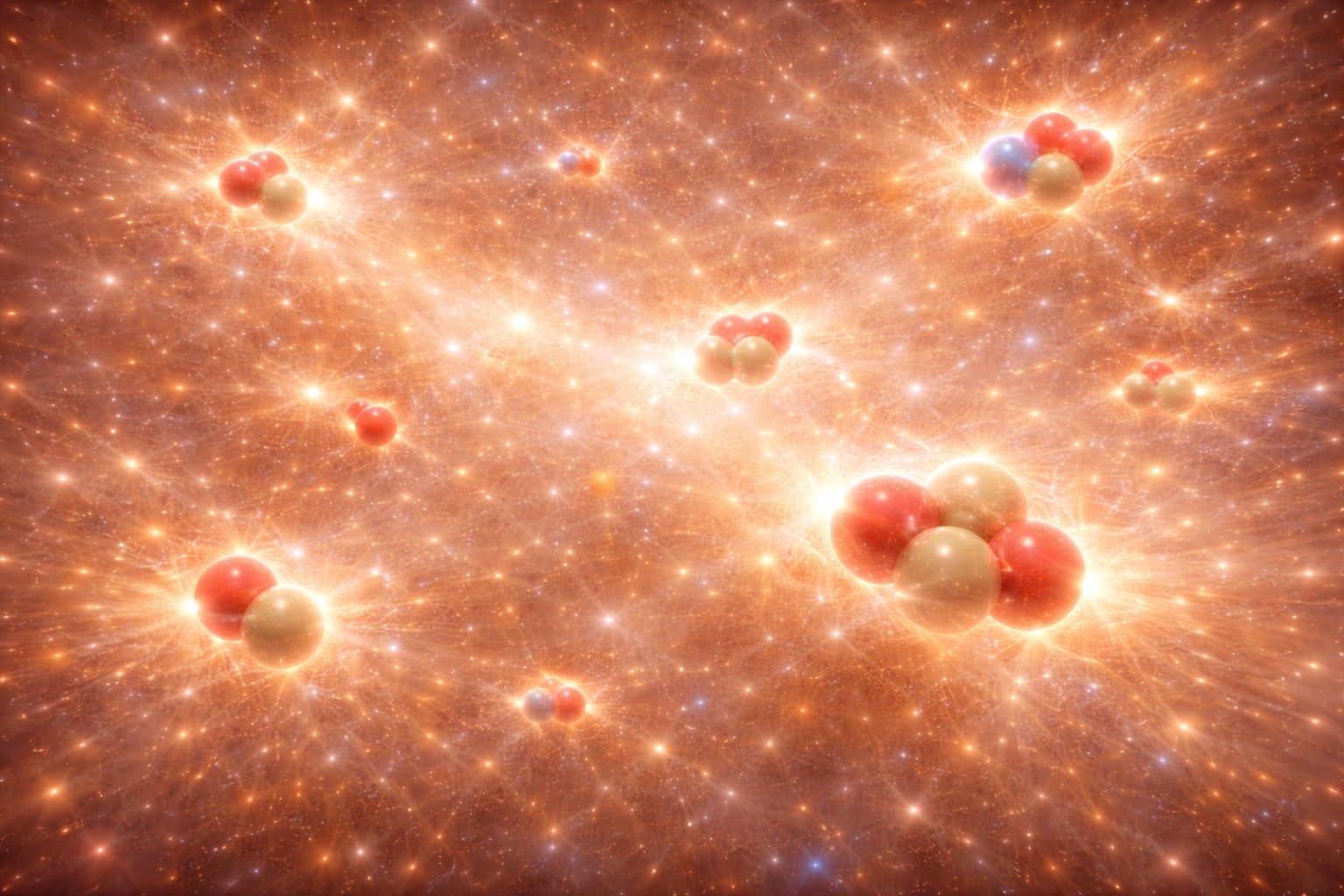
Primordial nucleosynthesis is the first time atomic nuclei form. As the universe cools further, protons and neutrons begin to collide and fuse, creating the earliest elements.
During this brief window, hydrogen and helium nuclei form in large quantities, along with small traces of lithium. Heavier elements cannot yet form. The universe cools too quickly, and densities drop before more complex nuclei can stabilise.
This process fixes the universe’s basic chemical composition. Nearly all ordinary matter for the rest of cosmic history is set here. Stars, galaxies, planets, and life will later rearrange these elements, but they will not significantly change their overall proportions.
When nucleosynthesis ends, the universe continues to expand and cool. Nuclei persist, but electrons remain free, keeping matter and radiation tightly coupled until recombination.

Helium Formation
Helium formation occurs during primordial nucleosynthesis, a brief window early in the universe’s history when temperatures and densities are high enough for nuclear fusion, but cooling rapidly. As the universe expands…
Hydrogen Formation
Hydrogen formation is the central outcome of primordial nucleosynthesis. As the universe cools from its earliest extreme conditions, free protons become stable and persist rather than annihilating with antimatter. These…
Lithium Formation
Lithium formation occurs during the same primordial nucleosynthesis window as hydrogen and helium, but it is rare and inefficient. As protons and neutrons collide in the early universe, a small number of reactions…