Hydrogen Formation
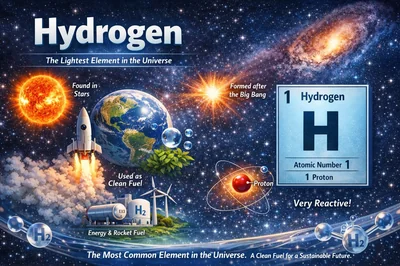
Hydrogen forms as the dominant element of the universe. Protons stabilise into long-lived nuclei, fixing the basic material from which all future stars, galaxies, and life will emerge.
Hydrogen formation is the central outcome of primordial nucleosynthesis. As the universe cools from its earliest extreme conditions, free protons become stable and persist rather than annihilating with antimatter. These protons are the nuclei of hydrogen atoms.
During this period, conditions briefly allow nuclear reactions to occur. Some protons fuse into helium, but the vast majority remain as hydrogen. The universe expands and cools too quickly for heavier elements to form in significant quantities. As a result, hydrogen becomes the dominant constituent of ordinary matter.
Hydrogen’s simplicity is its power. With just one proton, it remains stable across cosmic time and responds readily to gravity. Vast clouds of hydrogen gas will later collapse to form the first stars. Inside those stars, hydrogen fusion will become the primary source of light and energy for billions of years.
This moment fixes the universe’s chemical baseline. Roughly three-quarters of all normal matter is hydrogen, a ratio set here and never fundamentally altered. Everything that shines later—stars, galaxies, planets, and living systems—depends on the persistence of hydrogen formed during this brief early window.
Hydrogen formation does not create visible structure yet. Electrons remain free, and atoms cannot fully assemble until recombination. But the material foundation of the luminous universe is now in place.