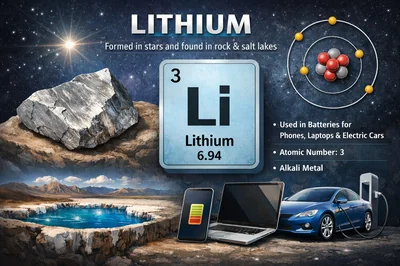
Lithium Formation
Lithium forms in trace amounts during primordial nucleosynthesis, marking the upper limit of element formation before the universe cools too quickly for further fusion.
Lithium formation occurs during the same primordial nucleosynthesis window as hydrogen and helium, but it is rare and inefficient. As protons and neutrons collide in the early universe, a small number of reactions briefly produce lithium nuclei before conditions become unfavourable.
Most primordial lithium forms as lithium-7, created indirectly through unstable beryllium-7 nuclei that later decay into lithium. A much smaller amount of lithium-6 may also form, but in extremely tiny quantities. These reactions require precise conditions and occur far less often than hydrogen or helium fusion.
The key reason lithium remains scarce is timing. The universe cools and expands rapidly. By the time heavier nuclei could stabilise, temperatures drop below the threshold needed for sustained fusion. Nuclear reactions effectively shut down after only a few minutes.
This makes lithium the heaviest element produced in meaningful quantities outside of stars. Anything heavier requires stellar interiors, where gravity maintains the heat and pressure needed for fusion.
Primordial lithium sets a hard boundary in cosmic chemistry. It marks the end of the universe’s first and only attempt at element formation without stars. Every heavier element that exists today is forged later, inside stars or explosive stellar deaths.
Lithium’s rarity is not accidental. It is a direct record of how quickly the universe cooled — a chemical fossil of the early cosmos.