Helium Formation
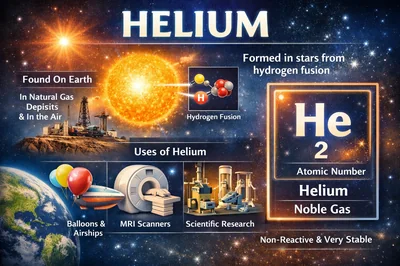
Helium forms during primordial nucleosynthesis when protons and neutrons fuse into stable helium nuclei, fixing the universe’s second most abundant element.
Helium formation occurs during primordial nucleosynthesis, a brief window early in the universe’s history when temperatures and densities are high enough for nuclear fusion, but cooling rapidly.
As the universe expands past its earliest fractions of a second, free protons and neutrons begin colliding. Most neutrons decay quickly, but before this happens, many bind with protons to form stable helium nuclei. Each helium nucleus contains two protons and two neutrons, making it far more stable than hydrogen under extreme conditions.
This process produces large amounts of helium-4, along with tiny traces of helium-3. Heavier elements cannot form at this time. The universe cools too quickly and becomes too diffuse for further fusion outside of stars.
By the end of this interval, roughly three quarters of the universe’s ordinary matter is hydrogen, and about one quarter is helium by mass. These proportions remain essentially unchanged for the rest of cosmic history. Stars, galaxies, planets, and life inherit this chemical starting point.
Helium formation marks the moment when the universe’s elemental composition is locked in. Later processes rearrange matter, but they do not significantly alter this primordial balance.
Helium is the first product of nuclear structure in the universe — the bridge between simple particles and the complex chemistry that follows.