Transitional High-Mass Fade
The universe enters a handover phase. Massive stars are gone, Sun-like stars begin to thin out, and red dwarfs rise toward dominance. Star formation continues, but the era of brilliant, short-lived stars is ending.
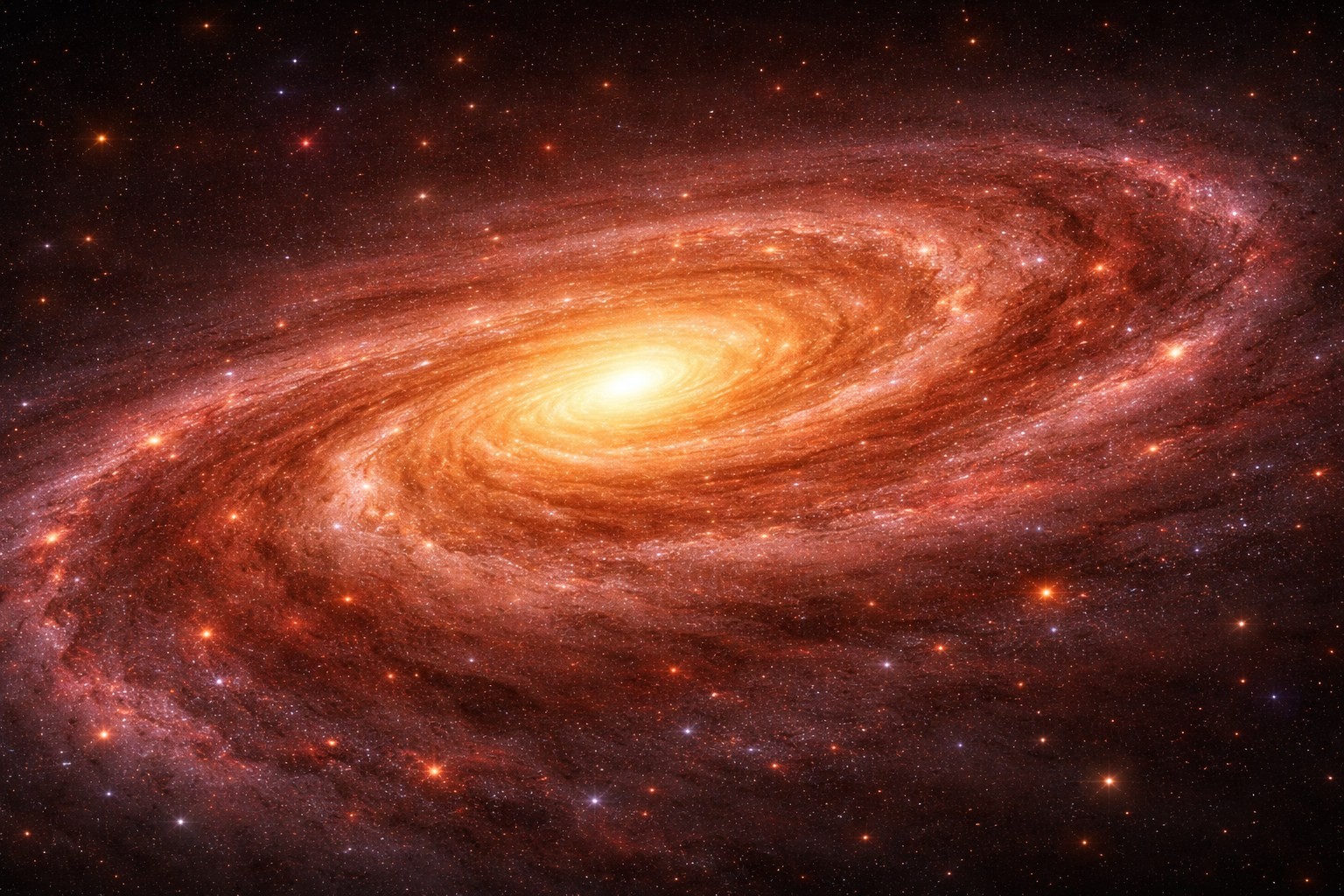
The Transitional High-Mass Fade marks the first stage of the red-dwarf era. By this point, the universe is over ten billion years old. The most massive stars have long since burned out, and even Sun-like stars are no longer being replaced at the rates seen in earlier epochs.
Star formation continues, but it shifts in character. New stars form more slowly and are increasingly low-mass. Red dwarfs already dominate stellar births, even though larger stars still contribute much of the visible light. Galaxies remain structured and recognisable, but they grow quieter with time.
This phase defines the cosmic conditions under which many long-lived planetary systems, including Earth, exist. Geological history unfolds within this astrophysical context, but is not a subdivision of it.
Many familiar cosmic conditions still exist during this phase. Spiral galaxies persist. Planetary systems remain stable. Long-lived stars like the Sun are common enough to support complex planetary histories. This makes the epoch especially important for planets, life, and observers.
This phase represents transition rather than collapse. The universe does not suddenly dim. Instead, it changes direction. Brilliance gives way to endurance. By the end of this period, the balance tips decisively toward a cosmos defined not by intensity, but by longevity.