Early Red-Dwarf Era
Red dwarfs dominate new star formation.
Sun-like stars still exist and shine.
Planetary systems are common.
Life has its best long-term window here.
This is the last era where complex planetary activity is widespread.
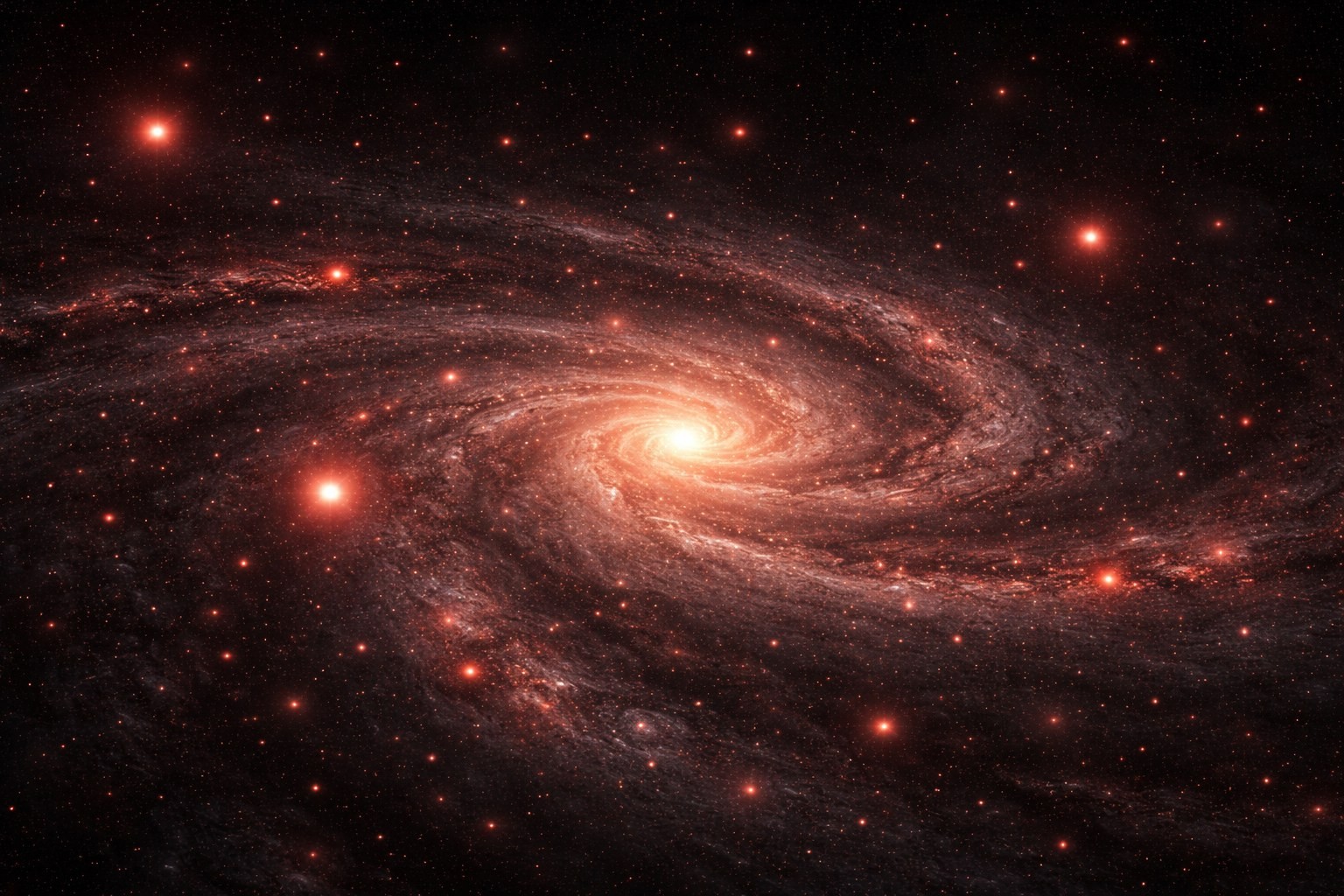
The early red-dwarf dominance epoch begins once the universe passes ten billion years of age. By this point, the era of prolific Sun-like star formation has ended. Massive stars are long gone, and few new medium-mass stars are being born. Star formation continues, but almost all new stars are small, cool red dwarfs.
Galaxies remain recognisable and structured. Spiral arms persist, and stellar systems stay dynamically stable. However, the character of galactic light changes. Bright, short-lived stars fade from prominence, replaced by dimmer but extraordinarily long-lived red dwarfs. The universe grows quieter, not darker — its light shifts from brilliance to endurance.
Planetary systems are widespread during this epoch. Heavy elements forged earlier are abundant, and long-lived stars provide stable energy output over immense timescales. This creates the longest-lasting window for planetary evolution, chemistry, and potential life. While dramatic cosmic events become rarer, slow processes gain dominance.
This epoch marks a decisive change in cosmic rhythm. The universe no longer races forward through intense creation. Instead, it settles into a prolonged, steady phase where light persists through patience rather than power. Red dwarfs do not redefine the universe by brightness, but by how long they last.