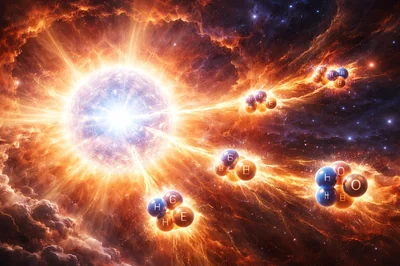
Population III Stars
The first stars. Massive, metal-free, short-lived. They end the Dark Ages and create the elements required for all later stars, planets, and life.
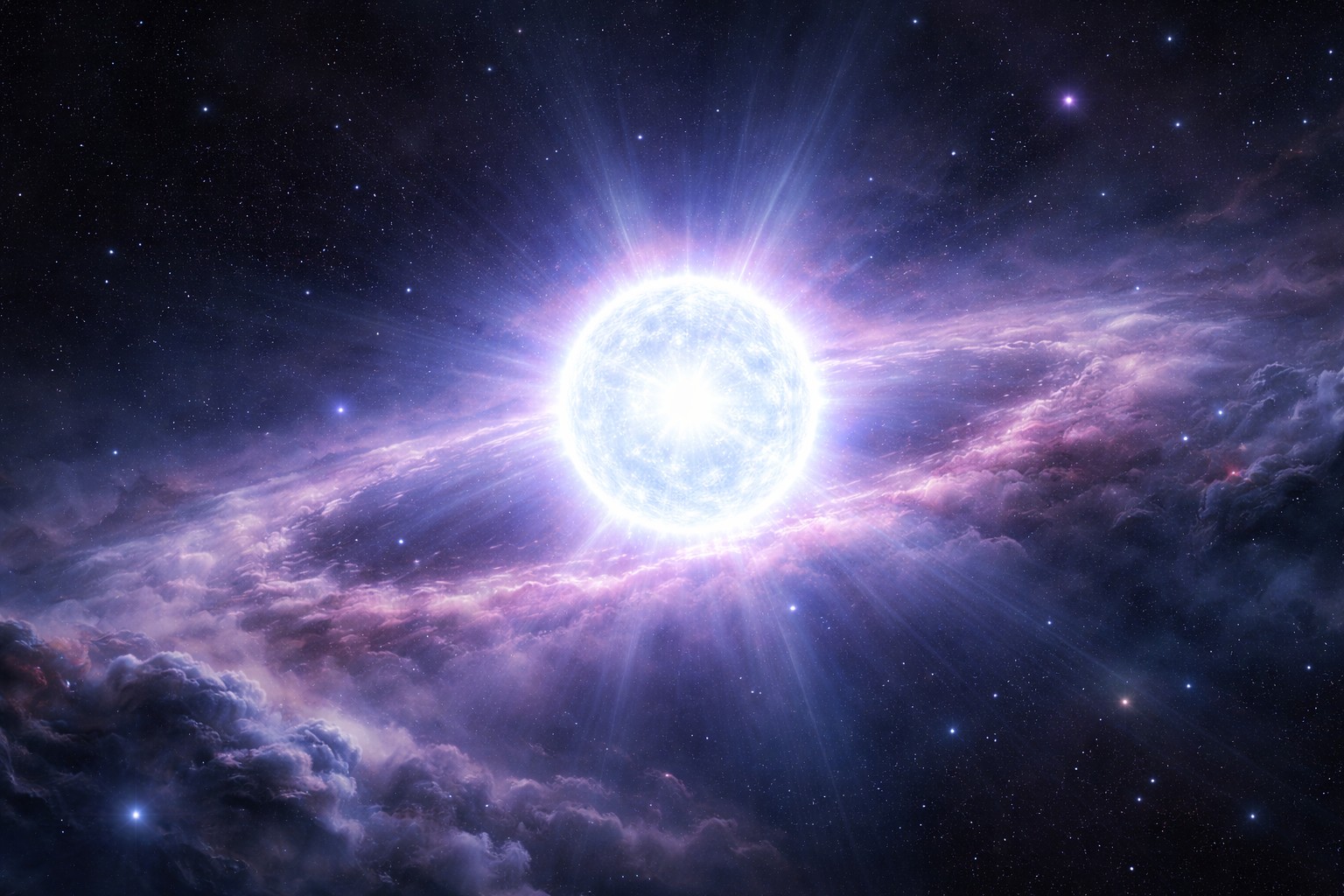
Population III stars are the first stars ever to form in the universe. They ignite when gravity collapses dense clouds of primordial hydrogen and helium during the end of the cosmic Dark Ages.
These stars contain no heavy elements. Their composition reflects the universe’s original chemistry, set during primordial nucleosynthesis. Without metals to cool their gas efficiently, Population III stars grow extremely massive, often tens or hundreds of times the mass of the Sun.
Their size makes them intensely hot and bright, but short-lived. Most burn through their fuel in only a few million years. When they die, many explode as powerful supernovae, forging the first heavy elements — carbon, oxygen, silicon, and iron — and dispersing them into surrounding space.
This enrichment permanently changes the universe. Later generations of stars form from metal-polluted gas, allowing smaller, longer-lived stars and the formation of planets. Population III stars therefore mark the transition from a chemically simple universe to one capable of complexity.
No Population III stars survive today. They exist only as fossils of influence, detectable through their chemical signatures and the structures they made possible.