Time
Primordial Era
Stelliferous Era
The Big Bang
Photon Epoch
Population III Epoch
Declining Star-Formation Epoch
Red-Dwarf Dominance Epoch
Planck Epoch
Inflation
Primordial nucleosynthesis
Population III Stars
Post-Peak Cooling Phase
Gas-Depletion Phase
Late Stelliferous Transition
Early Red-Dwarf Era
Time
Primordial Era
Stelliferous Era
The Big Bang
Photon Epoch
Population III Epoch
Declining Star-Formation Epoch
Red-Dwarf Dominance Epoch
Planck Epoch
Inflation
Primordial nucleosynthesis
Population III Stars
Post-Peak Cooling Phase
Gas-Depletion Phase
Late Stelliferous Transition
Early Red-Dwarf Era
Time
Primordial Era
Stelliferous Era
The Big Bang
Photon Epoch
Population III Epoch
Declining Star-Formation Epoch
Red-Dwarf Dominance Epoch
Planck Epoch
Inflation
Primordial nucleosynthesis
Population III Stars
Post-Peak Cooling Phase
Gas-Depletion Phase
Late Stelliferous Transition
Early Red-Dwarf Era

Post-Peak Cooling Phase

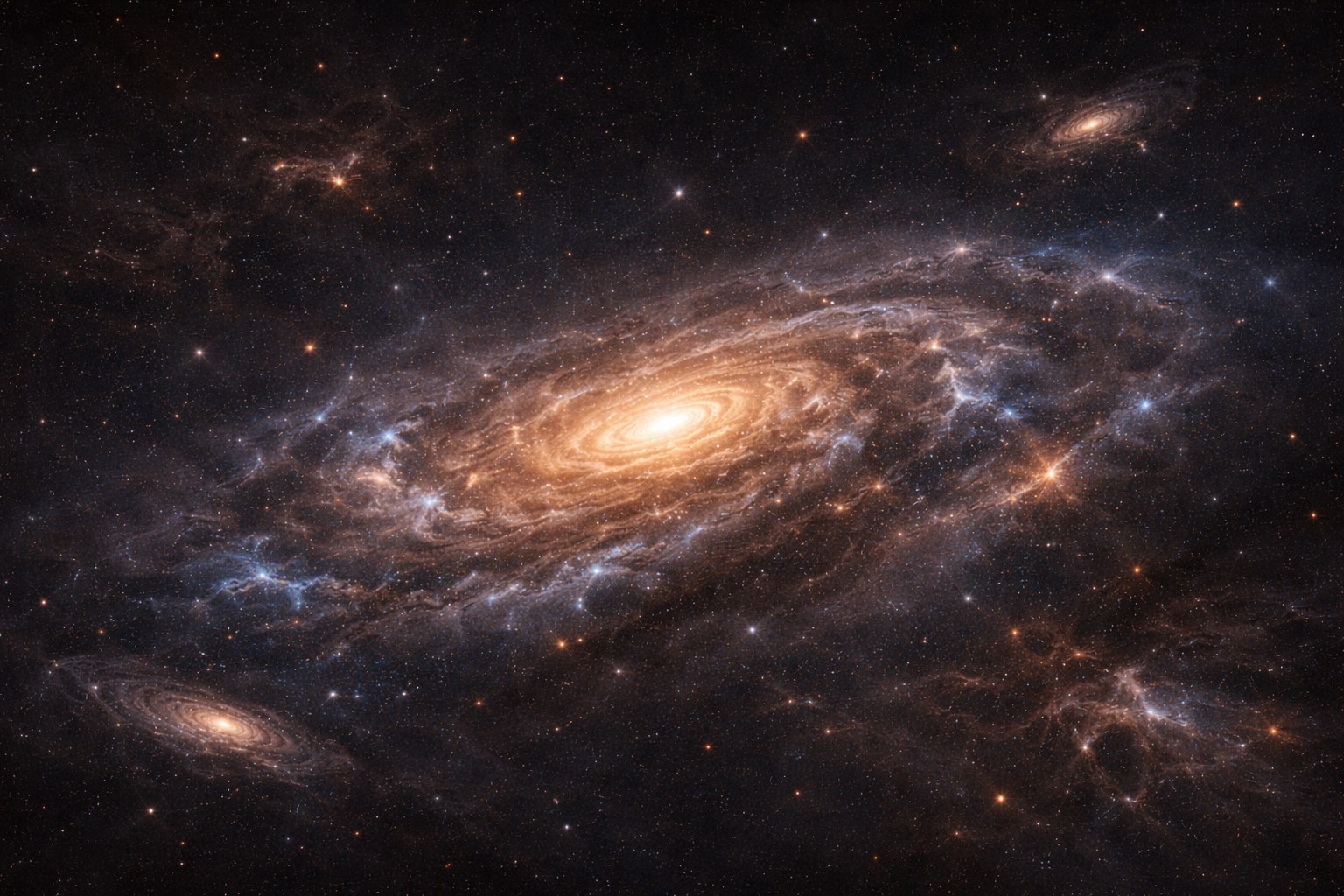
Star formation drops rapidly from its cosmic peak as galaxies begin to cool and stabilise.
Post-Peak Cooling Phase

The post-peak cooling phase marks the immediate aftermath of the universe’s most intense period of star formation. Galaxies still contain large reserves of cold gas, but star birth slows sharply compared to earlier epochs. The processes that once fuelled rapid growth now begin to self-limit.

Disc galaxies dominate this phase. Their structures remain active and dynamic, but feedback from supernovae and stellar winds increasingly regulates collapse. Much of the stellar mass of large spiral galaxies, including the Milky Way, forms during this time.

This phase represents the fastest rate of decline in cosmic star formation. The universe is still bright and busy, but the direction of change is clear.

PUBLIC