The Universe
Time
Primordial Era
Stelliferous Era
The Big Bang
Quark-Gluon Plasma Epoch
Hadron Epoch
Lepton Epoch
Photon Epoch
Recombination
Dark Ages
Pre-Stellar Epoch
Population III Epoch
Reionisation Epoch
Peak Star-Formation Epoch
Declining Star-Formation Epoch
Red-Dwarf Dominance Epoch
The Universe
Time
Primordial Era
Stelliferous Era
The Big Bang
Quark-Gluon Plasma Epoch
Hadron Epoch
Lepton Epoch
Photon Epoch
Recombination
Dark Ages
Pre-Stellar Epoch
Population III Epoch
Reionisation Epoch
Peak Star-Formation Epoch
Declining Star-Formation Epoch
Red-Dwarf Dominance Epoch
The Universe
Time
Primordial Era
Stelliferous Era
The Big Bang
Quark-Gluon Plasma Epoch
Hadron Epoch
Lepton Epoch
Photon Epoch
Recombination
Dark Ages
Pre-Stellar Epoch
Population III Epoch
Reionisation Epoch
Peak Star-Formation Epoch
Declining Star-Formation Epoch
Red-Dwarf Dominance Epoch

Hadron Epoch

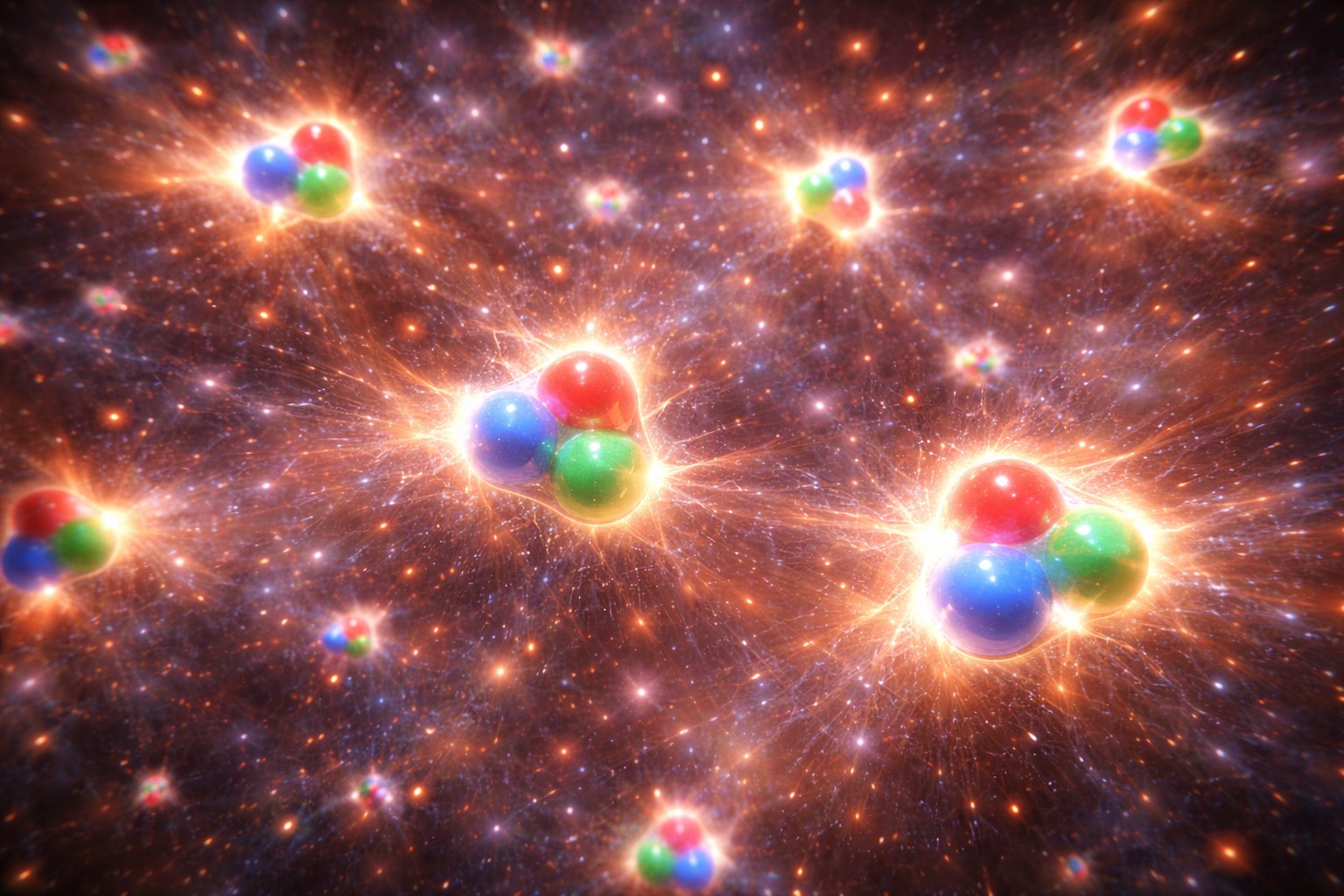
Quarks bind into protons and neutrons. Matter gains stable building blocks for atomic nuclei.
Hadron Epoch

As the universe continues to cool, quarks can no longer move freely. They bind together, forming protons and neutrons. For the first time, matter gains stable composite particles.

Most quarks and antiquarks annihilate each other, leaving a small excess of matter. This imbalance is critical. It ensures that matter survives rather than cancelling itself out entirely.

The hadron epoch establishes the basic building blocks of atomic nuclei. Structure is still impossible, but permanence has begun.

PUBLIC