The Big Bang
The universe originates as undifferentiated energy, then rapidly expands, stabilising space, time, and physical law while embedding the seeds of all future structure.
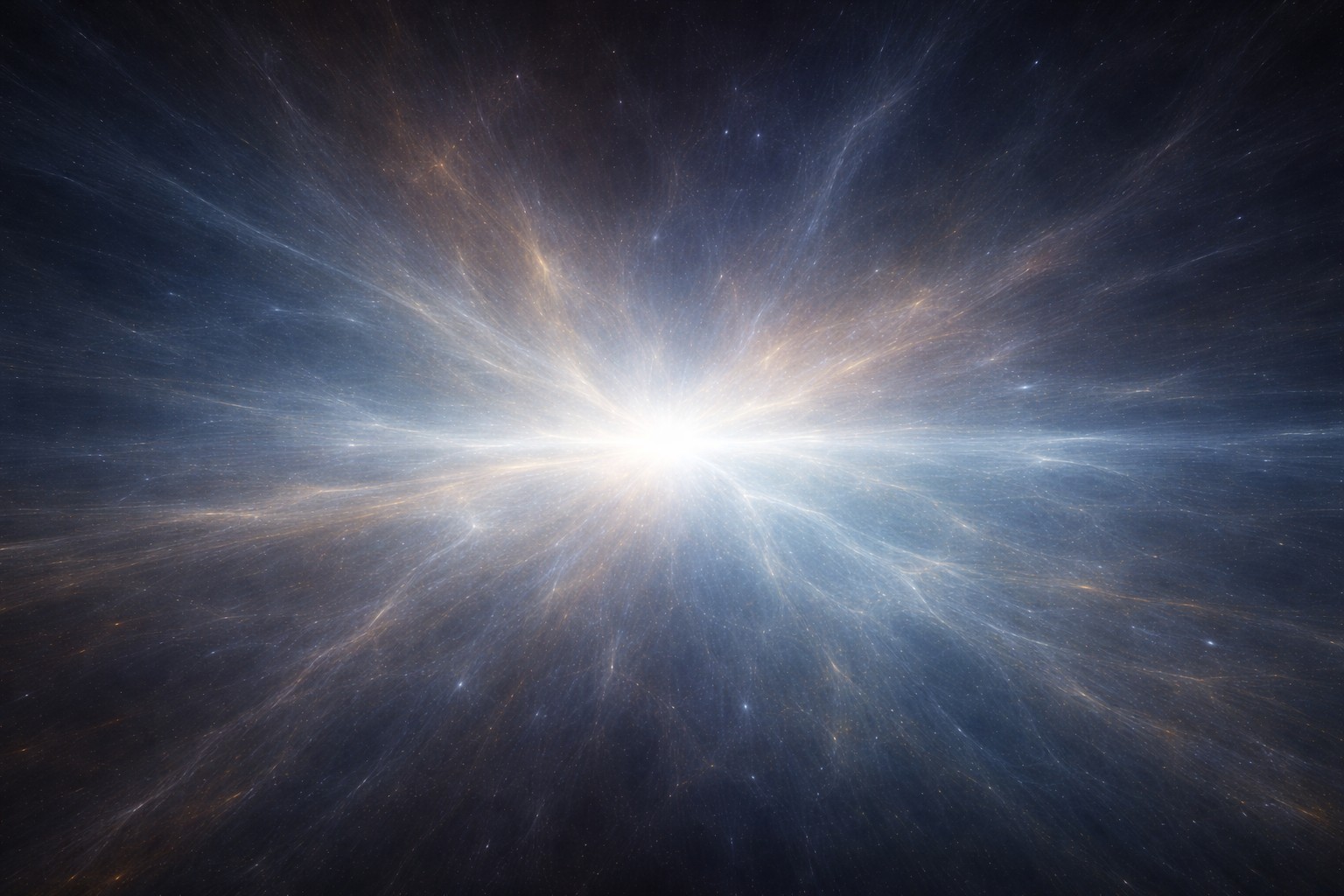
The Big Bang marks the beginning of the universe as a physical process. In its earliest moment, all energy, space, time, and forces exist in an undifferentiated state beyond the reach of known physics. There is no structure, no particles, and no stable flow of time.
Almost immediately, the universe undergoes a rapid phase of expansion. Space itself stretches at an extreme rate, transforming microscopic quantum variations into large-scale differences in density. This expansion sets the overall shape of the universe while embedding the irregularities that will later allow matter to gather.
As expansion slows, physical laws stabilise and energy redistributes. Conditions emerge in which particles, forces, and structure can begin to form. The Big Bang is not an explosion within space, but the origin of space, time, and the framework that governs all subsequent cosmic evolution.
Planck Epoch
The Planck epoch is the earliest moment of the universe, lasting only an instant after the beginning of time. At this scale, the universe is so hot and dense that gravity, space, and time behave as a single, unified…
Inflation
Inflation is a brief but decisive phase of extreme expansion. During this period, space itself grows exponentially, stretching the universe from microscopic to vast in a fraction of a second. This expansion happens…