Primordial Chemistry
How did a universe of nuclei, electrons and atoms begin to support chemical combinations without rebuilding the nuclei themselves?
A new level of change
You have already followed one enormous kind of change.
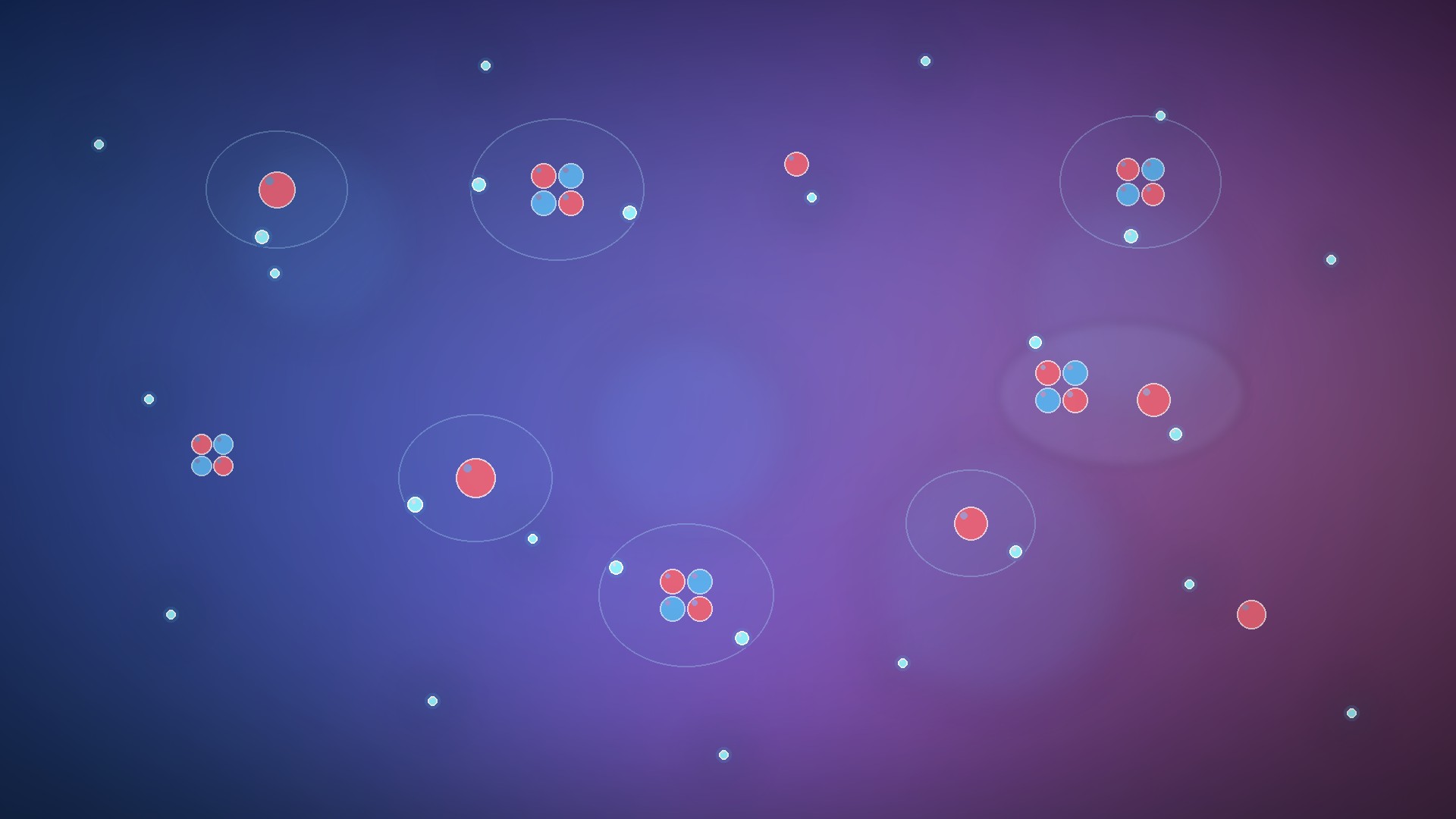
During primordial nucleosynthesis, protons and neutrons became parts of new nuclei. The nucleus itself was being built or changed.
Chemistry is different.
In ordinary chemical change, the nuclei usually keep their element identities. The new behaviour comes from electrons and from the ways atoms or ions become connected, separated or rearranged.
So the question changes from:
What nucleus can exist?
to:
What can these existing particles do together?
Chemistry did not wait for a neat finish line
It is tempting to picture a simple sequence:
first Recombination finishes, then chemistry begins.
The real early Universe is less tidy.
Recombination unfolded over time. Different kinds of nuclei and ions captured electrons under different conditions. Neutral helium became available before hydrogen had fully recombined.
That matters because the first chemical bonds could begin to appear during this wider transition.
The Journey teaches Recombination first because you need the idea of bound electrons before chemistry makes sense. That teaching order is not a claim that every chemical event waited until the end of Recombination.
The first molecular-bond context
In the young Universe there were very few kinds of nuclei to work with: mainly hydrogen and helium, plus tiny traces of other light nuclei.
One important early chemical species is helium hydride, HeH⁺. It can form when neutral helium combines with a proton.
Scientists describe this as the first type of molecular bond to form in the early Universe.
You do not need to use HeH⁺ as your first bonding model. It is a molecular ion, and its chemistry is more complicated than the simple model we need next.
Its job here is historical: it shows that once bound-electron species existed, the Universe could begin doing chemistry.
Nuclear change or chemical change?
A useful test is to ask what happened to the nucleus.
If the proton
eutron structure of a nucleus changes, you are looking at nuclear-level change.
If existing nuclei keep their identities while atoms or ions enter different combinations, you are looking at chemical-level change.
Chemical reactions can involve major changes in substances without turning one element’s nucleus into another element’s nucleus.
Which level changed?
1 of 2
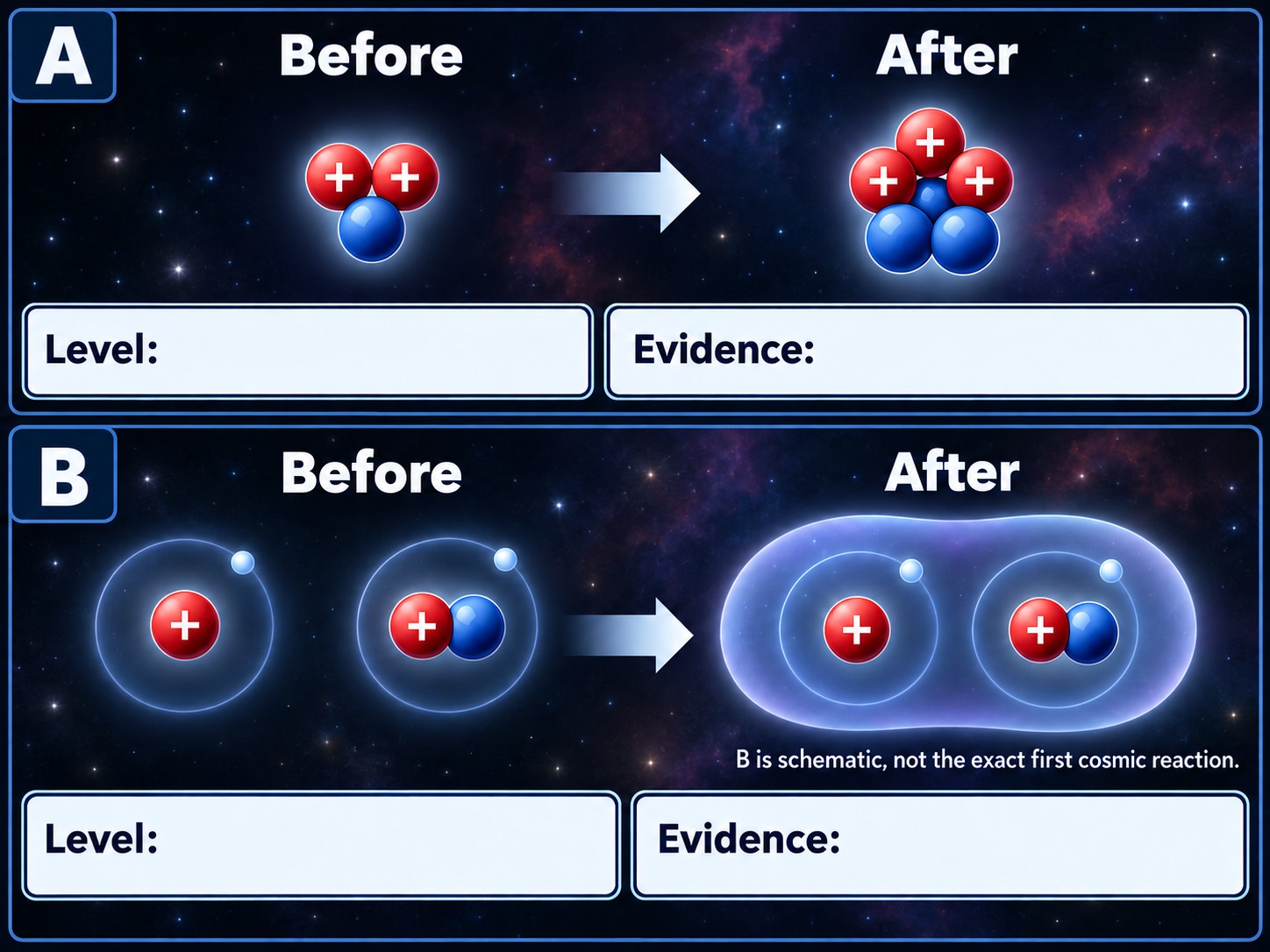
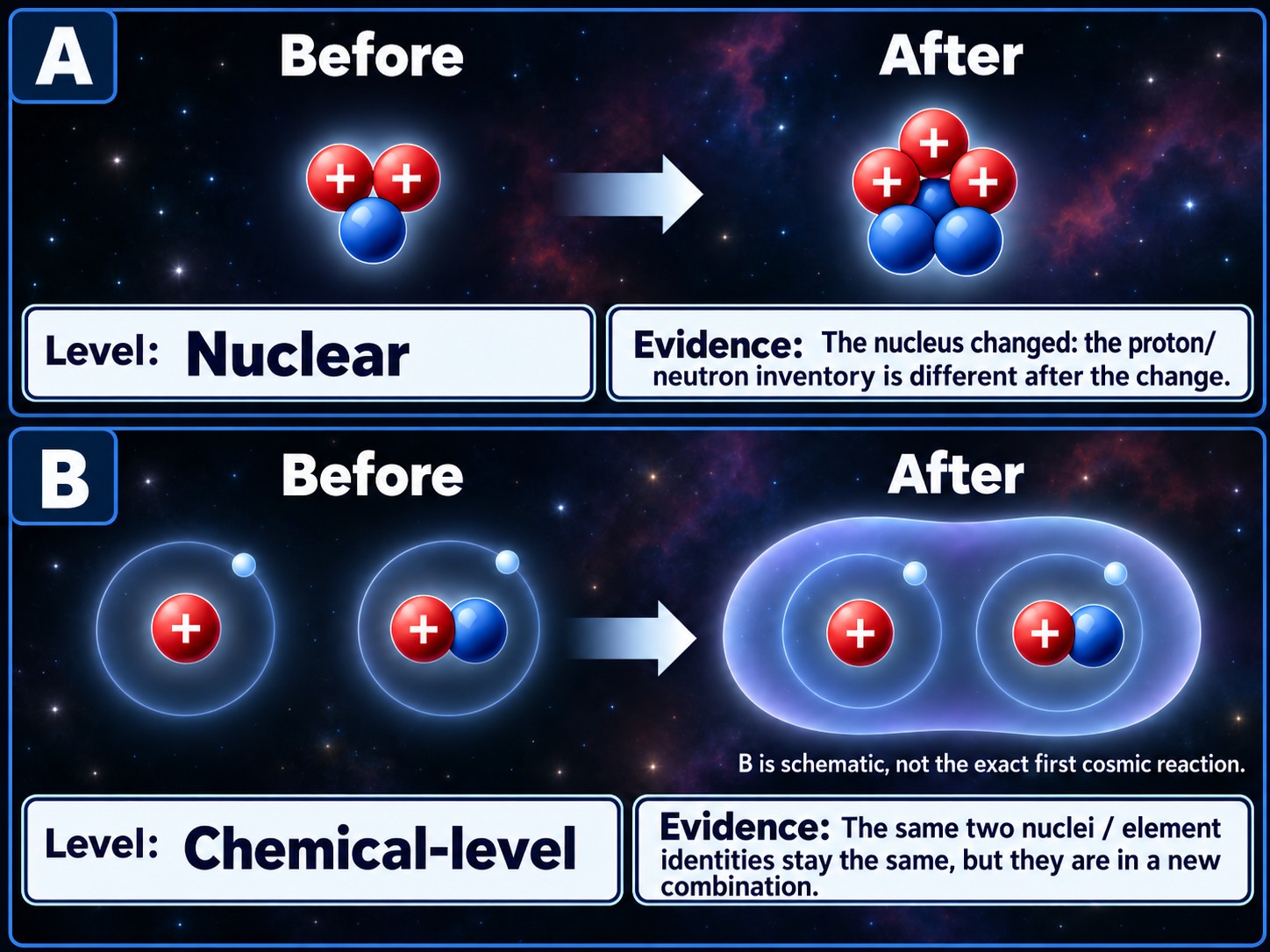
Look at the two before/after cases.
Case A: the before and after nucleus have different nuclear particle inventories.
Case B: the same two nuclei appear before and after, but the particles finish in a new combination.
For each case write:
1. nuclear change or chemical-level change?
2. what evidence decides?
Rearrangement, not a new element factory
In ordinary chemistry, atoms can be rearranged into new combinations.
The atoms are not treated as disposable pieces that vanish and get replaced with new elements. Their nuclei remain the anchor of their element identities.
This idea will later support conservation of mass and balanced equations.
But we are not claiming those GCSE topics are finished here. To complete them, you will need to work with equations, count atoms on both sides and consider what happens to measured mass in closed and open systems.
The next question
We have reached the point where the Universe can support chemical combinations.
But we have not yet answered the mechanism:
How can separate atoms stay connected as a molecule?
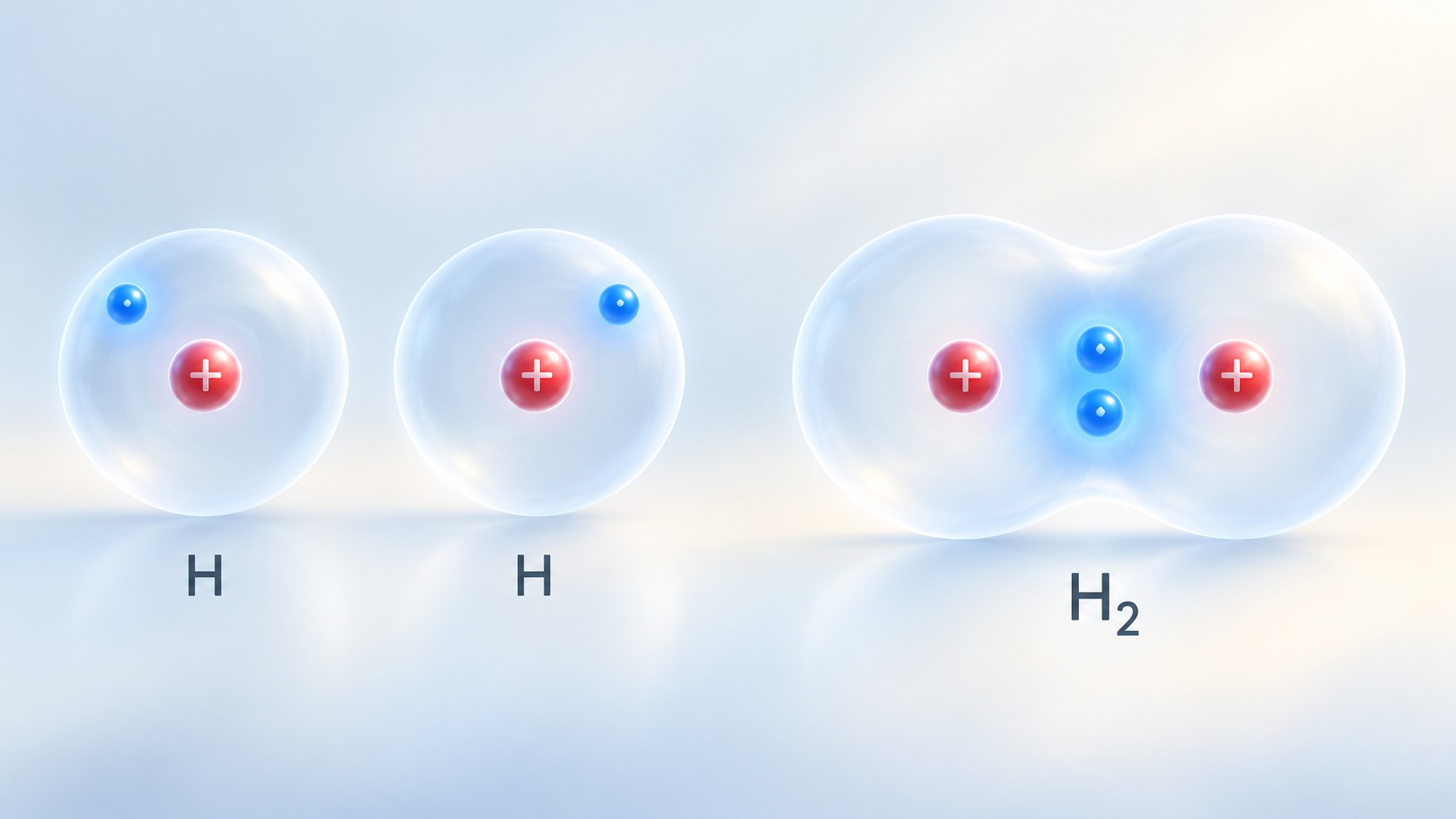
The next page uses the simplest useful model: two hydrogen atoms sharing electrons to form H₂.
Primordial Chemistry — Deeper page — Covalent Bonding and Molecules
You have seen how ordinary chemical change can combine existing particles without changing the nuclei. Go deeper to discover how two atoms can remain together as a molecule.
GCSE knowledge coverage
This page provides context and navigation; no new GCSE knowledge is taught here.