Ions
What changes — and what stays unchanged — when an atom becomes charged?
Neutral is a balance
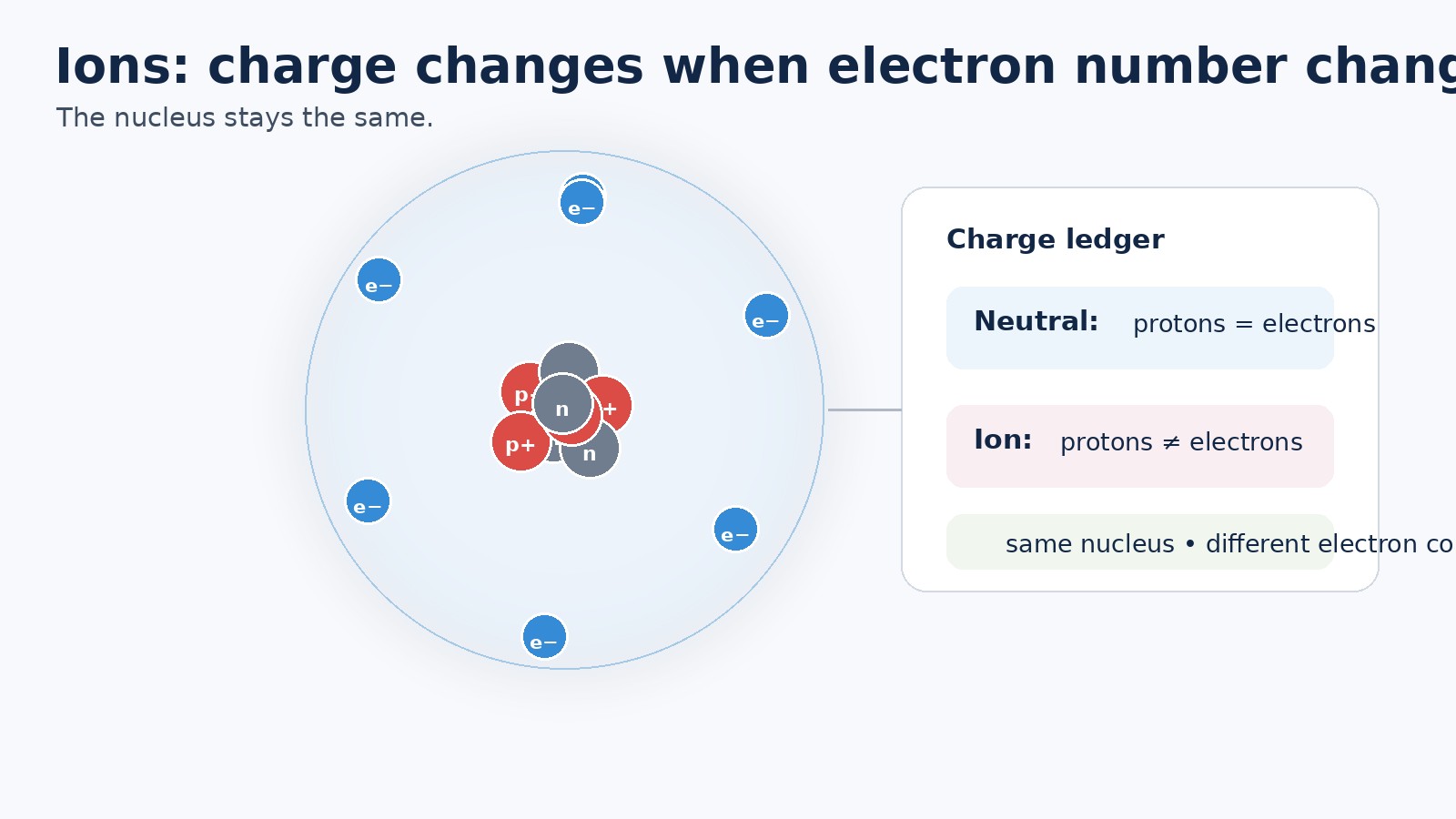
In a neutral atom, the number of electrons matches the number of protons.
Each proton contributes +1 relative charge. Each electron contributes −1. Equal numbers cancel, so the overall charge is zero.
Now change one thing: the electron number.
Losing an electron makes a positive ion
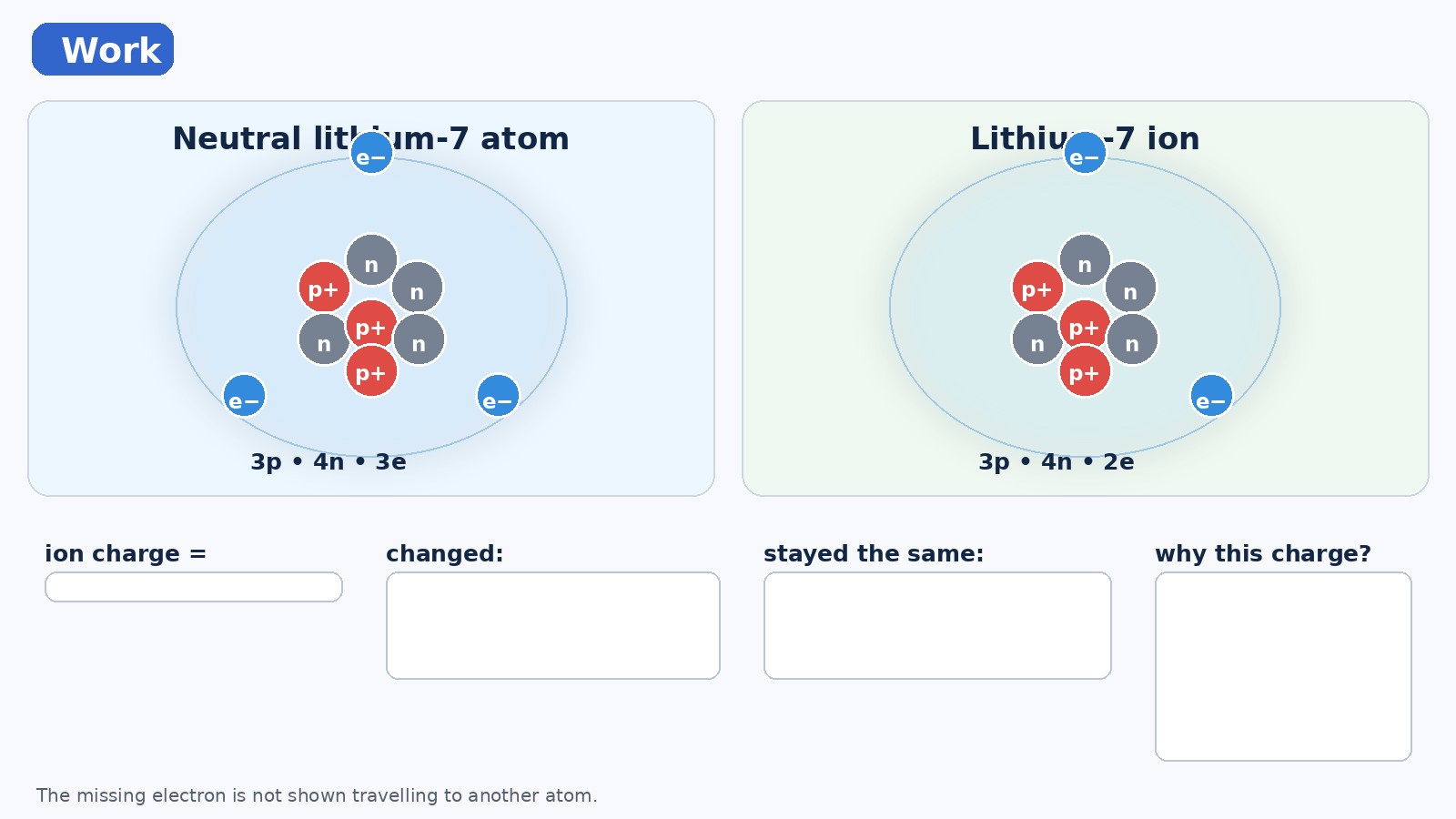
Imagine a neutral lithium-7 atom.
Its nucleus contains 3 protons and 4 neutrons. Because the atom is neutral, it also has 3 electrons.
Now remove one outer electron.
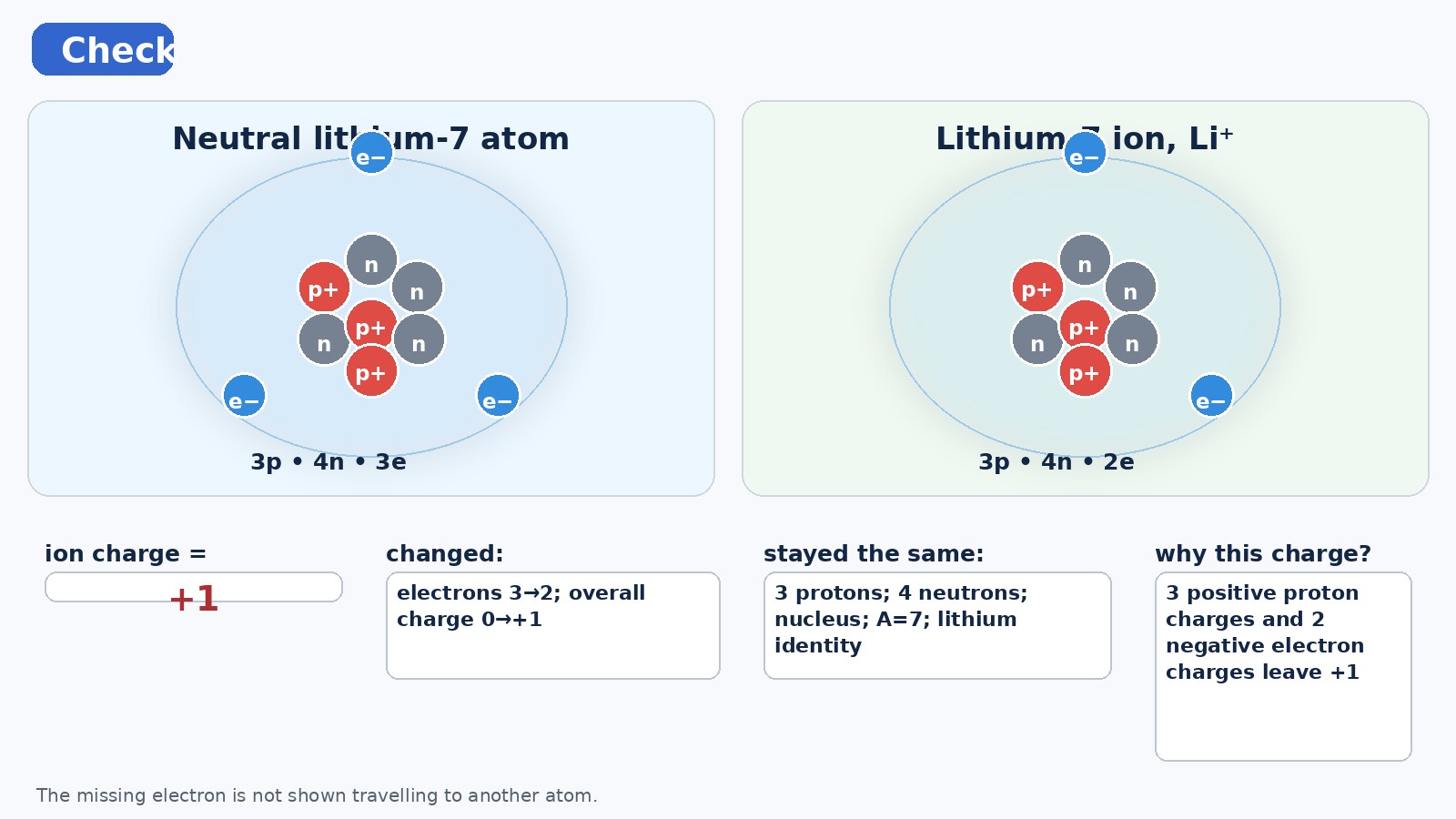
The nucleus has not changed: 3 protons and 4 neutrons. But there are now only 2 electrons.
The charges no longer balance:
+3 from the protons
−2 from the electrons
Overall charge = +1
The atom has become a positive ion: Li⁺.
The plus sign does not mean a proton was added. It means the ion now has more protons than electrons because an electron was lost.
What changed?
1 of 2
Compare the neutral lithium-7 atom with the lithium-7 ion Li⁺.
Write:
1. What changed?
2. What stayed the same?
3. Why is the ion’s charge +1?
Positive ions form by losing outer electrons
When an atom loses one or more outer electrons, it can form a positive ion.
Only electrons have been removed. The protons remain in the nucleus.
That is why the element stays the same. Lithium remains lithium because it still has 3 protons.
Extra electrons can make a negative ion
Now consider an ion with 17 protons and 18 electrons.
The proton charges contribute +17.
The electron charges contribute −18.
Overall charge = −1.
There is one more electron than proton, so the ion is negatively charged.
On this page, you only need the particle-accounting idea: gaining electron(s) can produce negative charge. Later chemistry will explain which atoms characteristically form particular ions and how ions take part in ionic bonding.
What does not change when an ion forms?
Gaining or losing electrons does not rebuild the nucleus.
So, unless a nuclear change happens separately:
• proton number stays the same;
• neutron number stays the same;
• mass number stays the same;
• element identity stays the same.
What changes is the electron count, electron arrangement and overall charge.
Reading the charge
Ion charge is written at the upper right of the element symbol.
Na⁺ means a sodium ion with charge +1.
Mg²⁺ means a magnesium ion with charge +2.
Cl⁻ means a chlorine ion with charge −1.
The superscript tells you the overall charge. It is not the mass number and it is not an electron count.
Count the particles in an ion
The nuclear rules still come first:
protons = Z
neutrons = A − Z
Then use the charge to work out electrons.
If the ion is +1, it has one fewer electron than protons.
If it is +2, it has two fewer.
If it is −1, it has one more electron than protons.
You can check your answer with:
protons − electrons = overall relative charge.
Two simple ions
Calculate protons, neutrons and electrons in each ion.
1. ²⁴₁₂Mg²⁺
2. ³⁵₁₇Cl⁻
Then choose one ion and explain how its charge tells you the electron count.
Do not jump to ionic bonding yet
An ion is a charged particle. That does not by itself explain an ionic bond.
Later chemistry will look at electron transfer between atoms, positive and negative ions together, and ionic structures.
For now, the important distinction is simpler:
an atom becomes an ion when its total positive and negative charges no longer balance.
Ions — Deeper page — Primordial Chemistry
You can now explain how changing electron number can make an atom charged without changing its nucleus. Go deeper to see how existing nuclei, atoms and ions can enter new combinations — and how to tell a chemical change from a nuclear one.
Remember this lesson
A simple ion has Z = 8, A = 16 and charge 2−.
Without looking back:
1. calculate protons;
2. calculate neutrons;
3. calculate electrons;
4. explain why the charge is negative;
5. state two things about the nucleus that did not change when the ion formed.
GCSE knowledge coverage
Key knowledge:
An ion is an atom or group of atoms with overall positive or negative charge. In simple monatomic ions, charge comes from proton/electron imbalance. Positive ions can form when atoms lose outer electrons. Atomic number, mass number and supplied charge allow p
/e calculation without changing the nucleus or element identity.
Covers:
• Pearson Edexcel GCSE Chemistry (1CH0): Topic 1 requirements 1.22–1.23. Requirements 1.21 and 1.24 remain later.
• Pearson Edexcel GCSE Combined Science (1SC0): Chemistry Topic 1 requirements 1.22–1.23 and Physics Topic 6 requirement 6.9.
• Pearson Edexcel GCSE Physics (1PH0): Topic 6 requirement 6.9.