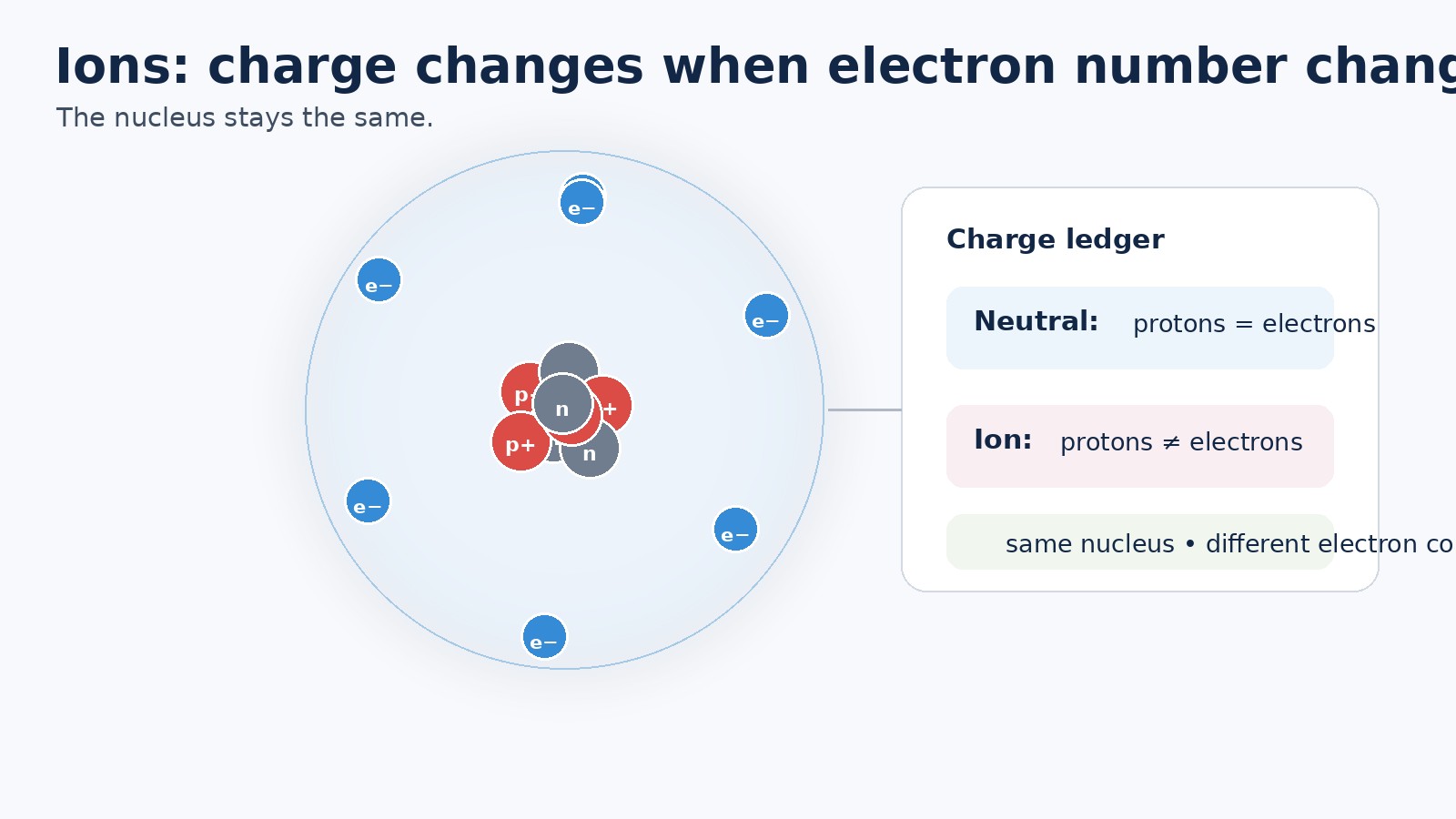
Electron Structure
How are an atom’s electrons arranged, and what can change their energy level?

Electrons do not sit just anywhere
You can now picture a complete atom: a tiny nucleus with electrons around it.
For GCSE, we use a model in which electrons occupy particular shells, or energy levels, at set distances from the nucleus.
The shell lines in a diagram are model lines. They help us show which energy level an electron occupies. They are not tiny metal tracks, and electrons are not little planets circling on drawn wires.
First count the electrons
In a neutral atom:
number of electrons = number of protons = atomic number Z.
So an atom with Z = 11 has 11 electrons to arrange.
Filling the first 20
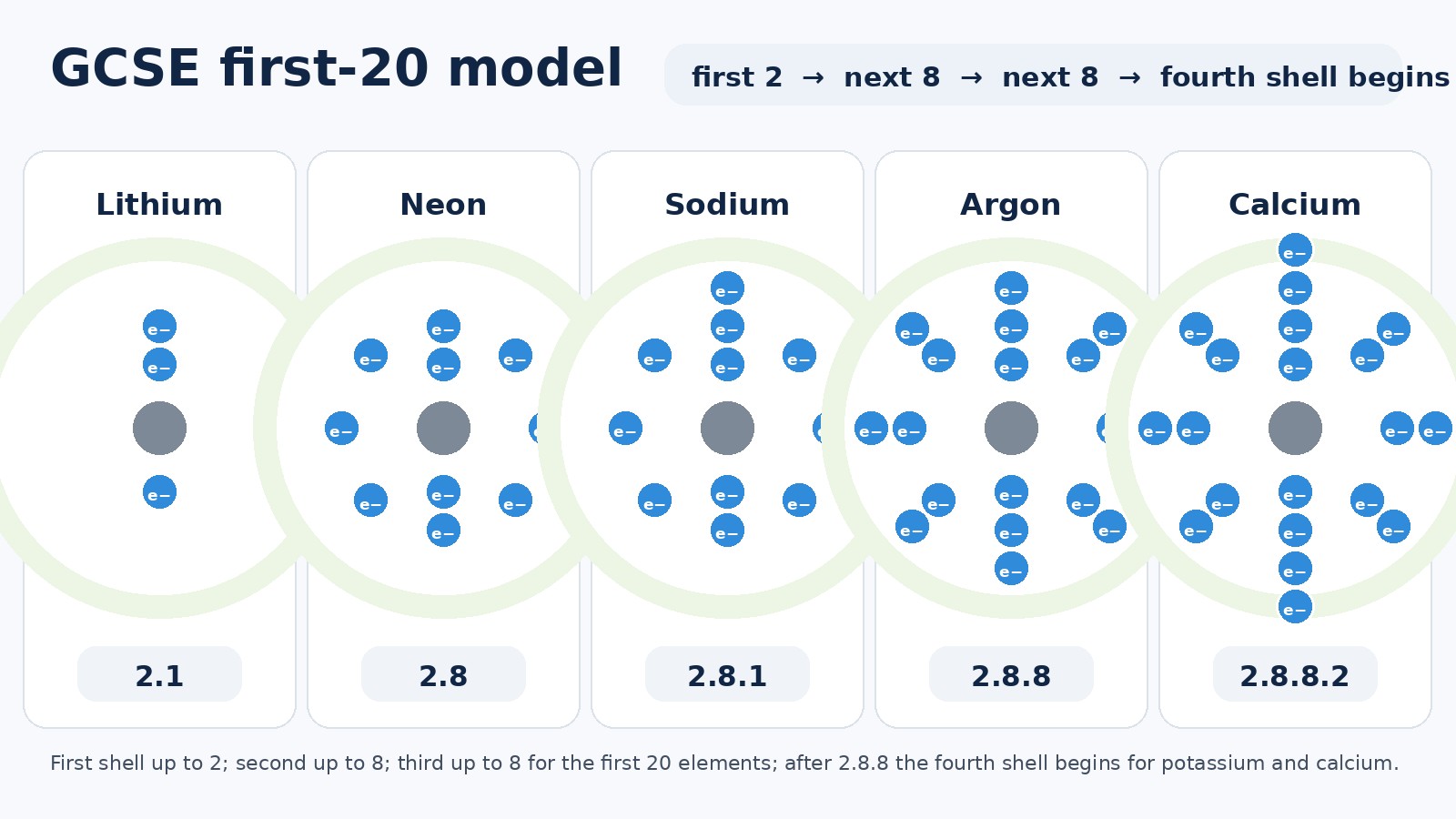
For the first 20 elements, use this GCSE filling model:
First shell: up to 2 electrons.
Second shell: then up to 8.
Third shell: then up to 8 for the first 20 elements.
After 2.8.8, the fourth shell begins for potassium and calcium.
This is a working model for the first 20 elements. Do not turn it into the rule “every shell can only ever hold eight electrons”.
Examples:
Lithium, Z=3 → 2.1
Neon, Z=10 → 2.8
Sodium, Z=11 → 2.8.1
Argon, Z=18 → 2.8.8
Calcium, Z=20 → 2.8.8.2
Each number tells you how many electrons are in one occupied shell, starting nearest the nucleus and moving outwards.
Diagram and notation say the same thing
A shell diagram and a configuration such as 2.8.1 are two ways to describe the same electron arrangement.
If a diagram shows 2 electrons in the first shell, 8 in the second and 1 in the third, write 2.8.1.
If you are given 2.8.7, draw 2 electrons in the first shell, 8 in the second and 7 in the third.
Keep the order fixed: nearest shell first.
Build the configurations
1 of 2
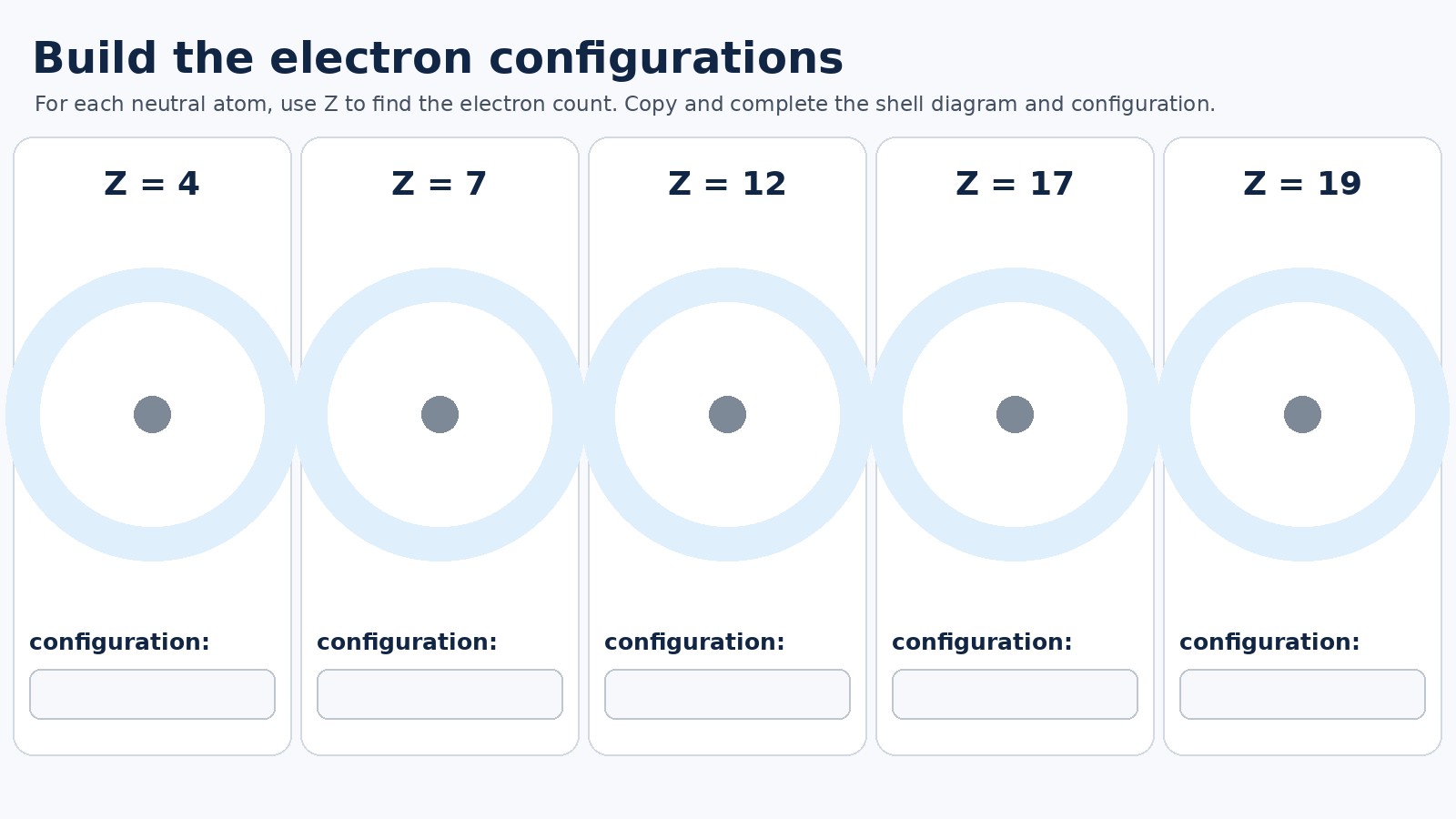
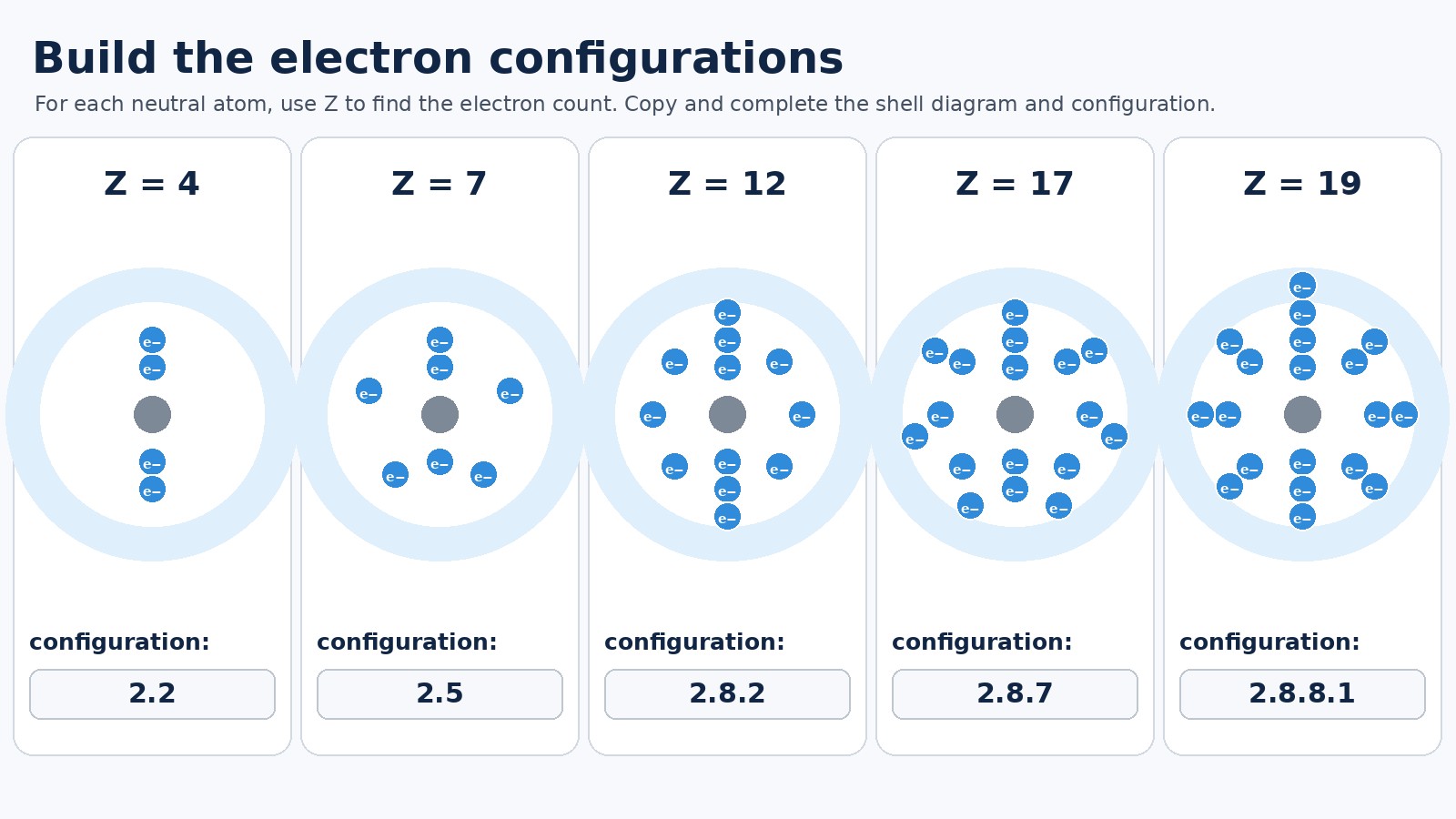
For each neutral atom below:
1. use Z to find the total number of electrons;
2. write the compact electronic configuration;
3. draw the shell diagram on paper.
A. Z = 4
B. Z = 7
C. Z = 12
D. Z = 17
E. Z = 19
Translate the model
1. A shell diagram contains 2 electrons in its first shell, 8 in its second and 4 in its third. Write the compact configuration.
2. Draw the shell diagram for 2.8.6.
The outermost occupied shell
The outermost occupied shell is the furthest shell from the nucleus that contains electrons.
For 2.8.1, the outermost occupied shell contains 1 electron.
For 2.8.7, it contains 7.
For 2.8.8, it contains 8.
For now, just learn to identify and count these outer electrons. Later, they will help explain ions, bonding and patterns in the periodic table.
Electrons can move between allowed levels
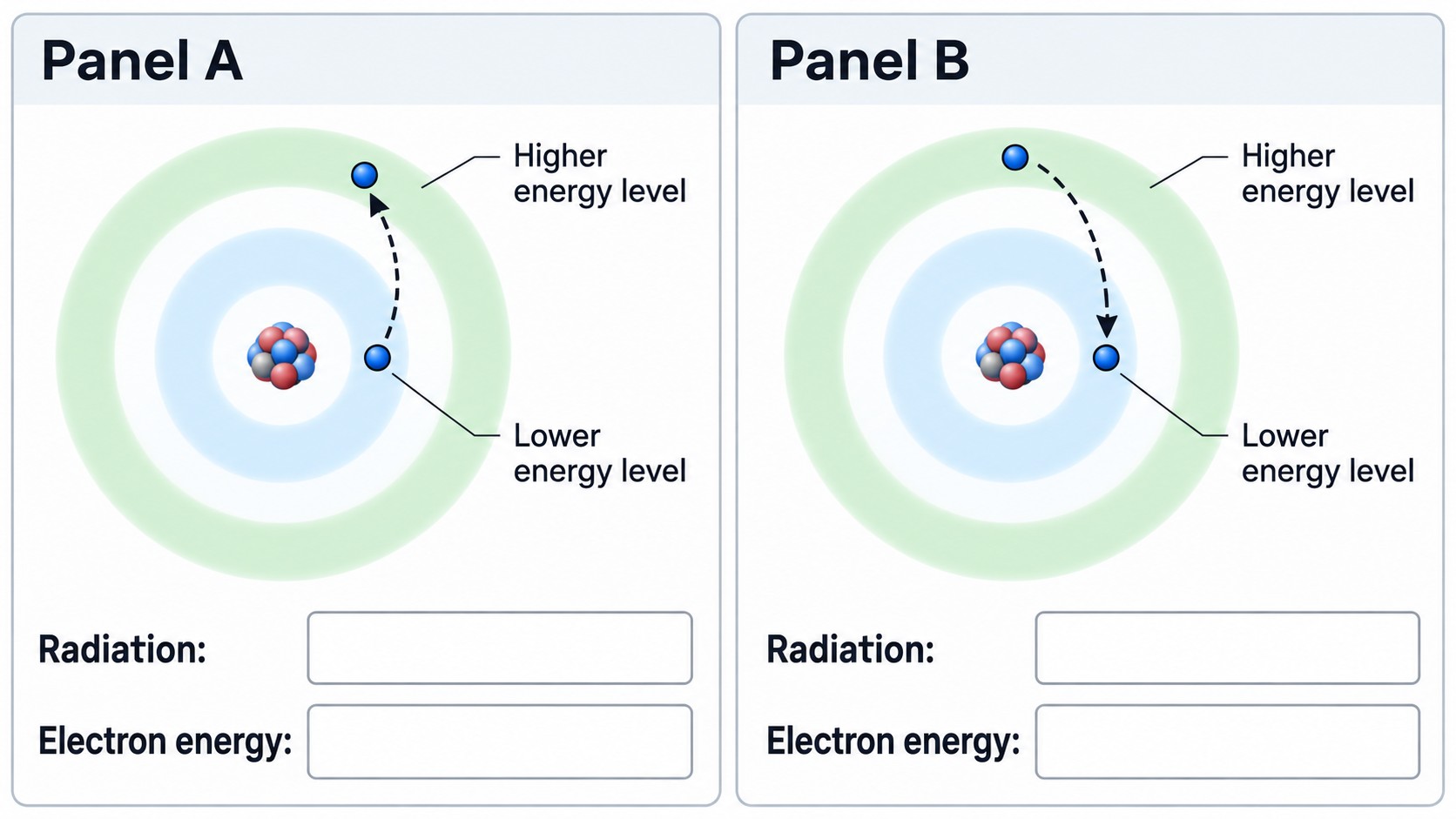
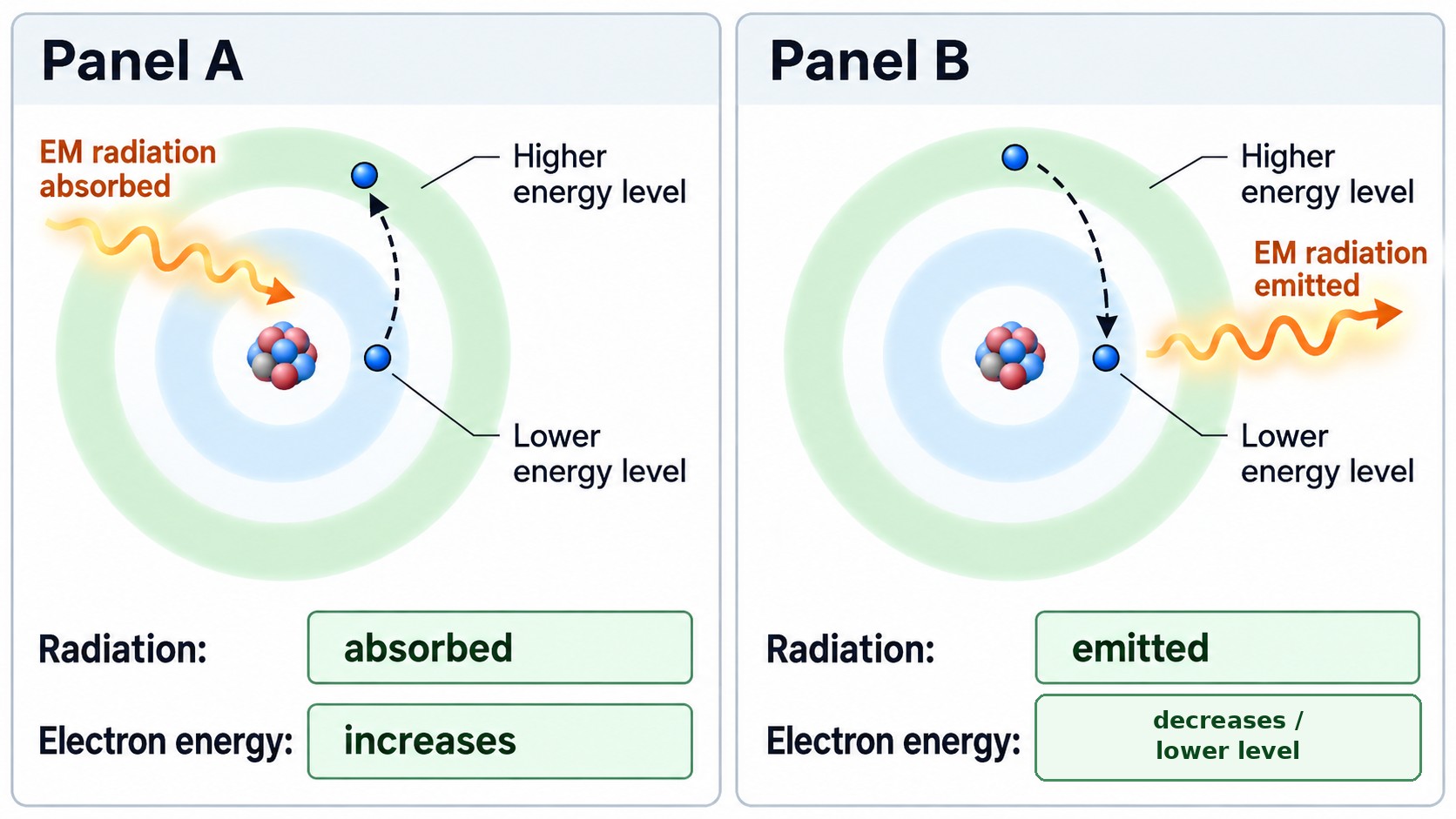
When an electron absorbs electromagnetic radiation, it can move to a higher allowed energy level.
When an electron moves to a lower allowed energy level, electromagnetic radiation is emitted.
The electron does not settle at any random distance between the allowed levels in this GCSE model.
Absorb or emit?
1 of 2
Two diagrams show the same electron changing level.
Diagram A: electron ends farther from the nucleus than it started.
Diagram B: electron ends nearer the nucleus than it started.
For each diagram, decide whether electromagnetic radiation is absorbed or emitted. Then explain what happened to the electron.
What this prepares you to ask
A neutral atom has the same number of electrons as protons.
You can now identify its outer electrons and build its electron arrangement.
So what happens if the atom loses or gains electrons and those counts stop matching?
That is the job of Ions.
Electron Structure — Deeper page — Ions
You can now build a neutral atom’s electron arrangement and identify its outer electrons. Go deeper to find out what changes when the electron count stops matching the proton count — and why the nucleus and element identity stay the same.
Remember this lesson
Without looking back:
1. write the configuration for a neutral atom with Z = 15;
2. state how many electrons are in its outermost occupied shell;
3. draw a shell diagram for 2.4;
4. explain what happens to an electron when electromagnetic radiation is absorbed;
5. explain what happens when an electron moves to a lower allowed energy level.
GCSE knowledge coverage
Key knowledge:
Electrons occupy allowed shells/energy levels in the GCSE model. For neutral atoms, Z supplies the electron count. First-20 electronic configurations can be represented as shell diagrams or compact notation such as 2.8.1. Electrons can change allowed level when electromagnetic radiation is absorbed or emitted.
Covers:
• Pearson Edexcel GCSE Chemistry (1CH0): Topic 1 requirement 1.19 — first-20 electronic configurations. Requirement 1.20 is deliberately reserved for Journey 4.
• Pearson Edexcel GCSE Combined Science (1SC0): Chemistry Topic 1 requirement 1.19 plus Physics Topic 6 requirements 6.7–6.8. Chemistry 1.20 remains Journey 4.
• Pearson Edexcel GCSE Physics (1PH0): Topic 6 requirements 6.7–6.8.
Knowledge overlap:
| Electrons occupy allowed/set shell distances | Chemistry model support | Combined Science ✓ | Physics ✓ |
|---|---|---|---|
| Use neutral Z/electron count to construct first-20 configurations | Chemistry ✓ | Combined Science ✓ | Physics — |
| Read/write shell diagrams and notation such as 2.8.1 | Chemistry ✓ | Combined Science ✓ | Physics model support |
| Identify outermost occupied shell/electron count | prerequisite/application | Combined Science prerequisite/application | Physics prerequisite for later ion reasoning |
| Absorption can move electron to higher allowed level | Chemistry — | Combined Science ✓ | Physics ✓ |
| Emission accompanies movement to lower allowed level | Chemistry — | Combined Science ✓ | Physics ✓ |
| Periodic-table position from configuration | NOT TAUGHT HERE | NOT TAUGHT HERE | — |