Atomic Structure
What makes a complete atom, and what can its particle counts tell us about the atom?
From nucleus to atom
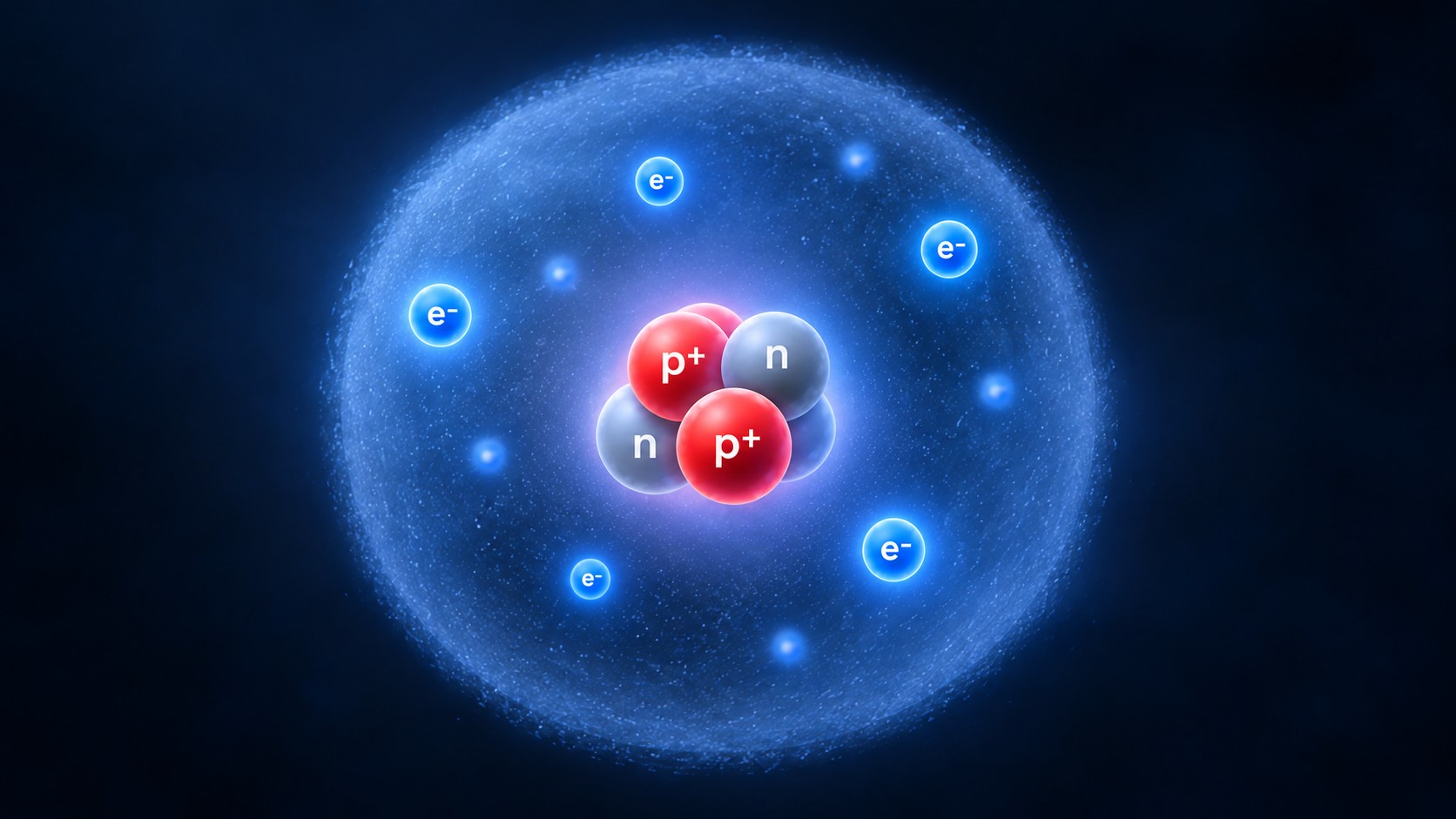
You already know the nucleus. It contains protons and, in most nuclei, neutrons.
Recombination adds the part that was missing from the earlier nuclear picture: electrons can now remain with nuclei.
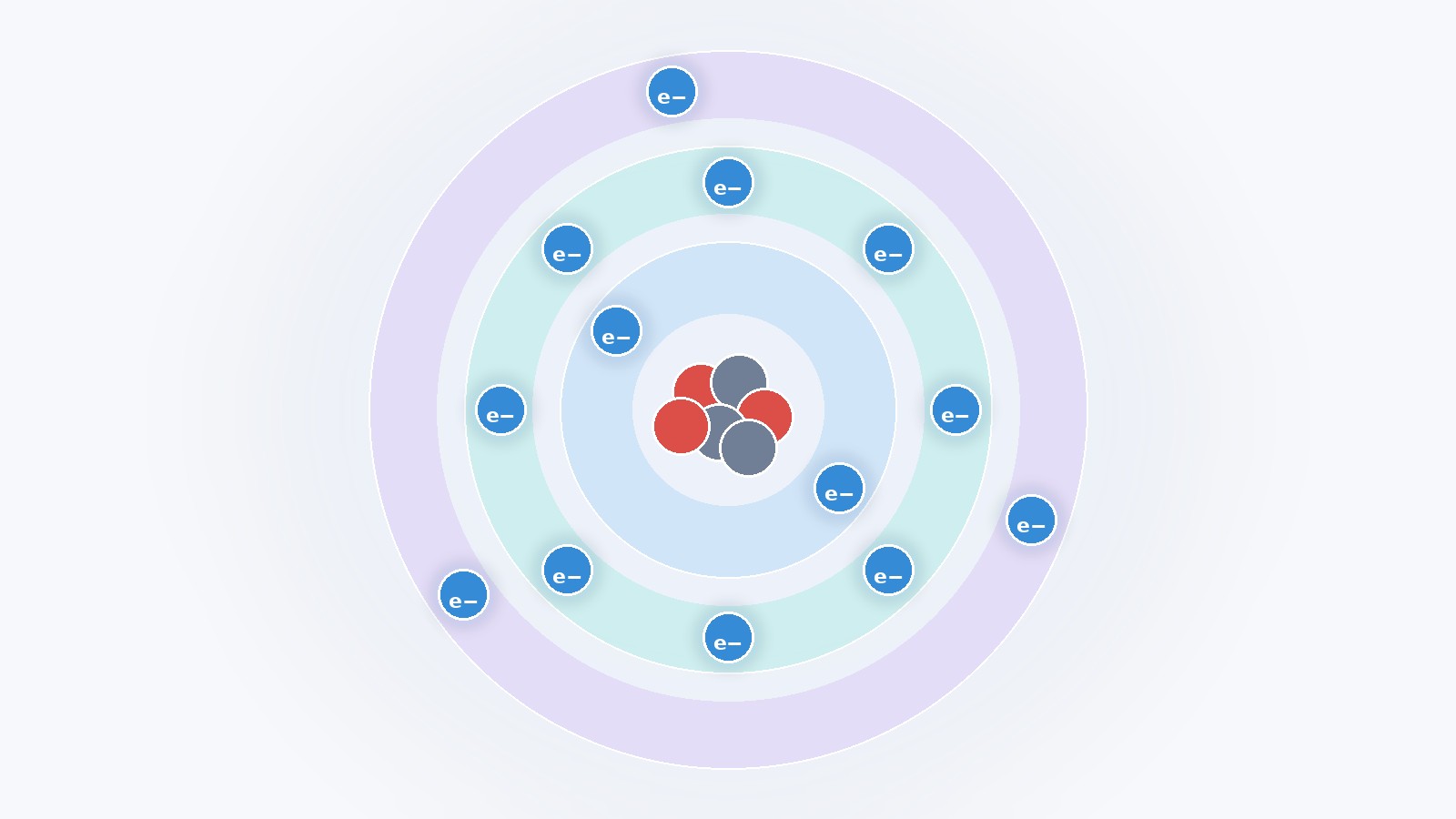
A complete atom has a tiny nucleus at its centre and electrons around it. In the GCSE model, those electrons occupy shells. We will look properly at how those shells are arranged on the next page.
The nucleus has not been replaced. The rules you learned for proton number, mass number and isotopes still apply inside the complete atom.
Scientific models change when evidence changes
Scientists have not always pictured atoms this way.
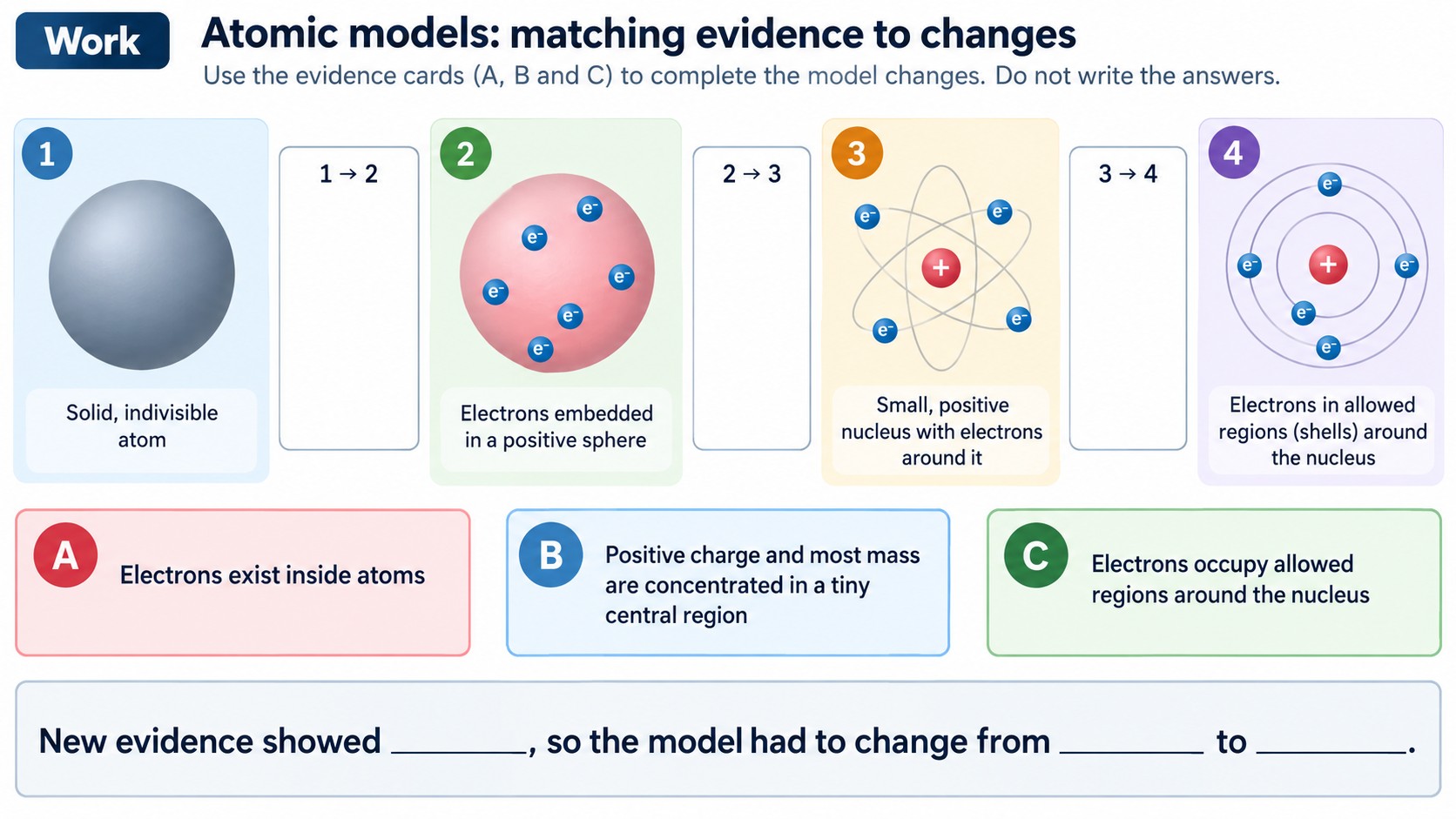
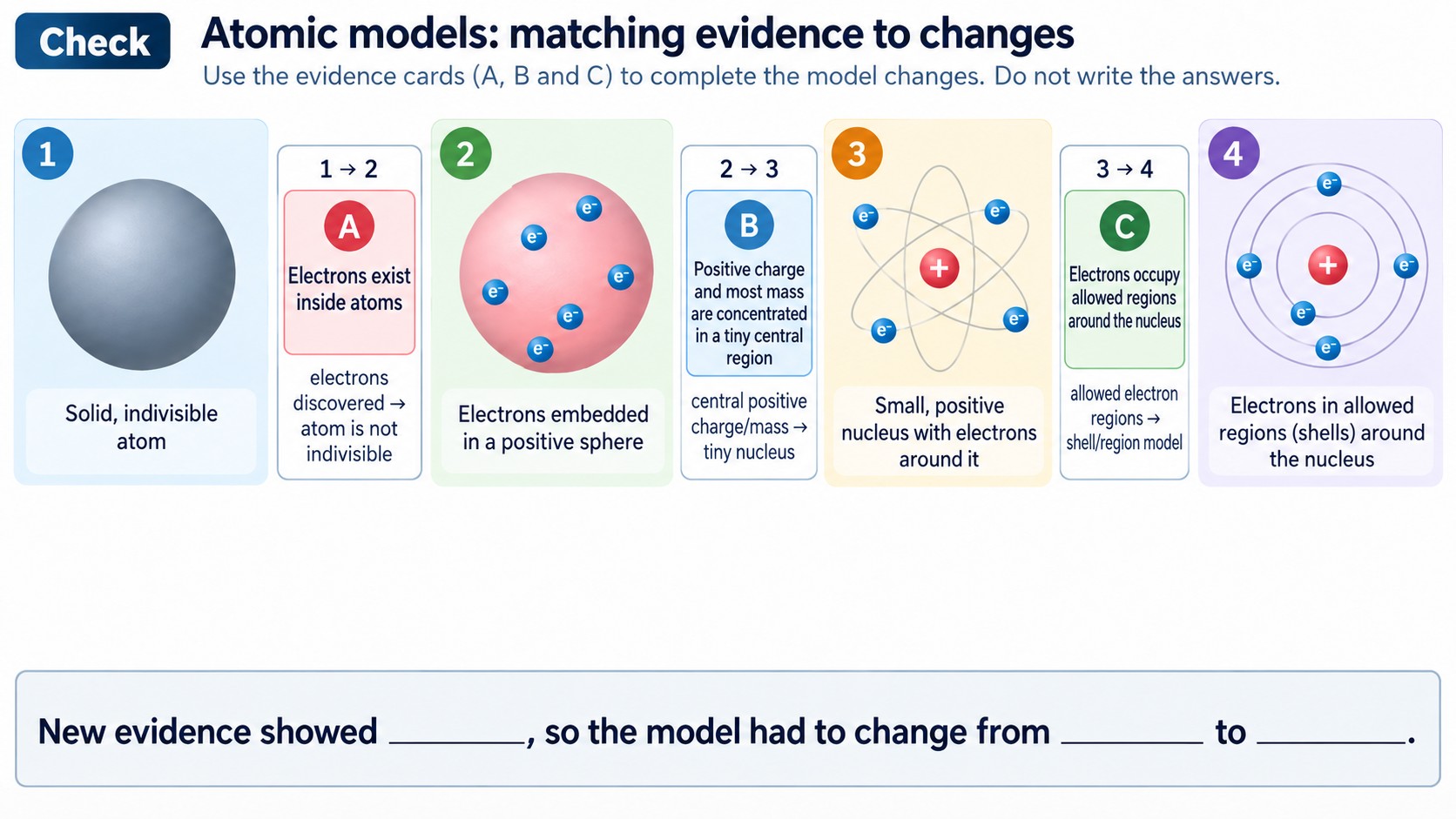
Dalton’s model treated atoms as tiny indivisible solid particles. That model was useful, but new evidence showed that atoms contained smaller parts.
The discovery of negatively charged electrons meant an atom could no longer be treated as indivisible.
Further experiments showed that the atom’s positive charge and most of its mass were concentrated in a very small nucleus rather than spread throughout the whole atom.
Later evidence refined the model again: electrons occupy allowed regions around the nucleus rather than being mixed into one solid ball.
The important story is not that scientists kept changing their minds at random. The model changed because new evidence showed that the old model could no longer explain what was observed.
Evidence changes the model
1 of 2
Match each piece of evidence to the model change it forced.
A. Electrons exist inside atoms.
B. Positive charge and most mass are concentrated in a tiny central region.
C. Electrons occupy allowed regions around the nucleus.
Write one sentence using this structure:
New evidence showed ______, so the model had to change from ______ to ______.
Three particles in one atom
| Particle | Relative charge | Relative mass | Main position in the GCSE model |
|---|---|---|---|
| Proton | +1 | 1 | nucleus |
| Neutron | 0 | 1 | nucleus |
| Electron | −1 | about 1/1840 | around the nucleus |
The electron’s mass is tiny compared with the mass of a proton or neutron. It is not zero.
Protons and neutrons account for almost all the atom’s mass. Electrons make an enormous difference to the atom’s charge and chemistry even though their mass is very small.
Why a neutral atom has equal protons and electrons
Each proton contributes +1 relative charge. Each electron contributes −1.
If an atom has three protons and three electrons, the charges balance:
+3 + (−3) = 0
The atom is neutral.
Neutrons have no electric charge, so changing the neutron number does not change the atom’s overall charge.
For a neutral atom, number of electrons = number of protons.
Do not use that rule blindly for every particle you meet. A later page will look at ions, where the electron number has changed.
A tiny centre holding almost all the mass
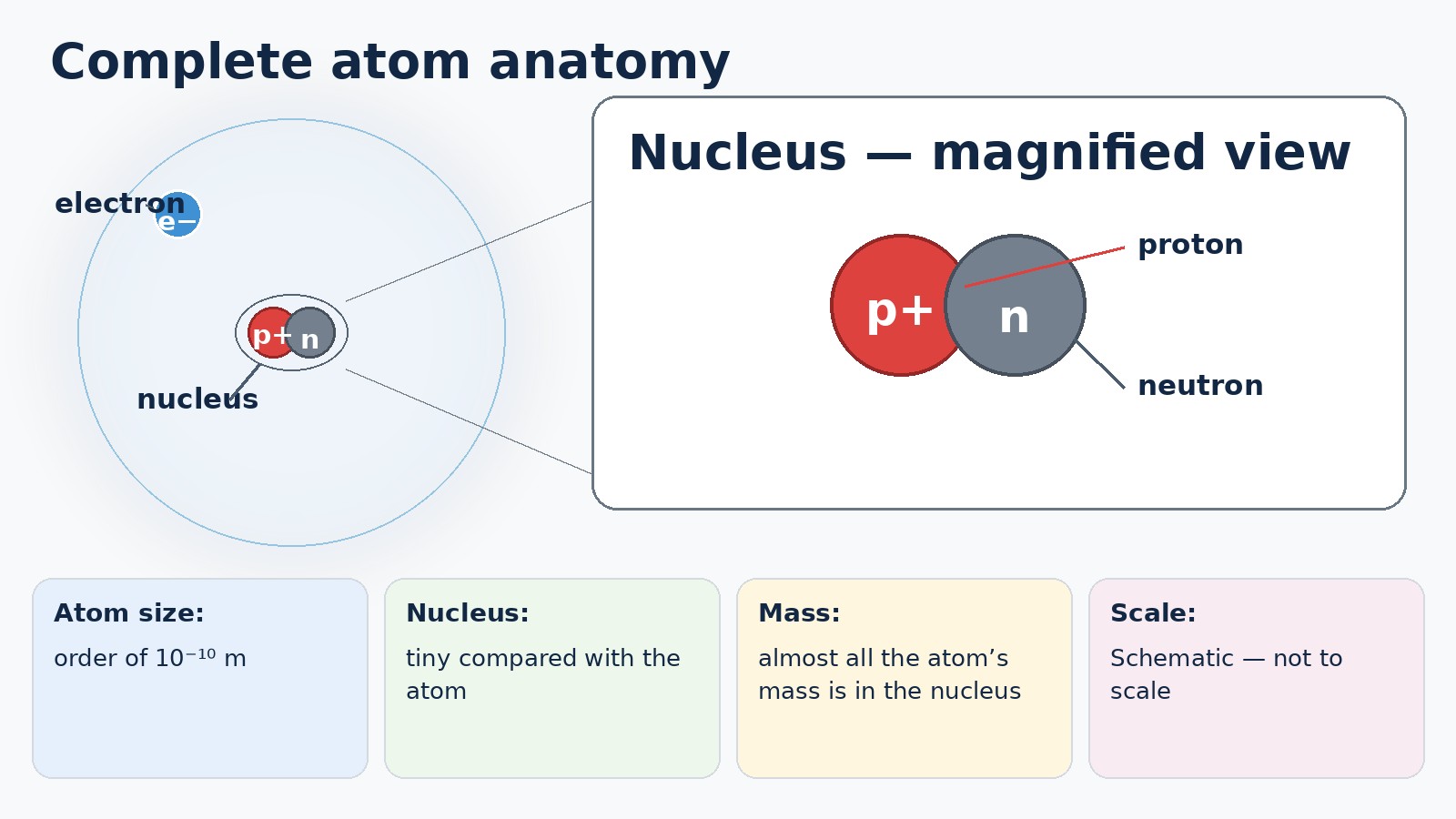
An atom is mostly space in the sense that its nucleus is extremely small compared with the overall size of the atom.
A typical atom is of order 10⁻¹⁰ metres across. That is about one ten-billionth of a metre.
The nucleus is far smaller than the whole atom, but almost all the atom’s mass is concentrated there because protons and neutrons are much heavier than electrons.
Atomic diagrams cannot usually show this honestly to scale. Treat the pictures on this page as models, not literal scale drawings.
Put the nuclear rules inside the whole atom
Atomic number Z = number of protons.
Mass number A = protons + neutrons.
Neutrons = A − Z.
Now add the whole-atom rule:
In a neutral atom, electrons = protons.
Example: lithium-7 has Z = 3 and A = 7.
Protons = 3.
Neutrons = 4.
Electrons in a neutral lithium-7 atom = 3.
The three protons still make it lithium. Adding the electrons completes the neutral atom; it does not change which element the nucleus identifies.
Build the complete atom
1 of 2
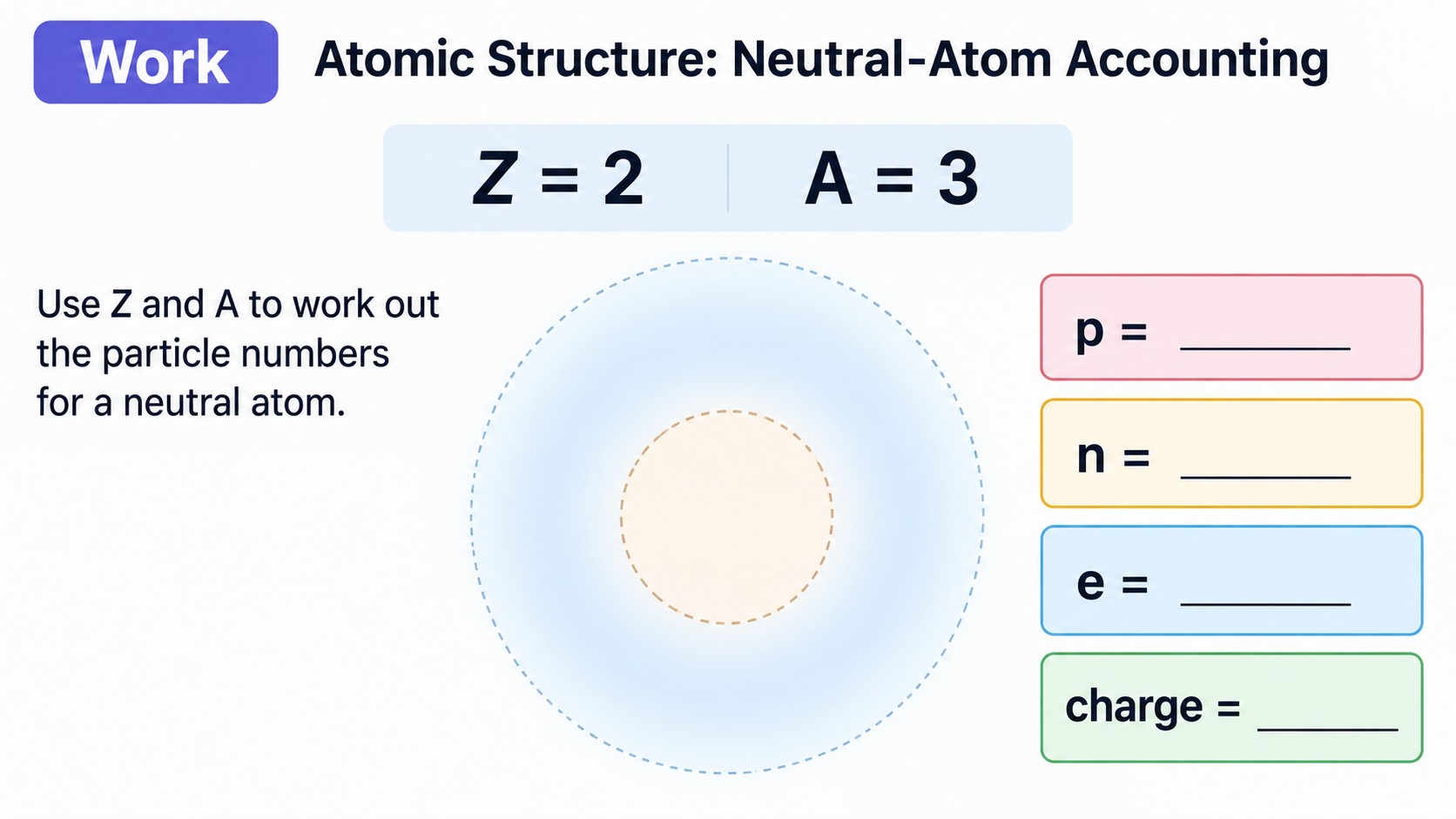
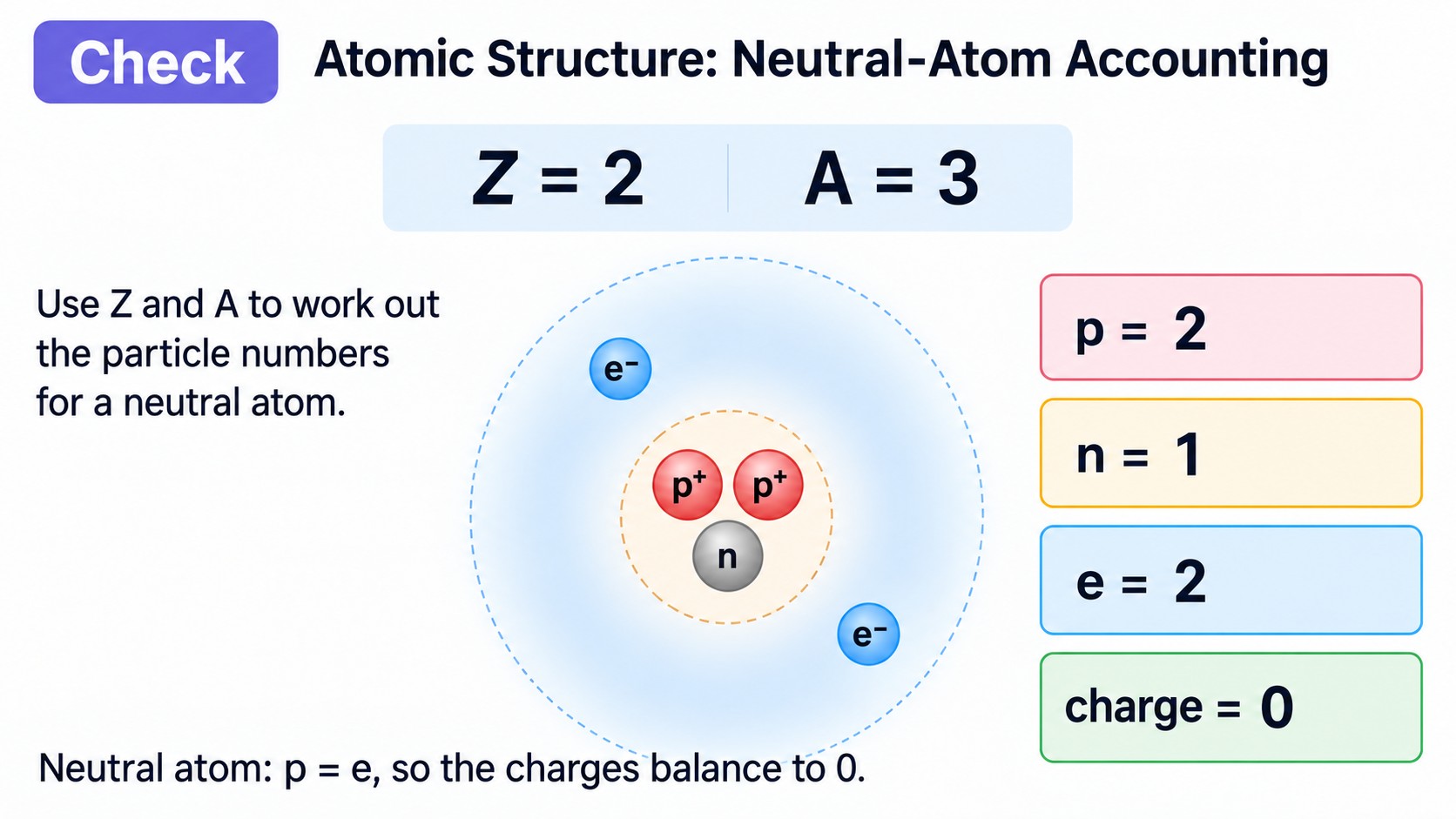
A neutral atom has Z = 2 and A = 3.
Before you check, work out:
1. number of protons
2. number of neutrons
3. number of electrons
4. why the atom is neutral
5. which particle count fixes the element’s identity
Isotopes are now complete atoms
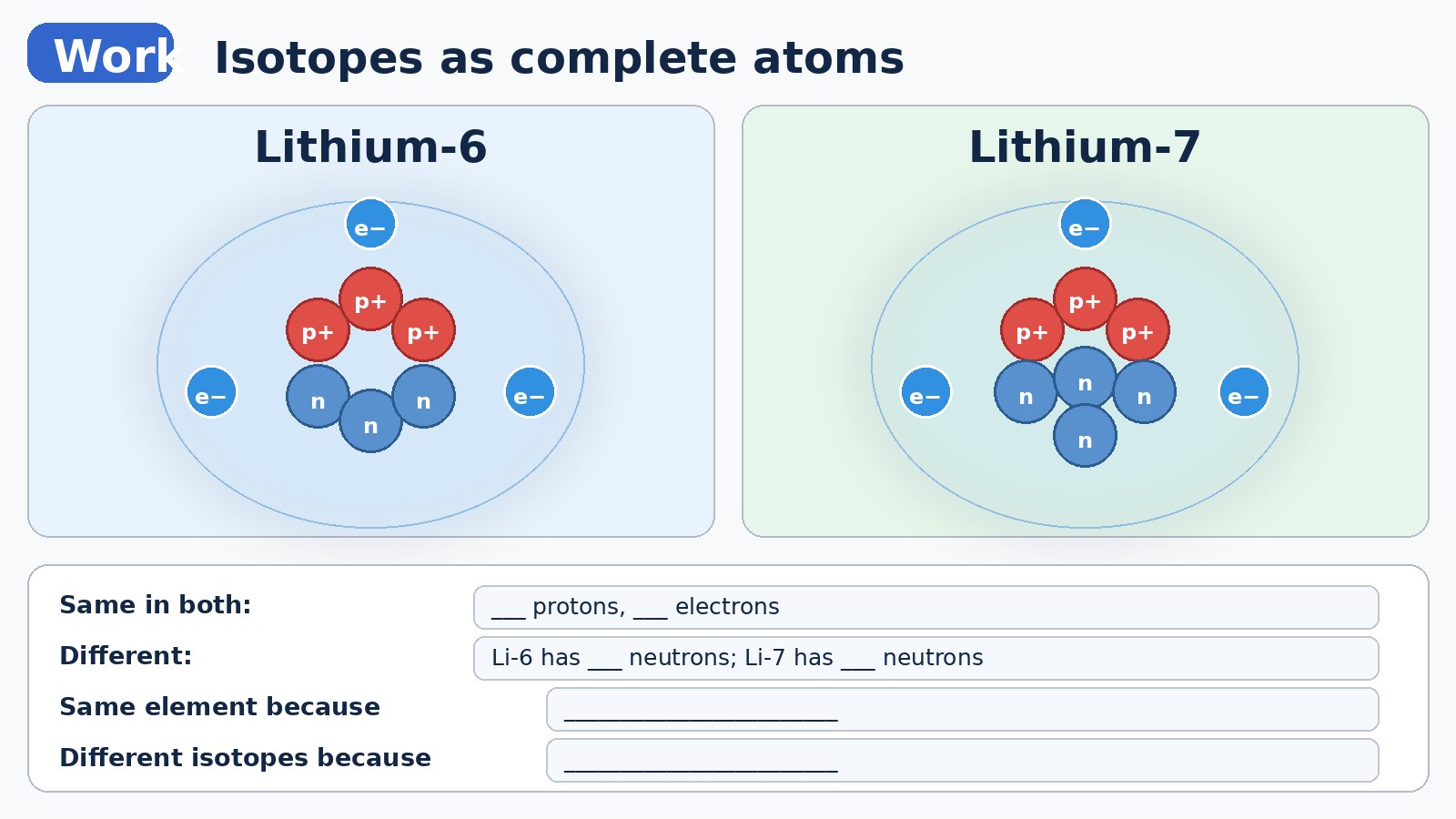
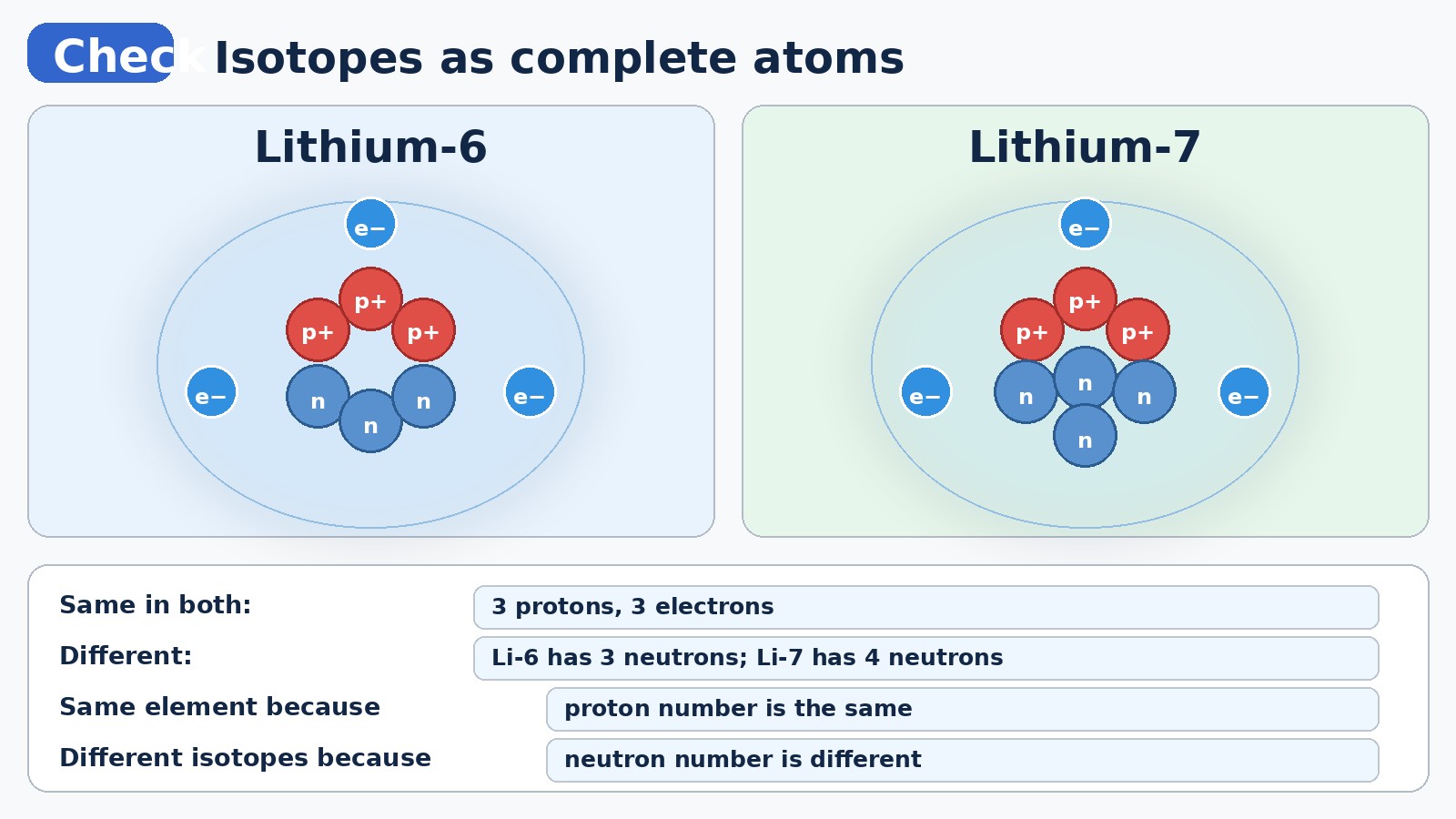
Isotopes are different atoms of the same element. They have the same number of protons but different numbers of neutrons.
Take lithium-6 and lithium-7.
Both have 3 protons, so both are lithium.
A neutral atom of either isotope also has 3 electrons.
Lithium-6 has 3 neutrons.
Lithium-7 has 4 neutrons.
The electron count does not create the isotope difference. The difference is in the neutron number inside the nucleus.
Same element, different isotope
1 of 2
Compare a neutral lithium-6 atom with a neutral lithium-7 atom.
Complete:
Same in both atoms: ______ protons and ______ electrons.
Different: lithium-6 has ______ neutrons; lithium-7 has ______ neutrons.
They are the same element because ______.
They are different isotopes because ______.
Why relative atomic mass is not always a whole number
Mass number describes one particular atom: it counts the protons and neutrons in that atom’s nucleus. It is always a whole number.
Relative atomic mass takes account of the different isotopes of an element and how abundant they are.
If an element contains more than one isotope, its relative atomic mass can fall between their mass values. The more abundant isotope pulls the average closer to its own mass.
Imagine a practice mixture containing two isotopes of the same element:
20% have relative isotopic mass 6.
80% have relative isotopic mass 7.
The relative atomic mass should be much closer to 7 than to 6 because the mass-7 isotope is much more abundant.
Higher Tier — calculate the weighted relative atomic mass
(6 × 20) + (7 × 80) = 680
680 ÷ 100 = 6.8
This 6.8 is not the mass number of a single atom. The atoms in the mixture still have whole-number mass values of 6 or 7.
Relative mass from isotopes
For all learners:
A sample contains isotopes with masses 10 and 11. The mass-11 isotope is much more abundant. Explain why the relative atomic mass should be between 10 and 11 and closer to 11.
Higher Tier:
30% of the atoms have relative isotopic mass 10 and 70% have relative isotopic mass 11. Calculate the relative atomic mass.
What this model still leaves for the next page
You can now build and count a complete neutral atom.
But we have only said that electrons occupy shells around the nucleus. We have not yet worked out how those electrons are arranged, how many go into each shell, or what those arrangements let us predict.
That is the job of Electron Structure.
Atomic Structure — Deeper page — Electron Structure
You can now build and count a complete neutral atom. Go deeper to work out how its electrons are arranged in allowed shells or energy levels, how to write configurations, and how electrons can move between allowed levels.
Remember this lesson
Use a fresh neutral atom with Z = 4 and A = 9.
Without looking back:
1. calculate its protons, neutrons and electrons;
2. explain why it is neutral;
3. state where almost all its mass is found;
4. explain why changing its neutron number would make a different isotope but not a different element;
5. explain why the atomic model changed after subatomic particles were discovered.
GCSE knowledge coverage
Key knowledge:
A complete atom contains a very small nucleus and surrounding electrons. Proton/electron counts explain neutrality; atomic and mass numbers allow p
/e calculation; isotopes are different atoms of the same element with different neutron numbers; isotope abundance explains non-integer relative atomic mass; scientific evidence changed the atomic model.
Covers:
• Pearson Edexcel GCSE Chemistry (1CH0), Topic 1 Atomic structure 1.1–1.11; 1.12 Higher Tier only.
• Pearson Edexcel GCSE Combined Science (1SC0), Chemistry Topic 1 Atomic structure 1.1–1.11; 1.12 Higher Tier only.
• Pearson Edexcel GCSE Physics (1PH0), Topic 6 atomic-structure knowledge overlapping 6.1, 6.2 and 6.6, with recall/application from 6.3–6.5 where genuinely practised here. This page does not claim the positron part of 6.5 or later radioactivity requirements.
Knowledge overlap:
| Atomic model changes with evidence | Chemistry ✓ | Combined Science ✓ | Physics — |
|---|---|---|---|
| Complete atom: nucleus + electrons | Chemistry ✓ | Combined Science ✓ | Physics ✓ |
Relative p
| /e charges and masses | Chemistry ✓ | Combined Science ✓ | Physics partial knowledge overlap; positron not taught here |
|---|---|---|---|
| Neutral atom has equal p/e | Chemistry ✓ | Combined Science ✓ | Physics ✓ |
| Tiny nucleus / almost all mass in nucleus | Chemistry ✓ | Combined Science ✓ | Physics ✓ |
Atomic/mass-number p
| /e calculation | Chemistry ✓ | Combined Science ✓ | Physics relevant recall/application |
|---|---|---|---|
| Isotopes as atoms | Chemistry ✓ | Combined Science ✓ | Physics relevant recall/application |
| Non-integer relative atomic mass from isotope mixture | Chemistry ✓ | Combined Science ✓ | Physics — |
| Weighted relative atomic mass calculation | Chemistry Higher Tier ✓ | Combined Science Higher Tier ✓ | Physics — |
| Typical atomic size/order of magnitude | Chemistry maths-scale support | Combined Science maths-scale support | Physics ✓ |