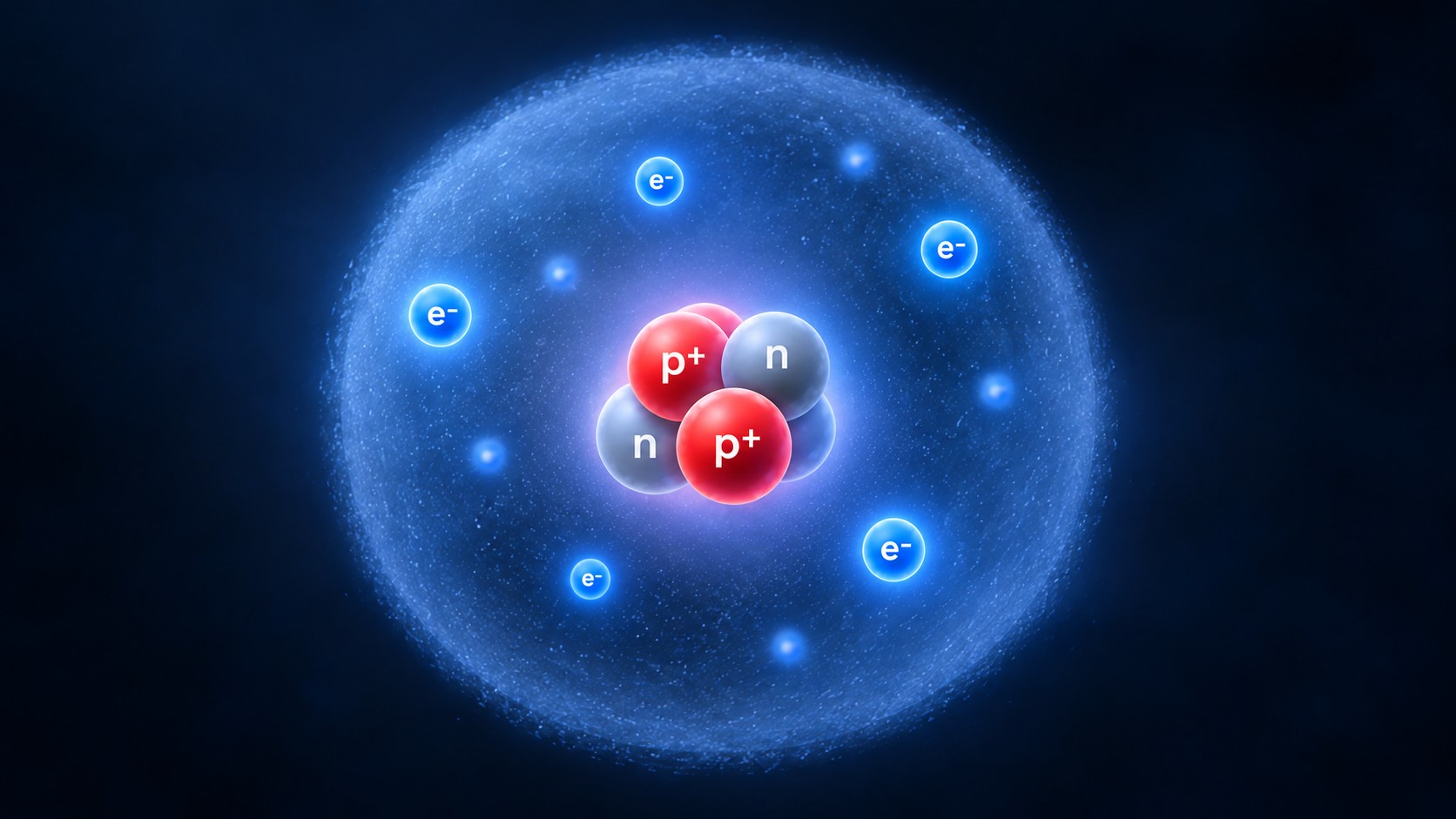
Recombination
How did a universe of bare nuclei and free electrons become a universe containing neutral atoms?
The nuclei are already there
The main period of primordial nucleosynthesis is over.
Hydrogen and helium nuclei already exist. Many hydrogen nuclei are single protons. Helium nuclei contain protons and neutrons bound together.
But these nuclei are not yet ordinary neutral atoms.
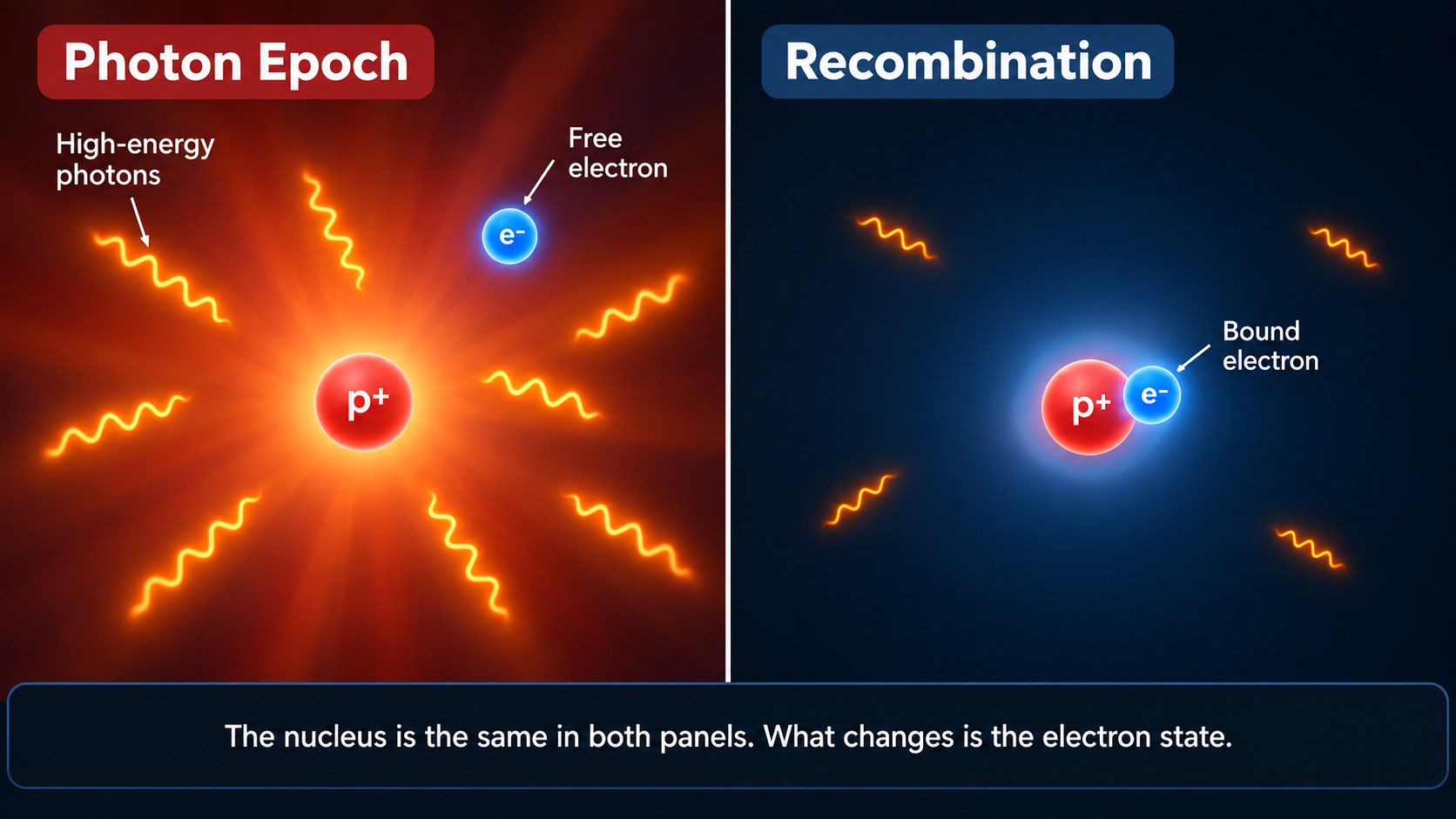
Electrons are still moving freely through the hot universe instead of remaining bound to the nuclei.
Recombination will not build the nuclei again. It will change what the electrons can do.
A universe full of fog
Light is everywhere, but it cannot travel far.
The universe is filled with a hot plasma of charged particles. Free electrons repeatedly scatter photons, so a photon does not get very far before its direction changes again.
That makes the early universe opaque. It is a little like trying to see through fog, although this cosmic “fog” is not made from water droplets. The important part is the free electrons interacting with the light.
Cooling changes what electrons can do
The universe keeps expanding. As it expands, it cools.
Around 380,000 years after the Big Bang, its temperature has fallen to roughly 3,000 kelvin. Under these cooler conditions, electrons can remain bound to atomic nuclei instead of being continually separated from them again.
A hydrogen nucleus can hold an electron. Helium nuclei can hold electrons too.
Neutral atoms can now become widespread.
Recombination — Deeper page — Atomic Structure
A new structure can now persist: the atom. Go deeper to see how a nucleus and electrons fit together, how a neutral atom is counted, and how the nuclear rules you already know carry into the complete atom.
The fog clears
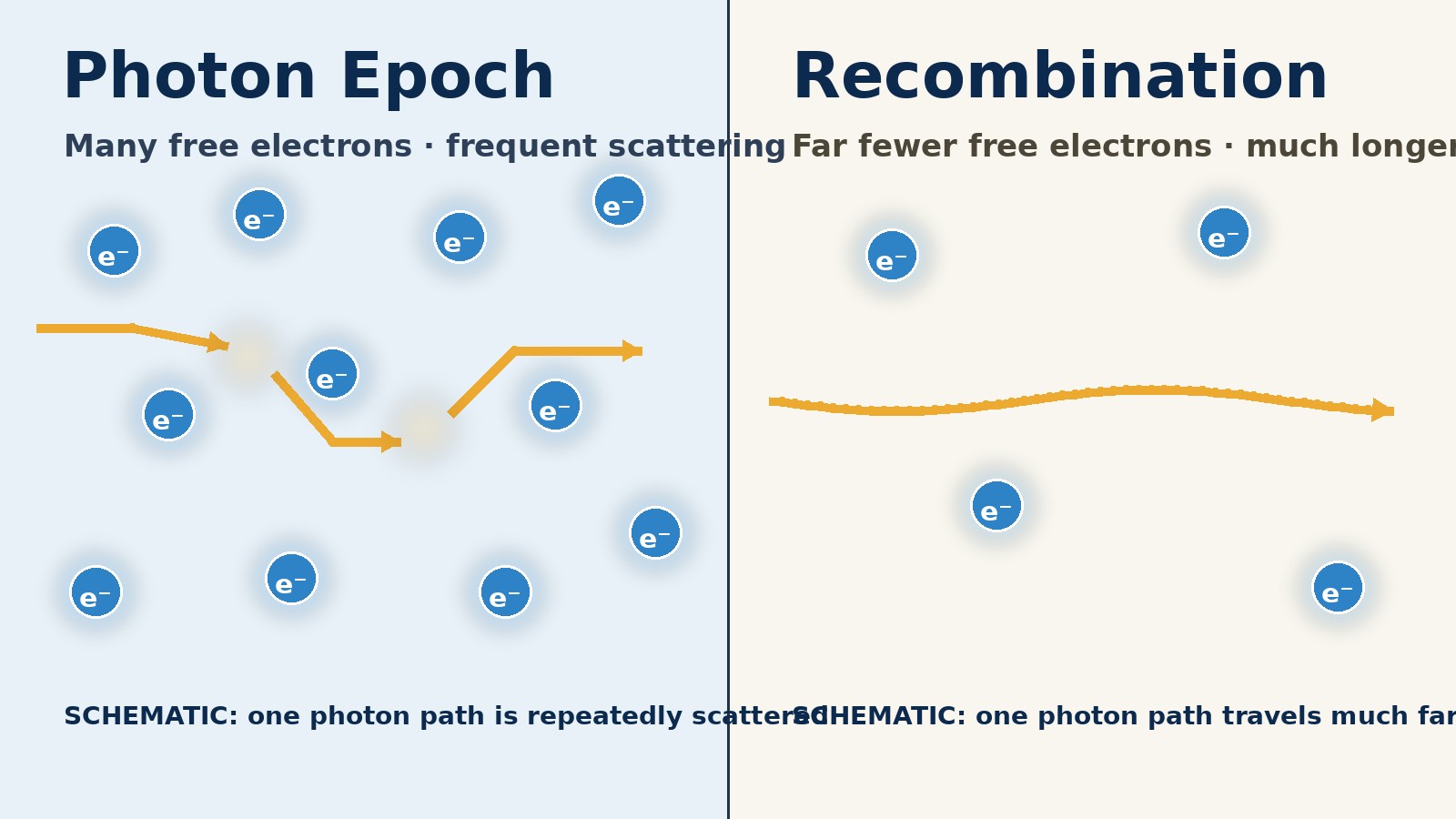
As electrons become bound inside atoms, the number of free electrons falls sharply.
There are now far fewer free electrons to scatter photons. Light can travel across enormous distances through the universe.
The ancient light that began travelling freely from this period is still detectable today. We call it the cosmic microwave background, or CMB. It is the oldest light we can directly observe.
The nuclei did not disappear. The same nuclear structures are still there inside the new atoms. What changed was the way electrons could remain with them.
What changed, and what stayed the same?
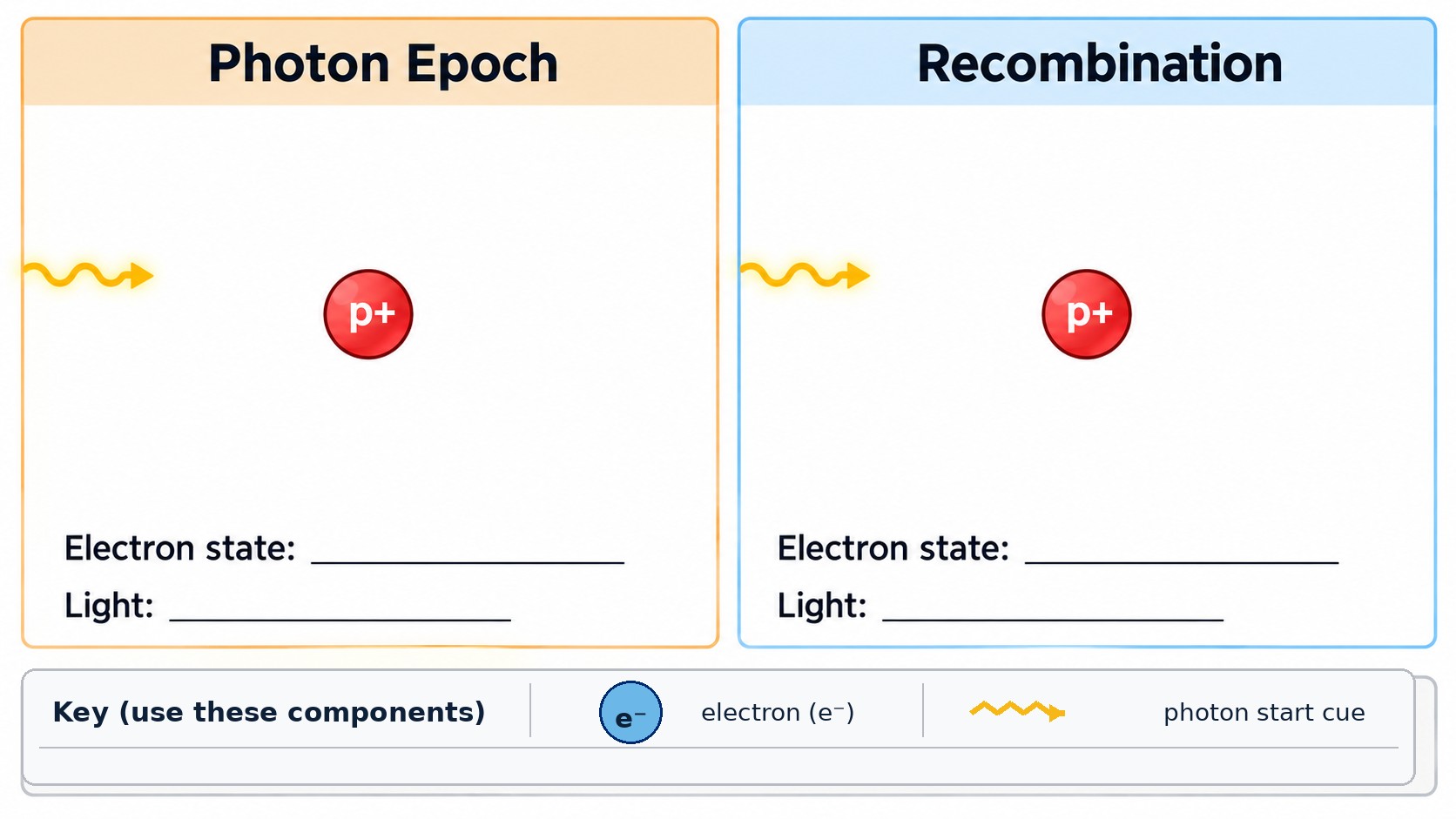
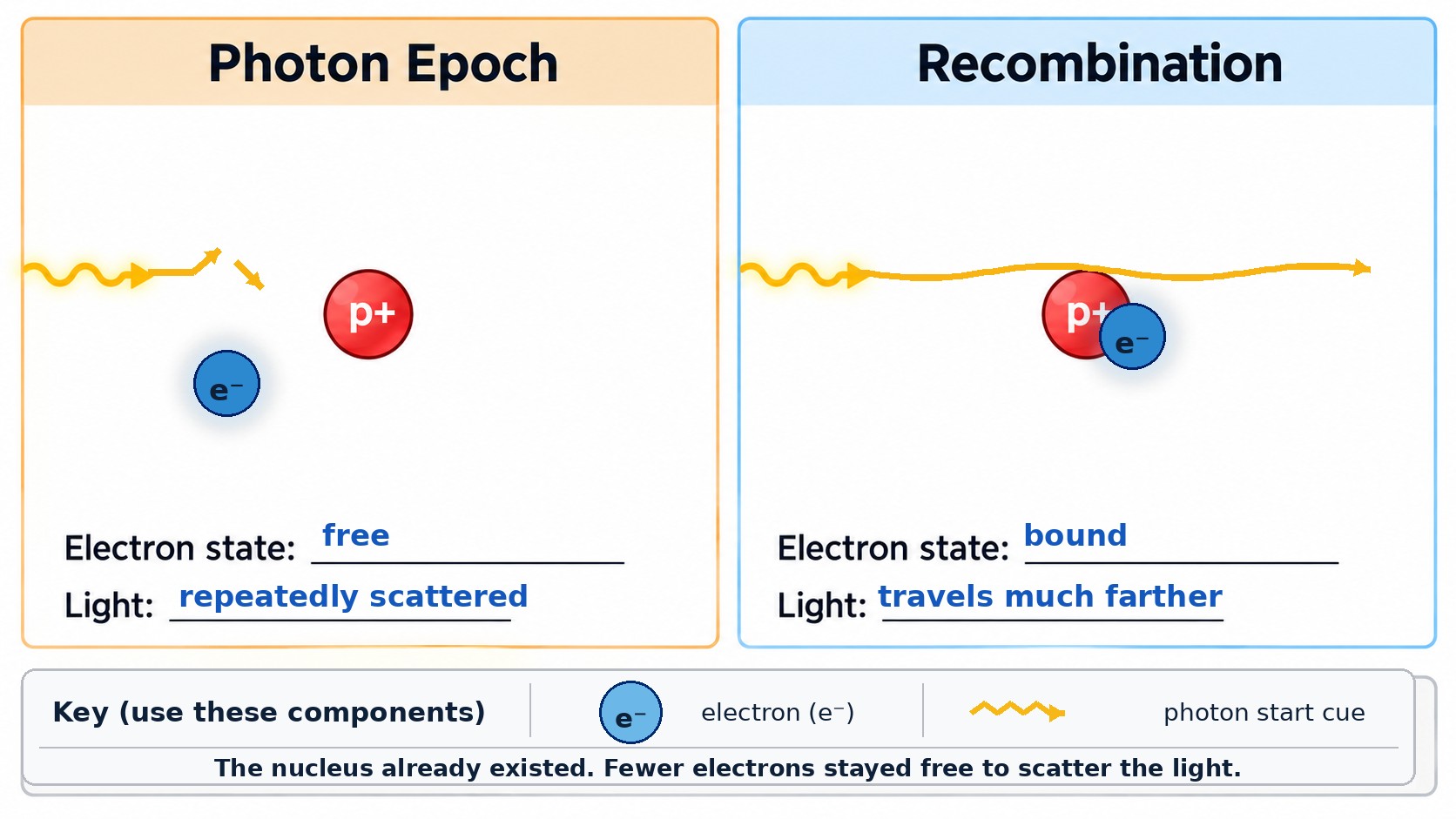
1 of 2
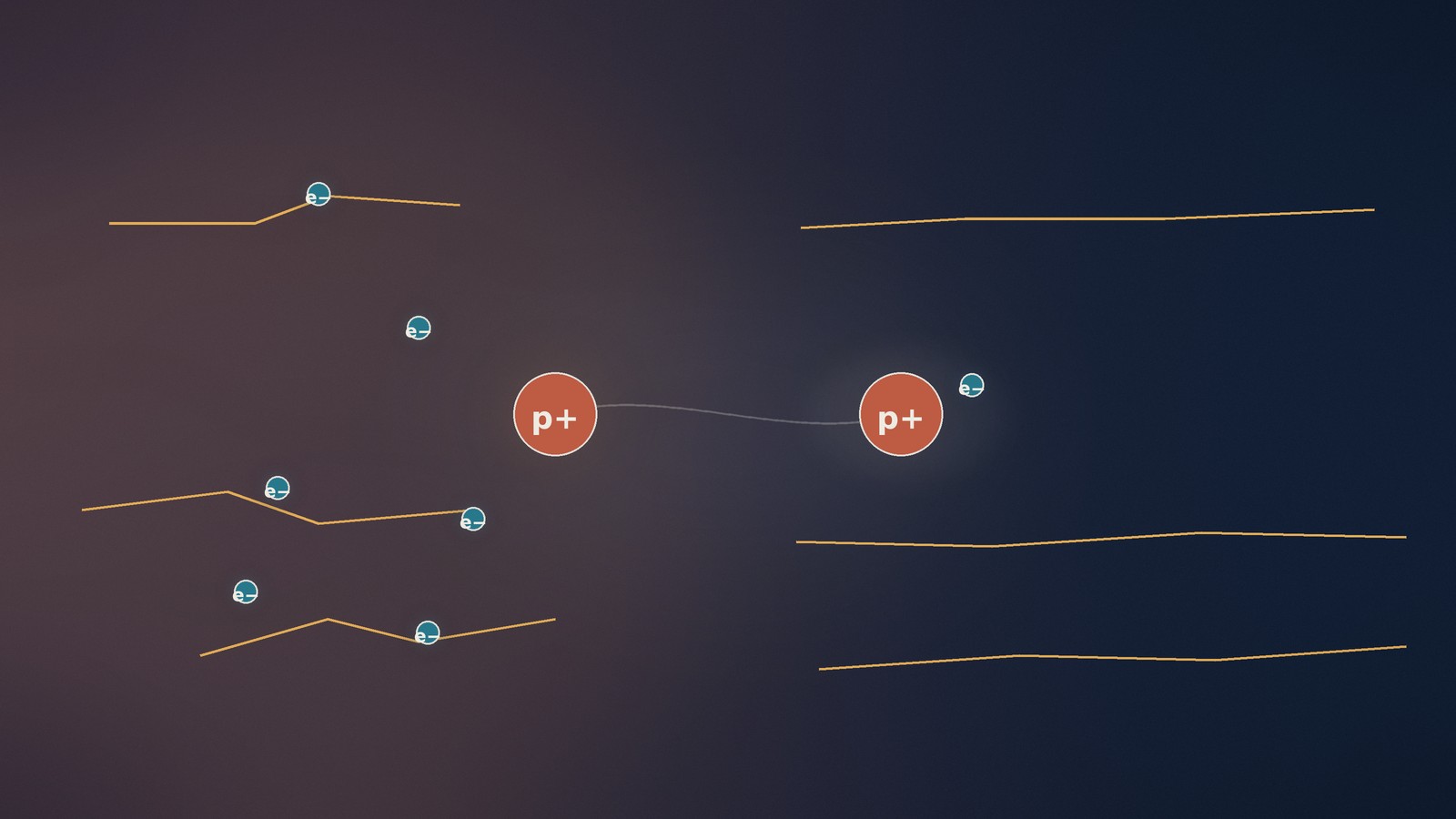
On paper, copy and complete the two matched scientific panels.
The SAME hydrogen nucleus is already shown in both panels. Each panel also gives you an electron symbol and the start of a photon path, but the important parts are unfinished.
Complete the Photon Epoch panel to show what the electron is doing and what happens to the photon.
Complete the Recombination panel using the SAME nucleus. Show what changes for the electron and how that changes how far the photon can travel.
Then write three short statements:
1. What changed at Recombination?
2. What did not have to be built again?
3. Why could light travel much farther?
The cosmic clock keeps moving
Recombination changes the universe, but it does not suddenly fill it with stars.
Neutral hydrogen and helium now make up much of the ordinary matter. The universe is transparent to the ancient light we see as the CMB, but individual stars and galaxies have not yet appeared.
Cosmic history now moves into the Dark Ages.
This journey pauses the clock here. Before following the universe towards its first stars, we are going to look inside these new atoms and find out what their electrons make possible.
GCSE knowledge coverage
This page provides context and navigation; no new GCSE knowledge is taught here.