Covalent Bonding and Molecules
How can separate atoms become one molecule without their nuclei fusing together?
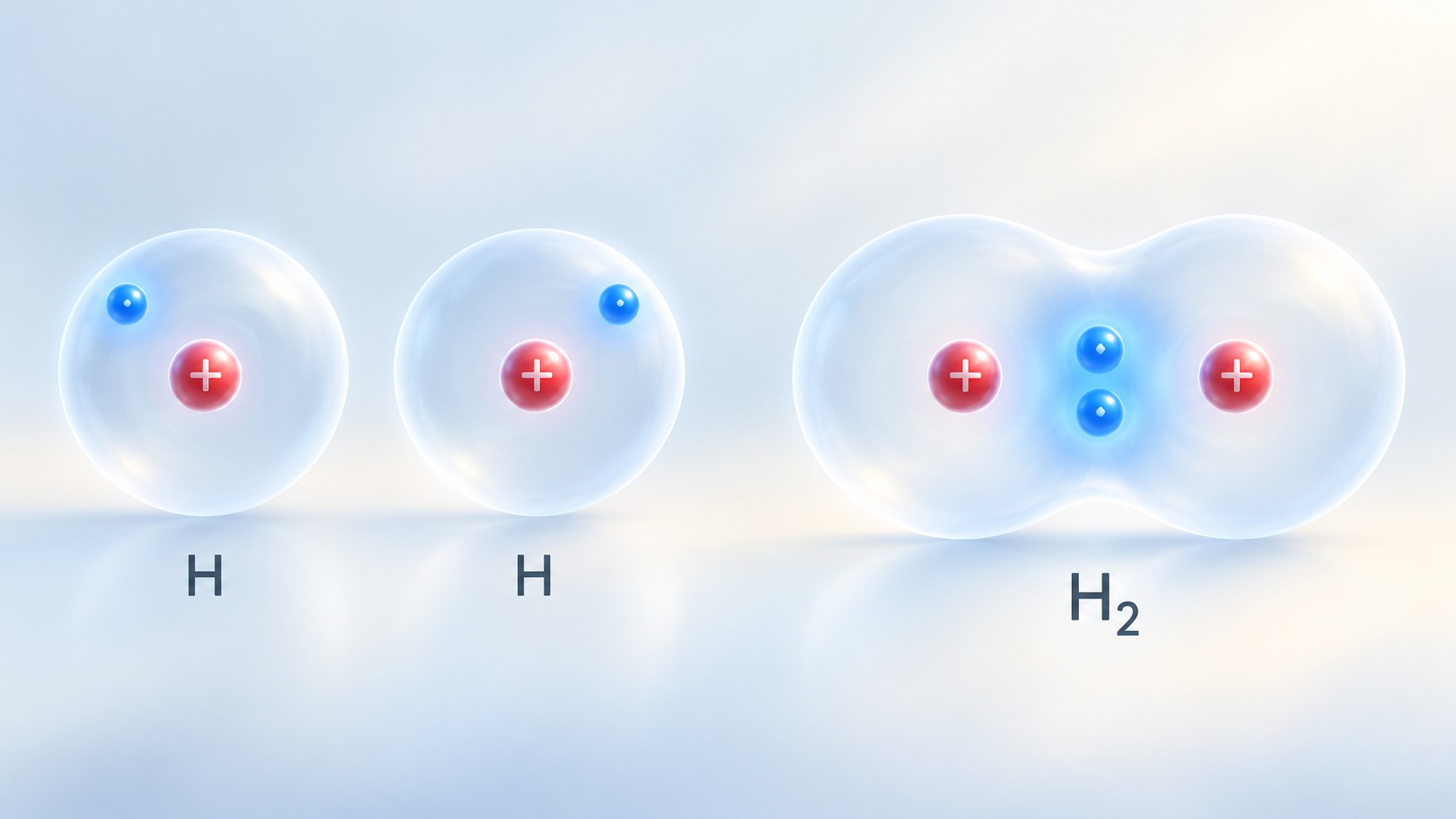
Start with two hydrogen atoms
A neutral hydrogen atom is as simple as an atom can be.
Its ordinary hydrogen-1 nucleus is one proton. Around it is one electron.
Now place two neutral hydrogen atoms near one another in our model.
We still have two hydrogen nuclei. Nothing has fused them together.
The new question is what can happen with their electrons.
One shared pair
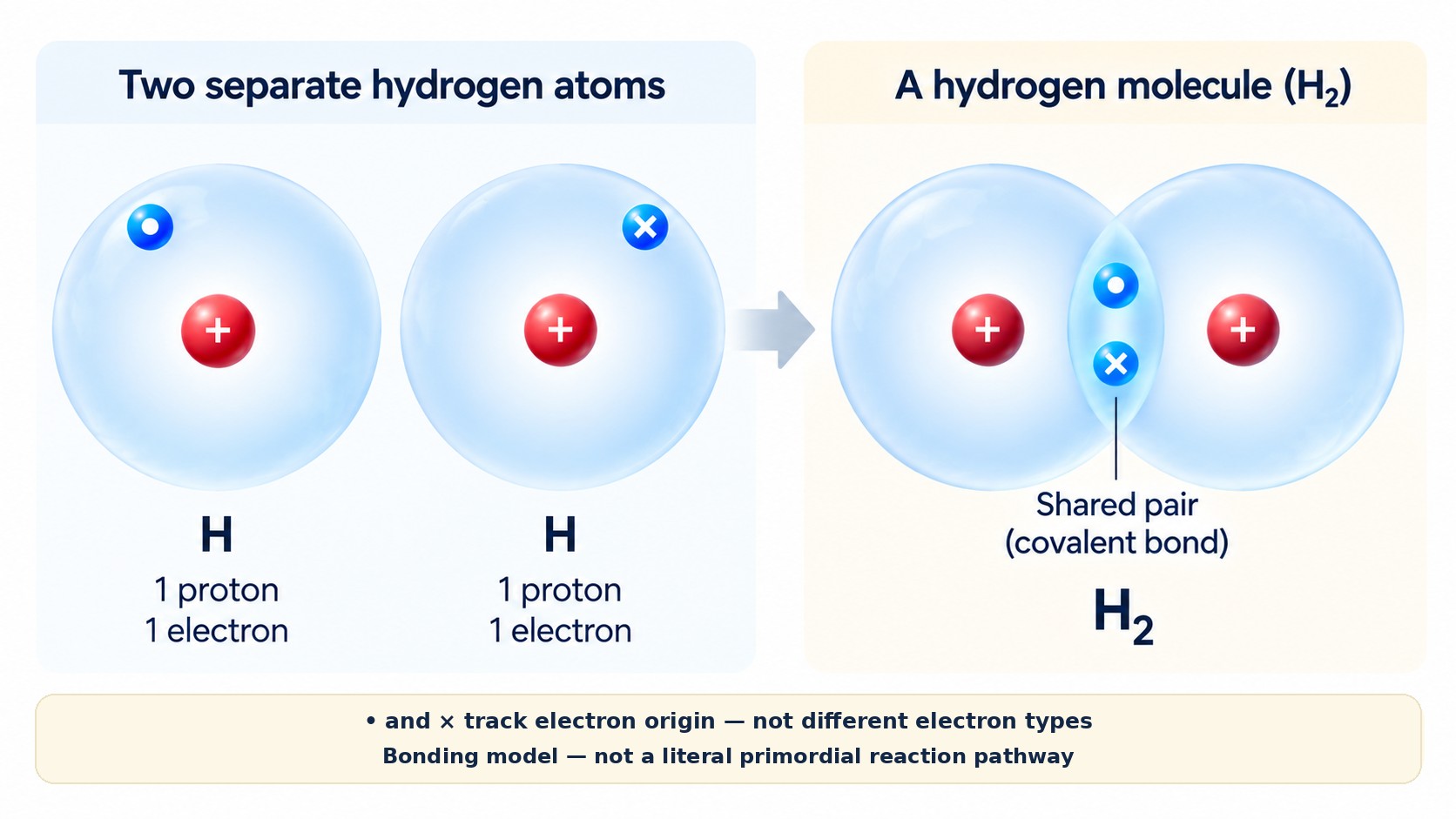
A covalent bond forms when two atoms share a pair of electrons.
For H₂, there are two electrons in the shared pair.
One came from one hydrogen atom.
One came from the other.
In a dot-and-cross diagram, we can draw one as a dot and one as a cross so we can track where they came from.
The dot and cross do not mean the electrons are physically different types. They are just labels in the model.
From two atoms to one molecule
Before bonding, we describe two separate hydrogen atoms.
After covalent bonding, we describe one hydrogen molecule: H₂.
H₂ contains two hydrogen atoms joined by a covalent bond.
The small 2 tells you that this molecule contains two H atoms.
We will build a more complete language of chemical formulae later. For now, read H₂ simply as one molecule containing two hydrogen atoms.
The nuclei have not fused
In H₂, the two hydrogen nuclei remain separate hydrogen nuclei.
Covalent bonding has not combined the protons into a helium nucleus.
The change is chemical: the atoms now share electrons and form a molecule.
Build H₂
1 of 2
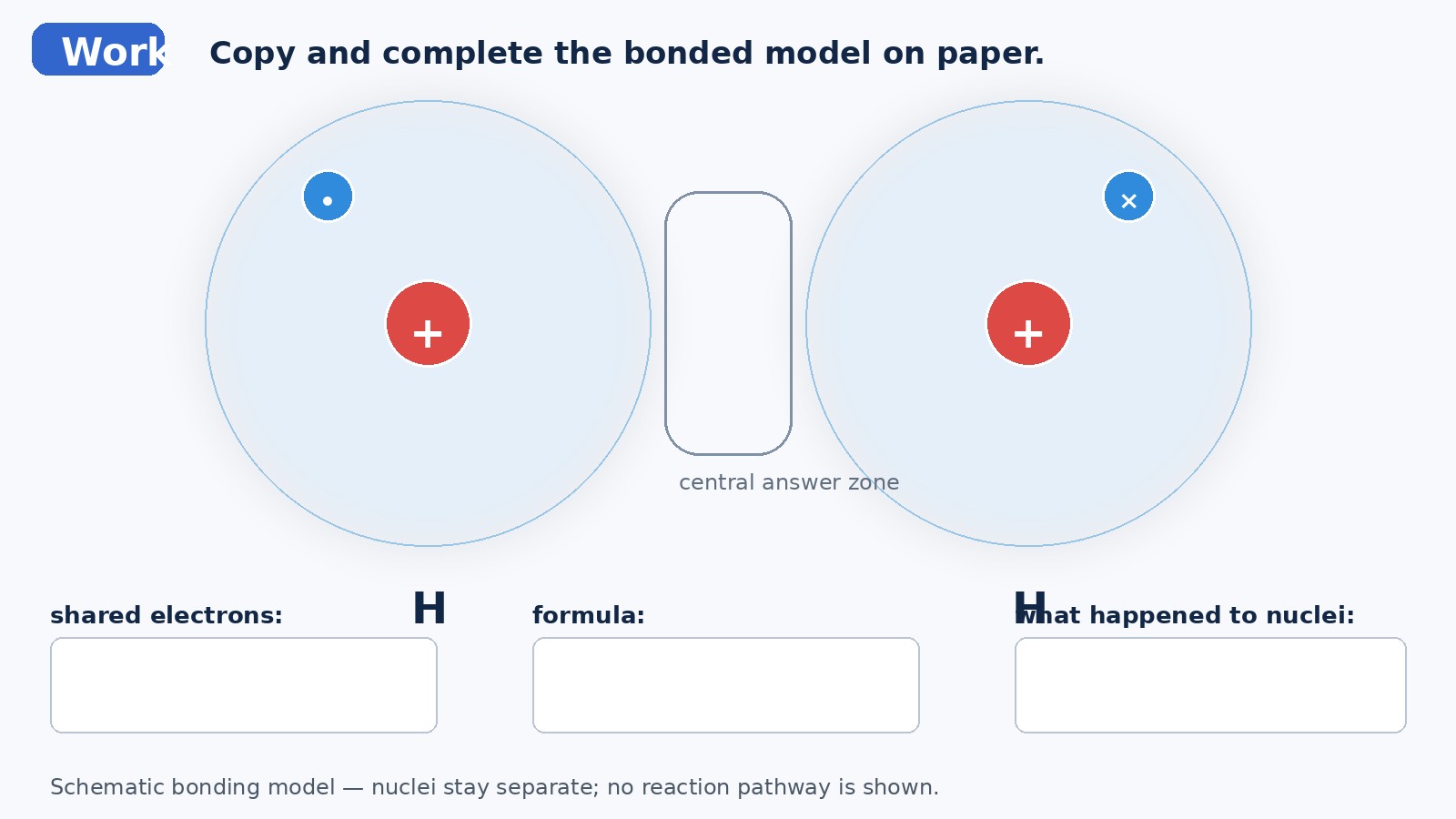
You are given two separate hydrogen atom models. Each has:
• one proton nucleus;
• one electron.
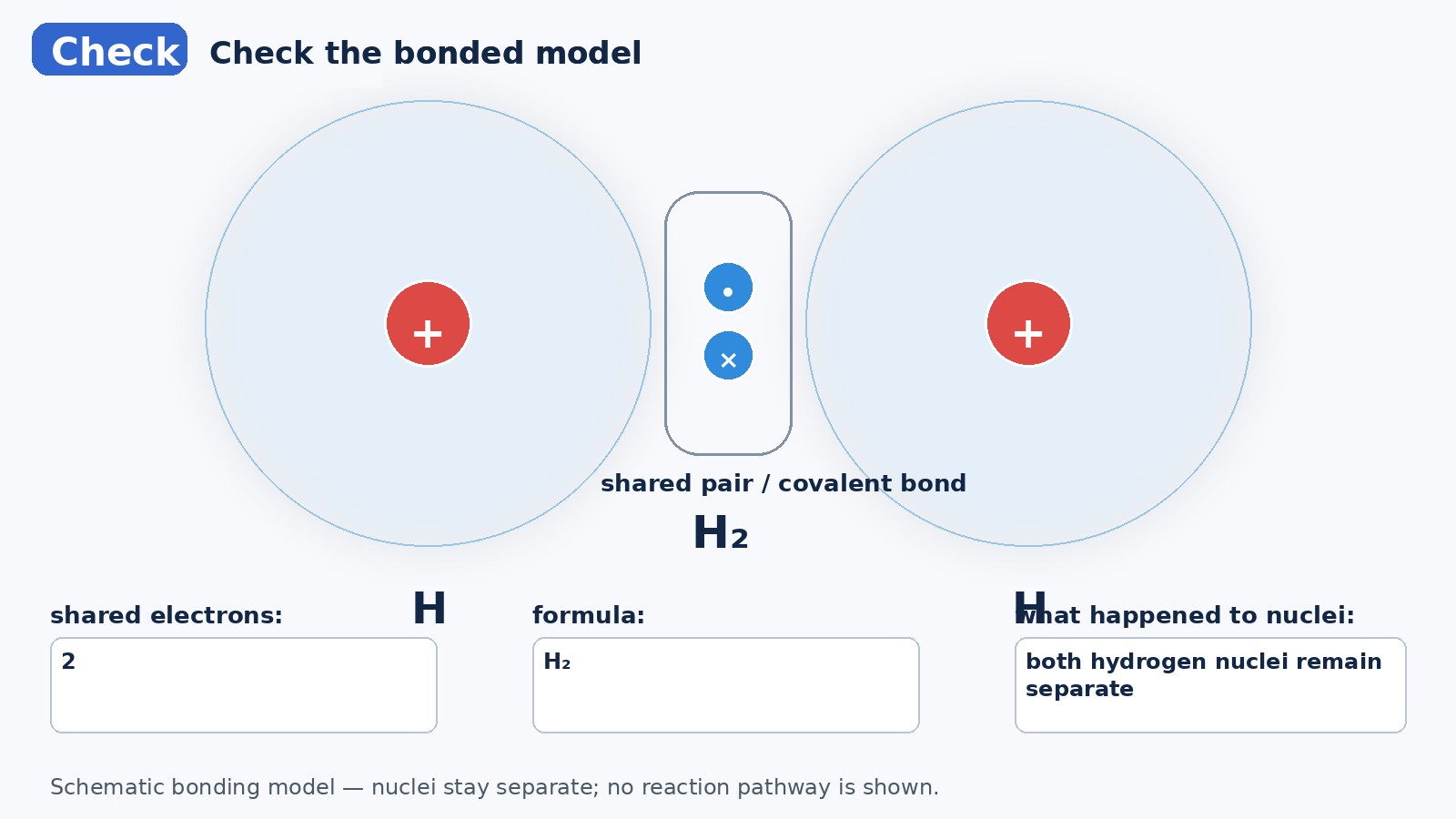
On paper, draw the bonded H₂ molecule.
Your model must show:
1. both hydrogen nuclei still present;
2. two electrons as one shared pair between the atoms;
3. one dot and one cross in that shared pair;
4. the label “shared pair / covalent bond”.
Then write:
• What is shared?
• Why is H₂ now one molecule rather than two separate atoms?
• What did NOT happen to the two nuclei?
What the diagram does and does not mean
A dot-and-cross diagram is a model.
It helps you keep track of the electrons involved in bonding. It does not show the real size of an atom, the exact shape of the electron distribution or a literal path travelled by each electron.
It also does not show the historical reaction pathway by which H₂ formed in the early Universe.
We are using H₂ because it gives the cleanest first model of a shared electron pair.
H₂ was important, but it was not the first molecule
The first molecular-bond context you met was helium hydride, HeH⁺.
H₂ became extremely important later in primordial gas. Molecular hydrogen helped the gas cool, which mattered as denser regions moved towards the formation of the first stars.
That is where the cosmic Path goes next: through the Dark Ages and Pre-Stellar Epoch towards the first stars.
Remember this lesson
Without looking back, start from two separate hydrogen atoms, each with one proton nucleus and one electron.
1. Draw the H₂ dot-and-cross model.
2. Circle the shared pair.
3. State how many electrons are in the shared pair.
4. State how many hydrogen nuclei remain in the molecule.
5. Explain why this is chemical bonding rather than nuclear fusion.
GCSE knowledge coverage
Key knowledge:
A covalent bond forms when two atoms share a pair of electrons. Covalent bonding can form molecules. H₂ contains two hydrogen atoms joined by one shared electron pair, which can be represented using a dot-and-cross diagram.
Covers:
• Pearson Edexcel GCSE Chemistry (1CH0): Topic 1 requirements 1.28–1.29, plus the hydrogen example within 1.31. The rest of 1.31 remains later.
• Pearson Edexcel GCSE Combined Science (1SC0): corresponding covalent-bonding requirements 1.28–1.29 and the hydrogen component of 1.31.