Pleistocene Epoch
The Pleistocene Epoch is the age of ice cycles, human emergence, and instability. Climate fluctuates dramatically, ice sheets advance and retreat, and early humans evolve, migrate, and develop symbolic behaviour long before civilisation begins.
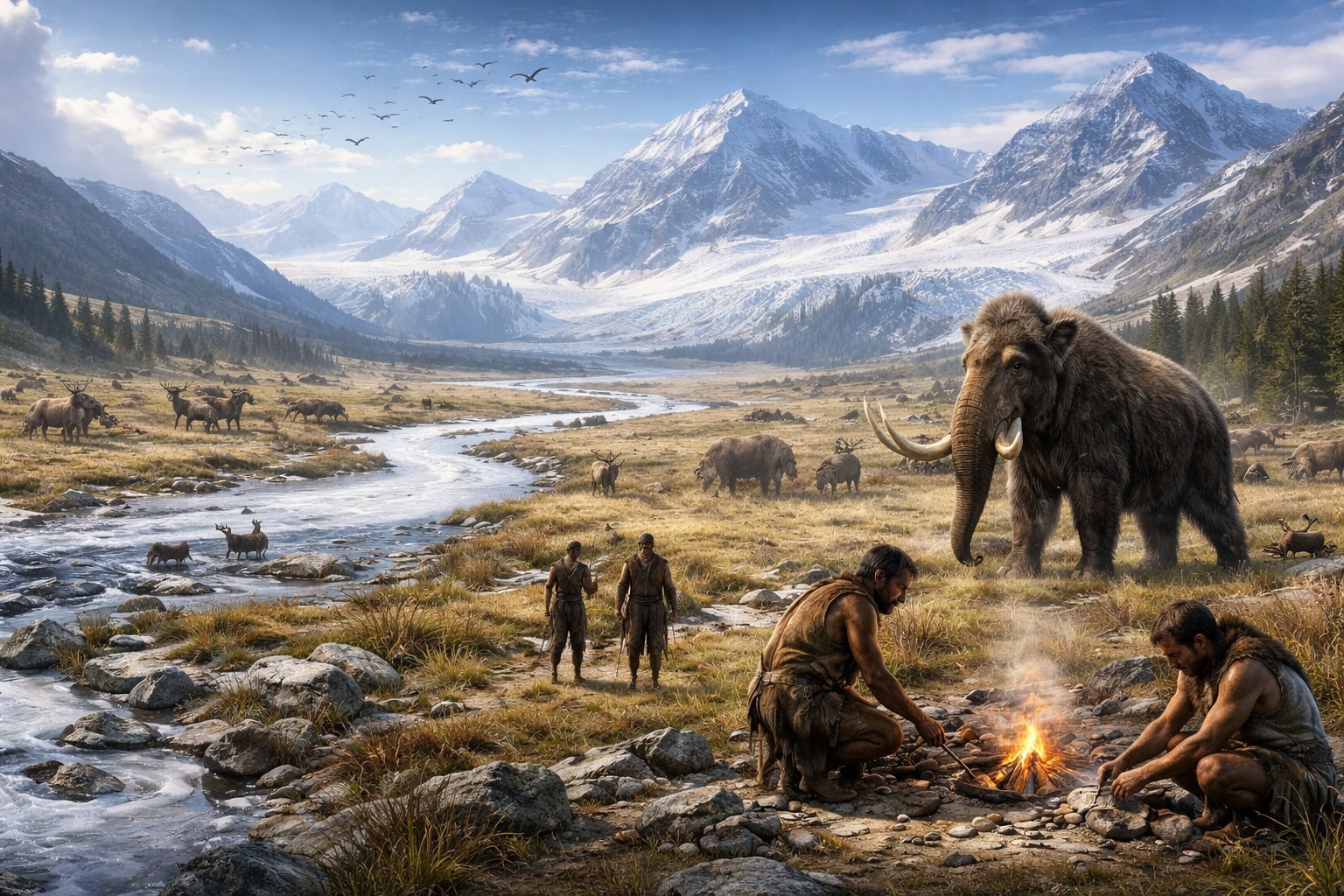
The Pleistocene Epoch spans the most volatile phase of recent Earth history. It is defined by repeated glacial and interglacial cycles, during which massive ice sheets expand across continents and then retreat again. Sea levels rise and fall by tens of metres. Ecosystems are repeatedly disrupted, fragmented, and rebuilt.
This instability shapes life profoundly. Large mammals dominate many environments, adapted to cold, open landscapes. Extinction and adaptation occur in pulses as climates swing. Forests contract and expand. Grasslands spread. Coastlines shift dramatically.
Humans emerge during the Pleistocene. Early members of the genus Homo evolve, walk upright, make tools, control fire, and spread across Africa, Eurasia, Australia, and eventually the Americas. These populations live as mobile hunter-gatherers, tightly coupled to climate and seasonal change.
Crucially, the Pleistocene is when symbolic behaviour appears. Humans begin making art, carving figures, painting caves, burying their dead, and transmitting culture across generations. Language, myth, and social memory deepen. These developments occur before agriculture and before climatic stability.
Despite human presence, the planet remains dominant. Ice sheets, droughts, and sudden warming events repeatedly reshape habitats. No long-term settlements persist. No global ecological restructuring occurs. Human influence is local and reversible.
The Pleistocene ends abruptly with the final retreat of the great ice sheets. Climate stabilises. Sea levels settle. Seasonal patterns regularise. This transition opens the narrow window in which agriculture, permanent settlement, and civilisation become possible.
The Pleistocene is not the age of civilisation.
It is the age in which humans become human.