Photosynthesis
GCSE: Biology · Combined Science
Photosynthesis at the whole-organism scale
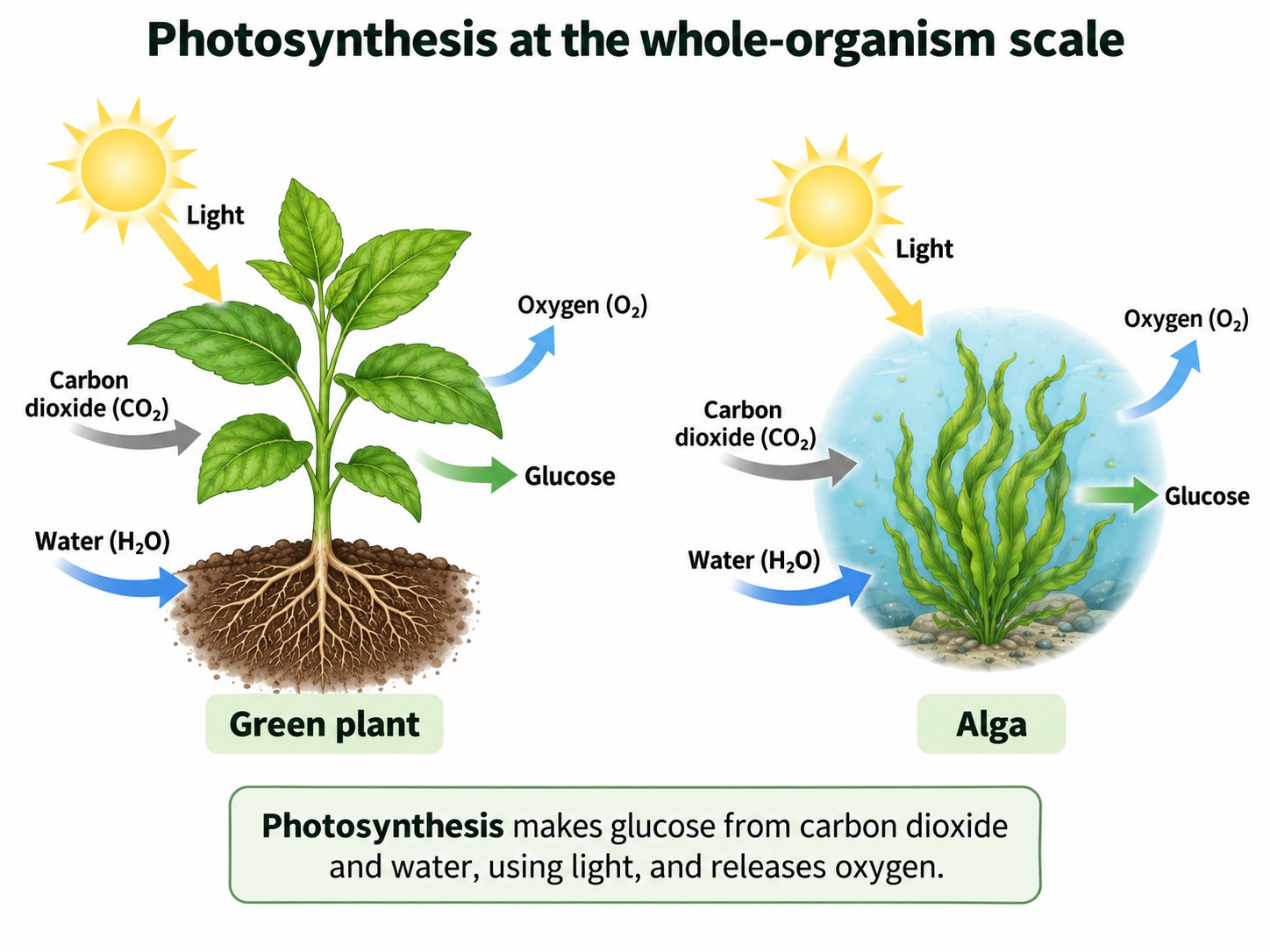
Green plants and algae carry out photosynthesis.
Light is required for photosynthesis.
Photosynthesis makes glucose from carbon dioxide and water.
Photosynthesis releases oxygen.
The leaf as an adaptation for photosynthesis
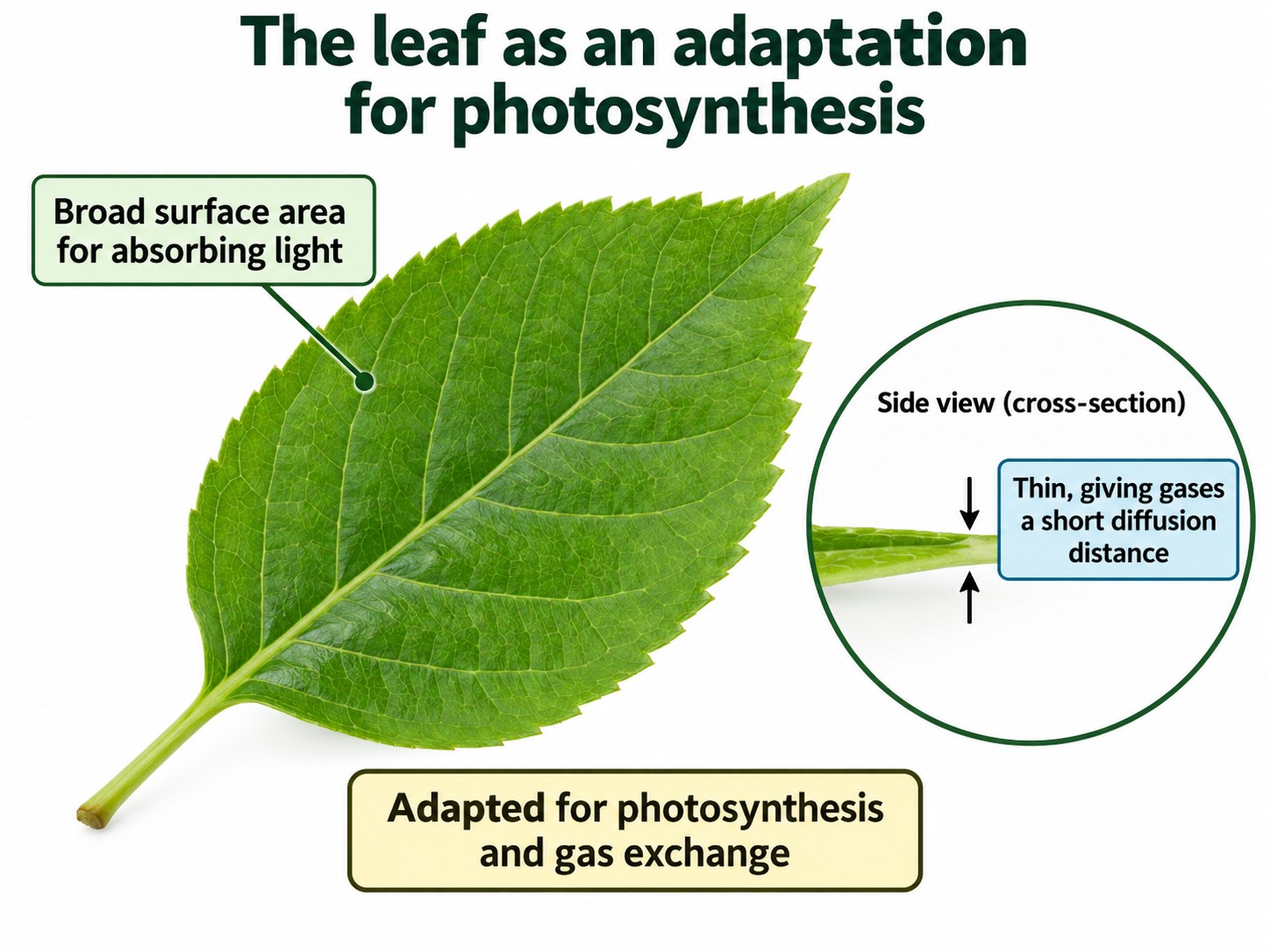
GCSE Biology: leaves are adapted for photosynthesis and gas exchange.
GCSE Biology: leaves have a broad surface area for absorbing light.
GCSE Biology: leaves are thin, giving gases a short diffusion distance.
Light entering the photosynthetic tissue
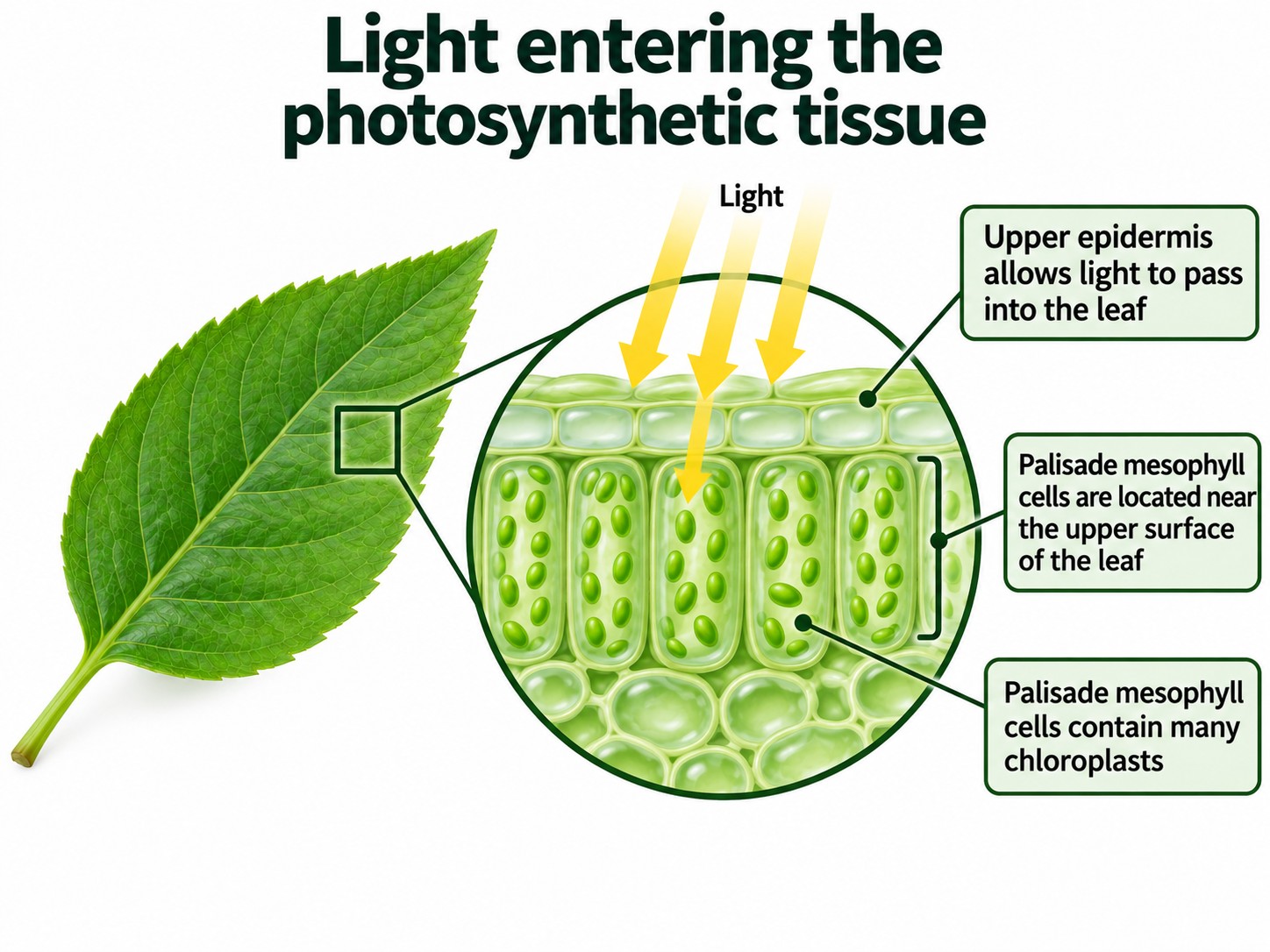
GCSE Biology: the upper epidermis allows light to pass into the leaf.
GCSE Biology: palisade mesophyll cells are located near the upper surface of the leaf.
GCSE Biology: palisade mesophyll cells contain many chloroplasts.
Gas movement through the spongy mesophyll
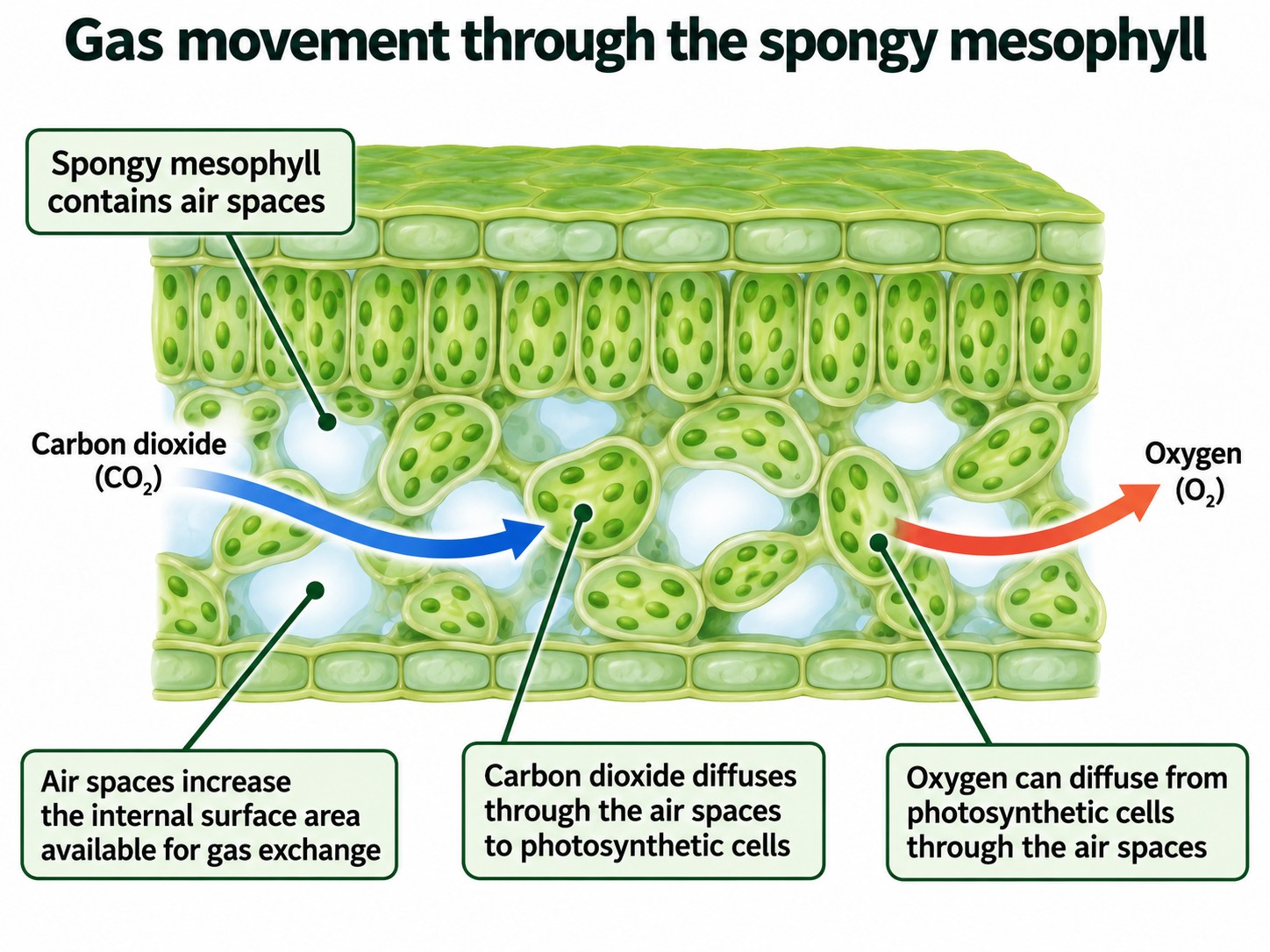
GCSE Biology: spongy mesophyll contains air spaces.
GCSE Biology: the air spaces increase the internal surface area available for gas exchange.
GCSE Biology: carbon dioxide diffuses through the air spaces to photosynthetic cells.
GCSE Biology: oxygen can diffuse from photosynthetic cells through the air spaces.
Stomata and guard cells
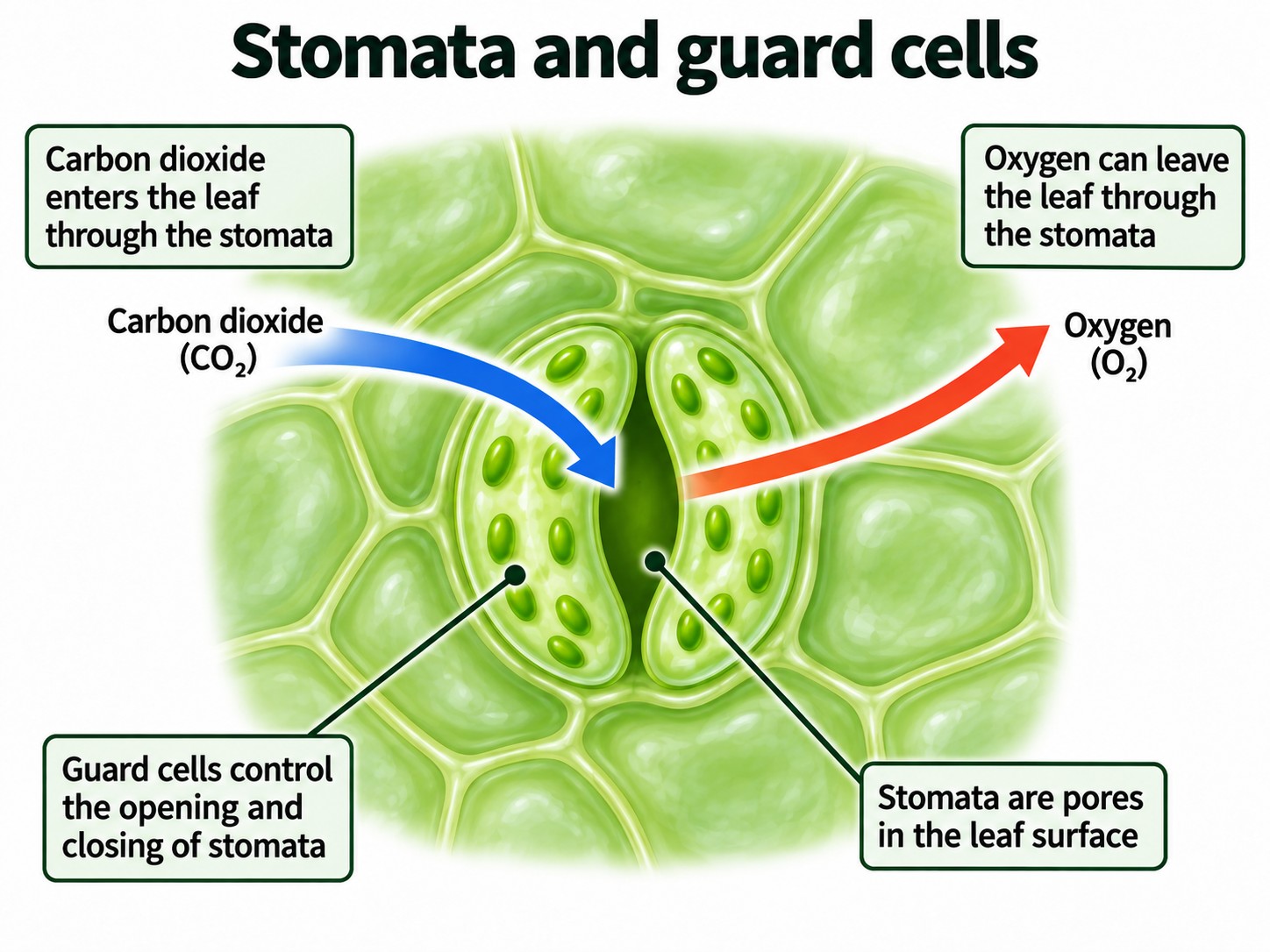
GCSE Biology: stomata are pores in the leaf surface.
GCSE Biology: carbon dioxide enters the leaf through the stomata.
GCSE Biology: oxygen can leave the leaf through the stomata.
GCSE Biology: guard cells control the opening and closing of stomata.
Transport to and from the leaf
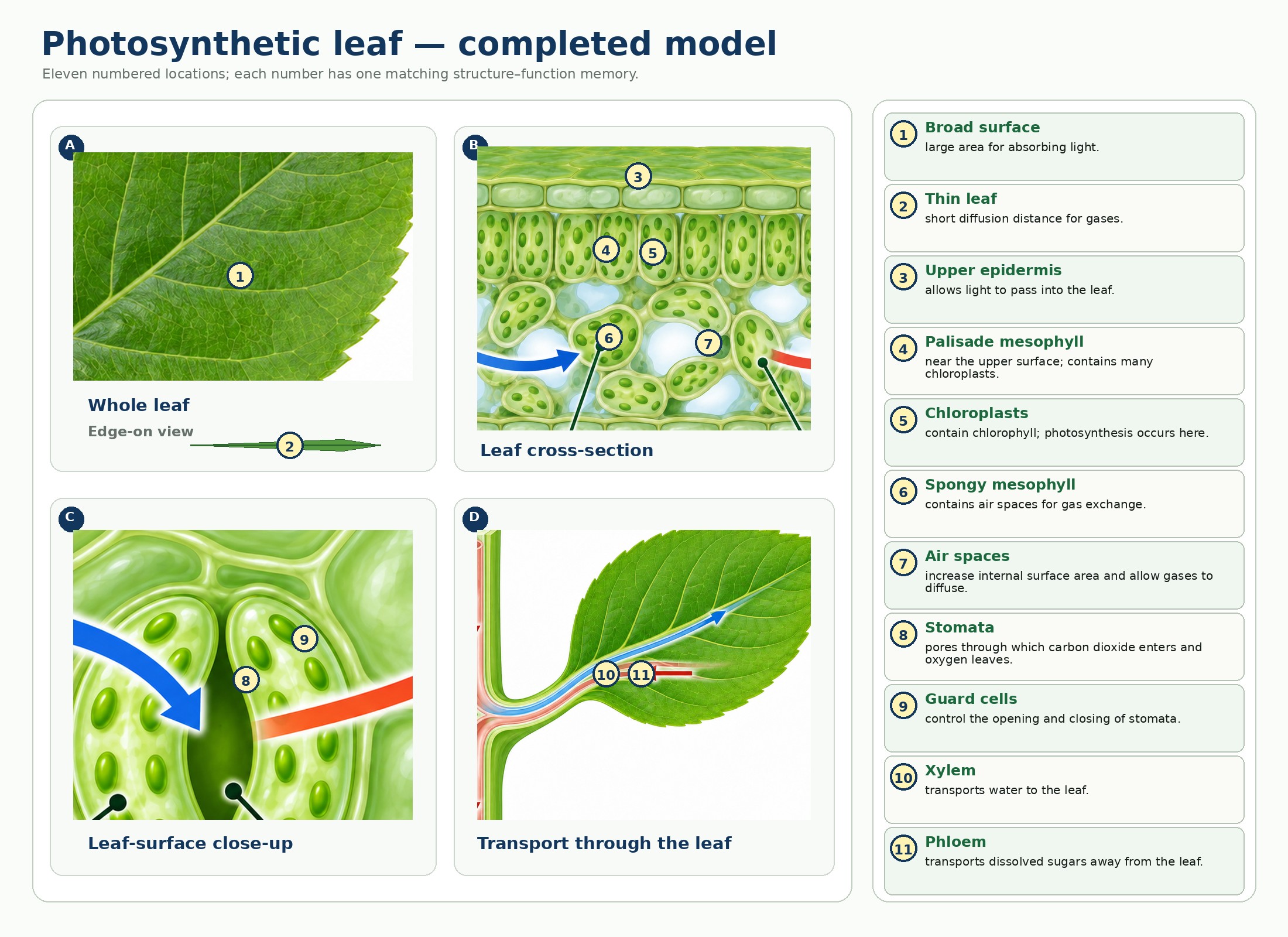
GCSE Biology: xylem transports water to the leaf.
GCSE Biology: phloem transports dissolved sugars away from the leaf.
From chloroplast to stored chemical energy
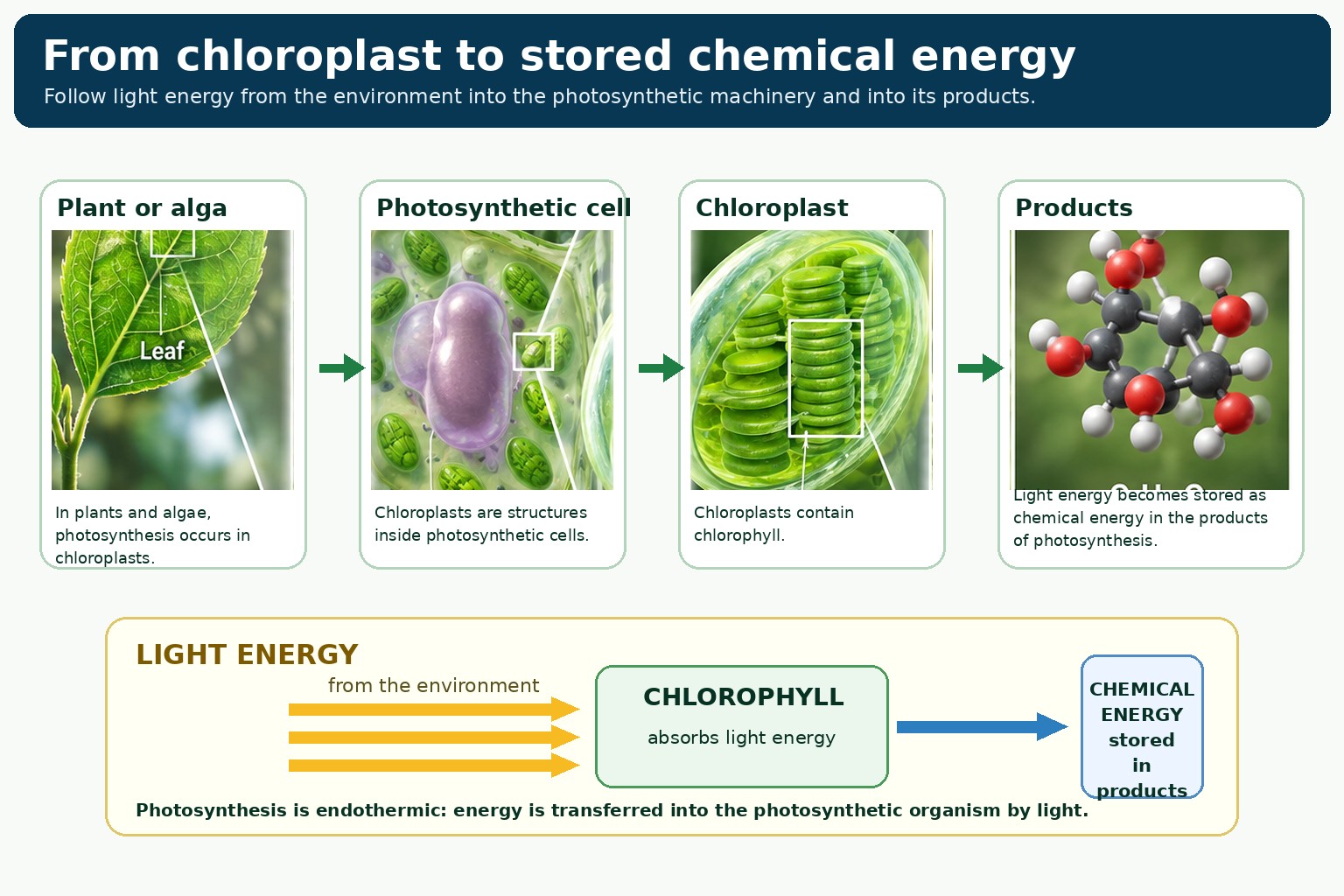
In plants and algae, photosynthesis occurs in chloroplasts.
Chloroplasts contain chlorophyll.
Chlorophyll absorbs light energy.
Energy is transferred from the environment to the photosynthetic organism by light.
Photosynthesis is an endothermic process.
Light energy becomes stored as chemical energy in the products of photosynthesis.
The reaction sequence inside photosynthesis
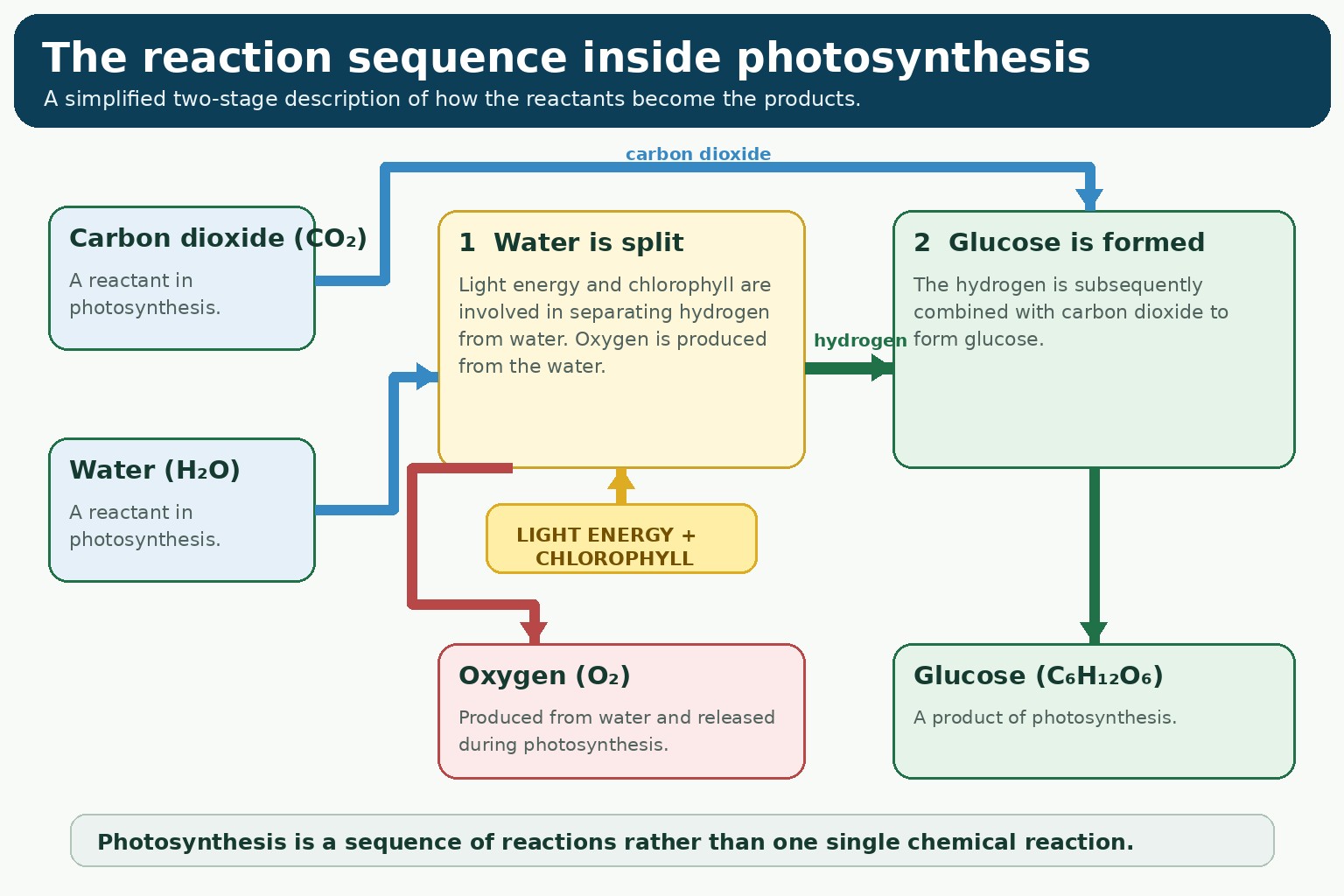
Carbon dioxide and water are the reactants in photosynthesis.
Glucose and oxygen are the products of photosynthesis.
Photosynthesis can be described as a sequence of reactions rather than a single chemical reaction.
Water supplies hydrogen used in the production of glucose.
In a simplified two-stage description, light energy and chlorophyll are involved in separating hydrogen from water.
Oxygen is produced from the water during this process.
Oxygen is released during photosynthesis.
The hydrogen is subsequently combined with carbon dioxide to form glucose.
From the word equation to the balanced symbol equation
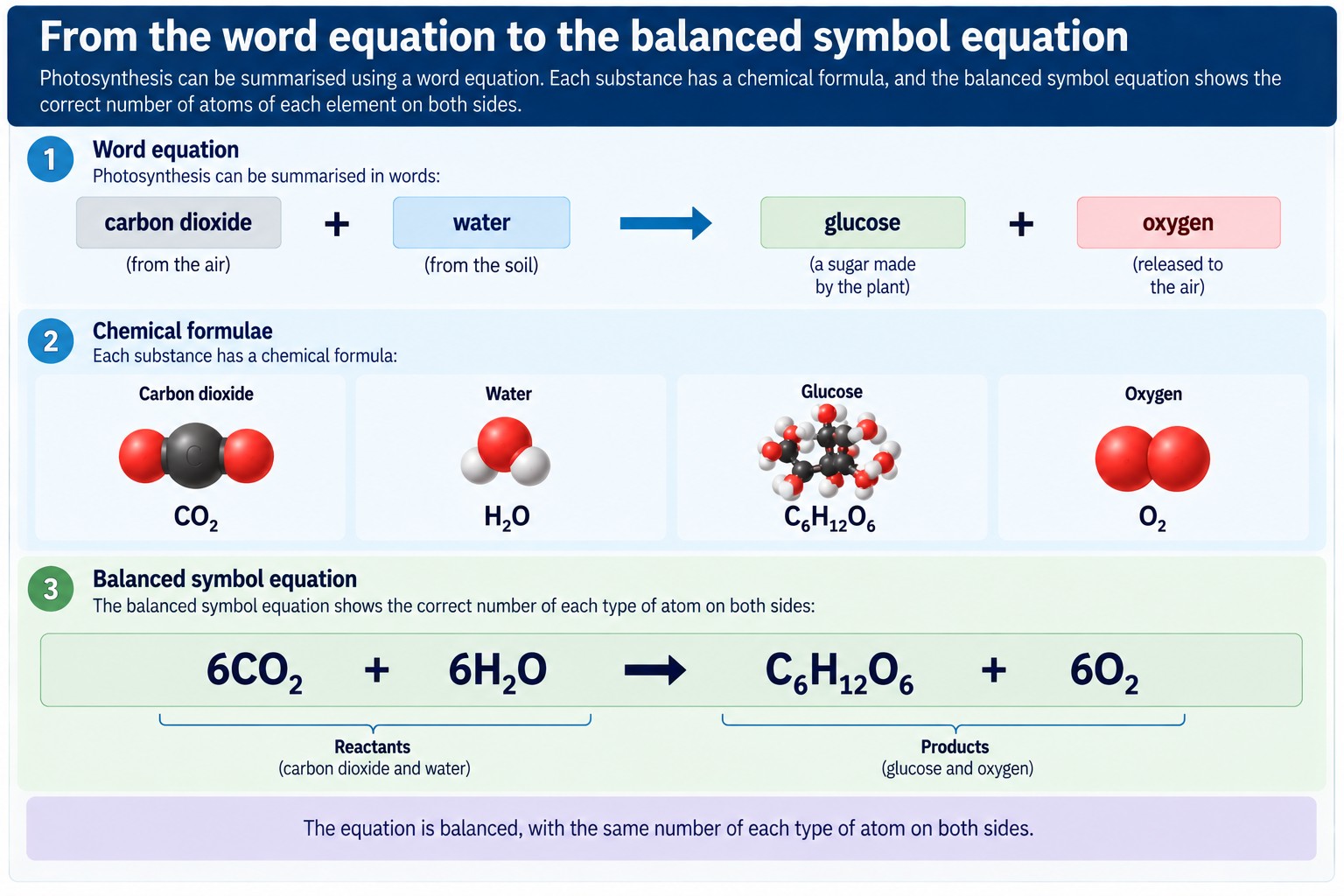
The word equation is: carbon dioxide + water → glucose + oxygen.
CO₂ is the chemical formula for carbon dioxide.
H₂O is the chemical formula for water.
C₆H₁₂O₆ is the chemical formula for glucose.
O₂ is the chemical formula for oxygen.
The balanced symbol equation is: 6CO₂ + 6H₂O → C₆H₁₂O₆ + 6O₂.
The destinations of glucose
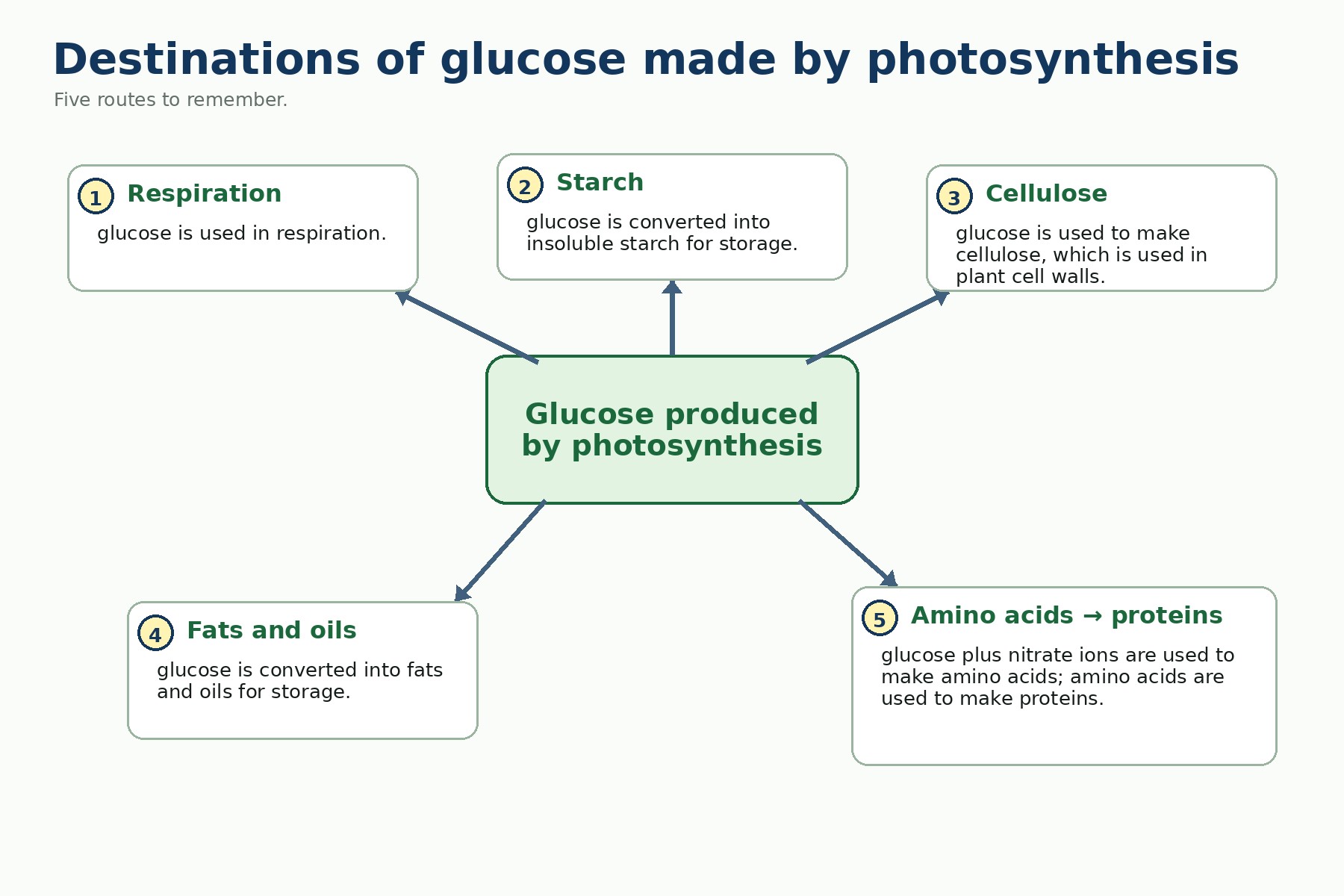
Glucose produced by photosynthesis can be used in respiration.
Glucose can be converted into insoluble starch for storage.
Glucose can be used to make cellulose.
Cellulose is used in plant cell walls.
Glucose can be converted into fats and oils for storage.
Glucose can be used to make amino acids.
Plants require nitrate ions as well as glucose to make amino acids.
Amino acids are used to make proteins.
What photosynthesis does beyond the individual plant
Photosynthetic organisms are the main producers of food and biomass for life on Earth.
Remember the lesson
These four activities will help you understand and remember the GCSE knowledge from this lesson.
For each activity, first use the lesson above to complete it correctly. Then hide the lesson and try the same activity again from memory.
If you forget something, look it up, correct what you missed, and try again. Once you can reconstruct the required knowledge correctly from memory, move on rather than repeating it unnecessarily.
You do not need to memorise every sentence. You do need to remember the scientific facts, relationships, terminology and equations used in the activities.
Retrieval task 1 — Put photosynthesis back together
1 of 2
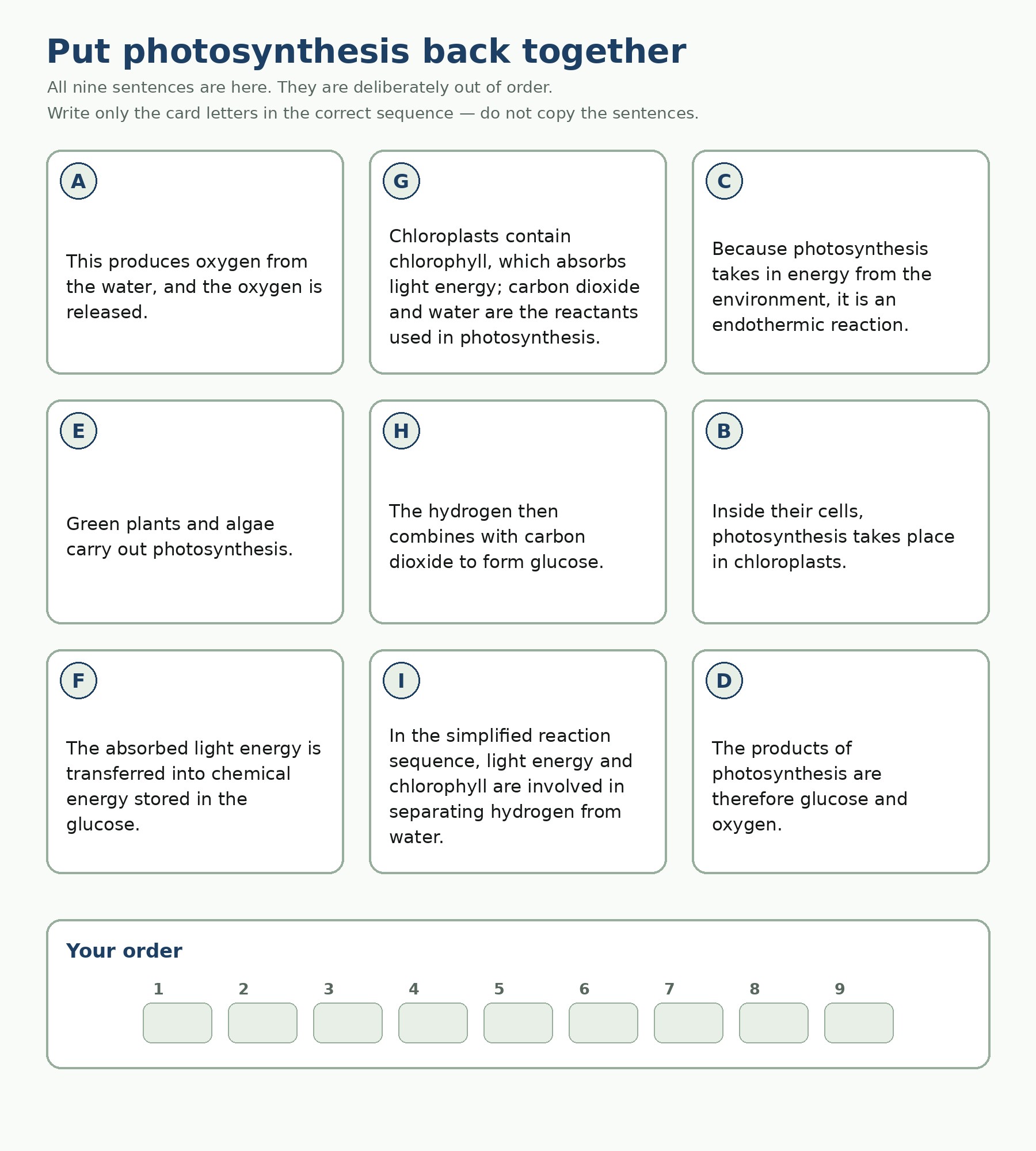
The nine cards in the exercise image are the complete sentences of one explanation of photosynthesis. Nothing is missing, and you do not need to copy the sentences out.
The cards are deliberately out of order.
Put them into the correct explanatory sequence by writing only the card letters from first to last in the nine answer spaces.
Use the lesson above for your first attempt. Then hide the lesson, cover your previous answer and put the same nine cards into order again from memory.
If you are unsure about one link, check only that part of the lesson, correct it, and try again.
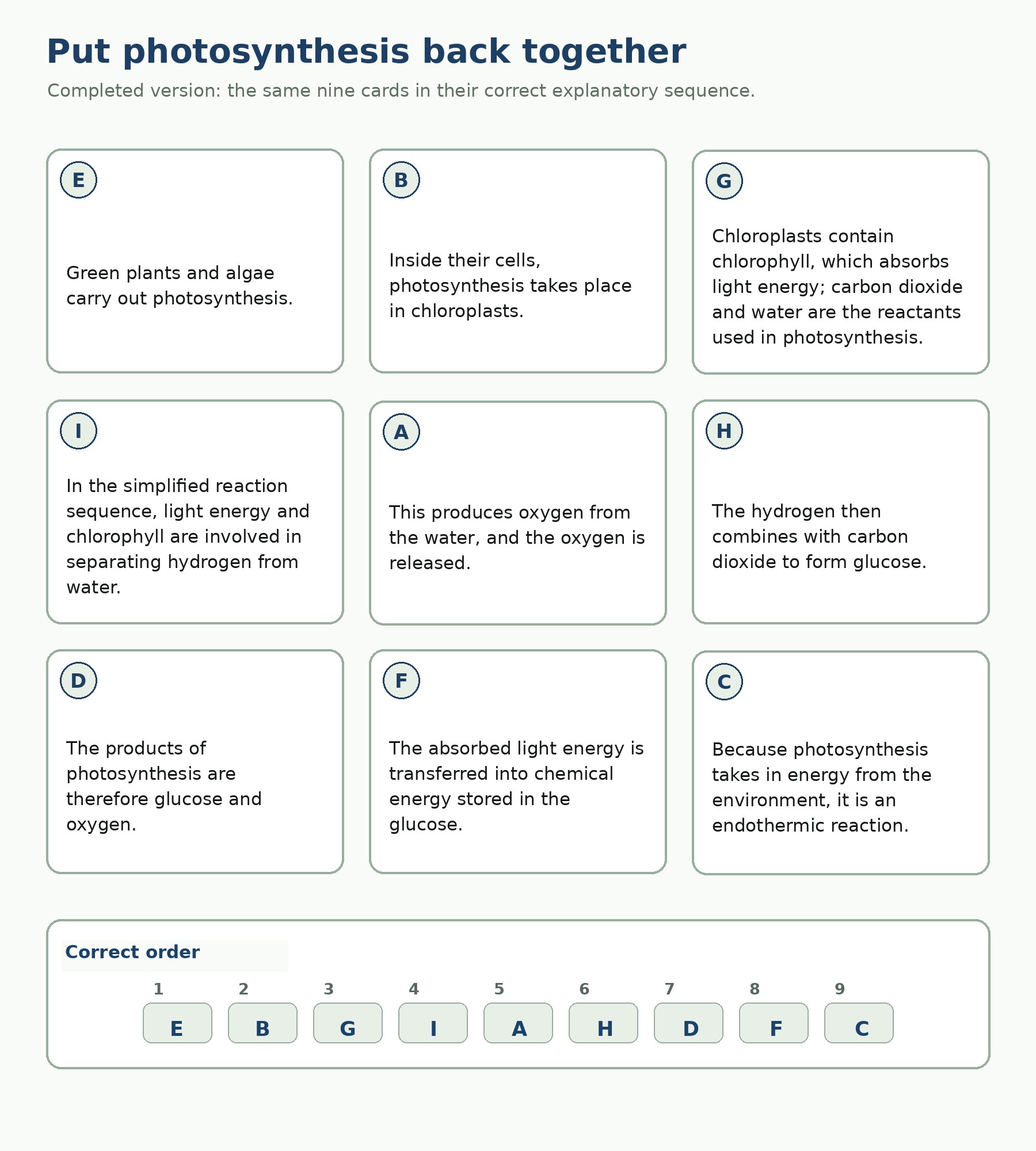
When you are ready to check your answer, press the right arrow on the image to see the completed version. Press the left arrow to return to the exercise.
The photosynthesis equations are not part of this ordering task because they describe the overall reaction rather than one stage in this sequence. They have their own task next.
Retrieval task 2 — Rebuild the photosynthesis equations
What to do
The equations describe the overall photosynthesis reaction rather than one stage in the ordered process cards, so remember them separately here.
Part 1 — Word equation for photosynthesis
Use these four terms:
glucose
water
oxygen
carbon dioxide
Put them into the correct places:
_____ + _____ → _____ + _____
Part 2 — Balanced symbol equation for photosynthesis
Use these four formulae:
O₂
H₂O
C₆H₁₂O₆
CO₂
A large number written before a chemical formula shows how many molecules of that substance take part. For example, 6CO₂ means six carbon dioxide molecules.
Put the formulae into the same four positions. Then add the large numbers before the formulae that make the numbers of each type of atom equal on both sides.
Use Visual 9 above for your supported attempt if you need it.
Then hide the lesson and recreate both equations from memory. If you forget a term, formula or number, check only that part and try again.
Retrieval task 3 — Rebuild a leaf for photosynthesis
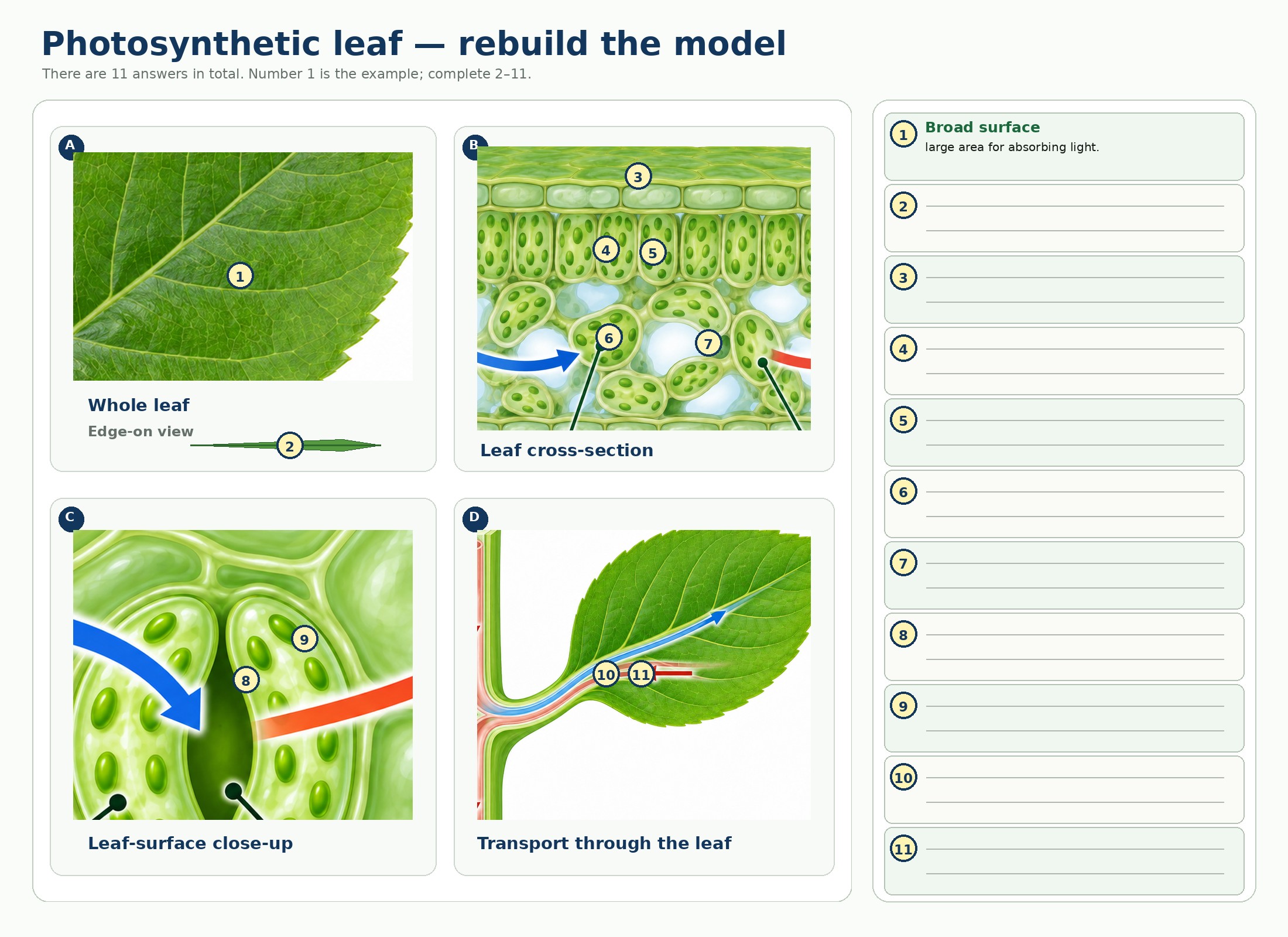
What to do
Earlier in the lesson, the completed Photosynthetic leaf model shows these same eleven numbered locations. The exercise image uses the same model with the answers removed.
There are exactly 11 answers. Number 1 is completed as the example. Complete numbers 2–11.
For each number, write:
feature → how it helps the leaf carry out photosynthesis, exchange gases or transport substances
Your completed model must contain these eleven memories:
• broad surface → large area for absorbing light;
• thin leaf → short diffusion distance for gases;
• upper epidermis → allows light to pass into the leaf;
• palisade mesophyll → near the upper surface and contains many chloroplasts;
• chloroplasts → contain chlorophyll and are where photosynthesis occurs;
• spongy mesophyll → contains air spaces for gas exchange;
• air spaces → increase internal surface area and allow gases to diffuse;
• stomata → pores through which carbon dioxide enters and oxygen leaves;
• guard cells → control the opening and closing of stomata;
• xylem → transports water to the leaf;
• phloem → transports dissolved sugars away from the leaf.
First use the completed model and lesson above to fill the exercise accurately. Then hide the lesson and try to reconstruct the eleven structure–function relationships from memory.
Retrieval task 4 — Rebuild the destinations of glucose
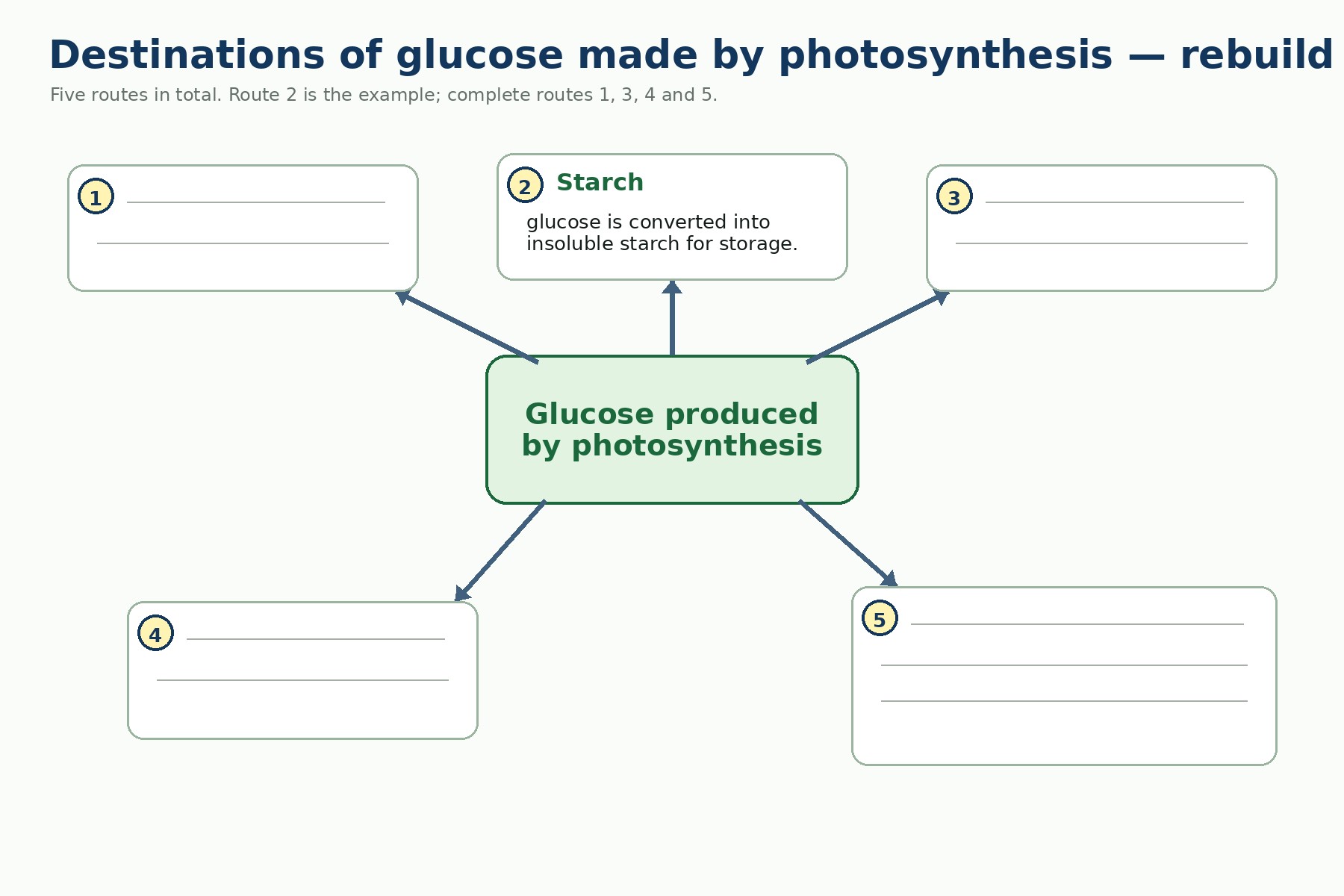
What to do
Earlier in the lesson, the completed Destinations of glucose made by photosynthesis model shows these same five routes. The exercise image uses the same model with the answers removed.
There are exactly five routes. Route 2, starch, is completed as the example. Complete routes 1, 3, 4 and 5.
Your finished model must account for:
• respiration;
• starch — glucose is converted into insoluble starch for storage;
• cellulose — glucose is used to make cellulose, which is used in plant cell walls;
• fats and oils — glucose is converted into fats and oils for storage;
• amino acids and proteins — glucose plus nitrate ions are used to make amino acids, and amino acids are used to make proteins.
First use the completed model and lesson above to fill the exercise accurately. Then hide the lesson and rebuild all five routes from memory.
Connect it back to the wider world
When you can reconstruct the five routes, answer in one sentence:
Why are photosynthetic organisms important to life on Earth?
Use the final teaching section for your first answer, then try again from memory.
GCSE knowledge coverage
Key knowledge:
Photosynthesis is an endothermic process in which light energy is transferred to chloroplasts and used to make glucose from carbon dioxide and water.
covers:
GCSE Biology → Bioenergetics → Photosynthesis → Photosynthetic reaction
GCSE Combined Science → Biology → Bioenergetics → Photosynthesis → Photosynthetic reaction
Knowledge overlap
| Knowledge covered | Biology | Combined Science |
|---|---|---|
| Green plants and algae carry out photosynthesis | ✓ | ✓ |
| Light is required for photosynthesis | ✓ | ✓ |
| Carbon dioxide and water are used to make glucose | ✓ | ✓ |
| Oxygen is produced and released during photosynthesis | ✓ | ✓ |
| Leaf adaptations for photosynthesis and gas exchange | ✓ | — |
| Broad, thin leaves support light absorption and gas exchange | ✓ | — |
| Upper epidermis allows light into the leaf | ✓ | — |
| Palisade mesophyll is positioned near the upper surface and contains many chloroplasts | ✓ | — |
| Spongy mesophyll and air spaces support gas exchange | ✓ | — |
| Carbon dioxide and oxygen diffuse through the leaf | ✓ | — |
| Stomata allow gases to enter and leave the leaf | ✓ | — |
| Guard cells control stomatal opening and closing | ✓ | — |
| Xylem transports water to the leaf | ✓ | — |
| Phloem transports dissolved sugars away from the leaf | ✓ | — |
| Photosynthesis occurs in chloroplasts | ✓ | ✓ |
| Chloroplasts contain chlorophyll | ✓ | ✓ |
| Chlorophyll absorbs light energy | ✓ | ✓ |
| Light transfers energy from the environment to the photosynthetic organism | ✓ | ✓ |
| Photosynthesis is endothermic | ✓ | ✓ |
| Light energy becomes stored as chemical energy in photosynthesis products | ✓ | ✓ |
| Carbon dioxide and water are the reactants; glucose and oxygen are the products | ✓ | ✓ |
| Photosynthesis involves a sequence of reactions | ✓ | ✓ |
| Water supplies hydrogen used to make glucose | ✓ | ✓ |
| Light and chlorophyll are involved in separating hydrogen from water | ✓ | ✓ |
| Oxygen is produced from water and released | ✓ | ✓ |
| Hydrogen combines with carbon dioxide to form glucose | ✓ | ✓ |
| Word equation for photosynthesis | ✓ | ✓ |
| Chemical formulae CO₂, H₂O, C₆H₁₂O₆ and O₂ | ✓ | ✓ |
| Balanced symbol equation for photosynthesis | ✓ | ✓ |
| Glucose can be used in respiration | ✓ | ✓ |
| Glucose can be stored as insoluble starch | ✓ | ✓ |
| Glucose can be used to make cellulose for cell walls | ✓ | ✓ |
| Glucose can be converted into fats and oils for storage | ✓ | ✓ |
| Glucose and nitrate ions can be used to make amino acids | ✓ | ✓ |
| Amino acids are used to make proteins | ✓ | ✓ |
| Photosynthetic organisms produce food and biomass supporting life on Earth | ✓ | ✓ |