Measuring the Rate of Photosynthesis
GCSE: Biology · Combined Science
Big enquiry: What changes how quickly photosynthesis happens?
Photosynthesis does not always happen at the same speed.
A plant may photosynthesise quickly in one set of conditions and much more slowly in another.
We are going to follow Maya as she investigates what changes the rate of photosynthesis.
Measuring the rate of photosynthesis
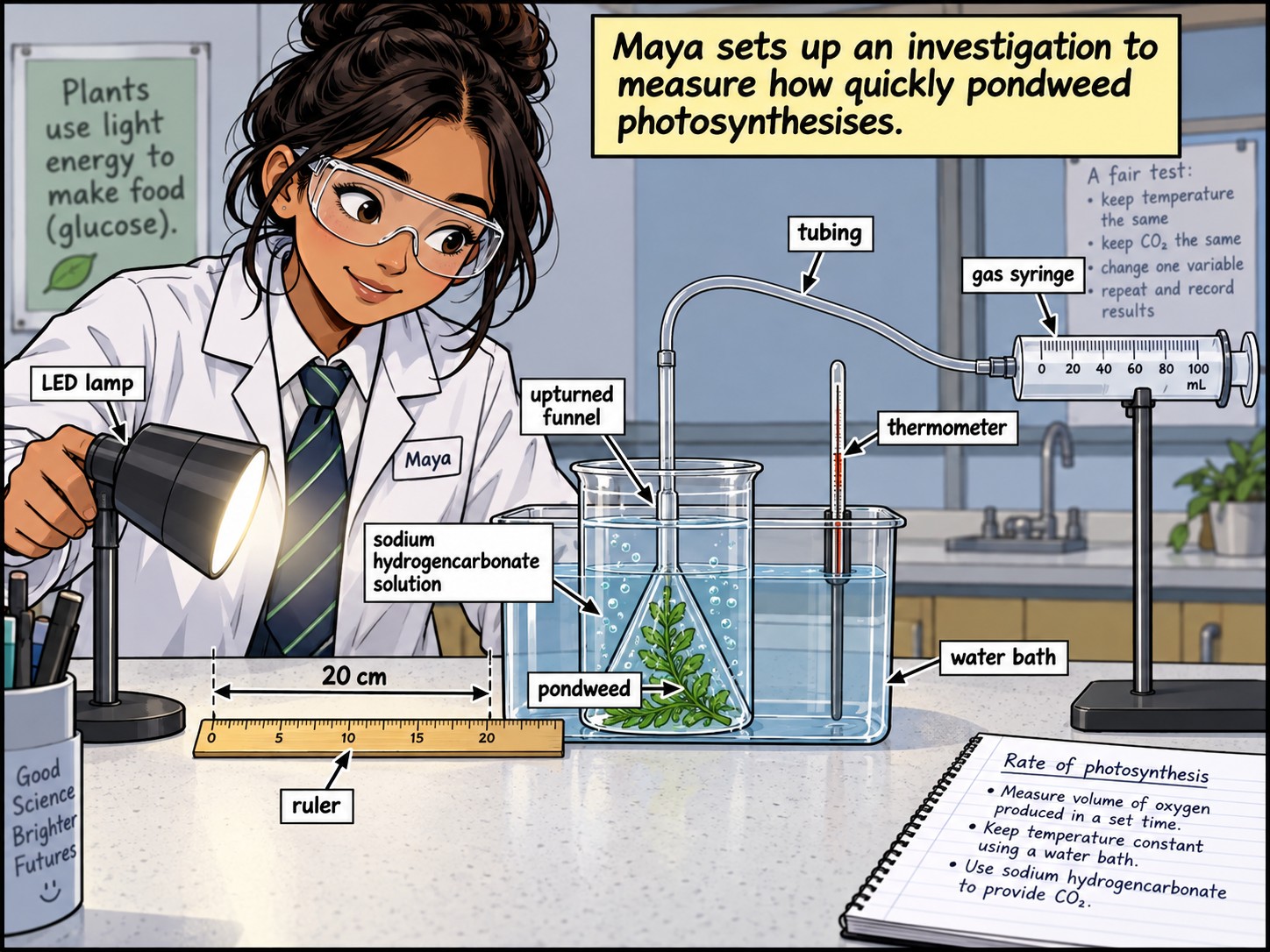
Maya begins with a piece of pondweed.
Pondweed is useful for this investigation because it lives underwater. When it photosynthesises, bubbles of gas leave the plant and rise through the water.
Maya wants to collect that gas so that she can measure it.
She puts the pondweed into a beaker containing water with some sodium hydrogencarbonate dissolved in it.
Sodium hydrogencarbonate is useful because it provides dissolved carbon dioxide for the pondweed.
For now, Maya keeps its concentration the same. Later, she will change the concentration to investigate how carbon dioxide availability affects photosynthesis.
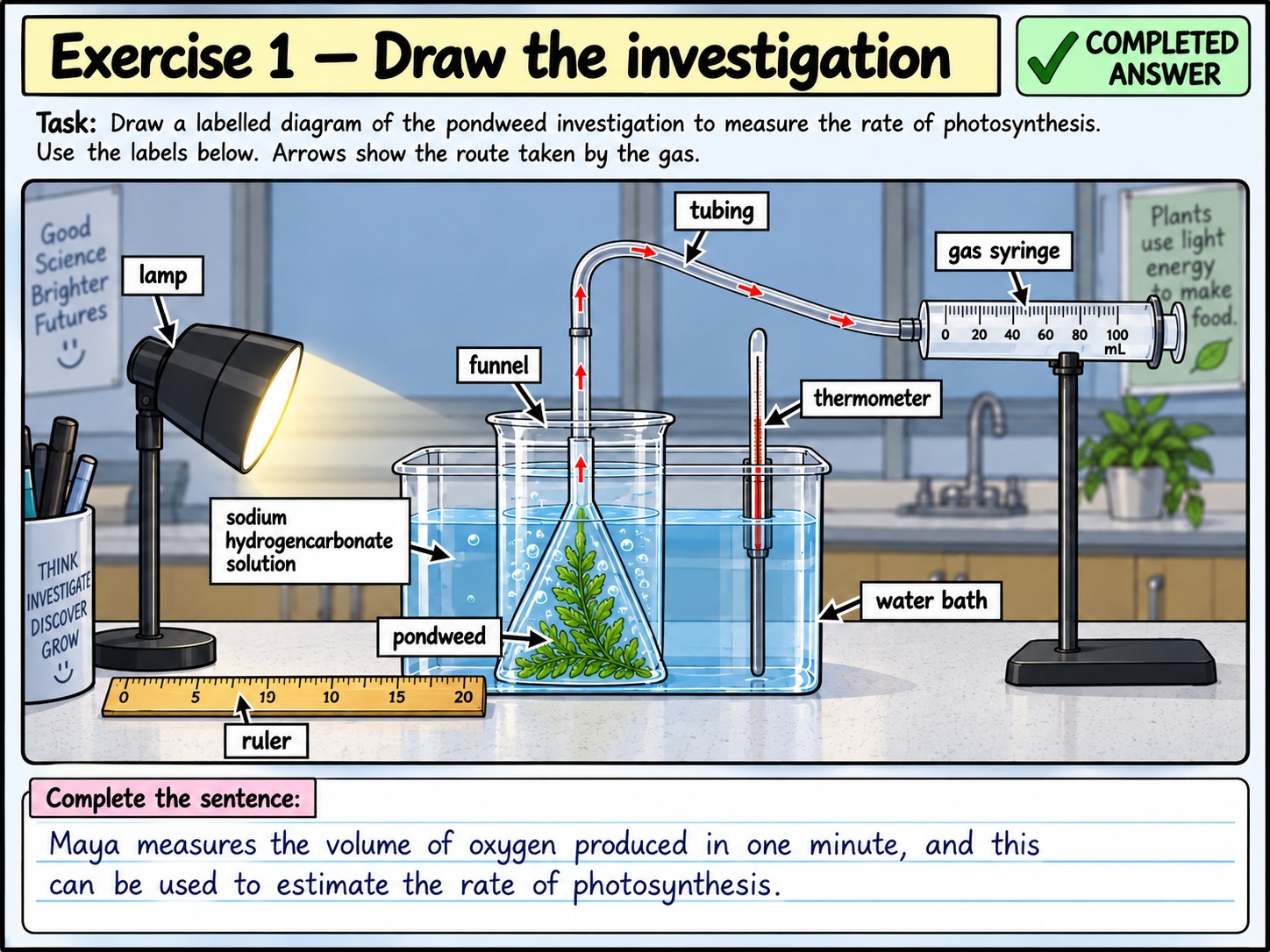
Maya places an upturned funnel over the pondweed.
The narrow stem of the funnel is connected by tubing to a gas syringe.
Any gas released by the pondweed rises into the funnel, travels through the tubing and pushes the plunger of the gas syringe outwards.
The markings on the gas syringe allow Maya to measure the volume of gas produced in cubic centimetres (cm³).
She also has:
a small lamp;
a ruler;
a stopwatch;
a thermometer;
a water bath to help keep the pondweed at a steady temperature.
The lamp should produce as little unwanted heating as possible. A small LED lamp is useful for this.
Maya places the lamp 20 cm from the pondweed. She measures the distance from the light source to the pondweed with the ruler.
She checks the temperature of the water around the pondweed.
Then she leaves the apparatus for a short time so that the pondweed can adjust to the conditions.
Maya starts the stopwatch.
For exactly one minute, the gas produced by the pondweed collects in the gas syringe.
Small bubbles leave the pondweed and rise towards the funnel.
After one minute, Maya stops the measurement and reads the gas syringe.
Her first result can be recorded like this:
| Lamp distance | Time | Gas collected |
|---|---|---|
| 20 cm | 1 minute | 3.8 cm³ |
What has Maya measured?
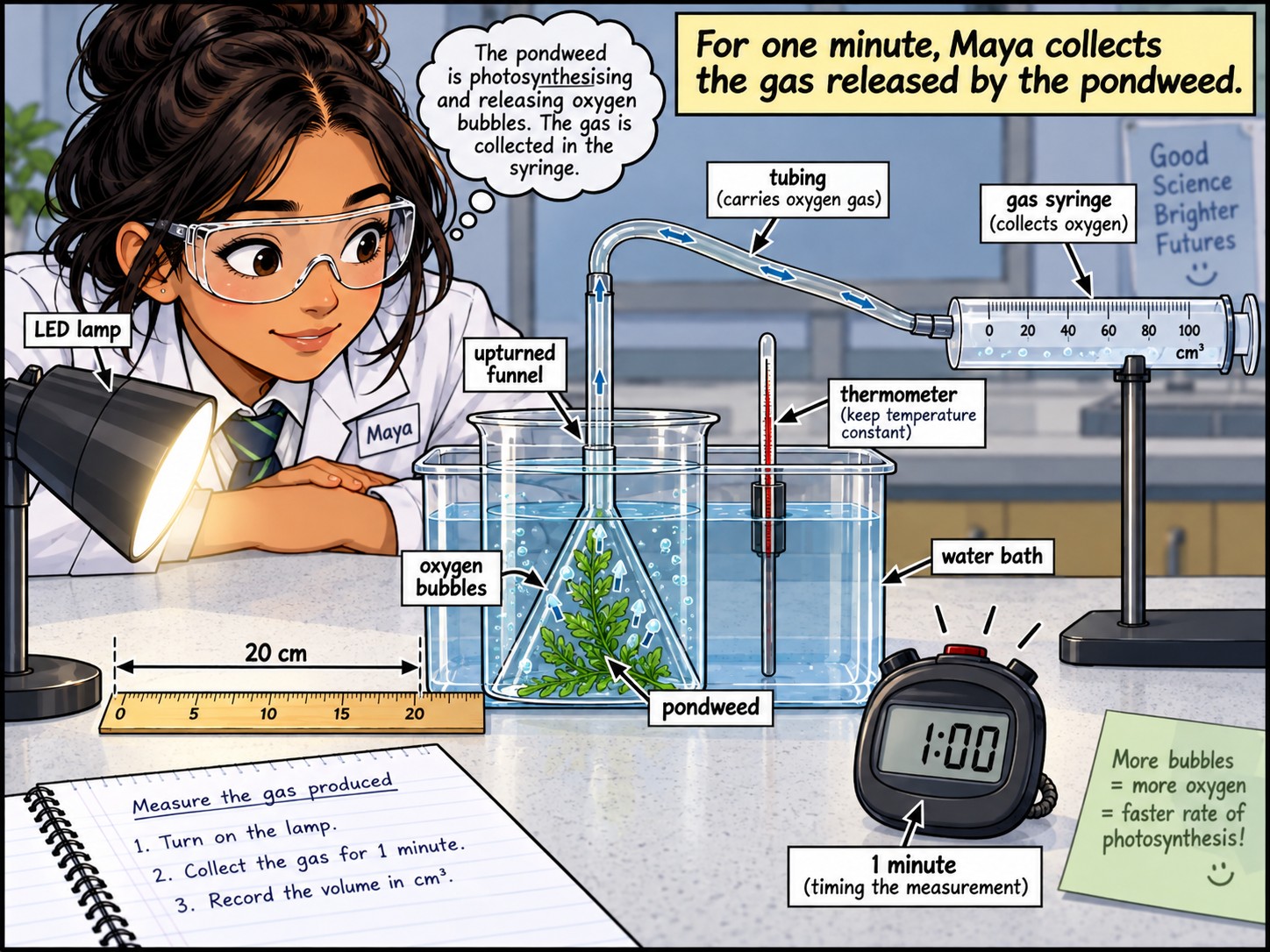
The gas being produced by the pondweed is oxygen.
Oxygen is one of the products of photosynthesis.
The oxygen therefore gives Maya evidence that photosynthesis is happening.
It also allows her to investigate how quickly photosynthesis is happening.
If the pondweed produces more oxygen in one minute, its rate of photosynthesis is higher.
If it produces less oxygen in one minute, its rate of photosynthesis is lower.
A rate compares an amount with time:
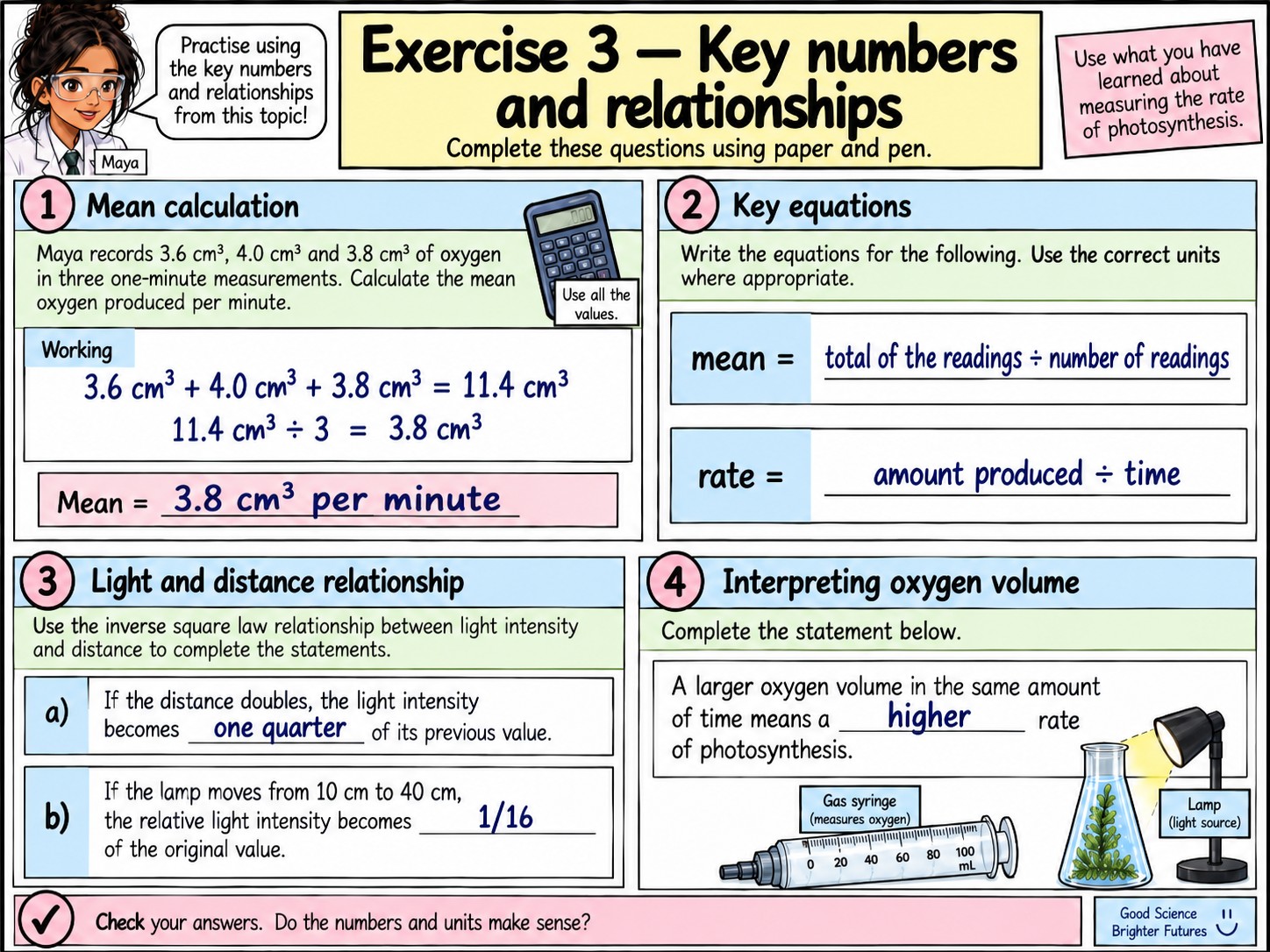
rate = amount produced ÷ time
Because Maya always measures the oxygen produced over the same amount of time, she can compare different results.
Some investigations count the number of bubbles produced instead.
This is less accurate because bubbles are not all the same size.
Measuring the volume of oxygen gives a better measurement.
Why one measurement is not enough
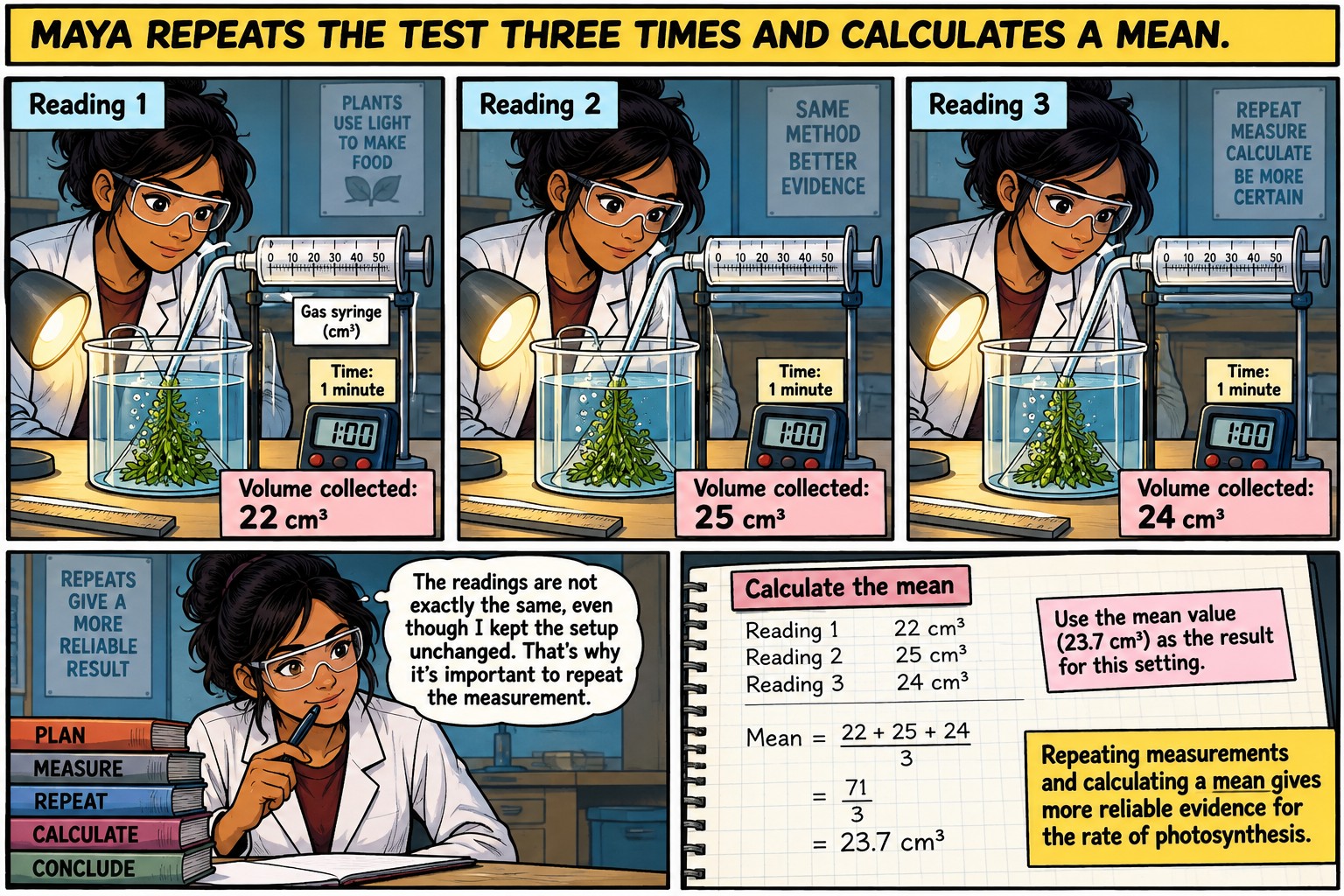
Maya does not immediately change the lamp.
First, she repeats the same measurement.
She keeps the lamp 20 cm away and leaves the rest of the setup unchanged.
She measures the oxygen produced for another minute.
Then she repeats the experiment once more.
Her table now looks like this:
| Lamp distance | Reading 1 | Reading 2 | Reading 3 | Mean |
|---|---|---|---|---|
| 20 cm | 3.8 cm³ | 4.0 cm³ | 4.2 cm³ | 4.0 cm³ |
The three results are slightly different even though Maya tried to keep the conditions unchanged.
Living organisms do not always behave in exactly the same way from one measurement to the next.
There may also be small differences in the way measurements are taken.
One result could therefore be unusually high or unusually low.
Repeating the measurement gives Maya more evidence.
She calculates the mean:
mean = total of the readings ÷ number of readings
The mean gives her a more reliable value for the rate of photosynthesis under those conditions.
Does the amount of light matter?
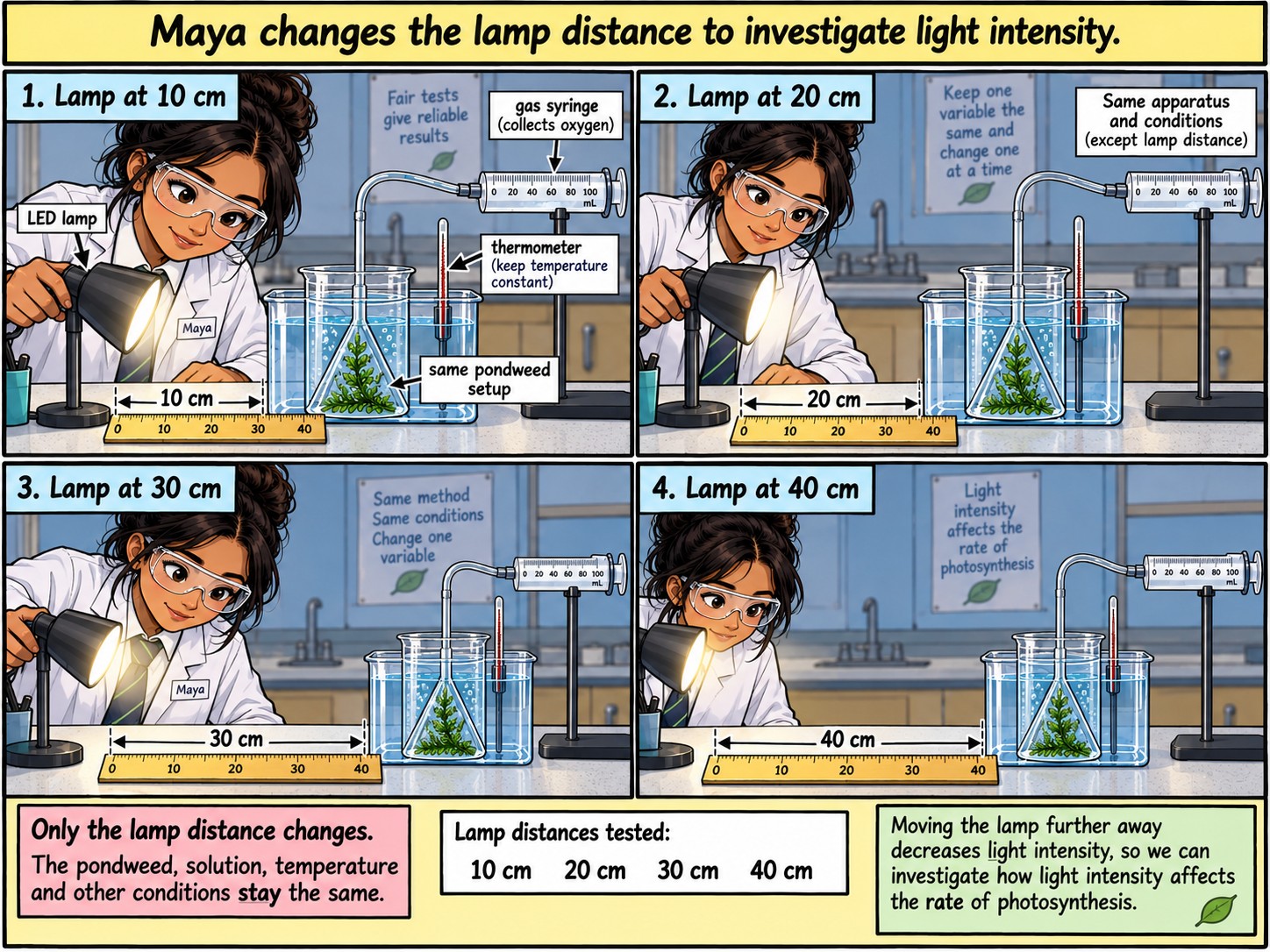
Maya now investigates light.
She keeps the same apparatus, but moves the lamp.
She first positions it 10 cm from the pondweed.
She measures the distance with the ruler.
She makes sure the water bath is keeping the pondweed at the same temperature as before.
This matters because a lamp can warm its surroundings. If the temperature changed as Maya moved the lamp, she would be changing two conditions at once.
She leaves the pondweed briefly to adjust to the new light level.
Then she collects the oxygen produced for one minute.
She repeats the measurement three times and calculates the mean.
Next she moves the lamp to 20 cm and repeats the same process.
She can then test other distances, such as 15 cm, 30 cm and 40 cm.
Her results table might look like this:
| Lamp distance | Reading 1 | Reading 2 | Reading 3 | Mean oxygen produced per minute |
|---|---|---|---|---|
| 10 cm | 5.1 cm³ | 5.3 cm³ | 5.5 cm³ | 5.3 cm³ |
| 15 cm | 4.8 cm³ | 5.0 cm³ | 5.2 cm³ | 5.0 cm³ |
| 20 cm | 3.8 cm³ | 4.0 cm³ | 4.2 cm³ | 4.0 cm³ |
| 30 cm | 2.2 cm³ | 2.4 cm³ | 2.6 cm³ | 2.4 cm³ |
| 40 cm | 1.0 cm³ | 1.2 cm³ | 1.4 cm³ | 1.2 cm³ |
Maya is deliberately changing the distance of the lamp.
Everything else should remain as similar as possible.
She uses the same pondweed.
She uses the same concentration of sodium hydrogencarbonate solution.
Every measurement lasts one minute.
The water bath keeps the temperature steady.
This matters because Maya wants to know whether light caused the change in the rate.
The variables in Maya's experiment
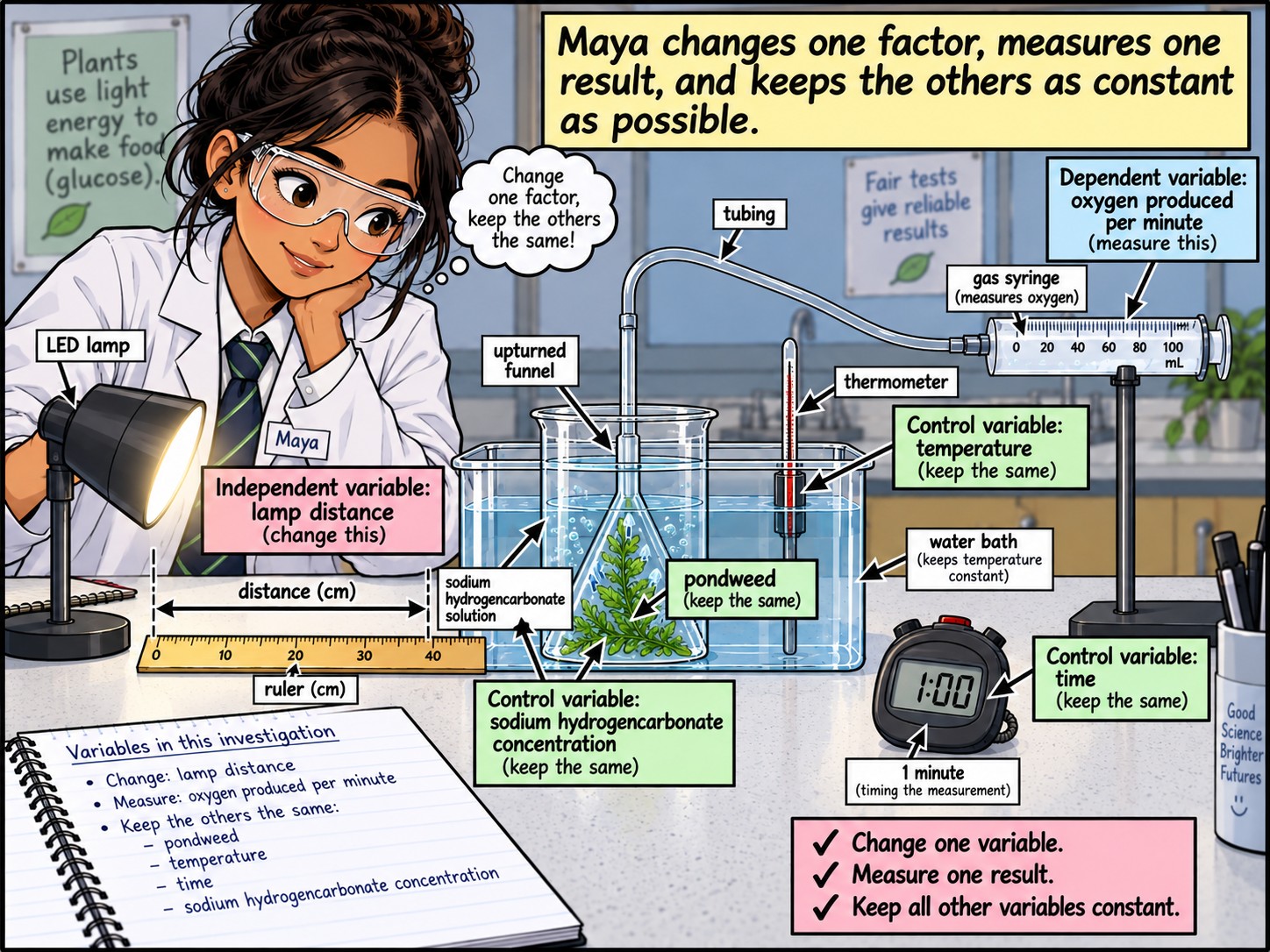
Scientists use particular names for the different parts of an investigation.
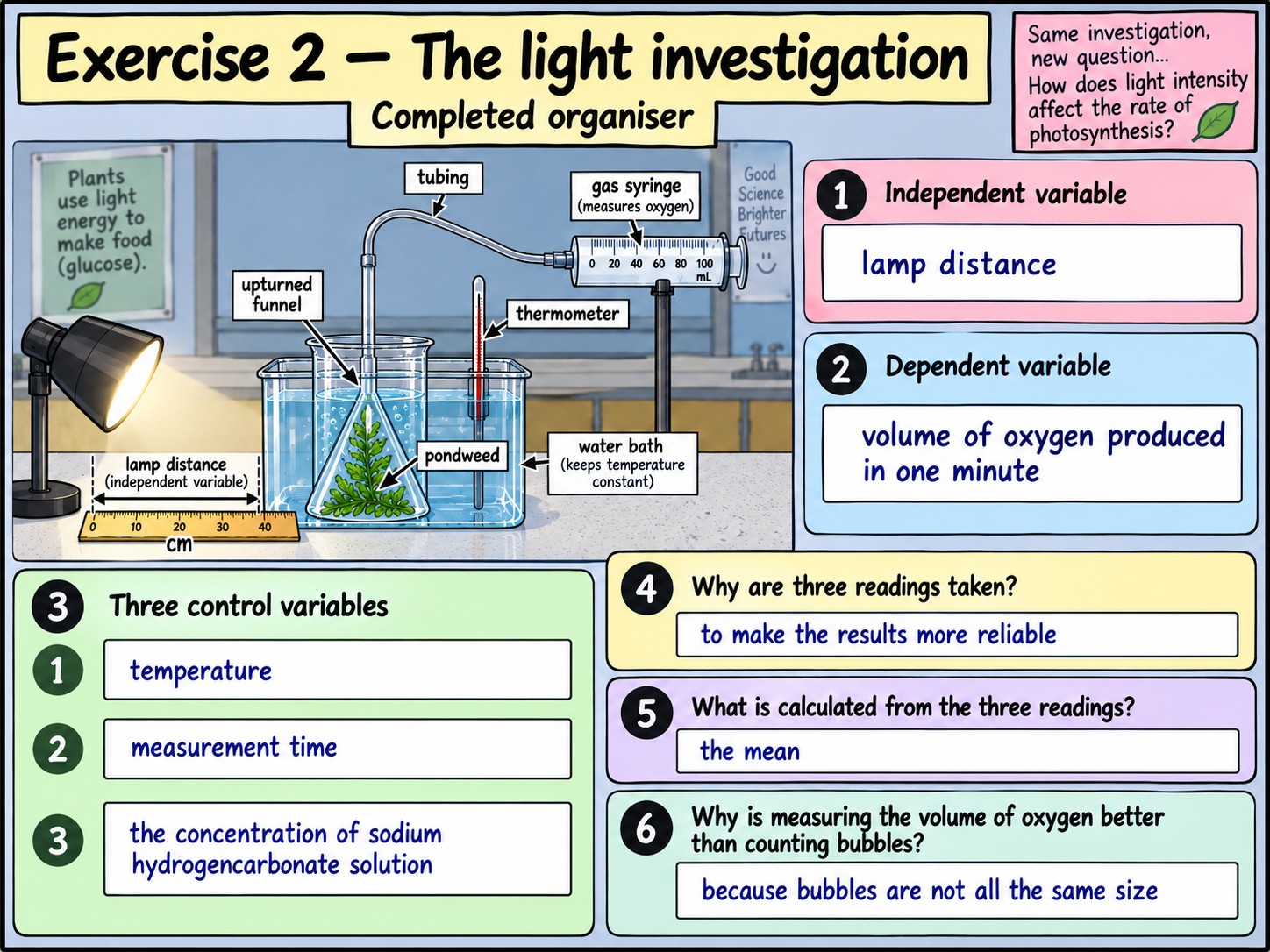
The condition deliberately changed is the independent variable.
Here, Maya changes the distance of the lamp in order to change the amount of light reaching the pondweed.
The result measured in response is the dependent variable.
Here, Maya measures the volume of oxygen produced in one minute.
Other important conditions should be kept as constant as possible.
These are control variables.
They include:
the piece and species of pondweed;
the amount of pondweed;
the carbon dioxide available;
the temperature;
the measurement time.
If several of these changed at once, Maya would not know which change caused the difference in oxygen production.
Lamp distance is not the same as light intensity
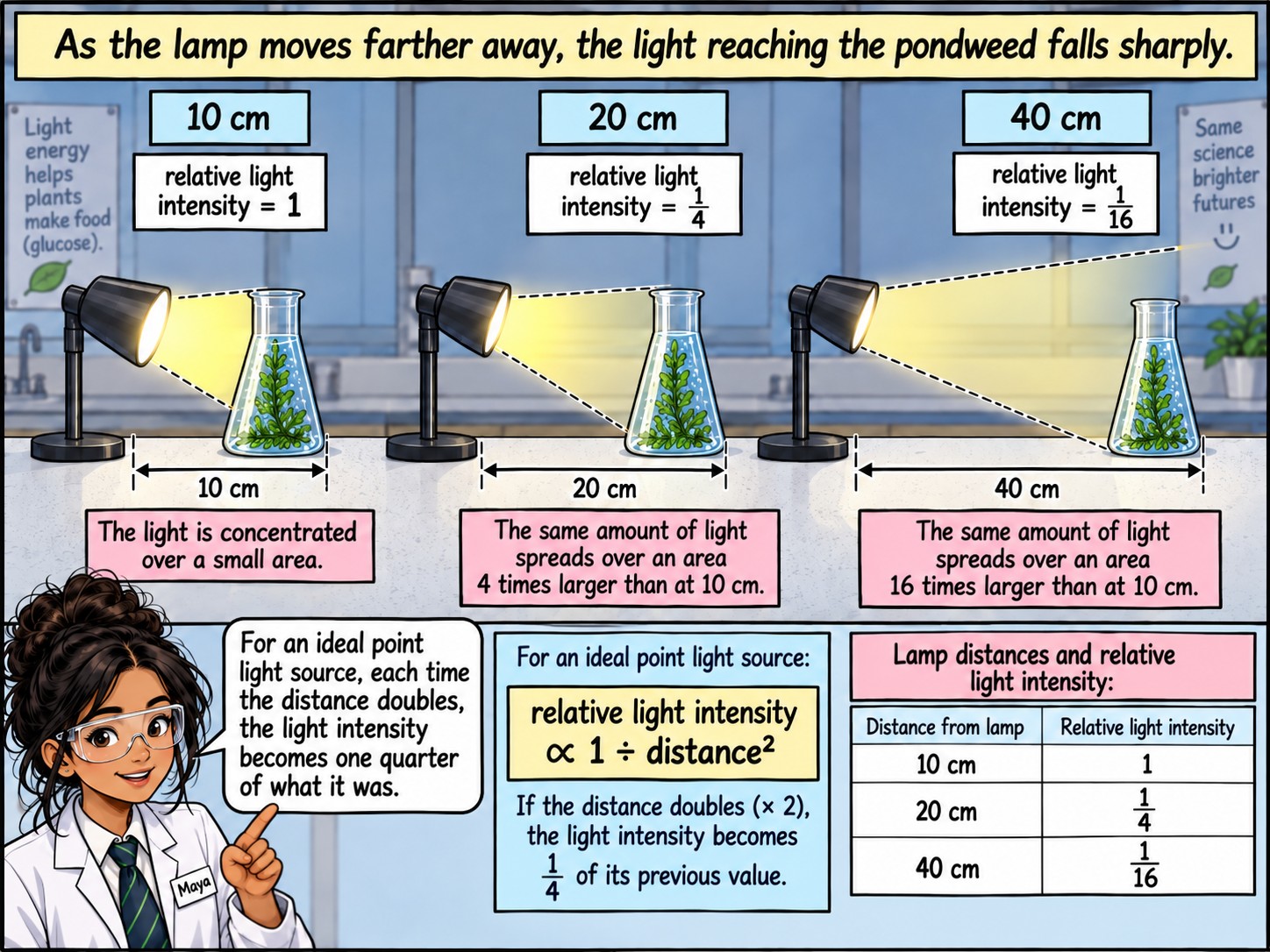
Moving the lamp changes the amount of light reaching the pondweed.
But distance and light intensity do not change by the same amount.
For an ideal point light source, light spreads out as it travels away from the source.
The relationship can be represented like this:
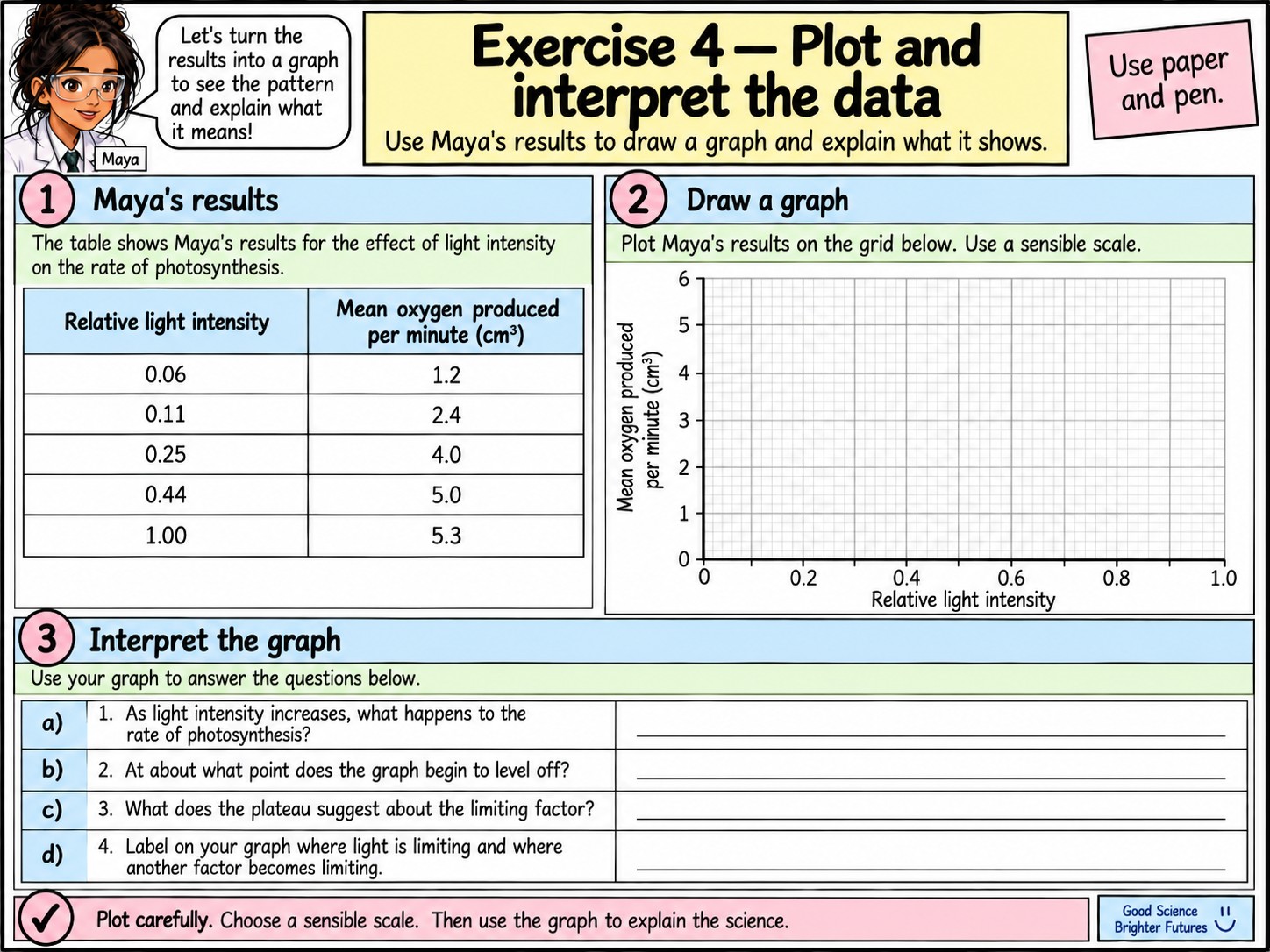
| Distance from light source | Relative light intensity |
|---|---|
| 10 cm | 1.00 |
| 15 cm | 0.44 |
| 20 cm | 0.25 (1/4) |
| 30 cm | 0.11 |
| 40 cm | 0.06 (1/16) |
When the distance doubles from 10 cm to 20 cm, the light intensity does not halve.
It falls to one quarter.
When the distance doubles again from 20 cm to 40 cm, it falls to one quarter again.
For a point light source:
light intensity ∝ 1 ÷ distance²
This is called an inverse-square relationship.
A real classroom lamp is not a perfect point source, so its light will not follow this model exactly.
The inverse-square relationship can still be used to estimate how relative light intensity changes with distance.
Maya can use the lamp distances from her investigation to calculate these relative values.
She can then plot:
relative light intensity
against
mean oxygen produced per minute.
What does the light graph show?
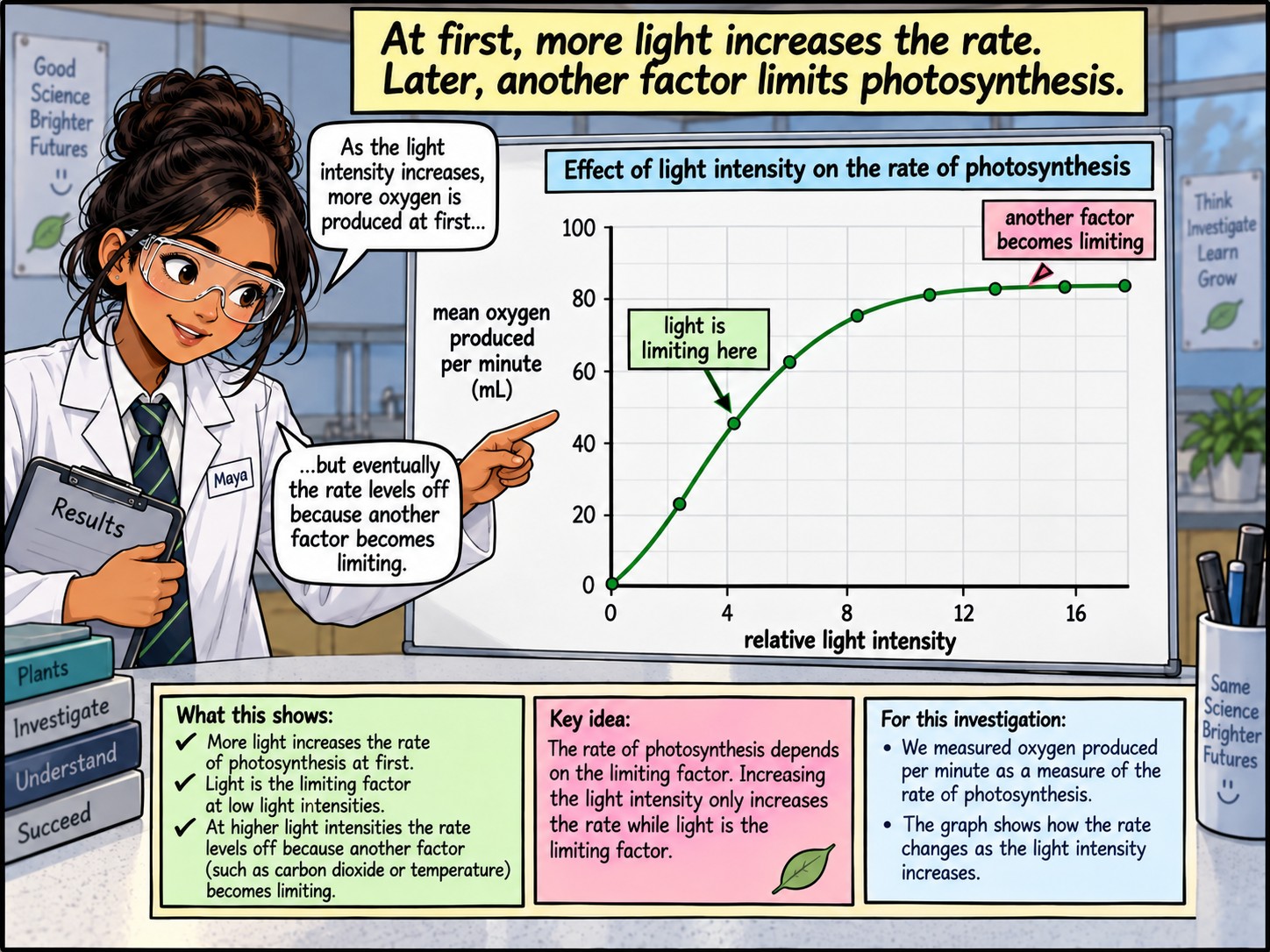
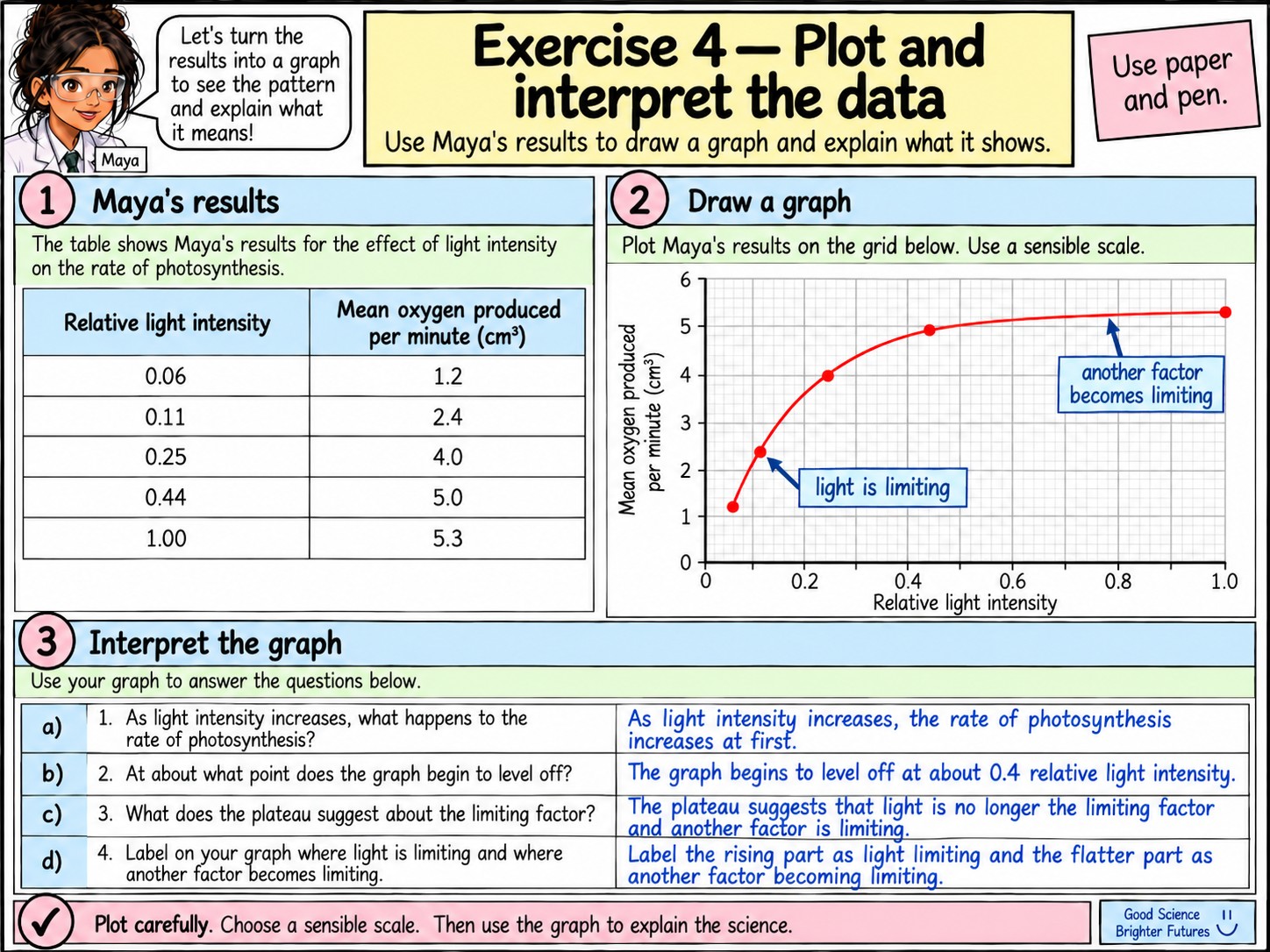
At low light intensity, Maya finds that increasing the light usually increases the amount of oxygen produced each minute.
The rate of photosynthesis rises.
But the graph does not necessarily continue rising forever.
Eventually it may begin to flatten.
Giving the pondweed still more light then produces little or no further increase in the rate.
At first, the plant did not have enough light to photosynthesise any faster.
Light was limiting the rate.
Once plenty of light is available, light is no longer the condition preventing the rate from increasing.
Something else must now be holding it back.
A condition that prevents a process from happening any faster is called a limiting factor.
At low light intensity, light may be the limiting factor.
At high light intensity, another factor may become limiting instead.
Carbon dioxide or temperature could now be more important.
Remember this lesson
These exercises are for learners following the investigation on the page, whether or not they are carrying it out physically.
Use paper and pen. Each exercise carousel starts on the learner version. Complete slide 1 before moving to slide 2 to check the completed answer. If you missed something, use the lesson to correct it. Then try the task again later without looking back at the answer.
Exercise 1 — Draw the investigation
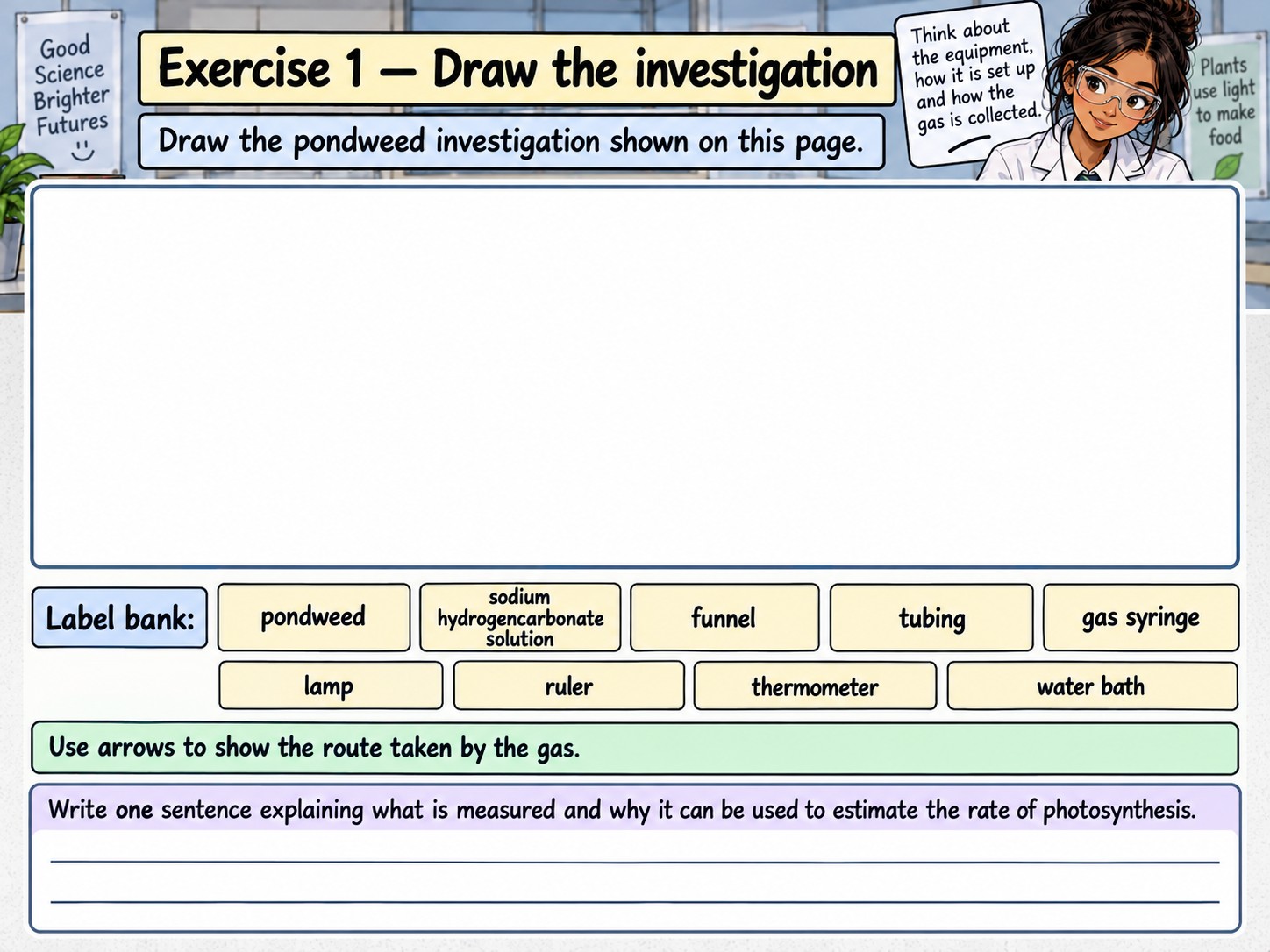
1 of 2
Slide 1 is the exercise. Draw the pondweed investigation shown there. Label the equipment, use arrows to show the route taken by the gas, and write the sentence requested at the bottom. When you have finished, move to slide 2 to check the completed answer and correct anything you missed.
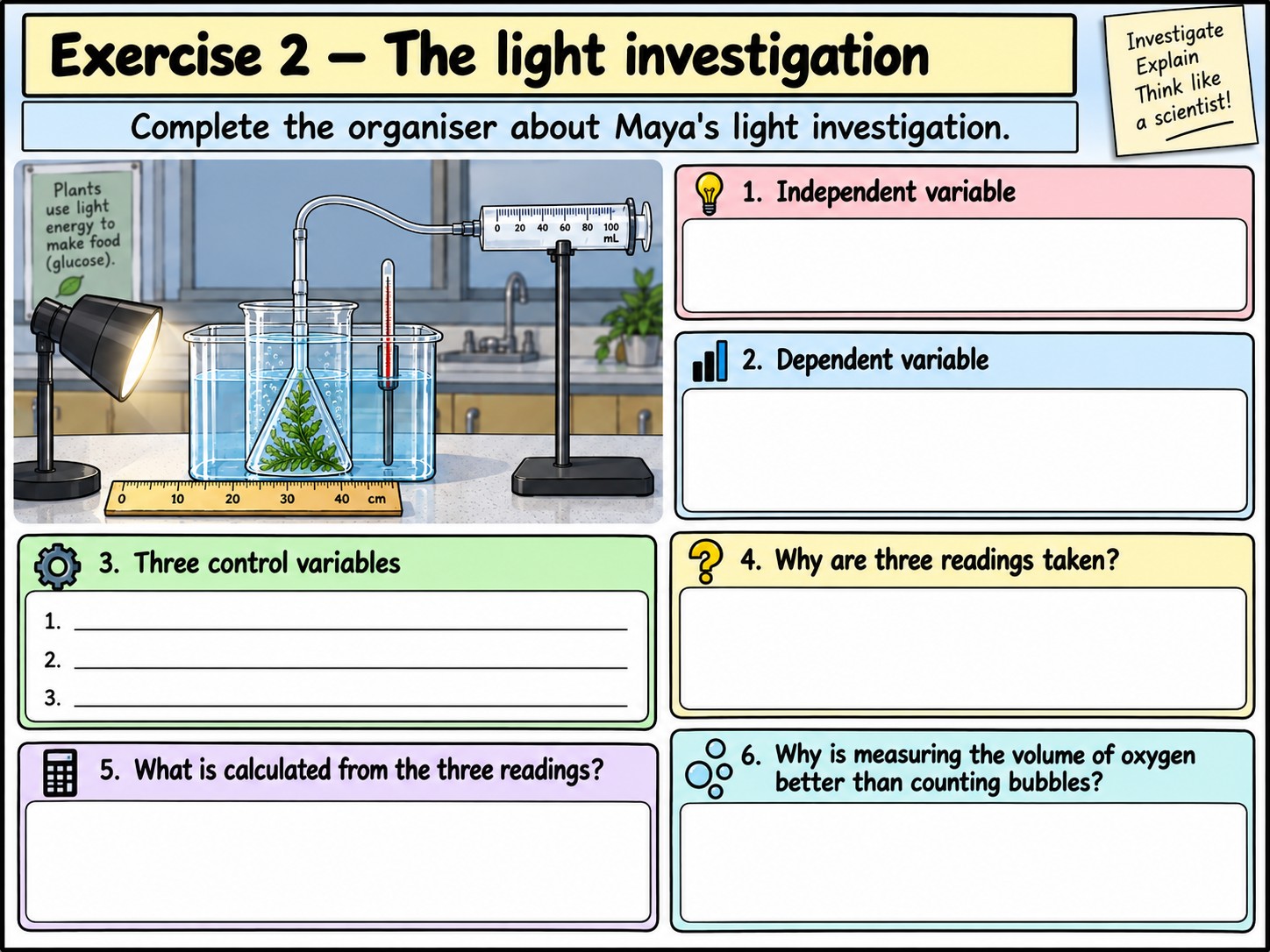
Exercise 2 — The light investigation
1 of 2
Slide 1 is the exercise. Complete the organiser about Maya's light investigation: identify the independent variable, dependent variable and three control variables, then answer the questions about repeats, the mean and oxygen measurement. When you have finished, move to slide 2 to check the completed answer.
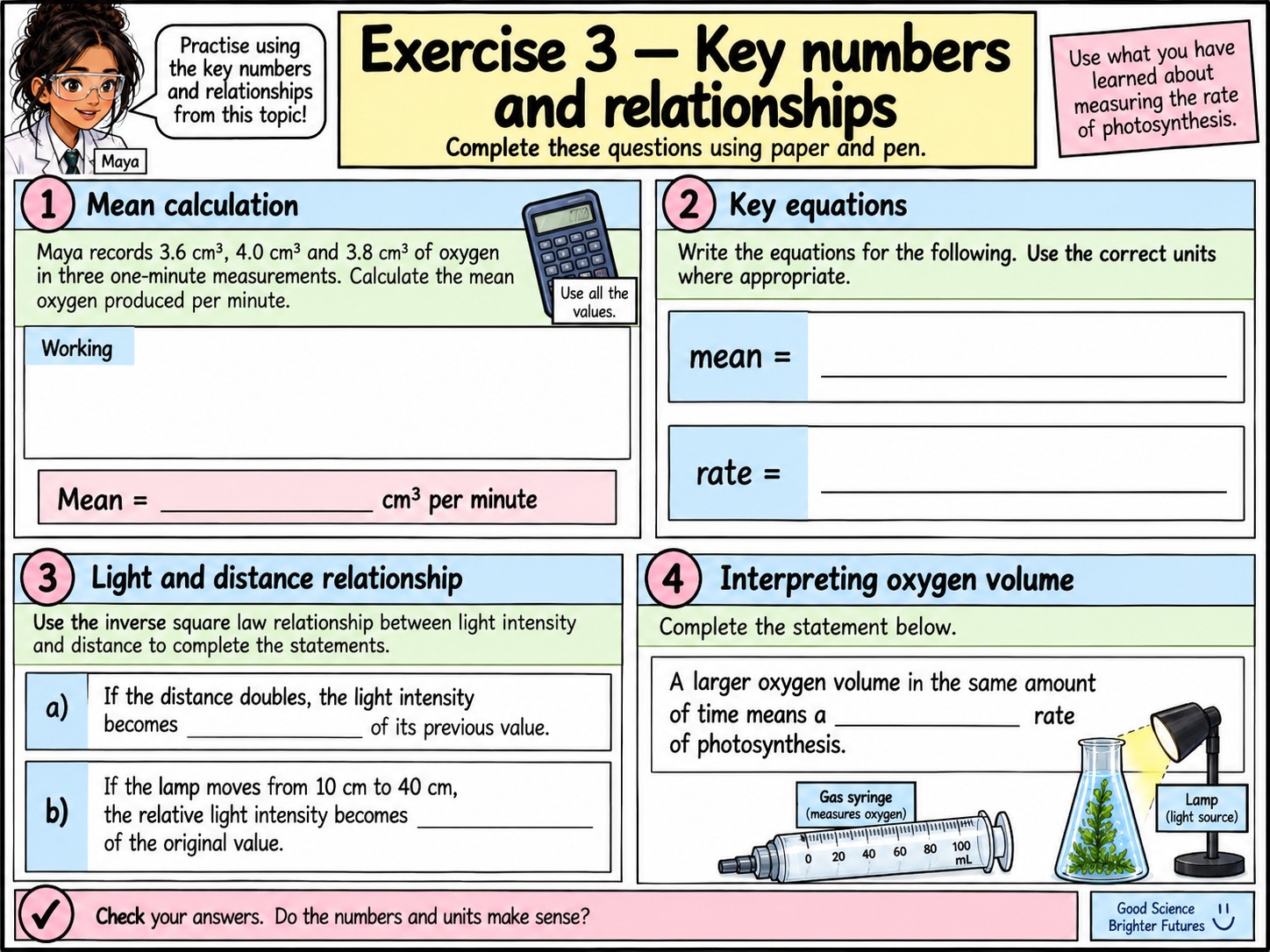
Exercise 3 — Key numbers and relationships
1 of 2
Slide 1 is the exercise. Complete the mean calculation, write the equations, complete the inverse-square relationship statements, and interpret what a larger oxygen volume means. When you have finished, move to slide 2 to check the completed calculation, equations and relationships.
Exercise 4 — Plot and interpret the data
1 of 2
Slide 1 is the exercise. Use Maya's supplied results to plot the graph on paper. Draw a suitable curve, answer the interpretation questions, and label where light is limiting and where another factor becomes limiting. When you have finished, move to slide 2 to compare your graph and interpretation with the completed answer.
GCSE knowledge coverage
Key knowledge: The rate of photosynthesis can be estimated from the volume of oxygen produced in a fixed time. In a light-intensity investigation, lamp distance changes the light reaching the pondweed while other important conditions are controlled. Increasing light raises the rate only while light is the limiting factor.
covers:
- GCSE Biology → Bioenergetics → Photosynthesis → Rate of photosynthesis
- GCSE Combined Science → Biology → Bioenergetics → Photosynthesis → Rate of photosynthesis
Knowledge overlap
| Knowledge | GCSE Biology | GCSE Combined Science |
|---|---|---|
| Pondweed can be used to investigate how light intensity affects the rate of photosynthesis. | ✓ | ✓ |
| Oxygen produced in a fixed time can be used as an indicator of photosynthesis rate. | ✓ | ✓ |
| Gas volume gives a better measurement than counting bubbles because bubbles are not all the same size. | ✓ | ✓ |
| Rate = amount produced ÷ time. | ✓ | ✓ |
| Measurements should be repeated and a mean calculated. | ✓ | ✓ |
| In the light investigation, lamp distance is the independent variable and oxygen volume produced in one minute is the dependent variable. | ✓ | ✓ |
| Important control variables include temperature, carbon dioxide availability, the species and amount of pondweed, and measurement time. | ✓ | ✓ |
| Increasing light intensity can increase the rate while light is the limiting factor. | ✓ | ✓ |
| A plateau in the light graph shows that light is no longer limiting and another factor is limiting the rate. | ✓ | ✓ |
| Photosynthesis data can be presented and interpreted in tables and graphs. | ✓ | ✓ |
| Higher tier: for a point light source, light intensity is proportional to 1 ÷ distance²; doubling the distance reduces the relative intensity to one quarter. | ✓ | ✓ |