Mass Number
How can we count every nucleon in a nucleus and work out a missing neutron number?
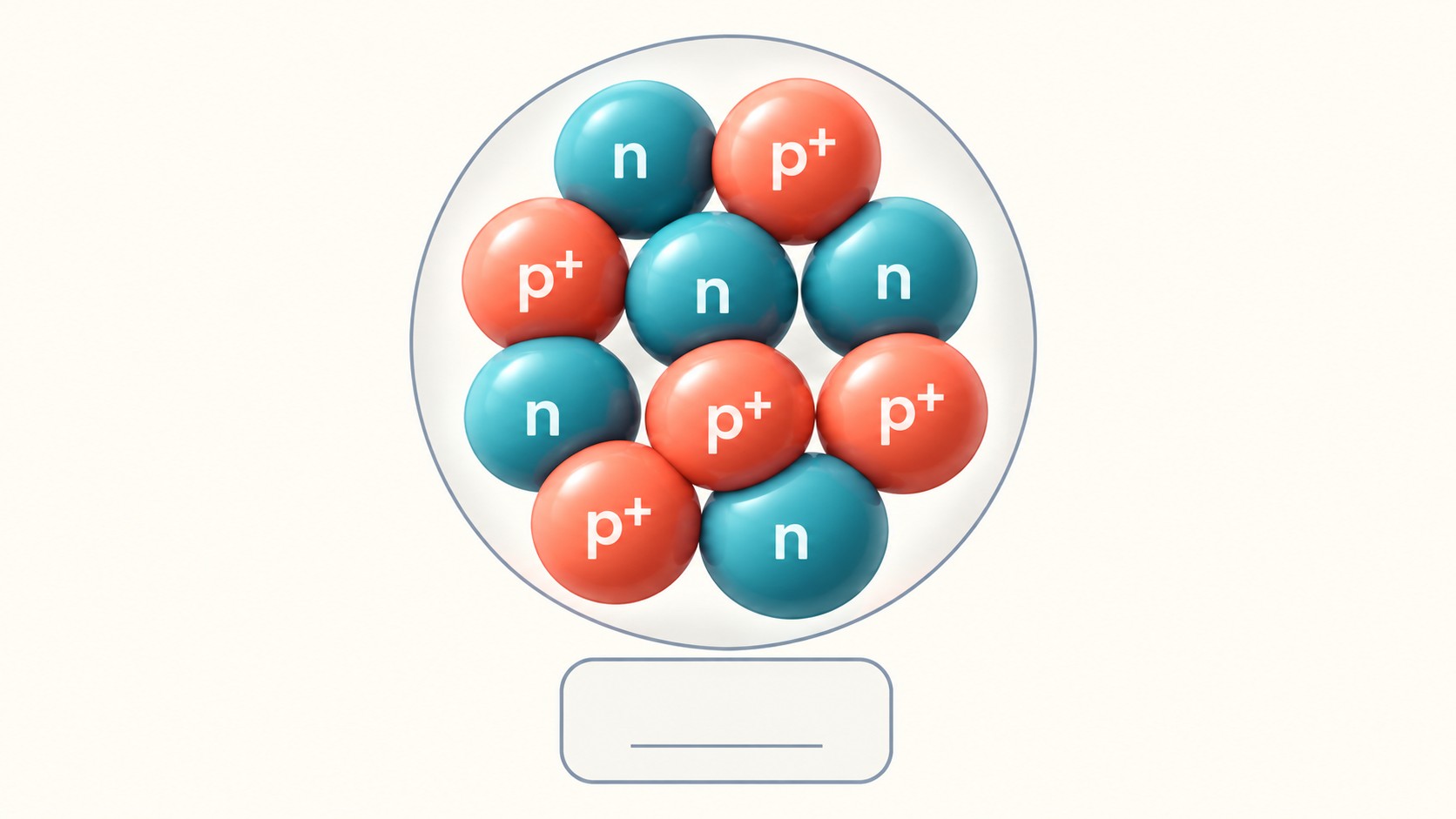
A new count
You can identify a chemical element by counting the protons in its nucleus. But the proton number does not tell you how many particles are in the nucleus altogether.
Look at two models of nuclei from the same element. Can they contain different total numbers of particles?
Count the complete nucleus
1 of 2
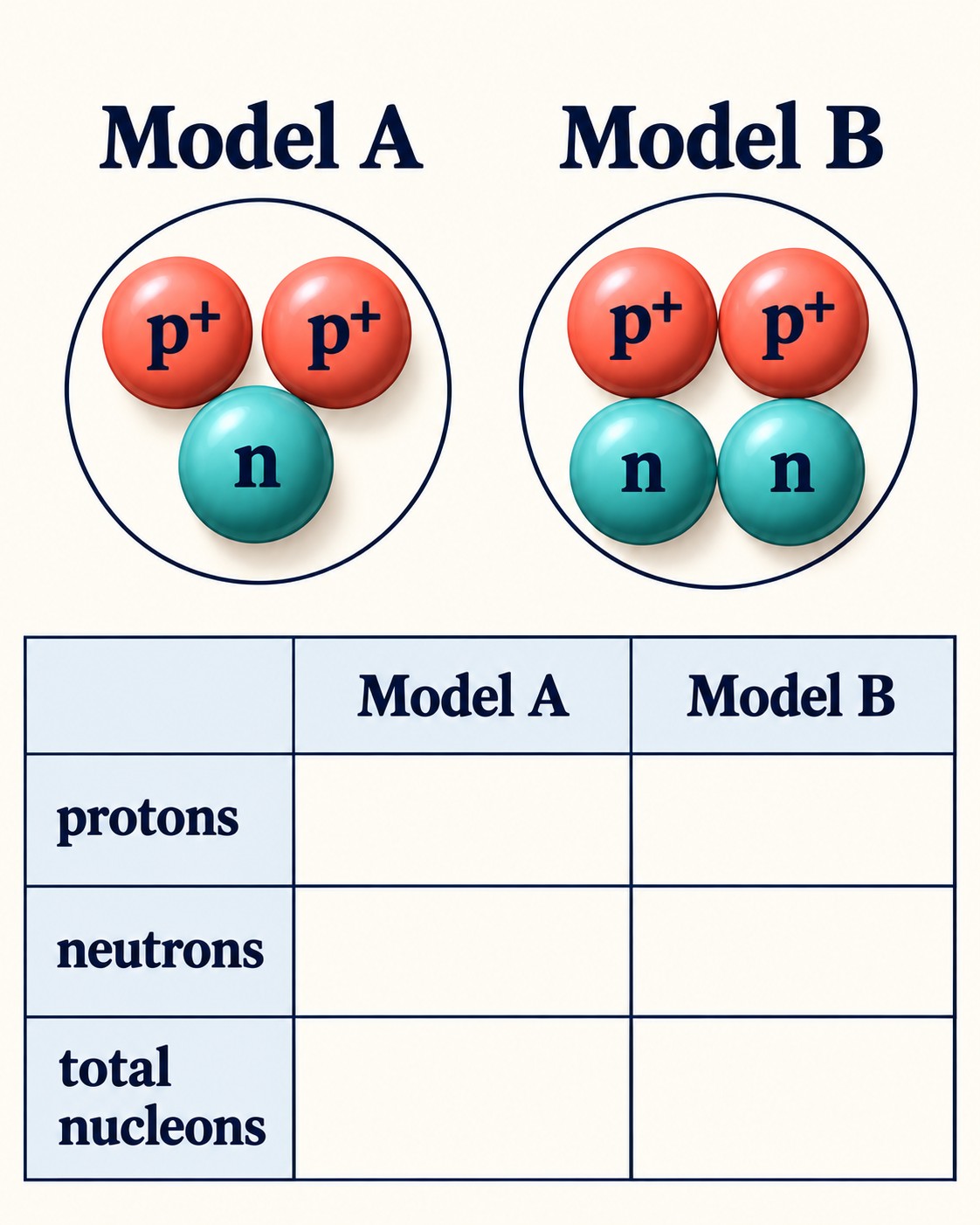
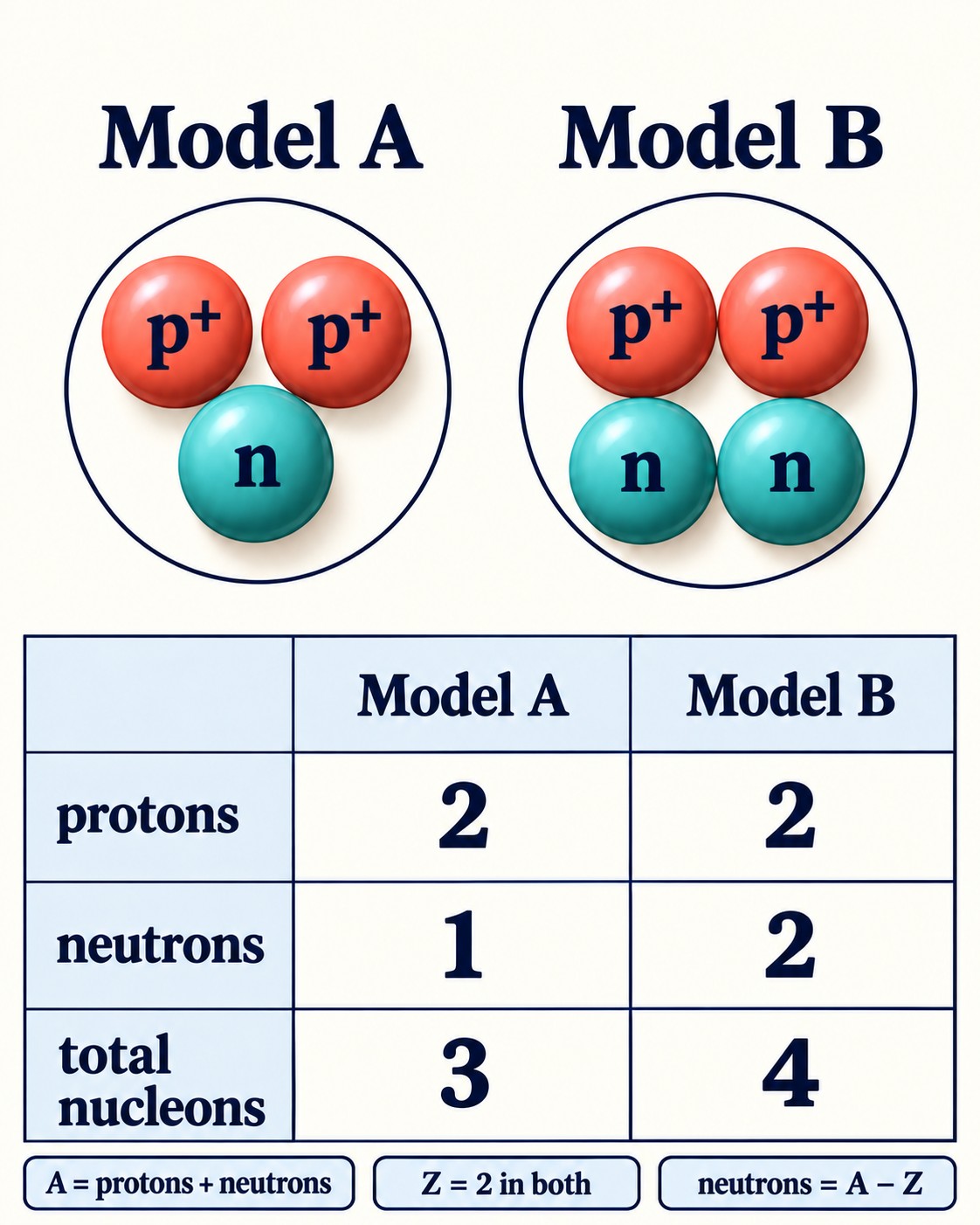
Model A contains two protons and one neutron. Model B contains two protons and two neutrons.
Count all the particles in each nucleus. Record the number of protons, the number of neutrons and the TOTAL number of protons and neutrons. The total should be a whole number.
How can the two nuclei have the same element identity but a different total count? Write your explanation before continuing.
Mass number
Model A contains three particles in its nucleus; Model B contains four. Both have two protons, so both belong to helium. But they have different numbers of neutrons.
The MASS NUMBER of a nucleus tells us the total number of its protons and neutrons. We use the capital letter A for mass number:
A = number of protons + number of neutrons.
The atomic number Z still tells us the number of protons. If we know A and Z, we can find how many neutrons there are:
number of neutrons = A − Z.
For Model B, A = 4 and Z = 2, so there are 4 − 2 = 2 neutrons. The mass number is a whole-number particle count. It is not the same as the decimal RELATIVE ATOMIC MASS you may later see on a periodic table; we will study that different idea with complete atoms.
Reading a nuclear symbol
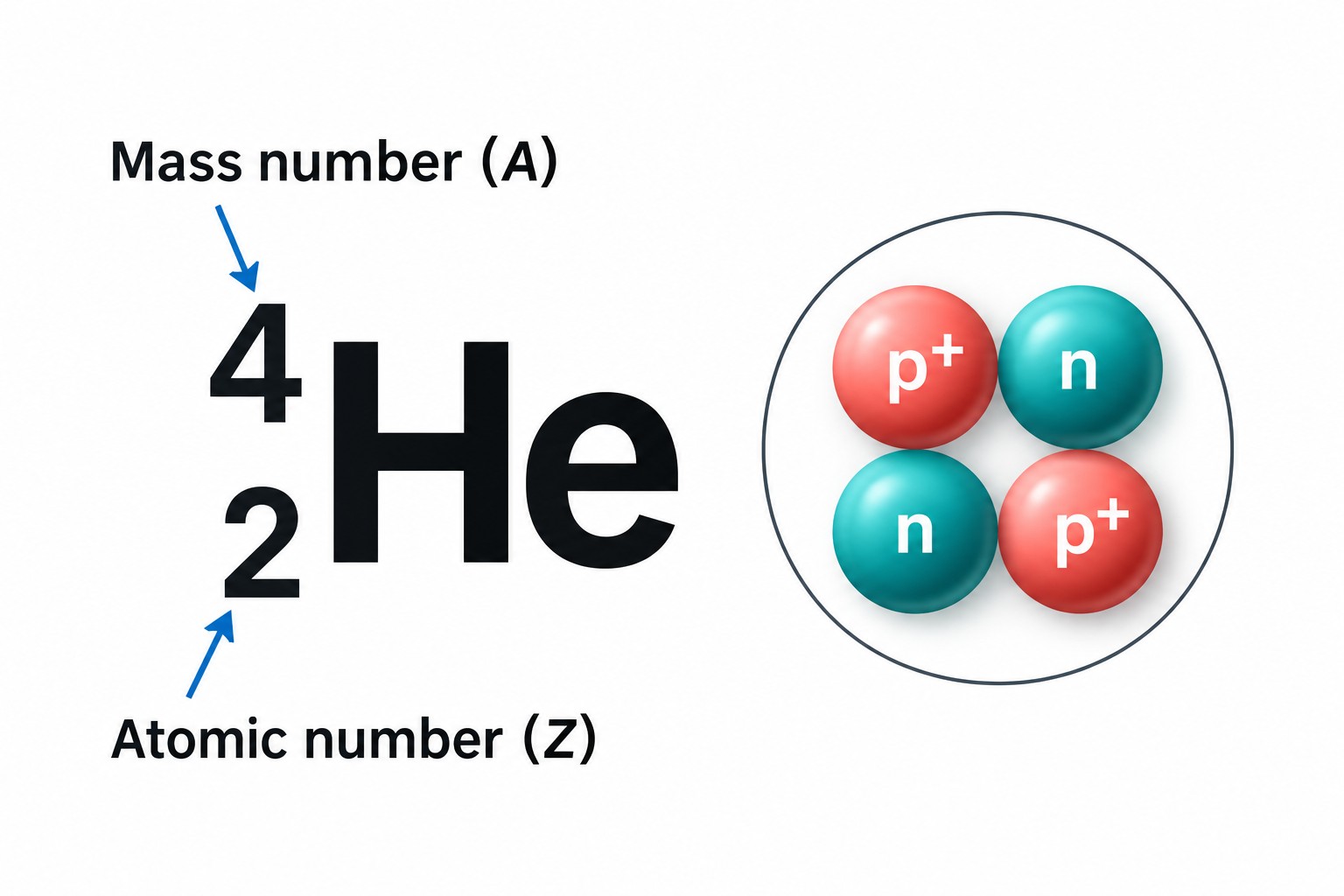
Scientists can write the mass number and atomic number next to an element's chemical symbol. They put the MASS NUMBER A at the upper left and the ATOMIC NUMBER Z at the lower left.
A helium nucleus containing two protons and two neutrons can be written as helium-4 with 4 at the upper left of He and 2 at the lower left. The upper number tells you there are four nucleons in total. The lower number tells you there are two protons, so the neutron number is 4 − 2 = 2.
The position of each number matters. The upper number is not the number of protons, and the lower number is not the number of neutrons.
Work backwards
1 of 2
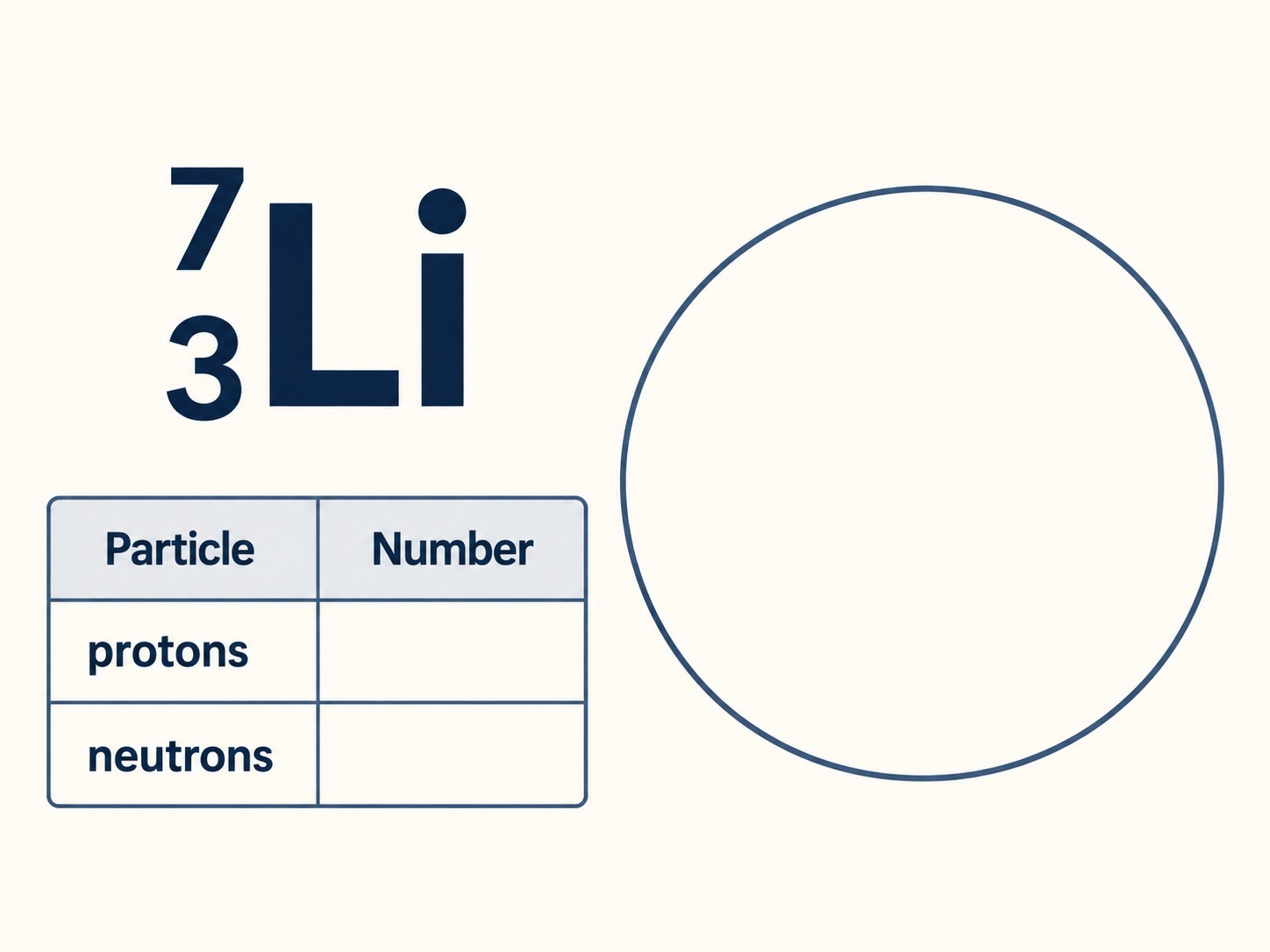
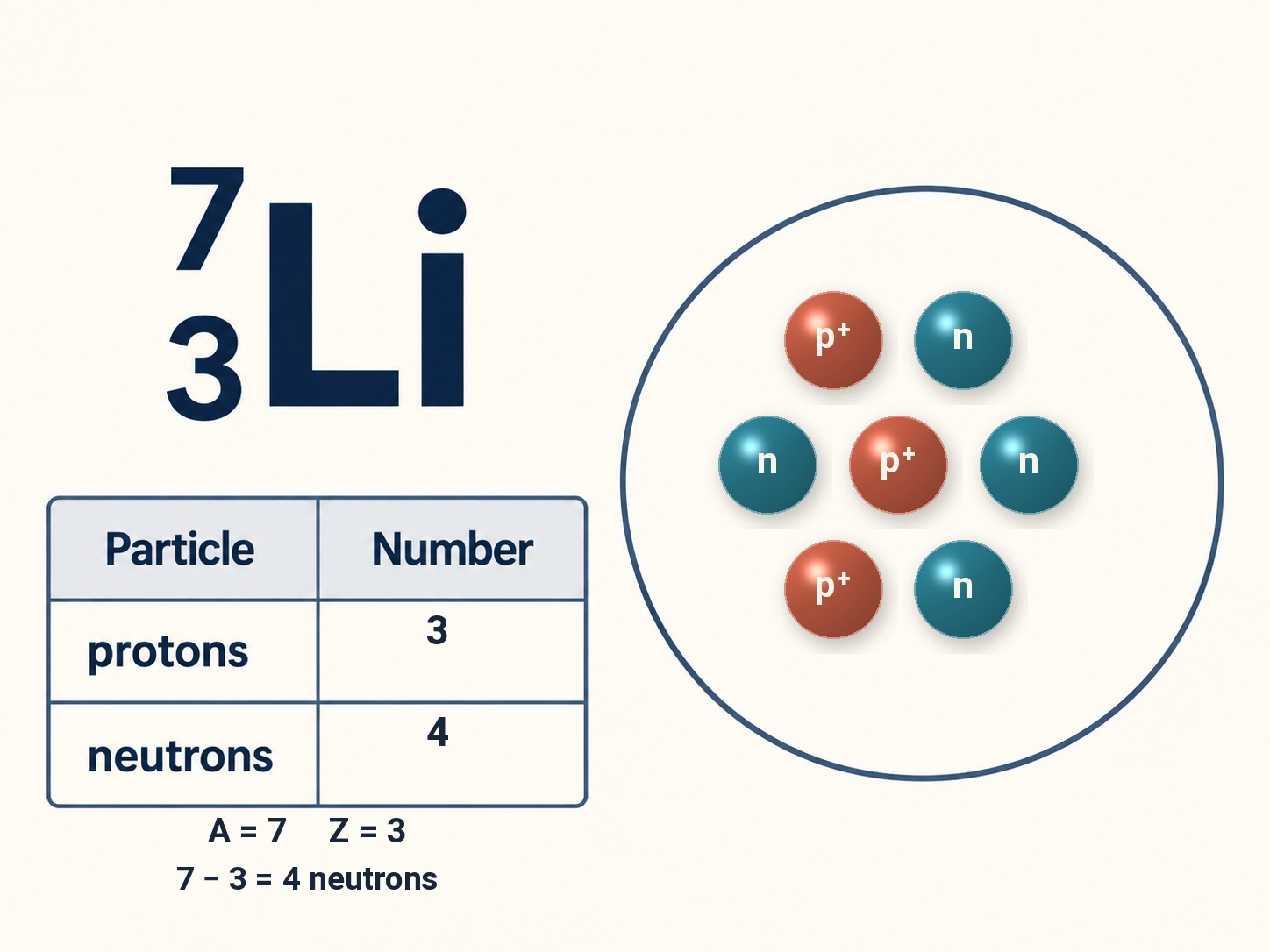
The symbol for a lithium-7 nucleus has 7 at the upper left of Li and 3 at the lower left. Work out:
How many protons does it contain? How many neutrons does it contain? What is its mass number? What is its atomic number?
Write your method, not just your answers. When you have finished, open Check your answers to compare your counts with the completed nuclear model.
Remember this lesson
1 of 2
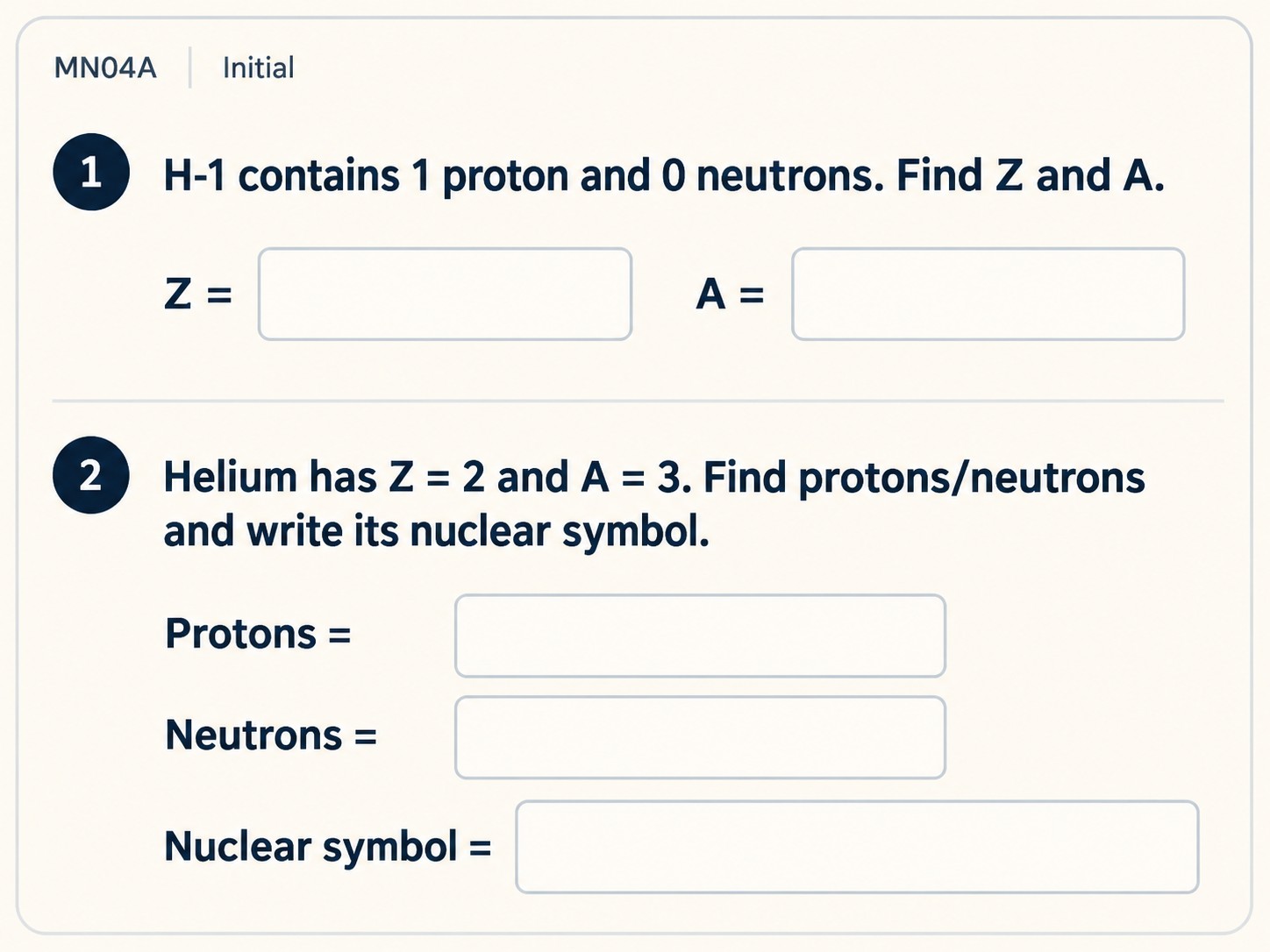
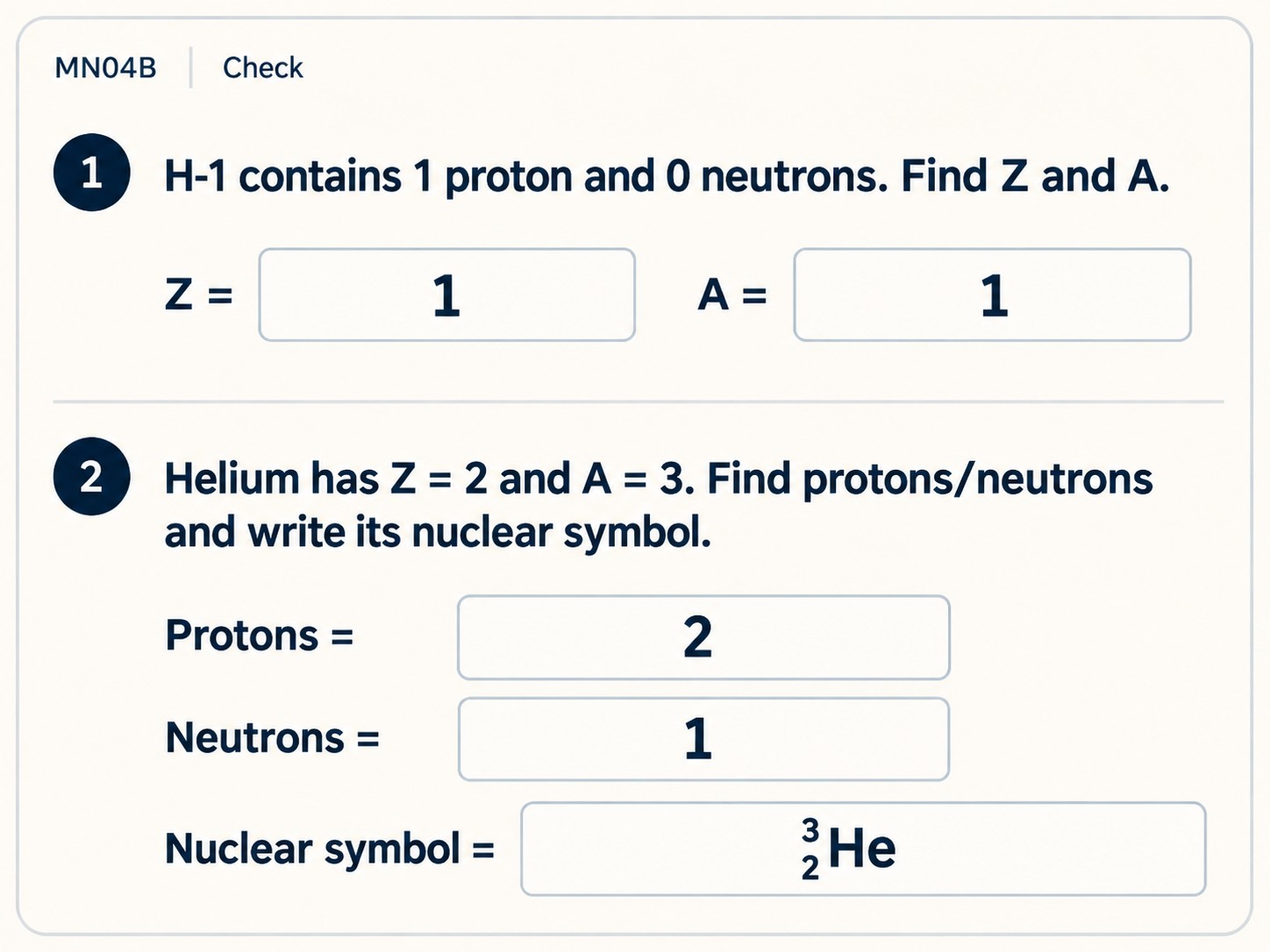
Without looking back at the worked examples, complete these two questions.
A nucleus contains one proton and no neutrons. What is its atomic number and its mass number? Explain why those two numbers happen to be equal in this case.
A helium nucleus has atomic number 2 and mass number 3. Work out its number of protons and neutrons. Then write down what the two numbers at the upper and lower LEFT of its chemical symbol mean.
Attempt both questions before you check your answers.
GCSE knowledge coverage
Mass number is the total number of protons and neutrons in a nucleus. You have practised adding those particles, calculating neutrons from mass number minus atomic number, and reading the two numbers in a nuclear symbol.
This covers the mass-number meaning in Pearson Edexcel Combined Science Chemistry 1.7. Your work on the upper-left mass number and lower-left proton number begins the nuclear notation required in Combined Science Physics 6.3; that broader requirement also asks you to compare isotope nuclei, which the next page develops. Calculation of all the particles in a COMPLETE atom, including electrons, is completed in later Atomic Structure teaching.