Formation of Primordial Element Nuclei
What light nuclei could exist after a short period of nuclear assembly, and which outcomes were common, rare or temporary?
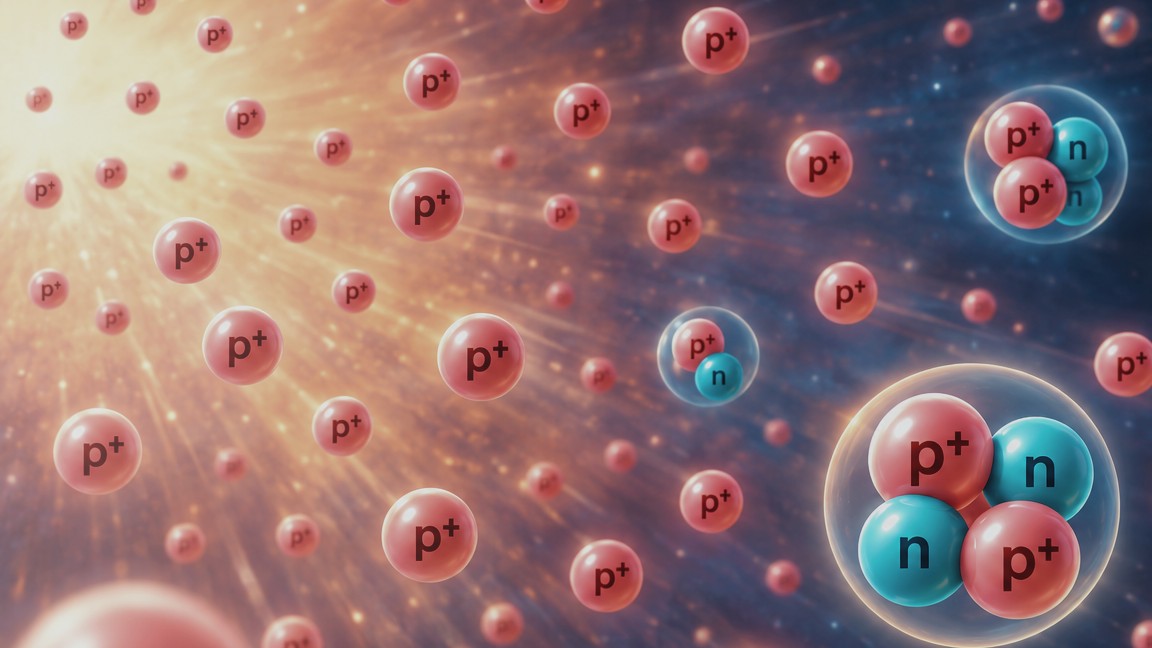
Entropy — several possibilities
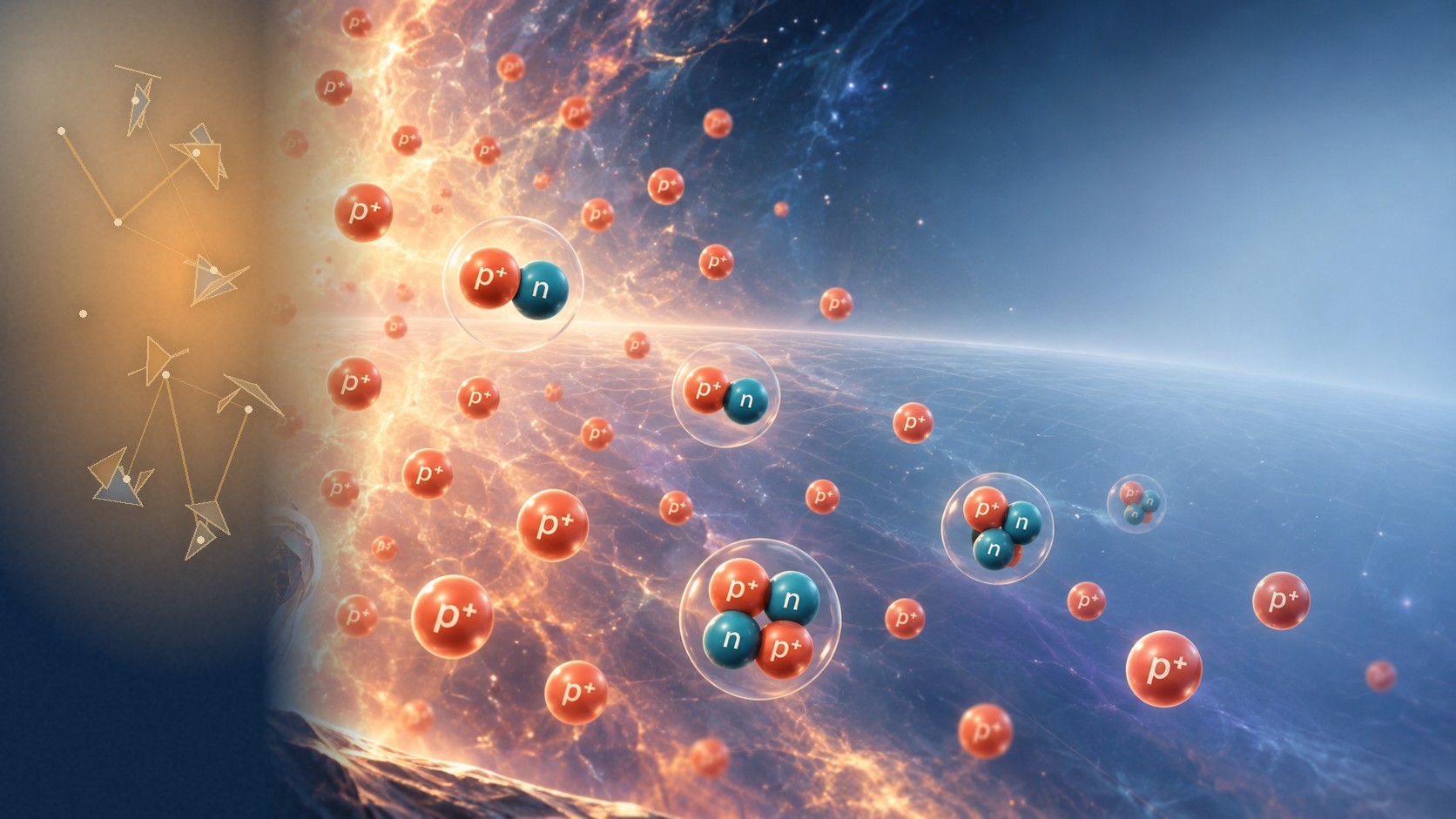
There are protons that remain by themselves.
There are protons and neutrons that no longer travel apart.
The conditions have changed. I see several possibilities, but they will not all leave the same trace.
What are we following?
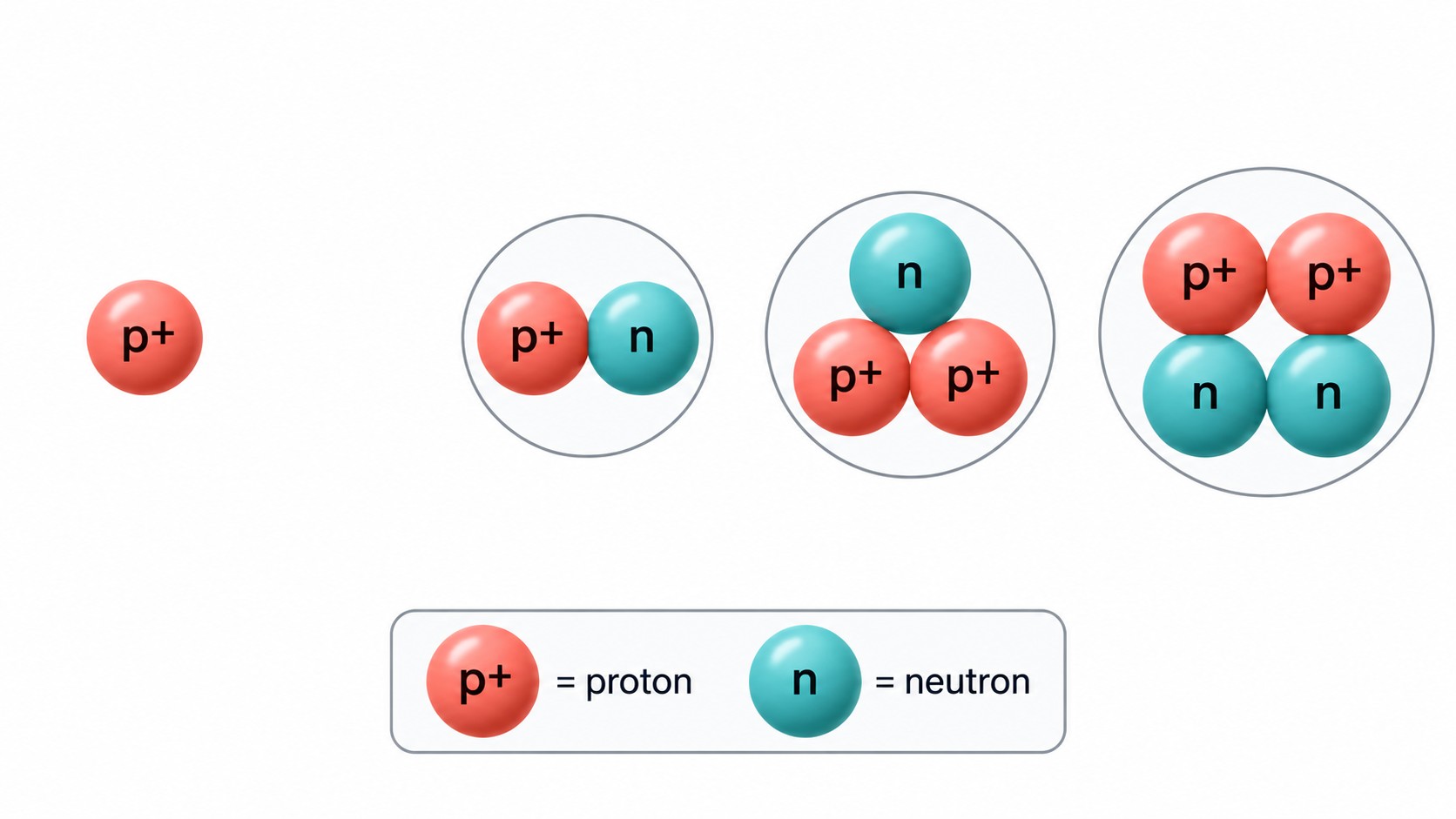
The universe has cooled enough for some composite light nuclei to persist. Nuclear reactions can join existing protons and neutrons into other nuclei, while many protons remain by themselves.
In this part of the story, we will look at four element families. We are not following complete neutral atoms: the nuclei we meet here do not yet have the stable bound electron structures of later atoms. Some nuclear products remain common; others are rare or do not remain unchanged.
Begin with the simplest nucleus, which was already possible before the main period of compound-nucleus formation.
Formation of Primordial Element Nuclei — Deeper page — Hydrogen Formation
Begin with the simplest branch: hydrogen. Open Hydrogen Formation to follow how the hydrogen branch fits into this early nuclear period.
From a simple start
A lone proton is already a hydrogen-1 nucleus. During the nuclear-reaction window, some protons and neutrons can form deuterium and take part in further reactions.
What happens when a surviving nucleus contains more nucleons than those first simple examples? Continue with helium.
Formation of Primordial Element Nuclei — Deeper page — Helium Formation
The simple hydrogen branch is not the end of the reaction network. Open Helium Formation to follow the next larger light-nucleus branch.
A common result
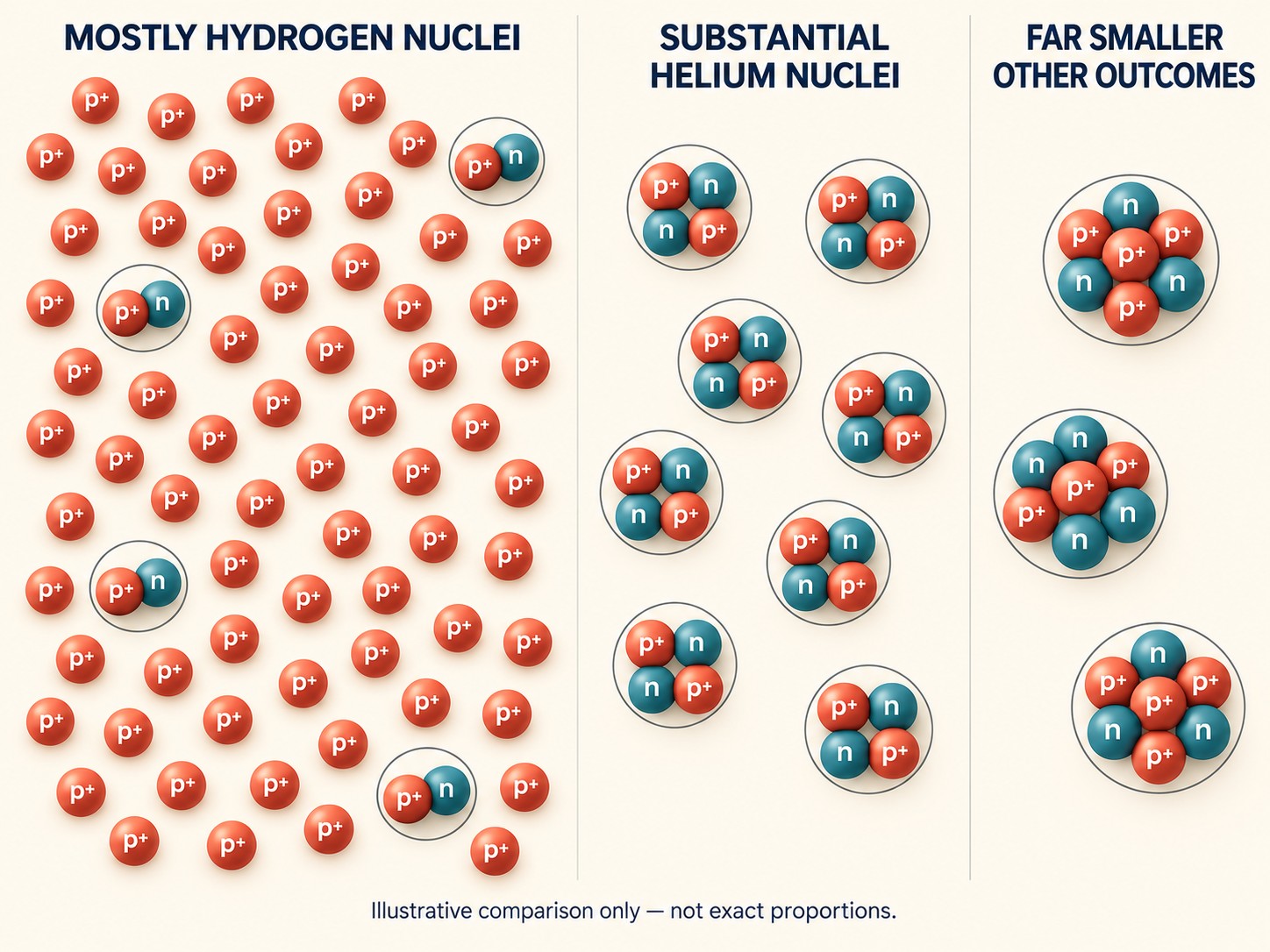
Helium nuclei became an important, lasting product of primordial nucleosynthesis. Much of the ordinary matter in the early universe remained in the form of hydrogen nuclei, while a substantial share was helium nuclei.
Hydrogen and helium therefore dominate the primordial light-nucleus inventory. Lithium and beryllium are trace outcomes. The four child pages will examine what defines each nucleus; this parent page owns their relative-production comparison.
Formation of Primordial Element Nuclei — Deeper page — Lithium Formation
Hydrogen and helium dominate, but the reaction network reaches rarer outcomes too. Open Lithium Formation to follow the lithium branch.
Formation of Primordial Element Nuclei — Deeper page — Beryllium
One more rare branch complicates the picture. Open Beryllium before following what happens to its primordial nuclei.
Why the early reaction window ends
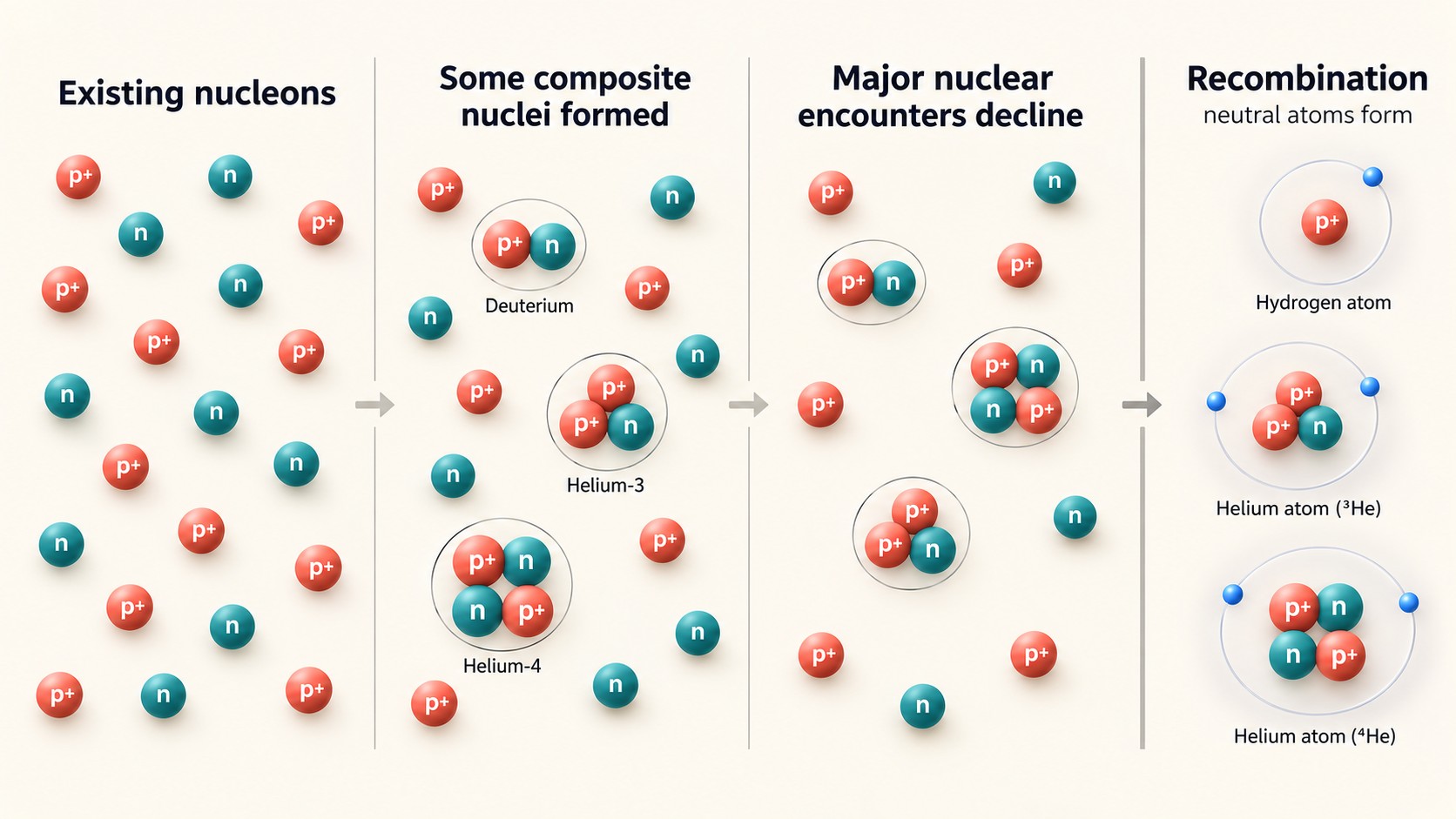
The universe continues to expand. Nuclear collisions become less frequent as it grows less dense, and the main period of primordial nucleosynthesis comes to an end after the first few minutes.
Hydrogen and helium nuclei make up almost all of the lasting ordinary nuclear material from this stage. The light-element story also includes rarer outcomes and nuclei that can change later. But these are still nuclei, not complete neutral atoms.
Much later, the universe will have cooled sufficiently for electrons to remain bound to nuclei and for neutral atoms to form. That is the next part of the journey.
Draw the before and after
1 of 2
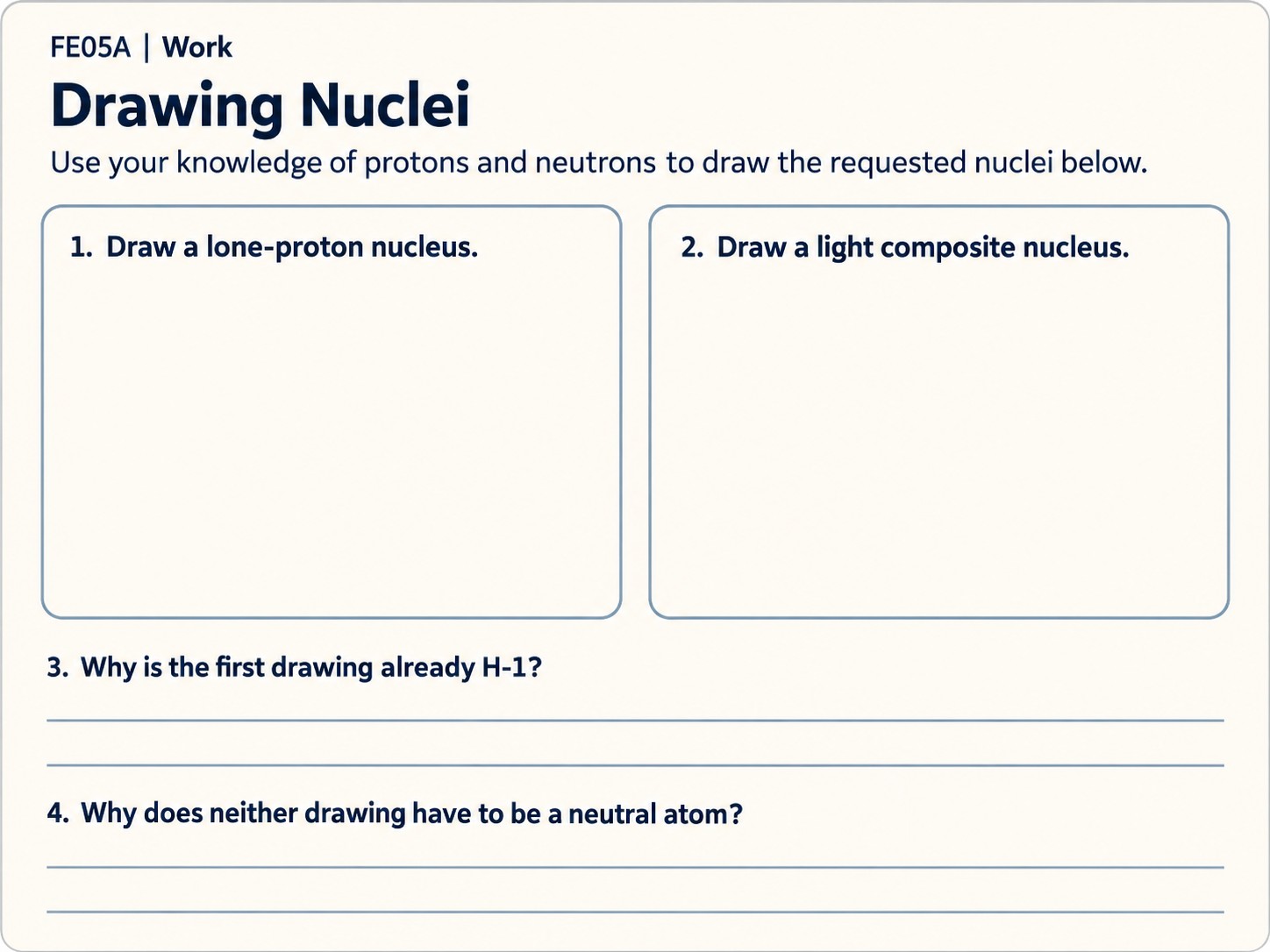
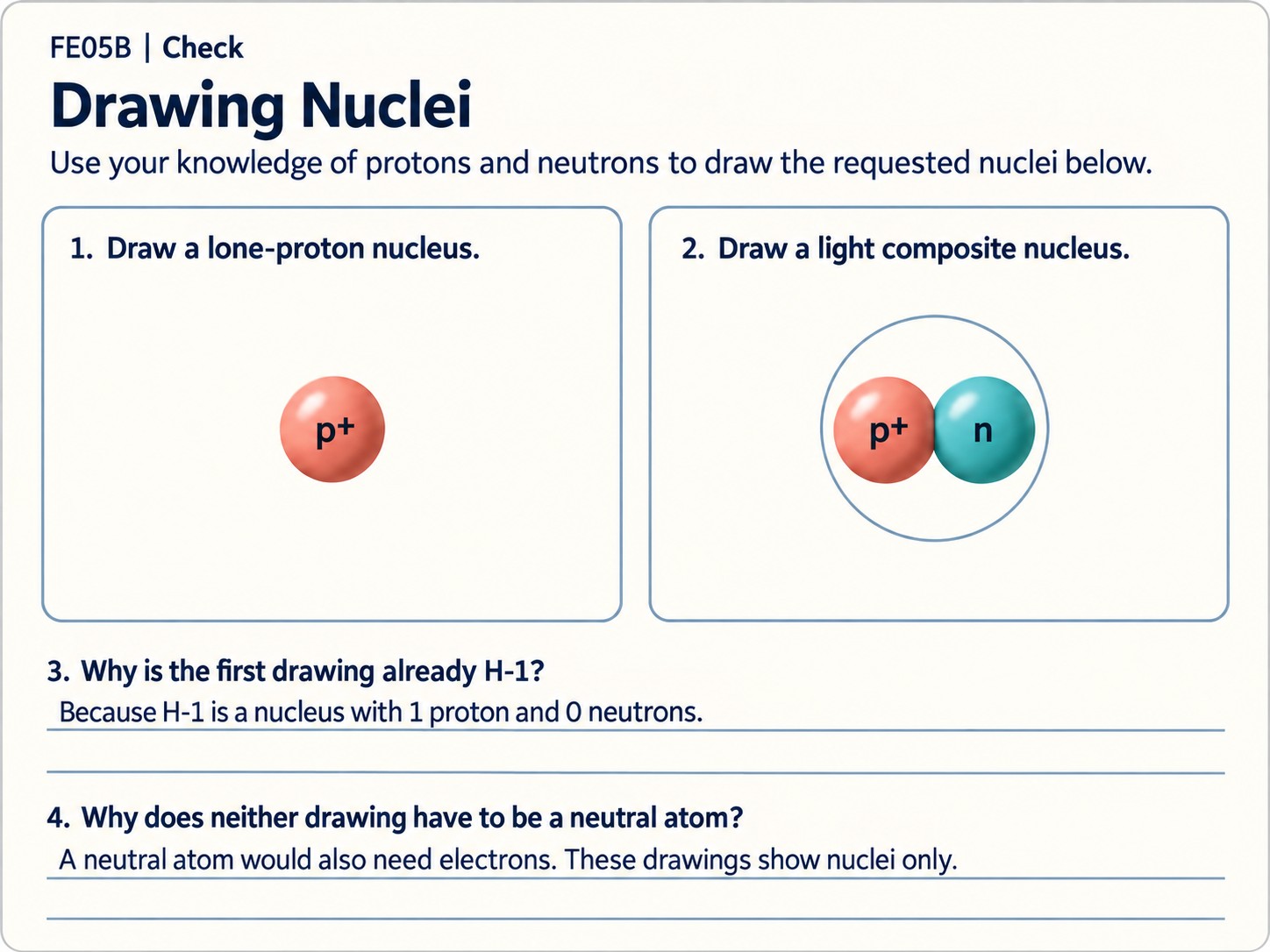
Draw a simple before-and-after diagram in two boxes. In the first box, show a proton that has not joined any other nucleon. In the second, show an example of a light nucleus containing several nucleons.
Underneath, write two sentences: one explaining why the first example is already a hydrogen nucleus, and another explaining why neither drawing has to be a complete neutral atom.
Before checking, ask yourself whether your second diagram implies that ALL protons joined larger nuclei. If it does, change it.
Entropy — handoff
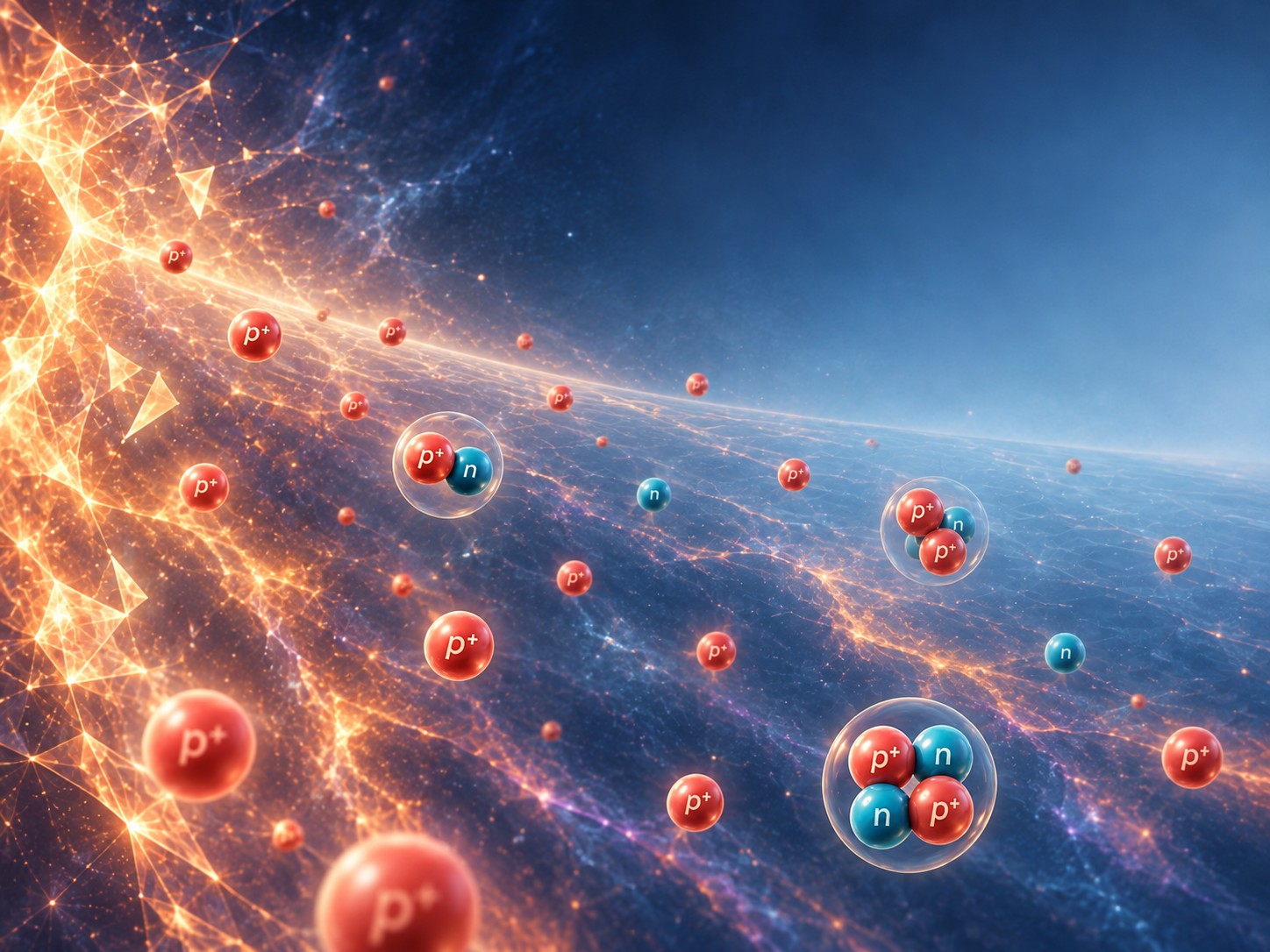
So much has happened in such a short time.
Some parts have joined. Some never did. Some of the new forms will not last unchanged.
The space grows thinner. The collisions grow rarer.
There will be another threshold, but not for a long while.
GCSE knowledge coverage
This page provides context and navigation; no new GCSE knowledge is taught here.

Beryllium
Beryllium is the chemical element identified by proton number 4; this branch groups its beryllium-specific nuclear learning.
Helium Formation
Helium forms during primordial nucleosynthesis when protons and neutrons fuse into stable helium nuclei, fixing the universe’s second most abundant element.
Hydrogen Formation
Hydrogen forms as the dominant element of the universe. Protons stabilise into long-lived nuclei, fixing the basic material from which all future stars, galaxies, and life will emerge.
Lithium Formation
Lithium forms in trace amounts during primordial nucleosynthesis, marking the upper limit of element formation before the universe cools too quickly for further fusion.