Atomic Number (Proton Number)
What tells us which chemical element a nucleus belongs to?
A new question
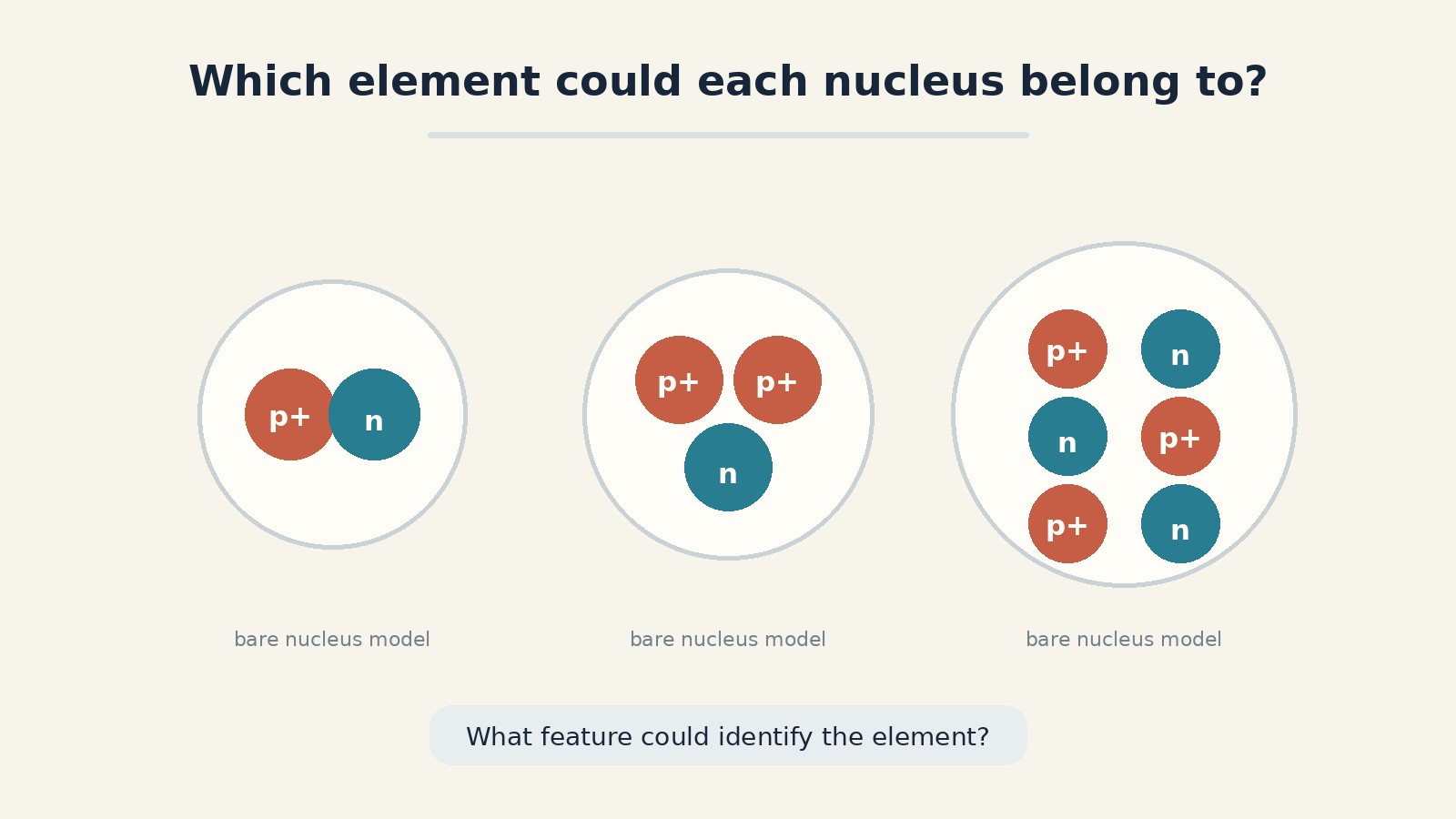
You have met the nucleus. You know that it contains protons and that many nuclei also contain neutrons. But how can we tell whether two different nuclei belong to the same chemical element?
Look closely at the particles in the next models. You already know how to recognise a proton and a neutron. You do not need a new rule yet: begin by observing what the models have in common.
Sort four nuclei
1 of 2
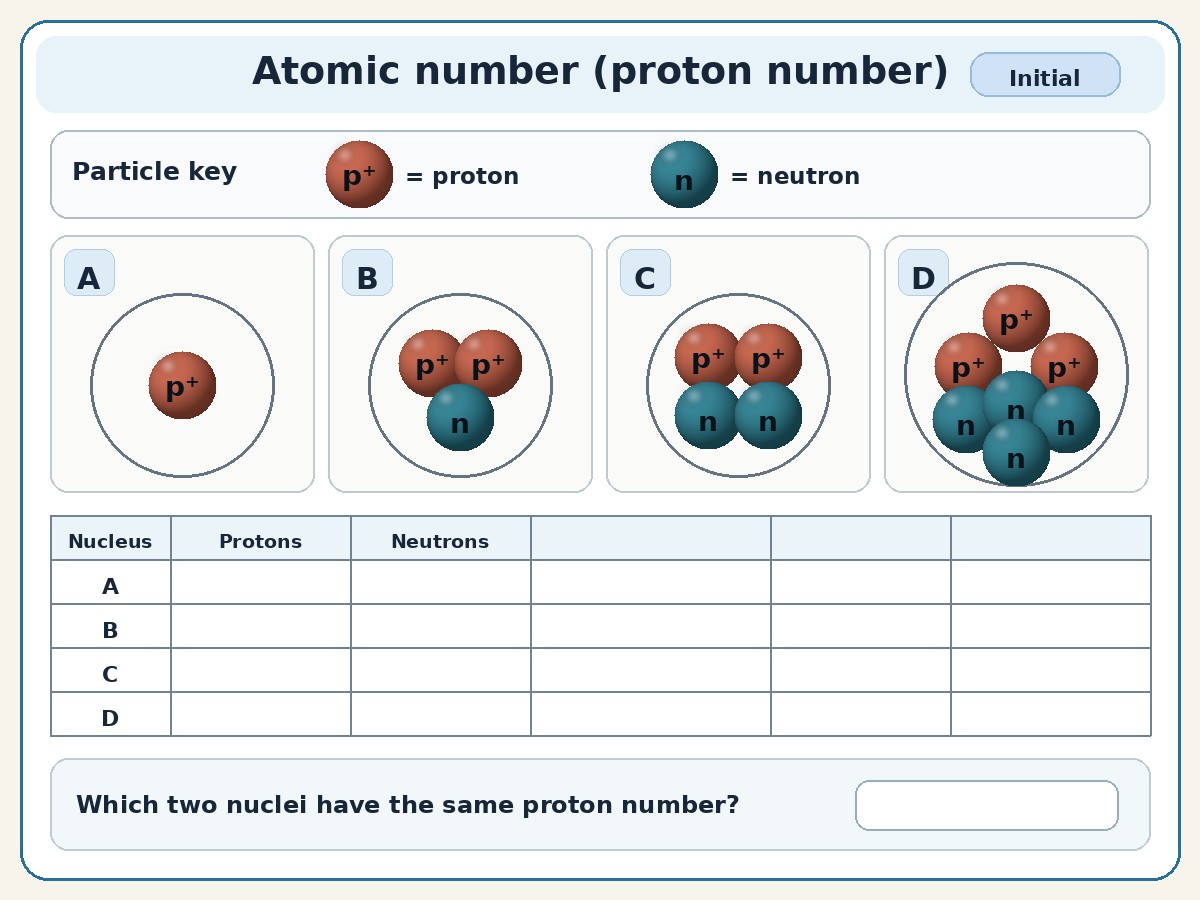
The four nuclear models are called A, B, C and D. Each proton and neutron is shown separately.
Count the protons in each model and record your results. Then count its neutrons. Which two models have the SAME number of protons, even though they do not have the same number of neutrons? Write the two letters and explain how you chose them.
The proton number
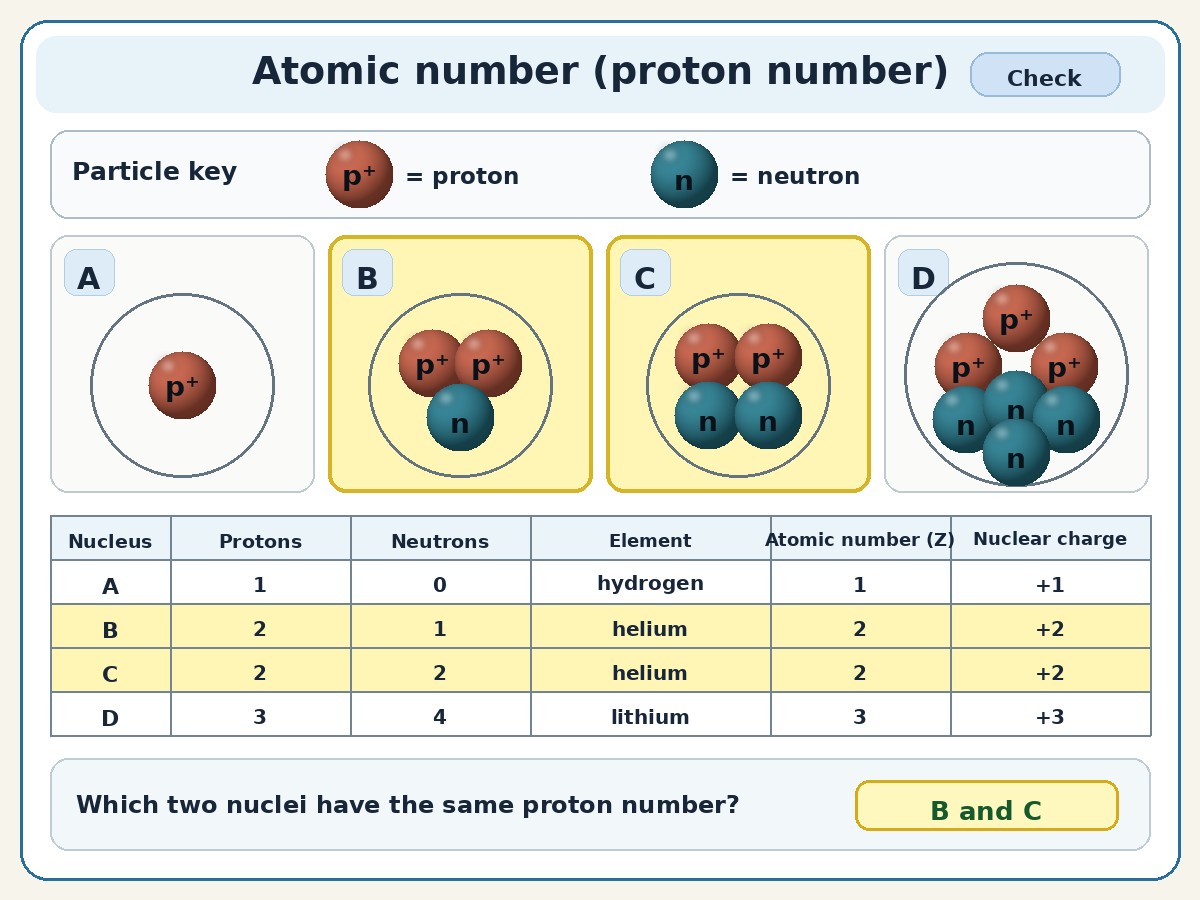
B and C both contain two protons. They belong to the same chemical element, even though one contains one neutron and the other contains two.
The number of protons in a nucleus is its ATOMIC NUMBER, also called its PROTON NUMBER. We write it as Z. Every nucleus of a particular element has the same Z. If the proton number is different, the element is different.
A, with one proton, is a hydrogen nucleus (Z = 1). B and C are helium nuclei (Z = 2). D is a lithium nucleus (Z = 3). Their neutron numbers do not change which element they belong to.
A proton has relative electric charge +1. A neutron has charge 0. This means a nucleus with two protons has relative charge +2, whether it has one neutron or several. The proton number therefore tells us both which element the nucleus belongs to and how much positive charge its nucleus has, measured in units of the proton's charge.
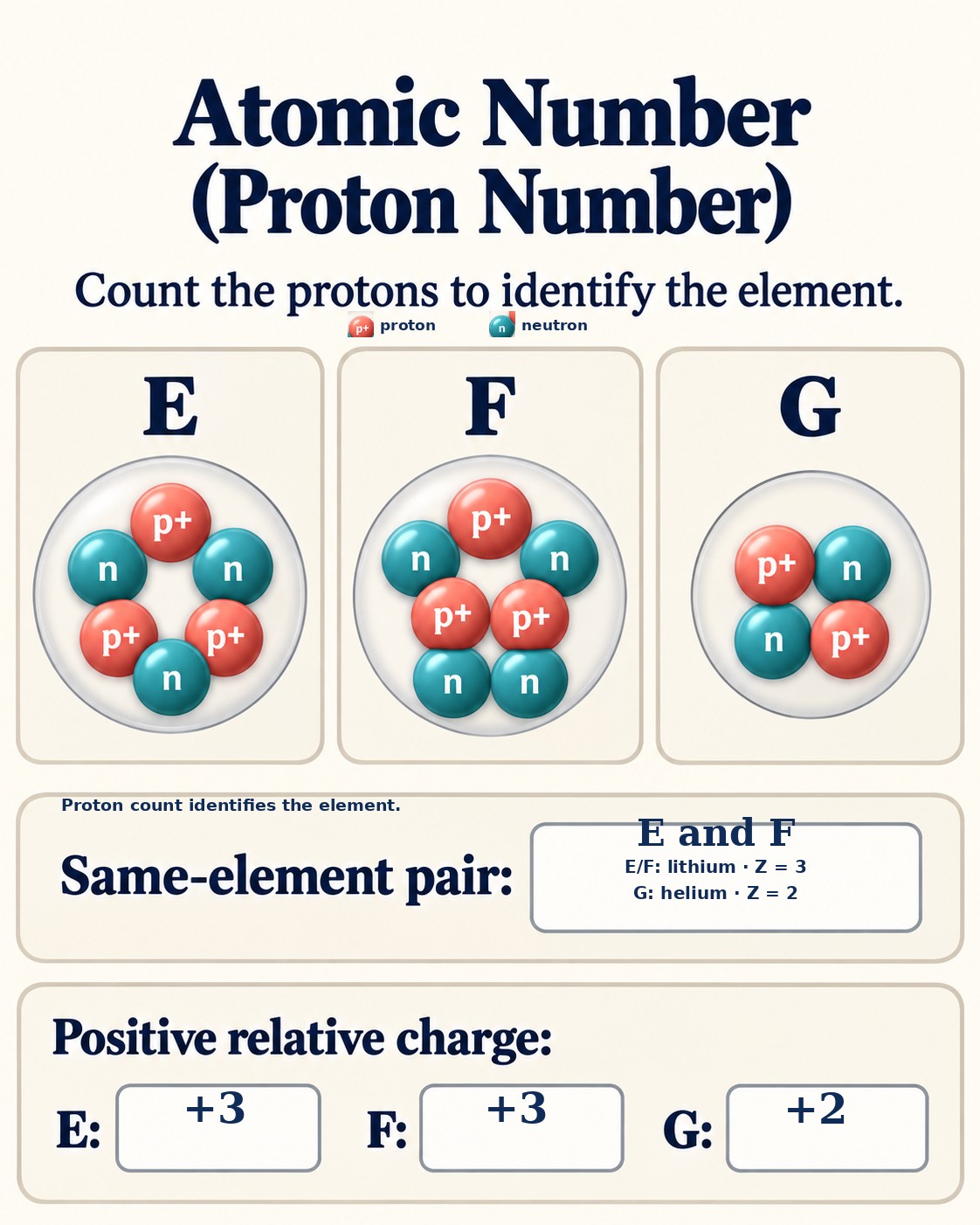
Can you identify a new pair?
1 of 2
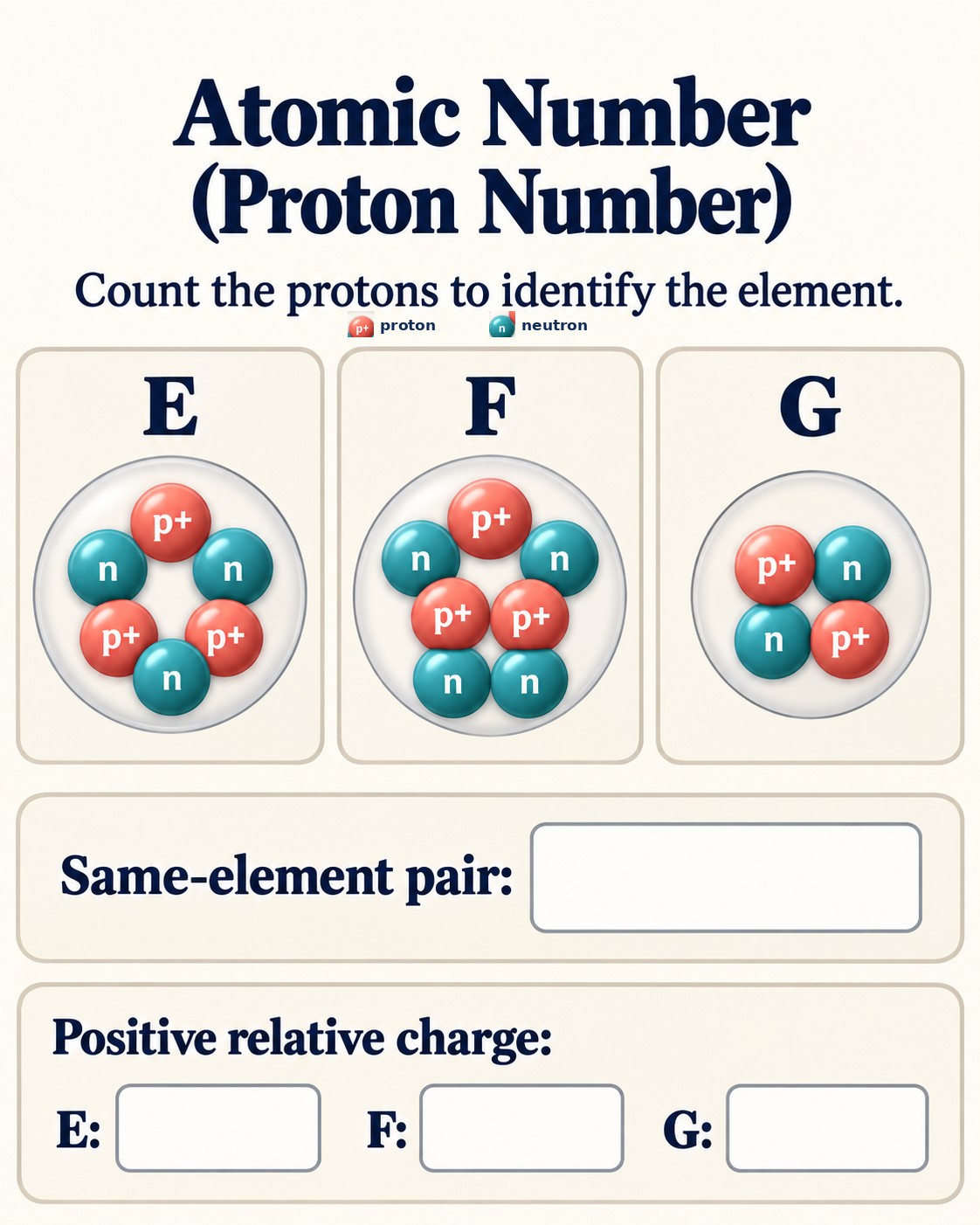
Here are three different nuclei. E has three protons and three neutrons. F has three protons and four neutrons. G has two protons and two neutrons.
Which two belong to the same element? Write their letters, their proton number Z, the element's name and the positive relative charge of EACH of those nuclei. Explain why the remaining model belongs to another element.
Try it before checking your answers.
Remember this lesson
Without returning to the explanation, answer three short questions.
First, what is the atomic number of an element, and what symbol represents it?
Second, compare a nucleus with one proton and no neutrons with one containing one proton and one neutron. Do they belong to the same element? Give the reason.
Third, a nucleus has three protons. Name its element and state its positive relative nuclear charge. Explain why adding one neutron would not change the answer to either part of this question.
Write down your answers before opening Check your answers.
GCSE knowledge coverage
You have learned that an element is identified by its proton number, also called its atomic number, Z. You have practised identifying an element by counting protons in unfamiliar nuclei, comparing nuclei with different neutron counts and working out their positive relative nuclear charge.
In Pearson Edexcel Combined Science, this establishes the nuclear core of Chemistry 1.8 and applies the characteristic-positive-nuclear-charge idea in Physics 6.4. The complete atom-level language and related electron calculations will be developed when we reach full atomic structure. The mass number and isotope comparisons are taught on the next linked pages. Your qualification route will determine which specifications appear in the final personalised coverage list.