Archean Eon
The Archean Eon is the age of Earth’s first life. Oceans stabilise, continents begin to form, and biology enters the planet’s story.
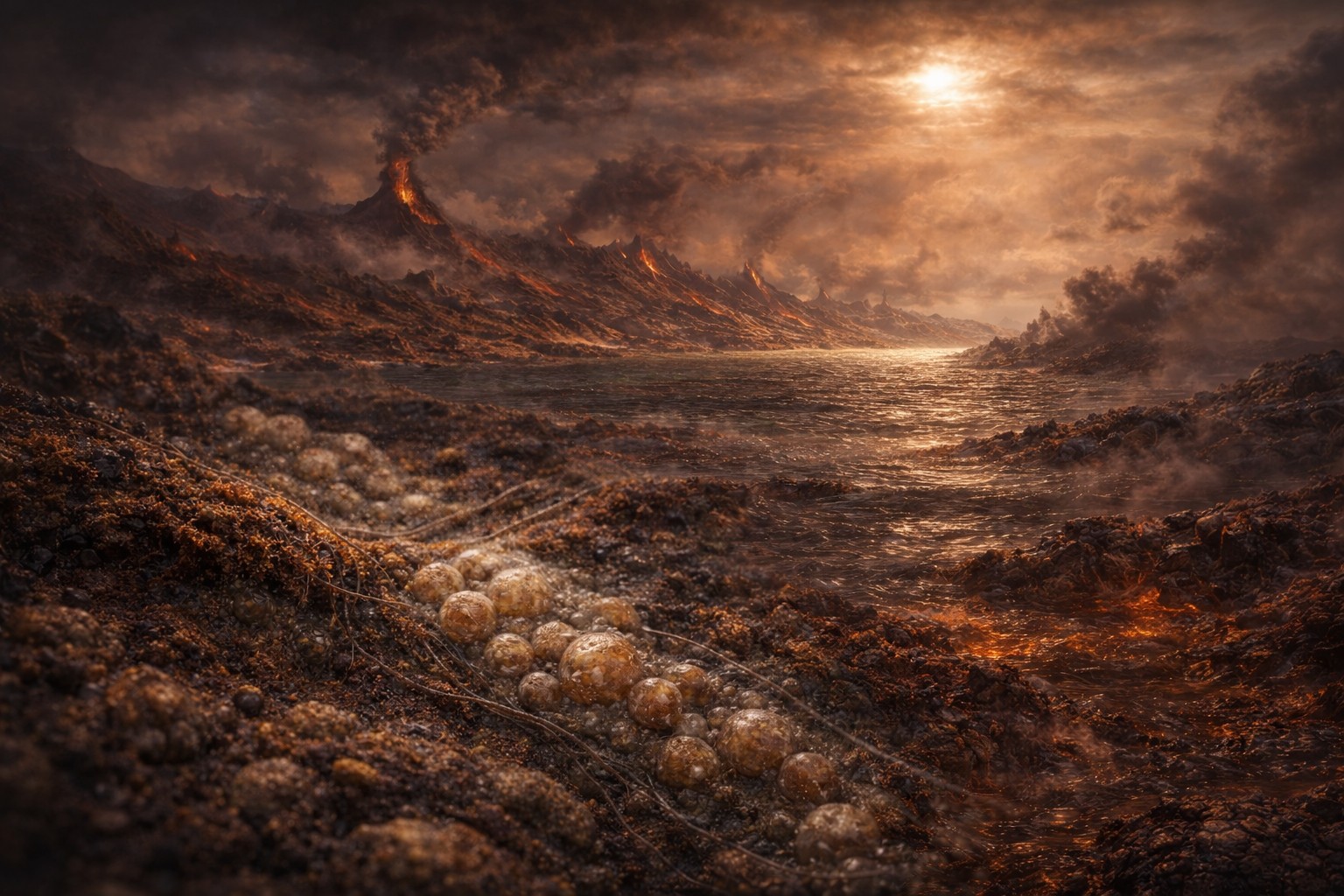
The Archean Eon begins around 4.0 billion years ago, roughly 9.8 billion years after the Big Bang. By this time, Earth has cooled enough to sustain long-lived oceans and a more stable crust.
It is during the Archean that life first appears. Simple, single-celled organisms emerge, likely in ocean environments. These early life forms are anaerobic, thriving without oxygen, and rely on basic chemical energy sources.
Continents grow slowly through volcanic activity and crustal recycling. The planet’s surface remains dynamic, but no longer chaotic. Atmosphere and oceans interact continuously with early biology, beginning a long process of planetary transformation.
Toward the later Archean, some organisms evolve photosynthesis. Oxygen is produced, but quickly absorbed by oceans and rocks. Its presence does not yet accumulate in the atmosphere, but the groundwork for a major planetary shift has been laid.
The Archean ends with life firmly established, though still simple. Earth is now a living planet.