Television
How television became a mass system for bringing the same moving images into millions of homes, how schedules and broadcasters shaped culture, and what remains of that system as streaming takes over the screen.
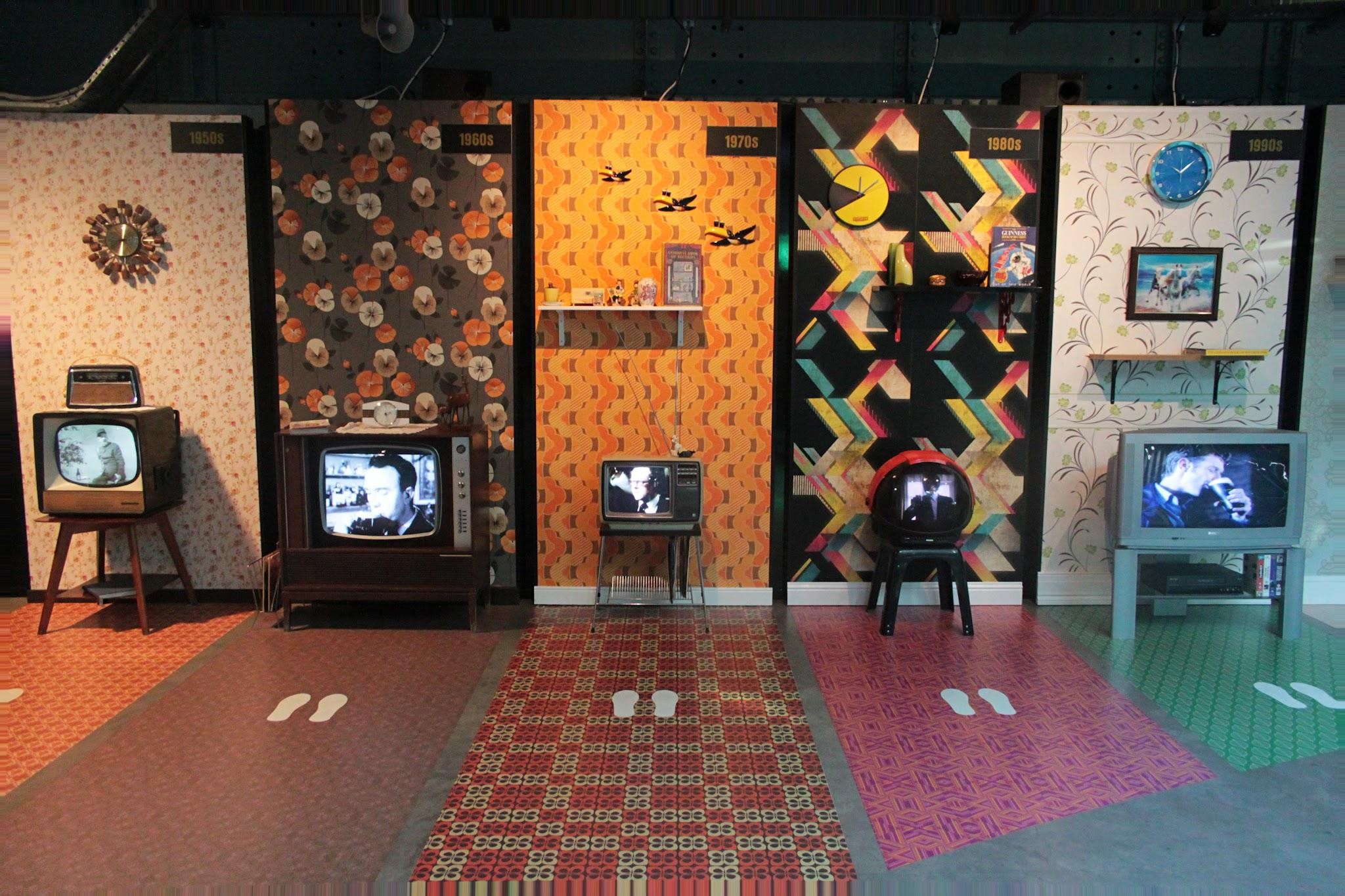
Television is more than a screen. For most of the twentieth century it was a distribution system: scheduled programmes sent by terrestrial broadcast, cable or satellite into homes, organised by broadcasters and experienced according to a shared timetable. The television set, the television schedule and the television industry became so closely associated that the object and the medium were often treated as the same thing.
On Unset, Television means that legacy broadcast medium rather than every series that happens to be watched on a television set. Programmes belong here when they originated within scheduled broadcast, cable or satellite television, including programmes whose original runs began before streaming platforms became the distribution environment they were designed around. Later availability on iPlayer, Netflix or another streaming service does not change that origin. A streaming-native series does not become Television merely because somebody watches it on a TV.
That distinction matters because the television set is surviving a transformation of television itself. Broadcasting once bundled the screen, the distributor, the schedule and a mass audience into one system. Streaming separates those layers. The history of television is therefore not only a history of better pictures and larger screens; it is also the history of a system that synchronised attention, created shared cultural moments and gave a relatively small number of institutions enormous influence over what whole populations saw.
The invention of television
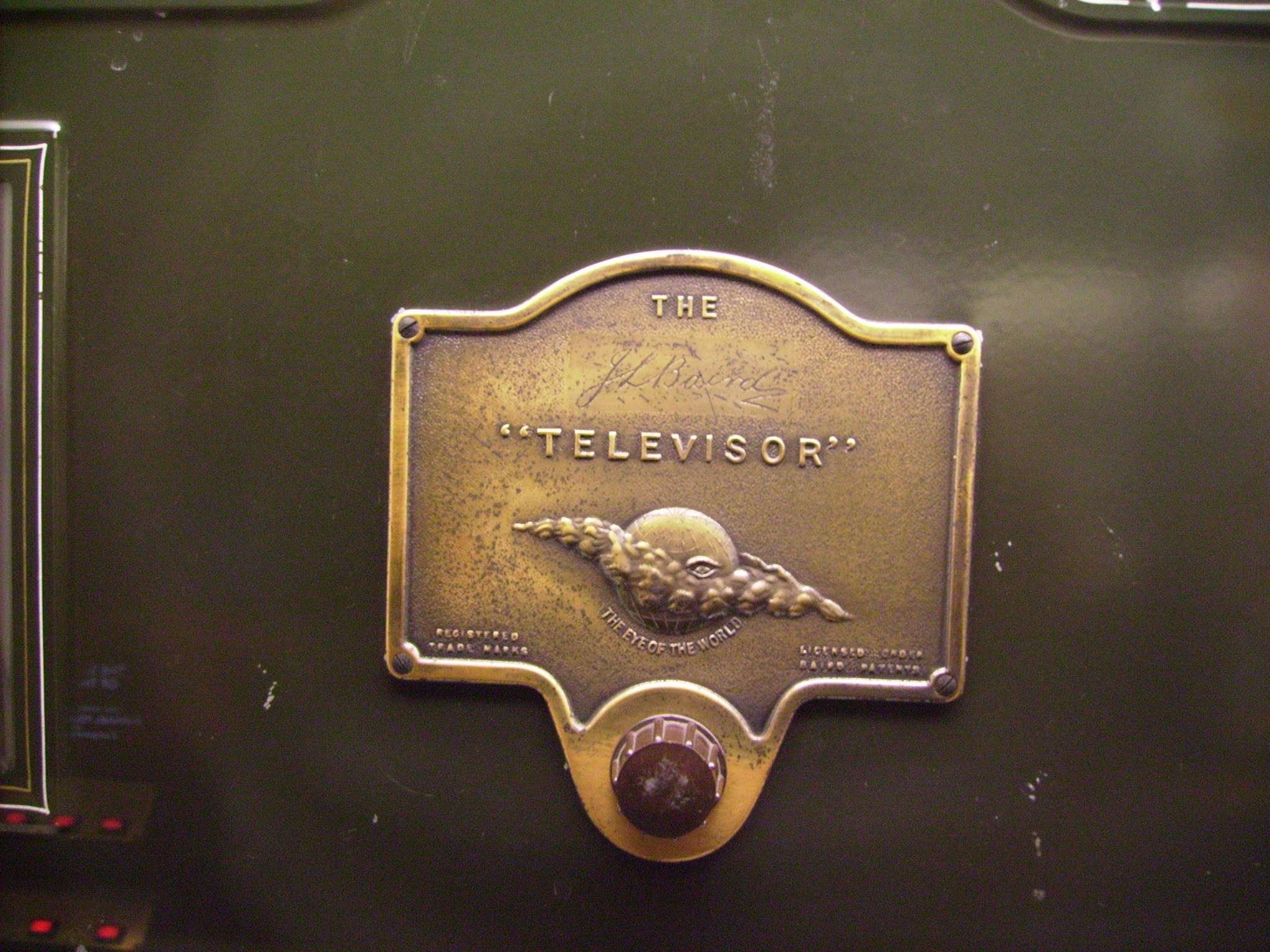
Television emerged from a long attempt to turn images into signals that could be transmitted and reconstructed somewhere else. In Britain, John Logie Baird's demonstration in Soho on 26 January 1926 publicly showed recognisable moving greyscale images produced by a mechanical television system. Baird's low-definition experiments were important because they demonstrated that moving pictures could be sent rather than physically carried, but mechanical scanning was only one stage of the technology's development.
During the 1930s, television moved towards electronic scanning, which could produce more stable and detailed pictures. The BBC opened its regular high-definition television service from Alexandra Palace on 2 November 1936, initially testing the Baird system alongside the electronic Marconi-EMI system. The electronic 405-line system prevailed. Television was therefore not the product of one invention or one inventor: it depended on the convergence of cameras, scanning systems, radio transmission, receivers, displays and the institutions capable of organising a continuous broadcast service.
Television becomes a mass medium
The BBC television service closed at the outbreak of the Second World War in September 1939 and resumed in June 1946. Its post-war importance came from scale. Television sets moved from technical curiosities and expensive luxuries into ordinary homes, while outside broadcasts demonstrated that events occurring somewhere else could be experienced collectively and immediately.
The Coronation of Elizabeth II in 1953 became a decisive example. Around 20 million people in the UK watched the broadcast, many gathered around the roughly 2.3 million television sets then in use. Television had become capable of creating a mass audience around a single live event. Commercial competition followed when ITV began broadcasting in 1955. By the end of the 1950s there were more television households than radio-only households in Britain, and by 1970 more than nine in ten households owned a television. The medium had become part of domestic infrastructure rather than a novelty.
Television and society
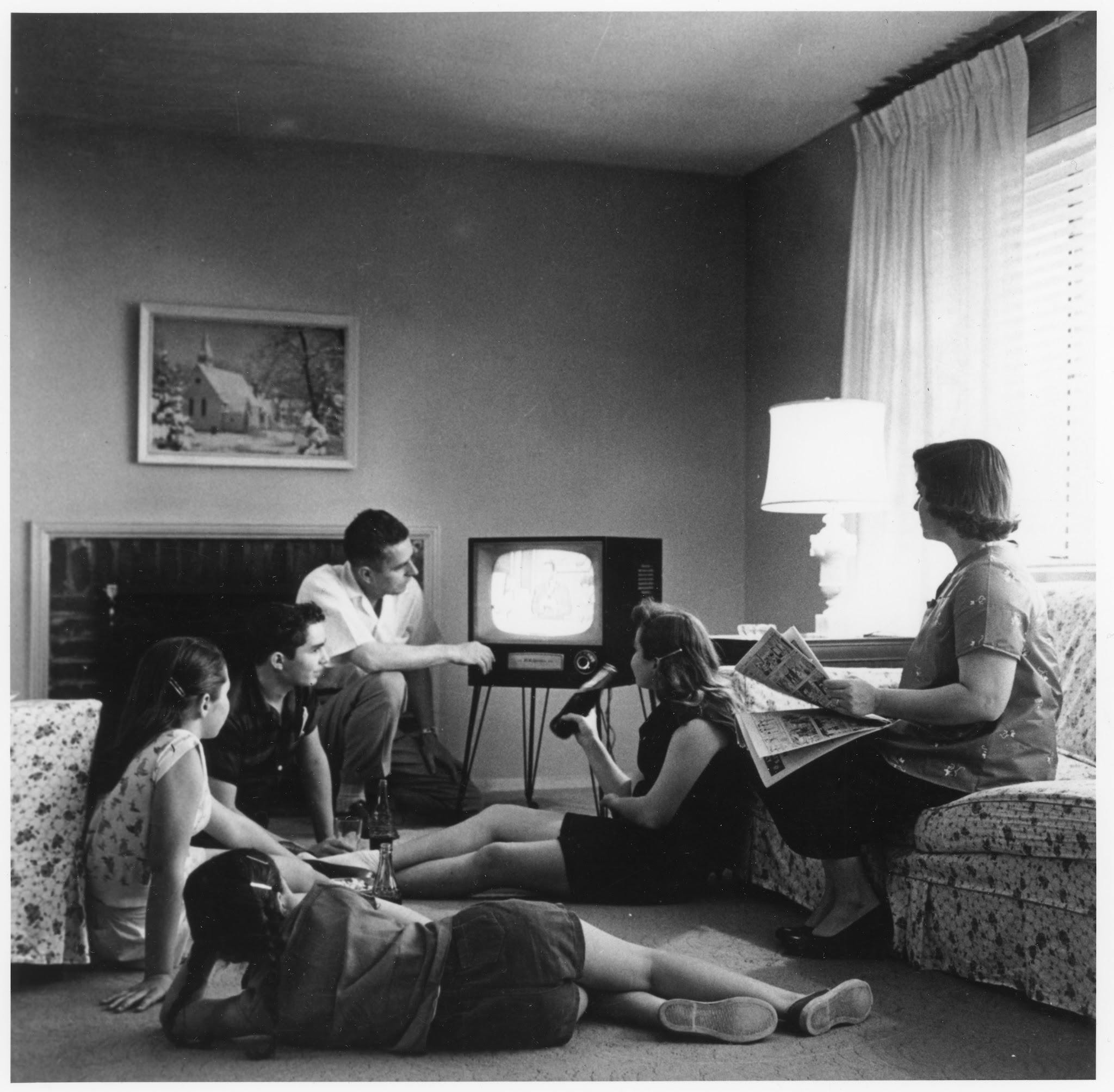
Television reorganised everyday life partly because it brought public events into private space. The set became a focal point of the living room, while schedules placed programmes at fixed points in the day and week. Families watched together because there was usually one screen, a limited number of channels and no expectation that a programme could simply be started whenever somebody wanted it.
The same system changed politics, advertising, sport, news, childhood and celebrity. Political leaders could address people in their homes. Television advertising attached images, personalities and stories to consumer products. Live sport became a shared national and international spectacle. Recurring presenters and performers acquired a familiarity that cinema stars did not necessarily have, while children's programmes became part of the rhythm of growing up. Television created common references across large populations, but that concentration also gave broadcasters substantial gatekeeping power over which people, subjects and ways of living became visible.
The form television created
The limitations of broadcasting became part of television's artistic grammar. A schedule needs programmes of predictable lengths. A channel needs material every day. Commercial channels need places for advertising. Audiences need reasons to return next week. These pressures helped establish the half-hour sitcom, the hour-long drama, the soap opera, the game show, the chat show, the nightly news bulletin, children's programming blocks, scheduled documentaries, live sport and the seasonal series.
Serial television could do something cinema usually could not: remain with characters and institutions for months or years. Repetition created familiarity, while weekly gaps made anticipation, cliffhangers and discussion part of the experience. Streaming has changed the delivery system, but much of its programme structure still inherits television's episodes, seasons, recurring characters and long-form serial storytelling.
Cable, satellite and time-shifting
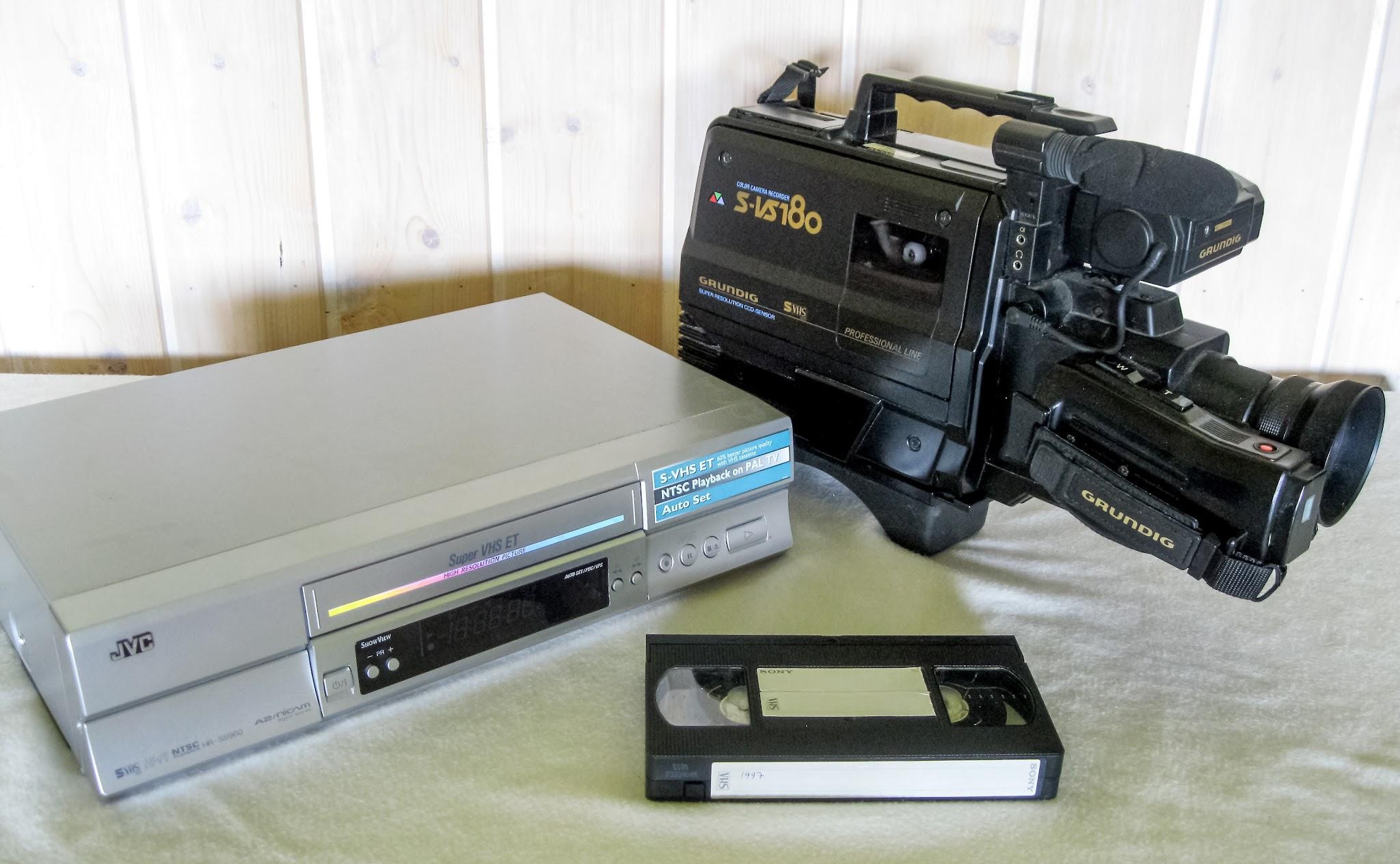
Streaming did not suddenly interrupt an unchanged broadcast system. Television had already been loosening the relationship between a programme and its transmission time for decades. Video recorders allowed viewers to time-shift programmes. Cable and satellite greatly increased the number of channels and made more specialised audiences economically viable. Remote controls and electronic programme guides changed how people moved through those expanding schedules.
Digital television increased capacity again and made broadcasting increasingly software-like. In the UK, the terrestrial network moved from analogue to digital through the regional switchover completed between 2008 and 2012. Digital recorders, broadcaster catch-up services and on-demand libraries weakened the assumption that watching television meant watching whatever a channel happened to be transmitting at that moment. By the time subscription streaming became dominant, television had already been moving from a flow of scheduled programmes towards an archive that viewers could search and start for themselves.
Television after streaming
By 2026 the television set and the television medium are clearly separating. Ofcom still finds that broadcaster content accounts for the majority of video watched in UK homes, but the weekly reach of traditional broadcast television continues to fall. Broadcasters are responding by turning themselves into on-demand platforms: viewing of services such as BBC iPlayer, ITVX, Channel 4 Streaming and 5 grew by 9% year on year, while subscription streaming penetration has largely plateaued at around 70% of UK homes.
The competition is now visible the moment a screen is switched on. In Ofcom's 2026 research, 26% of viewers said Netflix was the first place they looked for something to watch, compared with 25% for the BBC and 15% for ITV. YouTube viewing on television sets has doubled since 2022. The physical television remains important, but it has become a general-purpose display for competing distribution systems rather than the terminal of a single medium.
What remains strongest about television is often what streaming cannot completely replace: simultaneity. News, elections, major ceremonies and especially sport still gain value from being watched as they happen; Ofcom found that 85% of sports viewing in 2025 was live. Television is therefore unlikely to disappear all at once. Its linear channels may become less central, while broadcasters, live events and public-service institutions continue inside a hybrid environment of schedules, catch-up libraries, streaming apps and internet video. The screen survives; the old system that once controlled almost everything appearing on it becomes one layer among several.