Matter
Matter feels like the one thing that all of reality agrees on. A wall pushes back. A stone has weight. A body occupies space. But the solid world began as heat, particles and instability, then passed through stars, chemistry, cells and nervous tissue before becoming complex enough to ask what it is made of. Matter does not stay still. It holds shape for a while, then thins back into the dark…
The Survivors
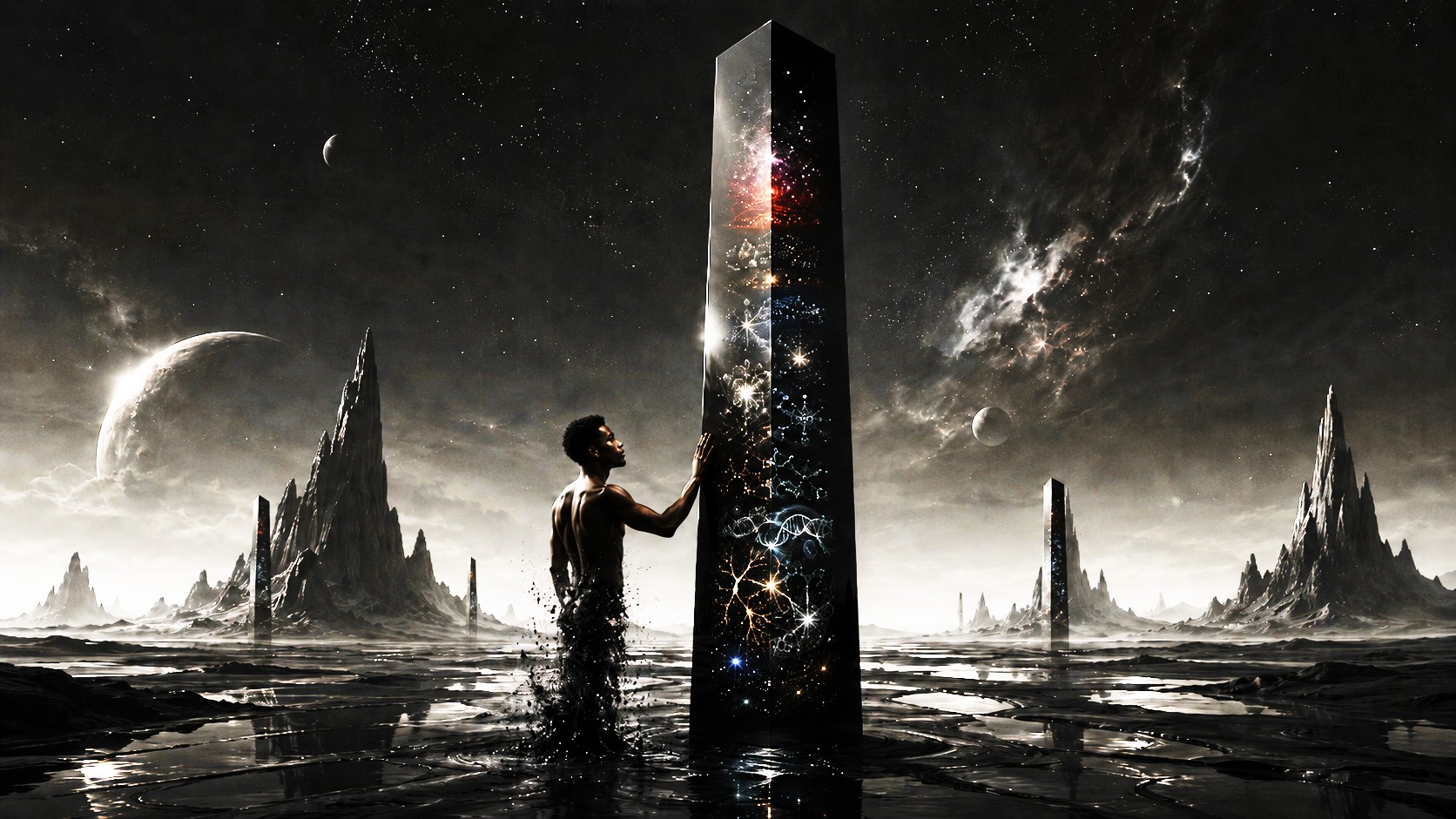
In the earliest universe, there were no tables, bones, oceans or planets. There was no matter in the ordinary sense.
There was heat, energy, radiation and particles appearing and disappearing. Energy could become particles. Particles could become energy. The universe was too hot and violent for stable structure.
As it expanded and cooled, most unstable particles vanished or decayed. The universe filtered itself down.
The matter we know came mainly from a small group of survivors: up quarks, down quarks and electrons.
Up and down quarks formed protons and neutrons.
Electrons would later gather around them.
That is the strange beginning of the material world. Not solidity. Not objects. Just a few stable ingredients surviving the cooling of the universe.
Cores Before Atoms
Quarks do not float around freely in ordinary matter. They bind together.
Two up quarks and one down quark make a proton.
Two down quarks and one up quark make a neutron.
These became the heavy cores of matter.
A few minutes after the Big Bang, the universe had cooled enough for some protons and neutrons to join. This formed the first simple nuclei: mostly hydrogen and helium, with tiny traces of lithium.
But these were not yet atoms. They were bare nuclei. Electrons could not settle around them because the universe was still too hot. Light kept knocking them away. Matter had formed cores, but not stable shells.
Then, hundreds of thousands of years later, the universe cooled enough for electrons to settle around nuclei. Atoms formed.
The material world took another step towards recognisable structure.
The Rule of Elements
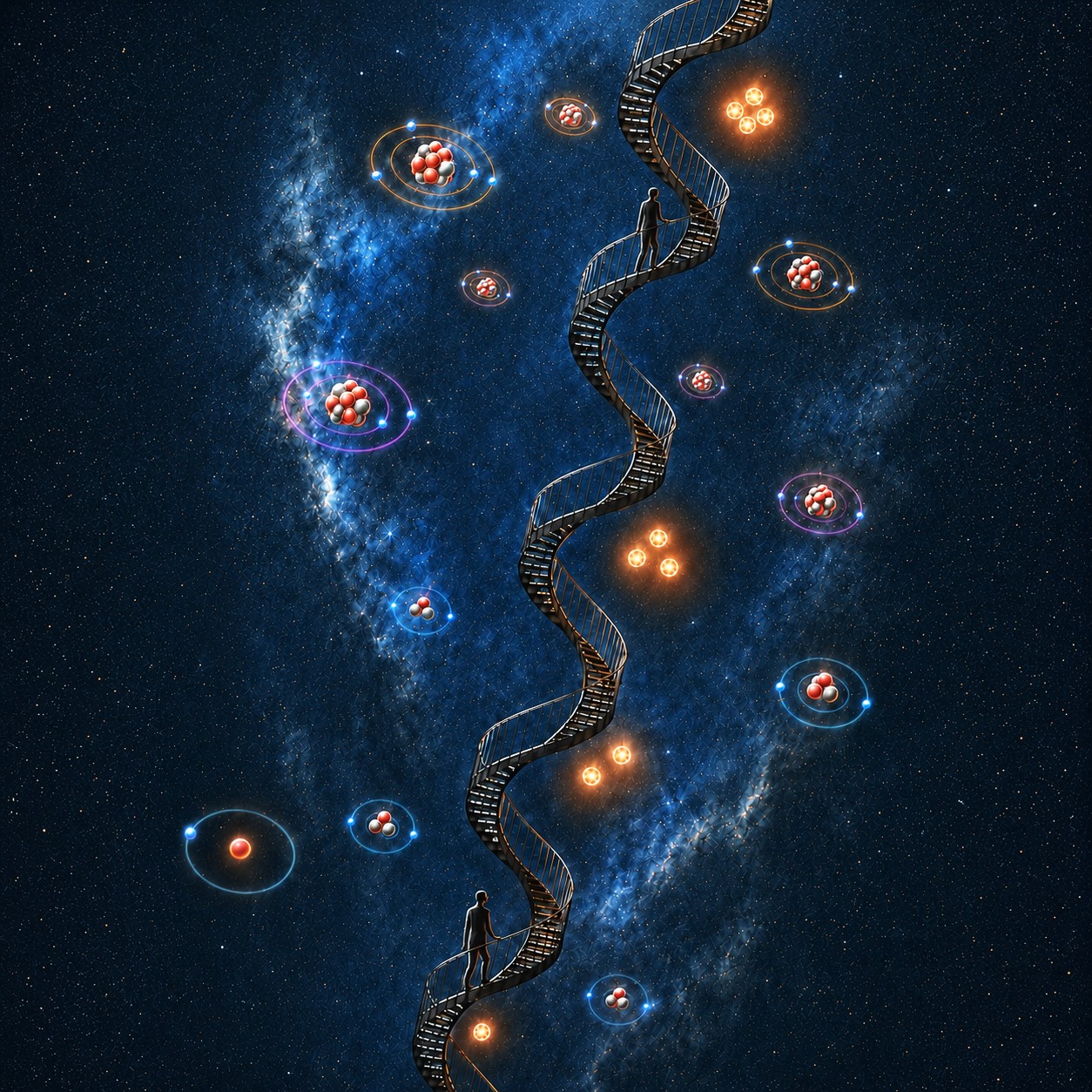
Matter becomes easier to understand once one rule is clear:
The number of protons decides the element.
One proton is hydrogen.
Two protons is helium.
Six protons is carbon.
Eight protons is oxygen.
Neutrons change the mass and stability of an atom. Electrons shape how atoms bond and react. That means the richness of matter comes from simple changes in structure. Add a proton and the identity changes. Rearrange electrons and the chemistry changes. Bind atoms together and new substances appear.
Matter is not made interesting by having endless ingredients.
It becomes interesting through arrangement.
Stars Make the World Rich
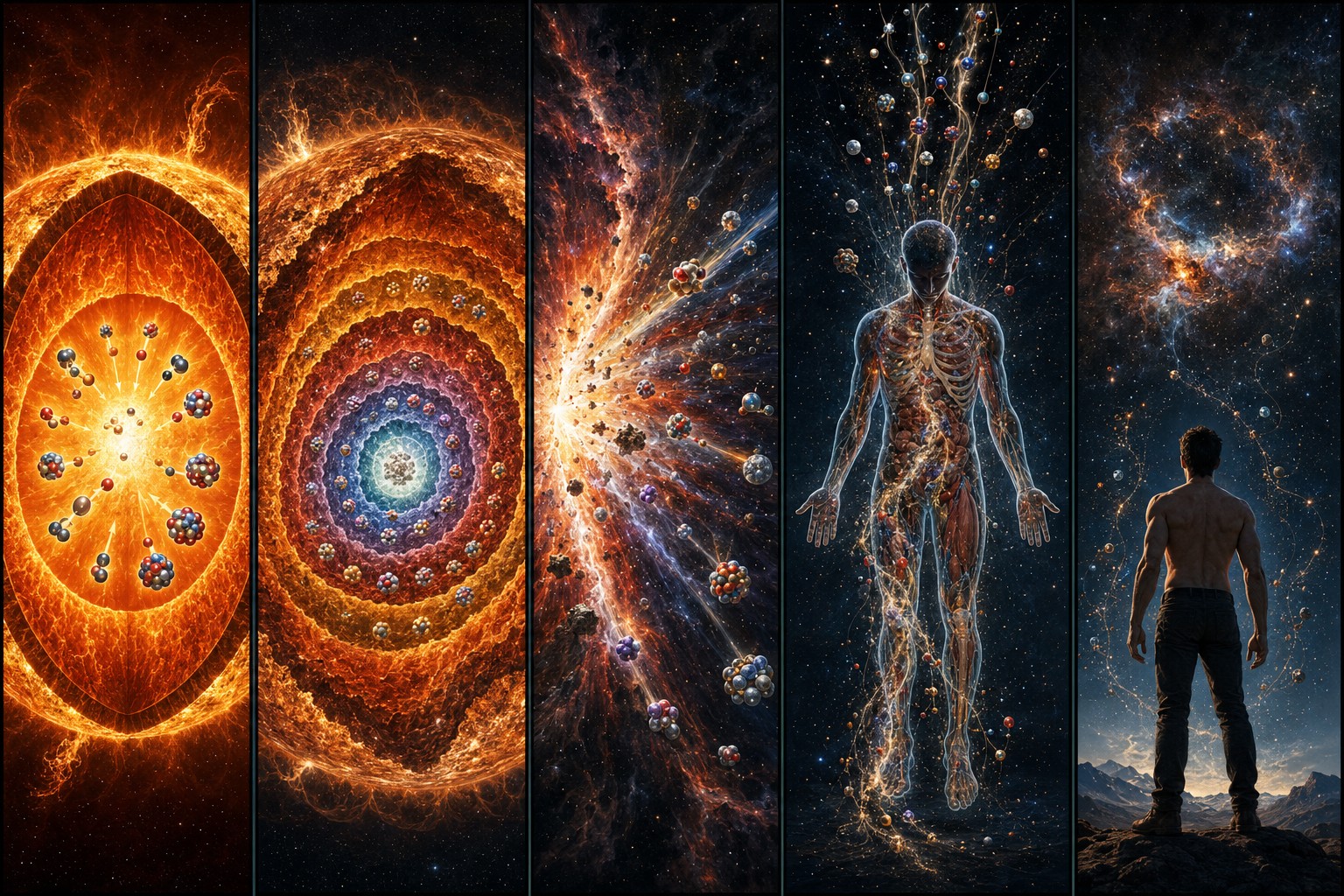
The Big Bang made mostly hydrogen and helium.
That was enough to make stars, but not enough to make rocky planets, oceans, blood, wood, skin or brains. For that, matter needed stellar pressure.
Inside stars, hydrogen fuses into helium. In larger and older stars, helium can fuse into carbon, oxygen and heavier elements. Massive stars build elements up to iron. The heavier elements need more extreme events, such as supernovae and neutron-star collisions.
Stars are not just lights in the sky. They are furnaces where matter becomes more varied.
When stars die, they scatter those elements into space. Later, gravity gathers them again. New stars form. Planets form. Chemistry deepens.
The atoms in a body are not new.
They are old matter, rebuilt.
Chemistry Becomes Life
Atoms bond by sharing or exchanging electrons. They form molecules. Hydrogen and oxygen become water.
Carbon, hydrogen, oxygen, nitrogen and other elements become sugars, fats, proteins and DNA.
At this stage, matter is no longer only forming objects. It is forming systems.
A cell is not made from some special life-stuff. It is matter arranged into membranes, reactions, repair, copying, signalling and energy use.
Life is matter organised into a process that maintains itself for a while.
It takes in material.
It uses energy.
It repairs damage.
It responds.
It reproduces.
It fails.
It adapts.
A stone and a cell are both matter, but they are not arranged in the same way. One holds shape. The other holds a living pattern.
Matter Begins to Notice
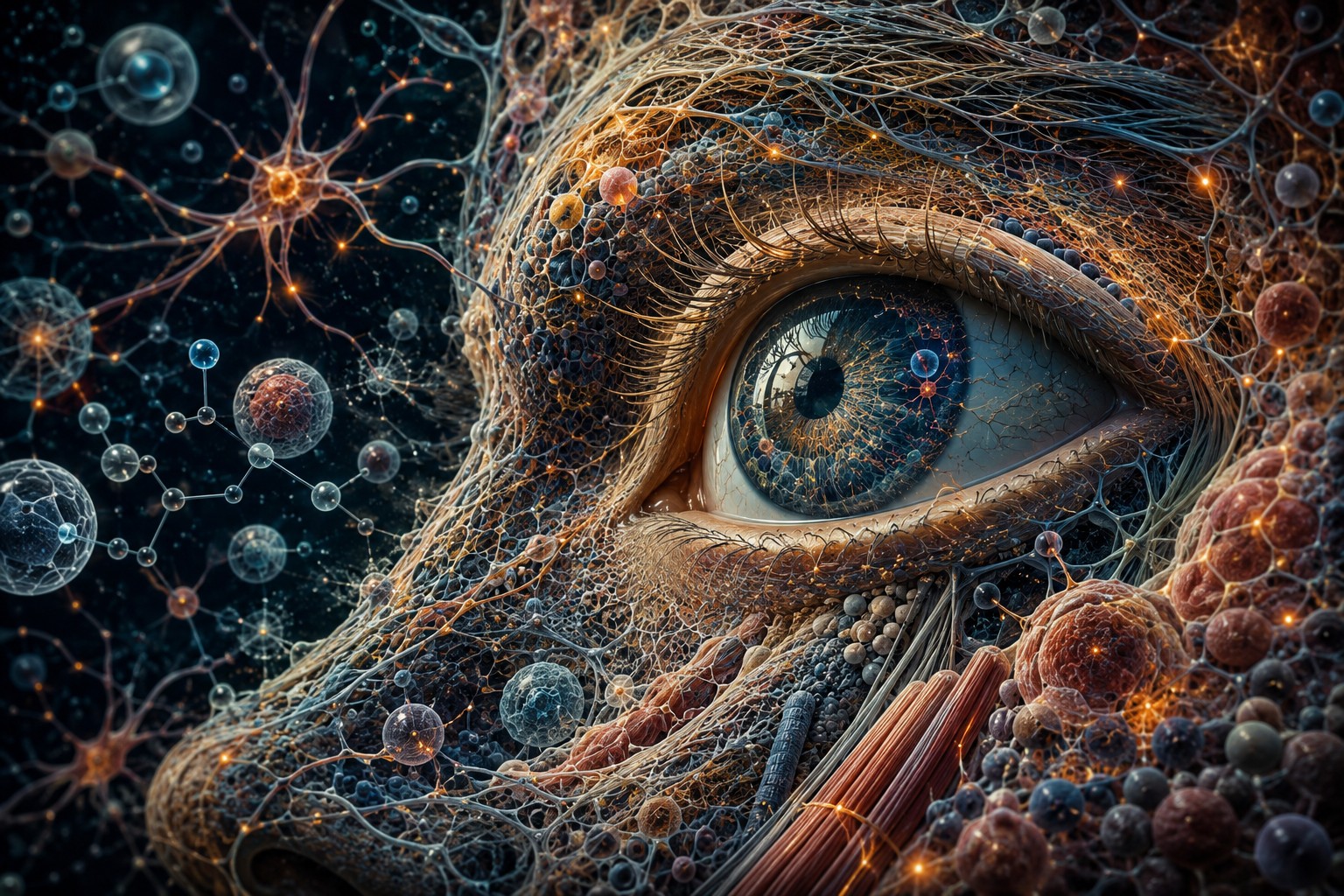
Some living matter becomes nervous tissue.
Neurons send signals. Glial cells support and regulate them. Grey matter becomes dense with processing. White matter becomes the wiring that connects distant regions.
This is still matter. Atoms become molecules. Molecules become cells. Cells become tissue. Tissue becomes circuits.
Circuits become perception, memory, movement, language and thought.
Nothing supernatural has been added. Matter has simply become organised enough to model the world around it.
That is where the question turns back on itself.
Matter becomes the thing asking what matter is.
The Long Cooling
This does not last forever.
The same universe that allows matter to gather also pulls it towards dispersal. Stars burn out. New star formation slows. Stellar remnants cool. Black holes dominate for vast stretches. Eventually, even those fade.
In the far future, the universe spreads so widely and becomes so cold and thin that meaningful interactions become almost impossible. Matter no longer gathers into stars, planets, bodies or brains. It drifts through distances too vast for new stories to form.
Matter does not end in a dramatic final moment. It thins. It loses structure.
It stops meeting itself.
What the Matter Is
Matter is not fixed stuff.
It is a structure held for a time.
It begins as instability and survives as particles. It binds into protons, neutrons and nuclei. It settles into atoms. It is remade in stars. It bonds into molecules. It organises into cells. It gathers into nervous systems. For a while, it becomes complex enough to notice itself.
Then, across enough time, it disperses again.
That is the deeper movement.
Matter is the universe becoming structured enough to resist, combine, burn, flow, live, think and ask what it is made of.