Protons and Neutrons
How can different combinations of the same kinds of quark produce two particles with different charges — and why do both matter later?
A difference appears
There.
Two new things.
Almost the same.
Almost.
Look inside.
Two kinds of hadron
As the early universe expanded and cooled, conditions changed. Up quarks and down quarks could become confined inside larger particles called hadrons.
A hadron is a composite particle: it contains smaller particles. Protons and neutrons are two kinds of hadron. Unlike the elementary up and down quarks, they have an internal structure.
Protons and neutrons are also called nucleons. The name matters because these particles can later become parts of an atomic nucleus.
A nucleus is the small central part of an atom. We are not at the stage of complete atoms yet. First, we need to look inside the two particles.
Inside a proton
1 of 2
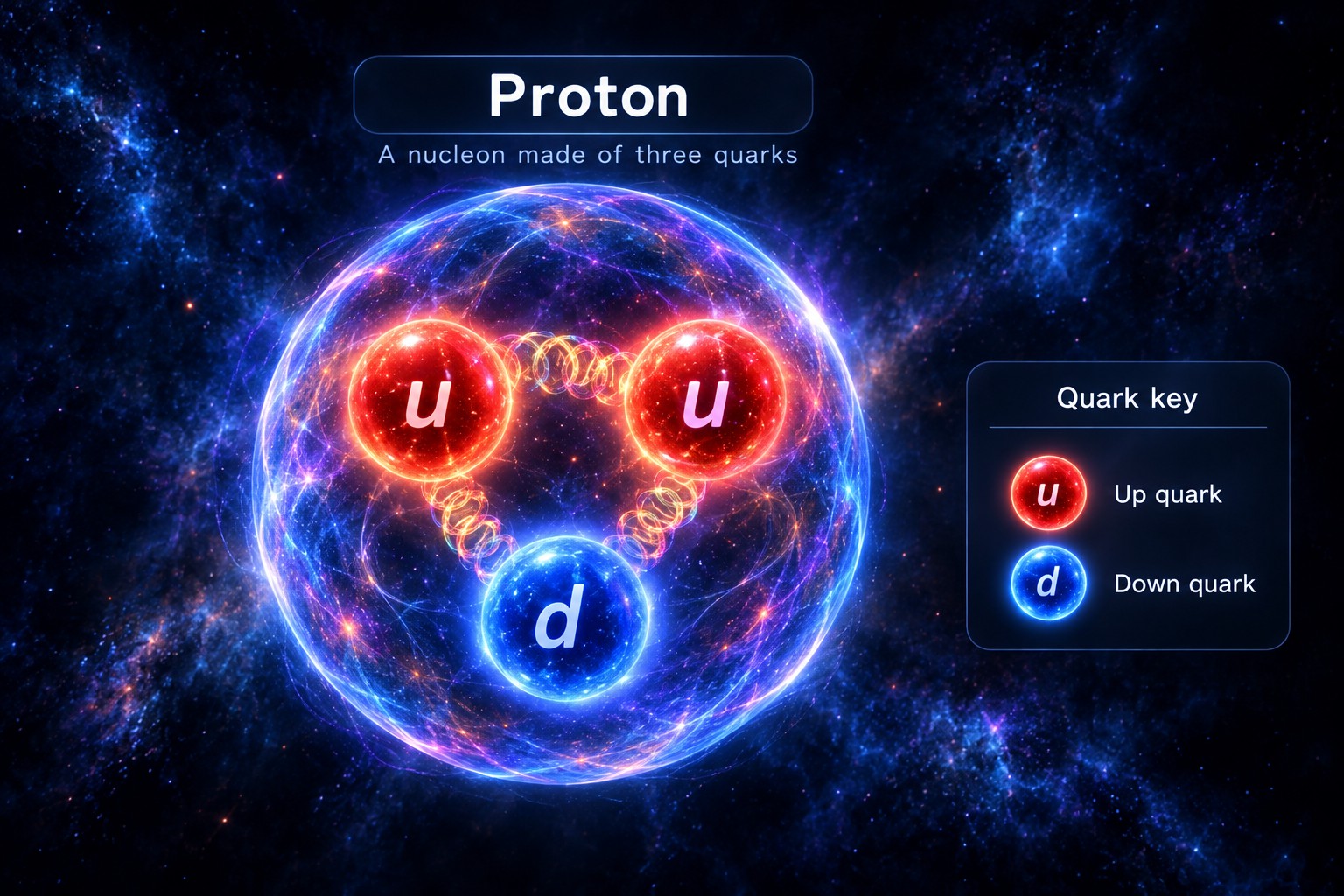
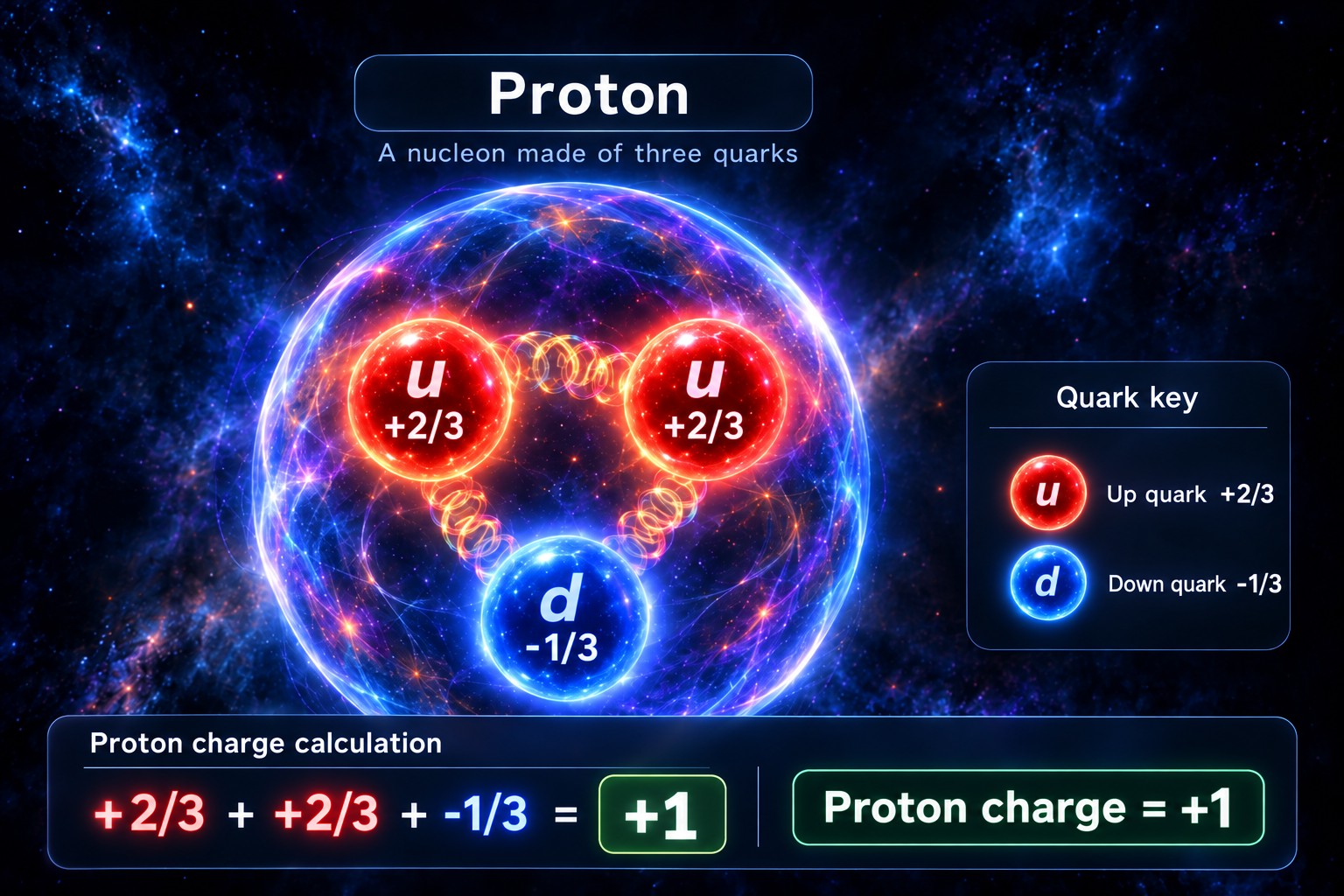
A simple way to describe a is to show its three valence quarks. These are the quarks used to identify the ’s main constituent pattern. The diagram is a scientific model, not a literal photograph of three motionless balls.
In the first image, u means and d means . Count them before moving to the completed image. How many up quarks are shown? How many down quarks?
Then calculate the relative charge using the supplied values: an contributes +⅔ and a contributes −⅓. Write your sum before using the image controls to check it.
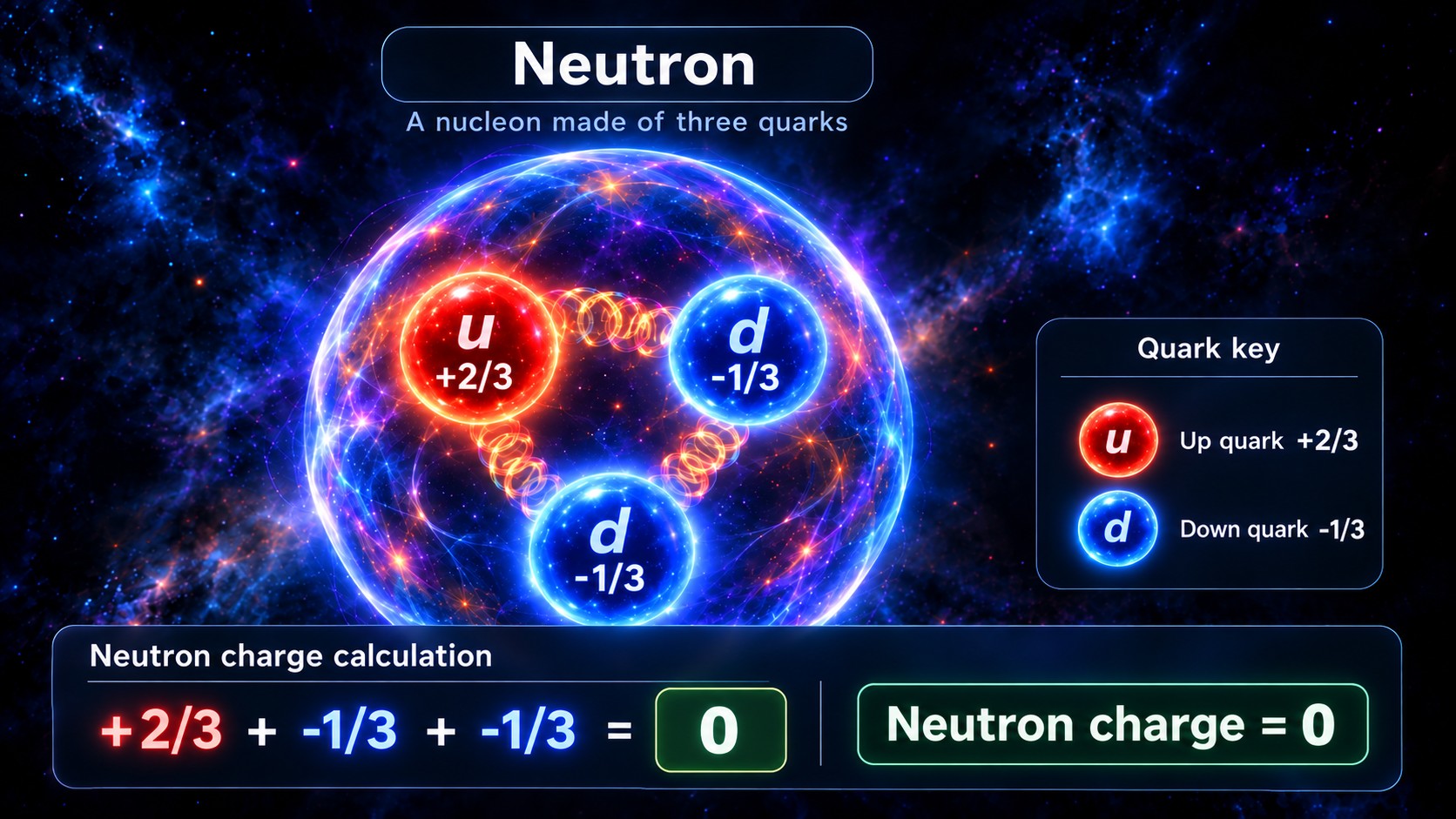
Inside a neutron
1 of 2
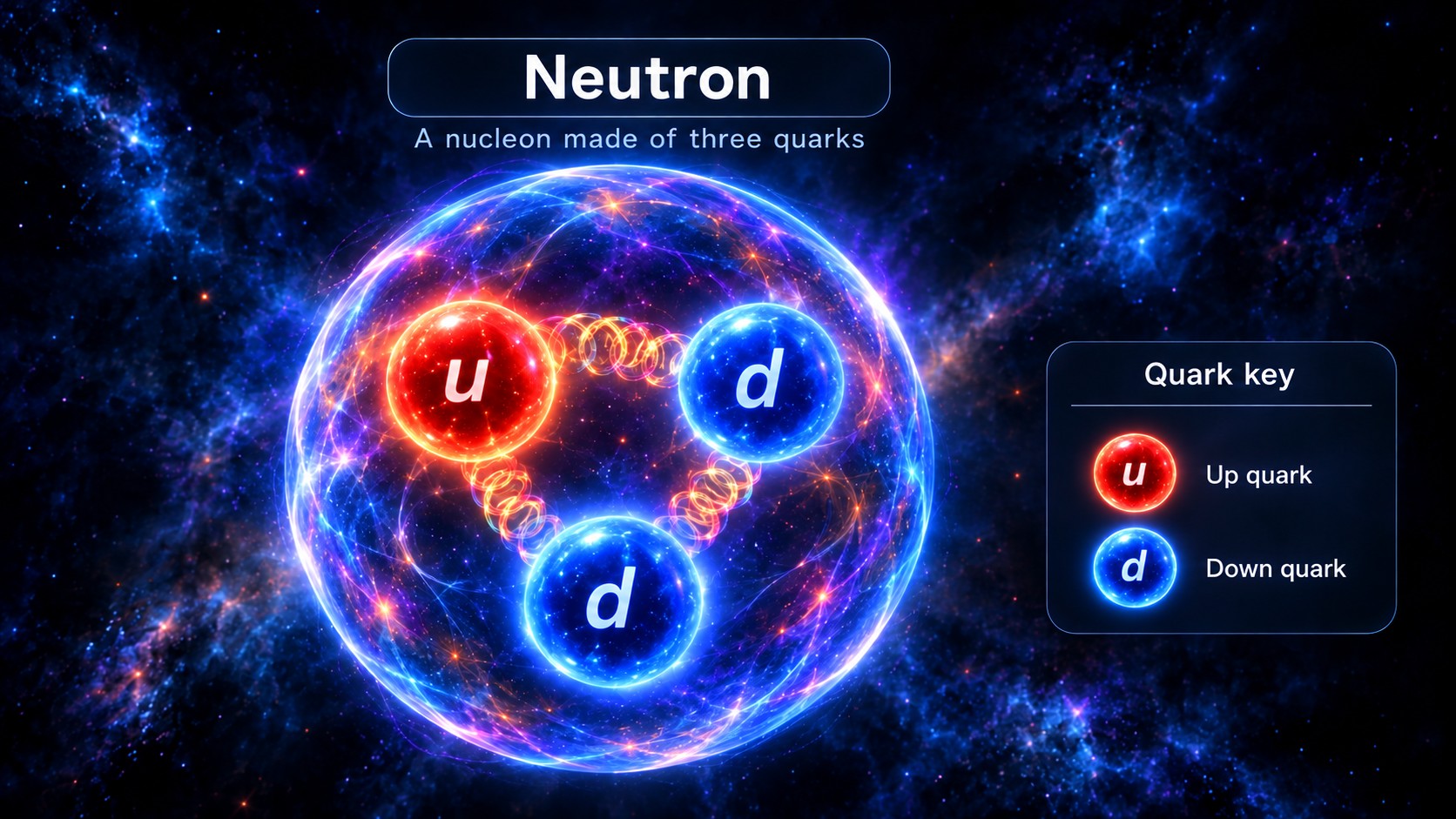
Now examine the model. It uses the same two kinds of valence quark, but in different numbers.
Count the up quarks and down quarks in the first image. Then use the same supplied charge values — up +⅔ and down −⅓ — to calculate the total relative charge.
Try the count and the calculation before moving to the completed image. Notice that a total charge of zero does not mean the constituent quarks have no charge; their charges add to zero.
The small difference
There it is.
The same kinds of pieces.
A different pattern.
And something changes.
Two particles, two properties
We can now compare the and without looking inside a model every time.
— valence model: up + up + down; relative charge: +1; approximate relative mass: 1.
— valence model: up + down + down; relative charge: 0; approximate relative mass: 1.
Relative mass means mass expressed on a common comparison scale. The two values are rounded: the actual masses of a and a are close, but not exactly equal.
In your own words, write one similarity and one difference between the two particles.
The quark-charge calculation explains their different electric charges. It does not calculate their masses.
What the model leaves out
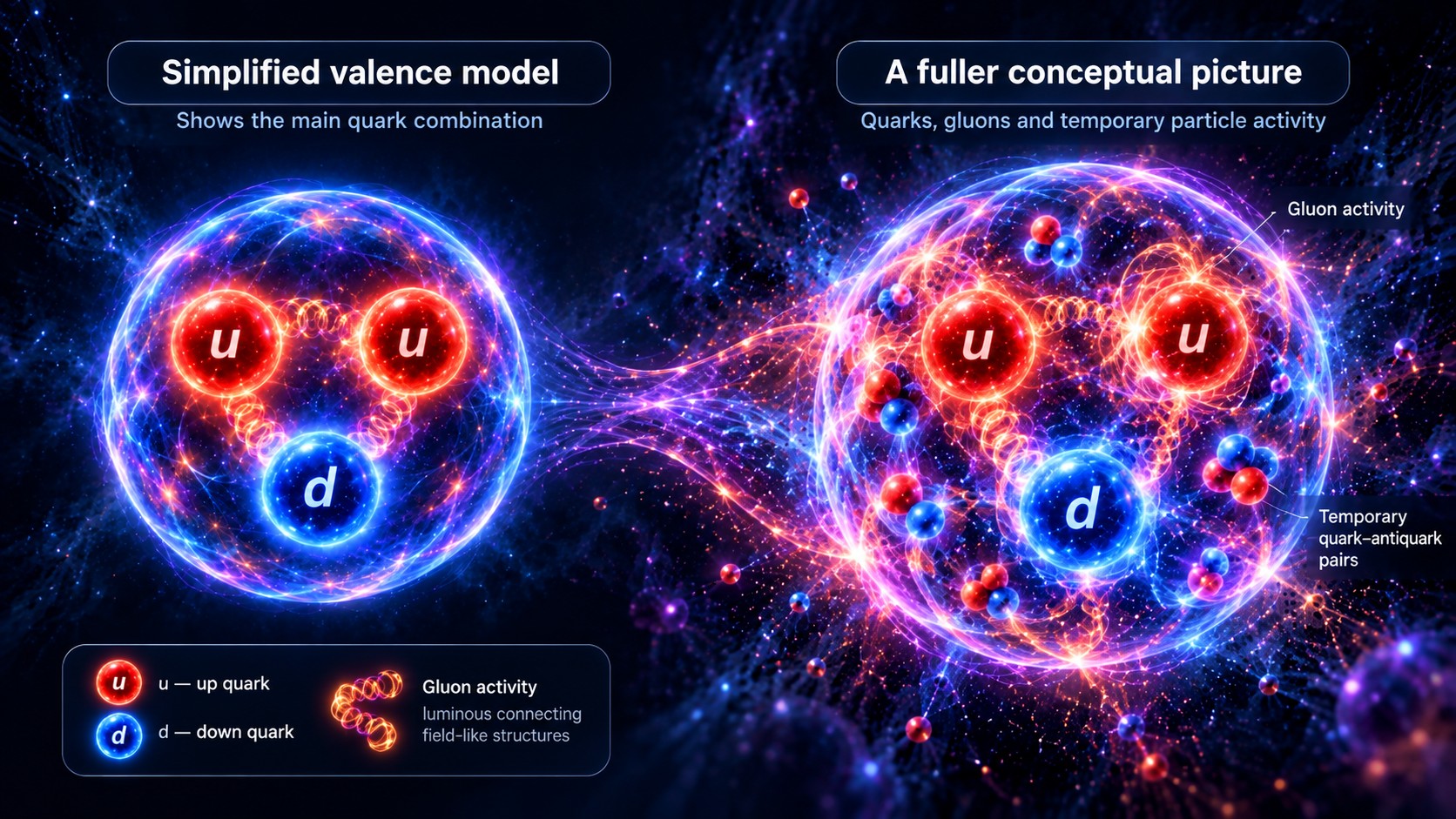
Our three-quark diagrams are useful because they show the different valence-quark patterns. But they leave out much of what is happening inside a real or .
A is a particle involved in the strong interaction that keeps quarks confined within a nucleon. A fuller description also includes temporary quark– pairs. An is the corresponding antiparticle of a quark.
The three-symbol diagram is therefore a simplified model. Look at the simple model and the fuller conceptual picture. Name one thing the simple model leaves out.
Later, a residual effect of the same underlying strong interaction can also help bind separate nucleons within a nucleus. That is a different level of interaction from confining quarks inside one nucleon.
The next possibility
A thing can be a whole.
And still be a part.
Not yet.
But the conditions will change again.
Earlier and later
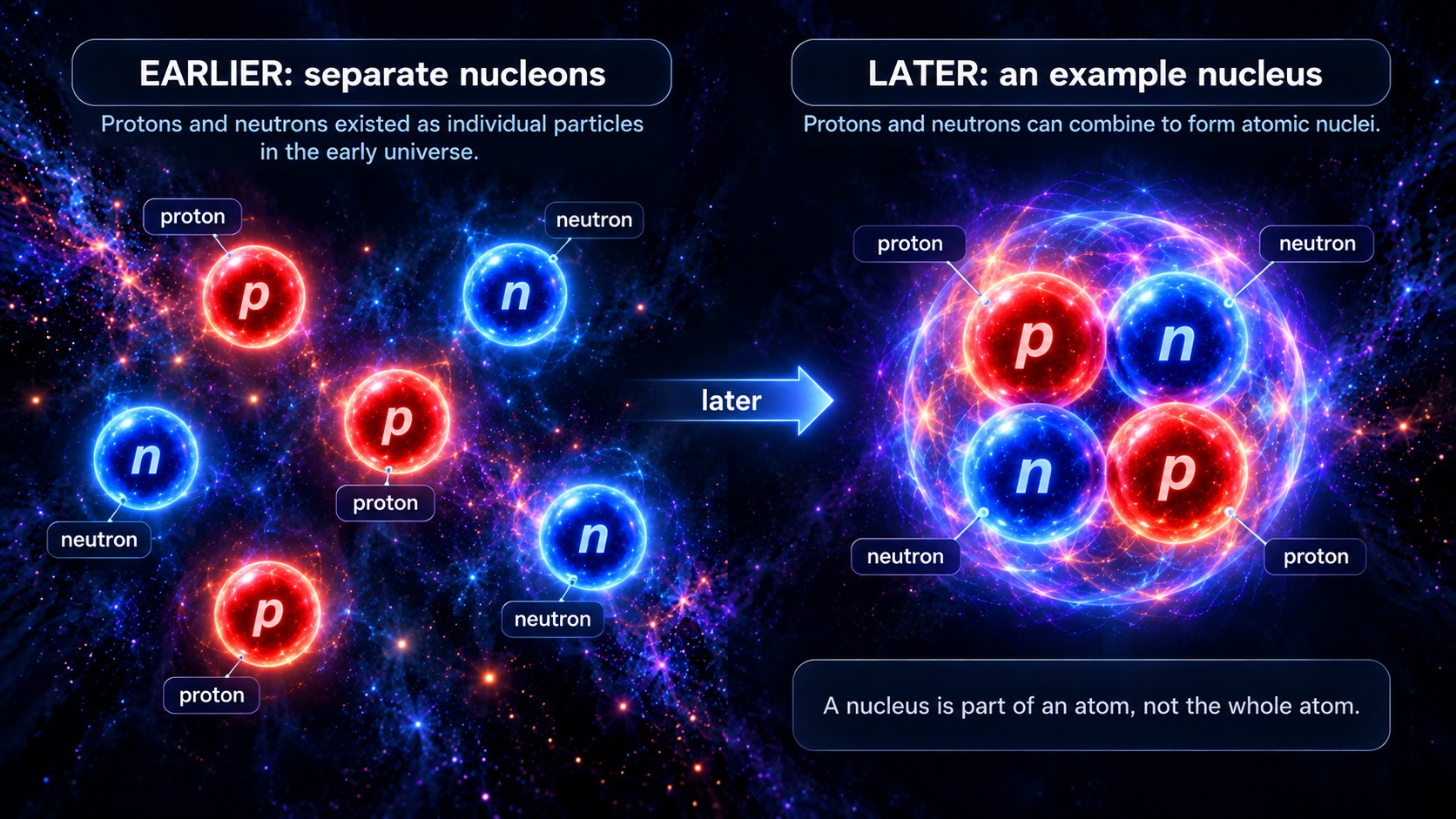
At the stage we are studying, protons and neutrons exist as separate nucleons. Atomic nuclei have not yet formed in this part of the story.
Later, protons and neutrons can become parts of atomic nuclei. A is present in every atomic nucleus. Many nuclei contain neutrons too, although some — such as the nucleus of the most common form of hydrogen — contain no .
Use the image to compare the earlier and later stages. The right-hand structure is a nucleus, not a complete atom.
WHAT EXISTS NOW?
protons · neutrons · electrons
Up and down quarks have not disappeared: they now exist inside protons and neutrons.
Complete atoms have not yet formed.
Remember this lesson — particle properties
Remember this lesson.
Without looking back, write the four missing facts:
— relative charge: ______ ; approximate relative mass: ______
— relative charge: ______ ; approximate relative mass: ______
Particle A has relative charge 0 and approximate relative mass 1. Particle B has relative charge +1 and approximate relative mass 1.
Which particle is A? ______
Which particle is B? ______
In one sentence, explain which property distinguishes them even though their approximate relative masses match.
When you have attempted every answer, choose Check your answers below to compare your work.
Remember this lesson — inside a later nucleus
1 of 2
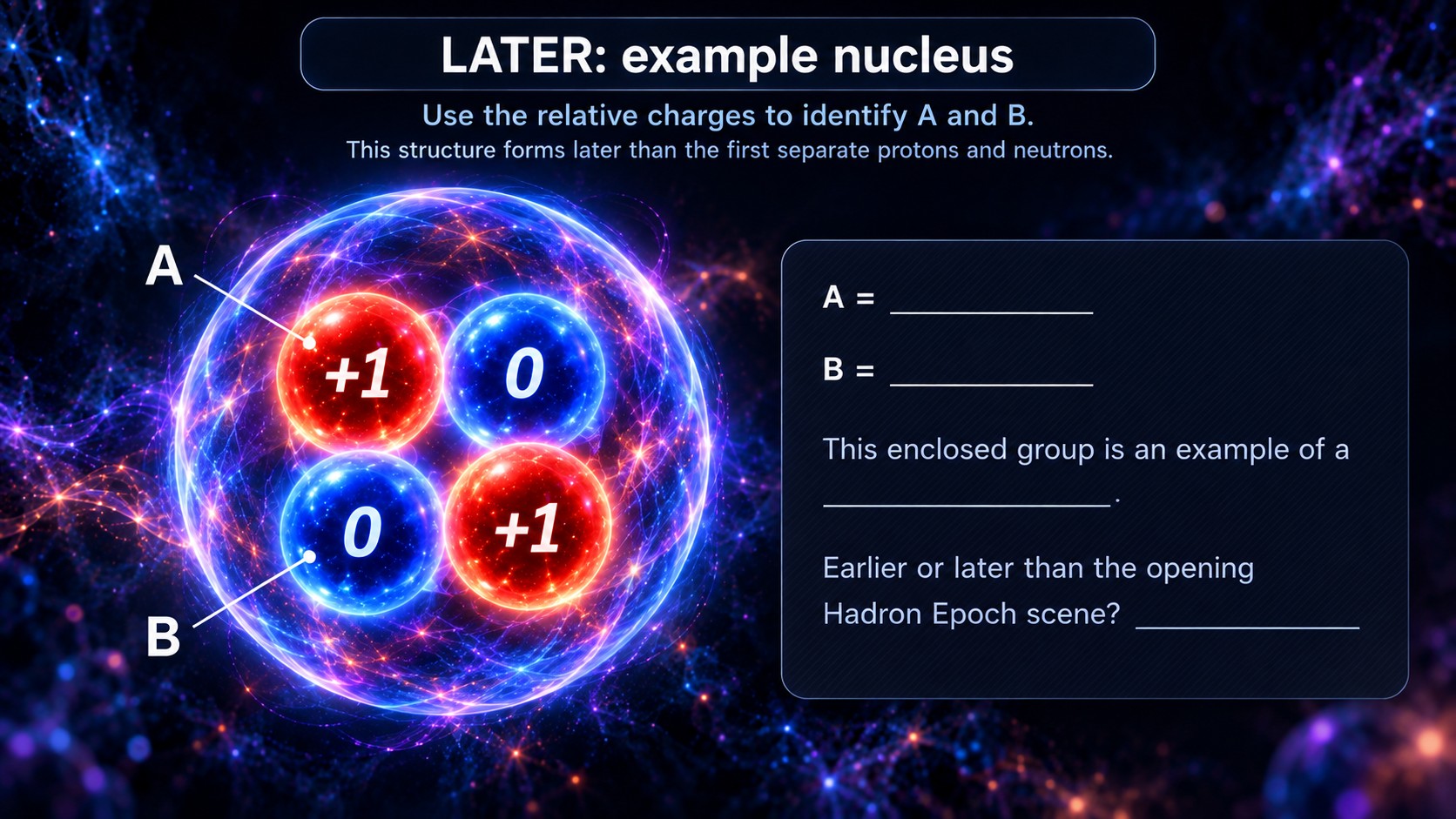
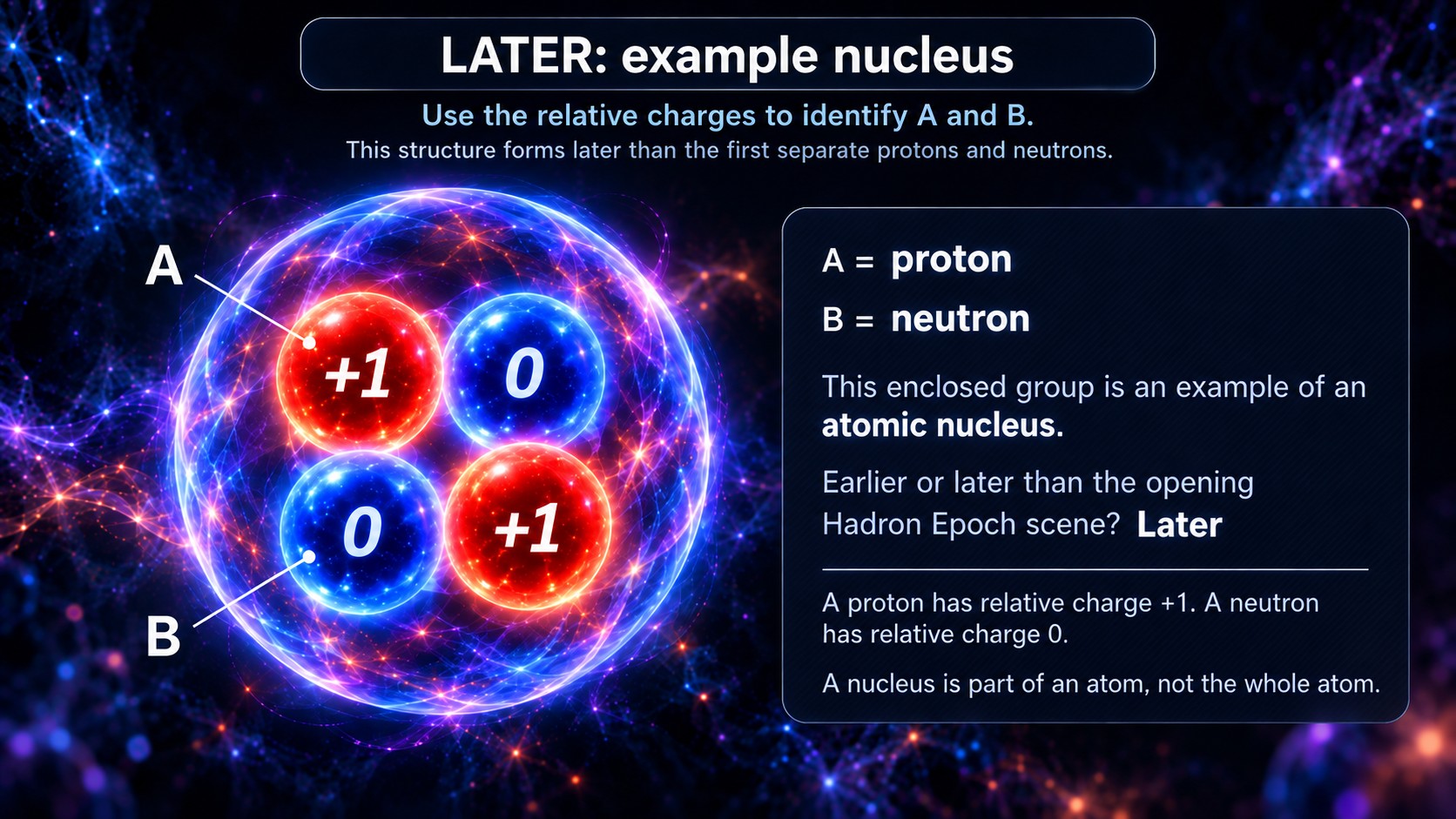
This exercise shows an example nucleus from later in the story. Use the relative charges in the learner image to identify A and B.
Also identify what the enclosed group represents and whether it belongs earlier or later than the opening Hadron Epoch scene.
Attempt all four answers before moving to the completed image.
GCSE Knowledge Coverage
This page contributes to GCSE Chemistry, Physics and Combined Science by establishing that a has relative charge +1 and approximate relative mass 1, while a has relative charge 0 and approximate relative mass 1.
You have also practised identifying the two particles and recognising them as constituents of later atomic nuclei.
The full structure of an atom, its electrons, atomic number, mass number and isotopes are taught on later pages.
Atomic Nuclei
You have seen the pieces.
Now watch the spaces between them.
Another change.
Another possibility.
NEXT: ATOMIC NUCLEI