Hydrogen Nuclei
Why is a lone proton already hydrogen-1, and what changes when a neutron joins it?
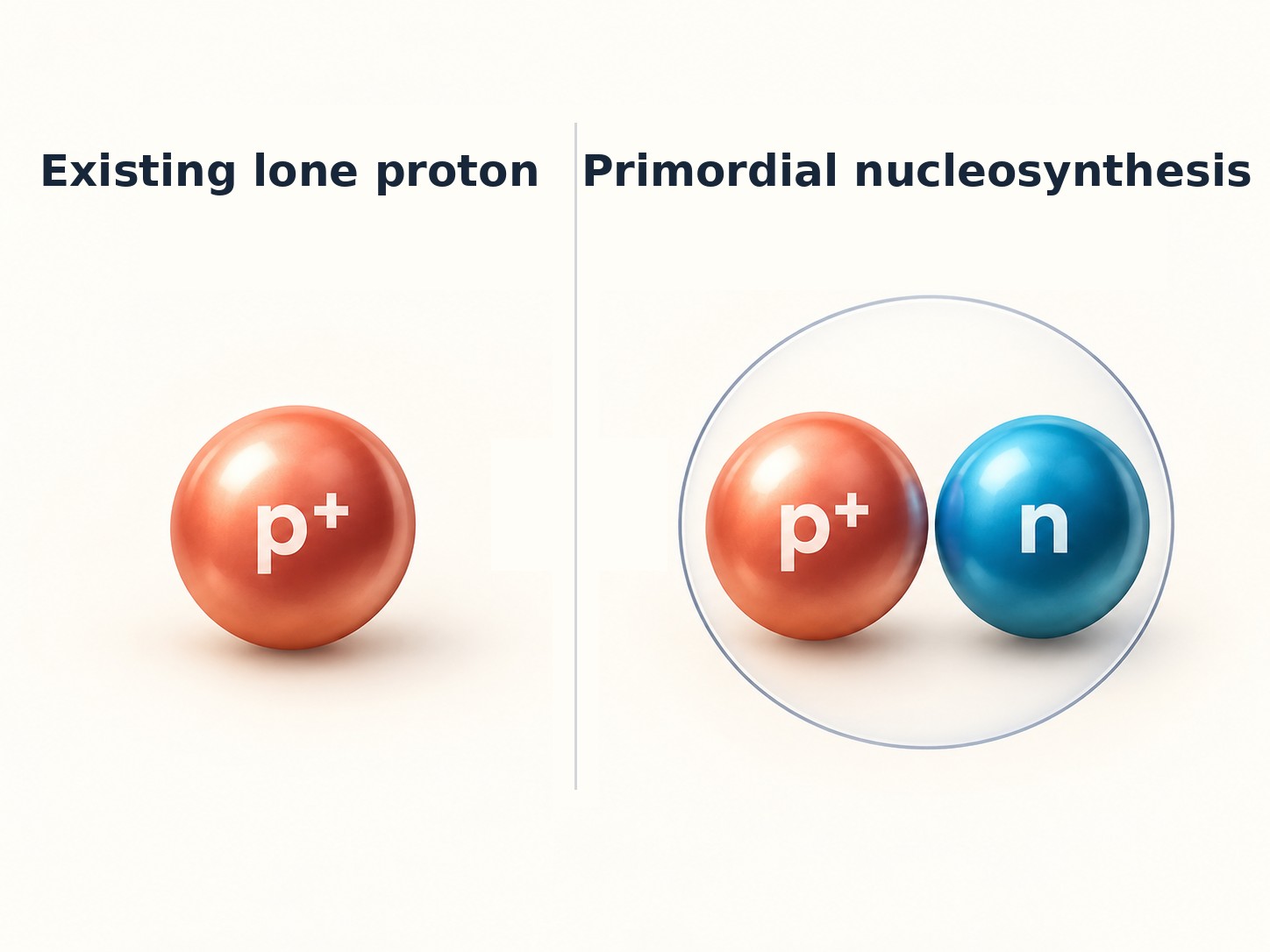
Something already exists
When we began the period of primordial nucleosynthesis, protons already existed. A single proton is itself the nucleus of ordinary hydrogen, hydrogen-1.
That is a strange-sounding fact: a nucleus does not always have to be a group of particles. The nucleus of hydrogen-1 contains ONE proton and NO neutrons. It is positively charged, and its proton number is 1.
Do not imagine that two particles had to collide to create that ordinary hydrogen-1 nucleus. The proton was already there. In our early-universe scene it is a BARE nucleus, not yet a complete neutral hydrogen atom with a bound electron.
What would one neutron change?
1 of 2
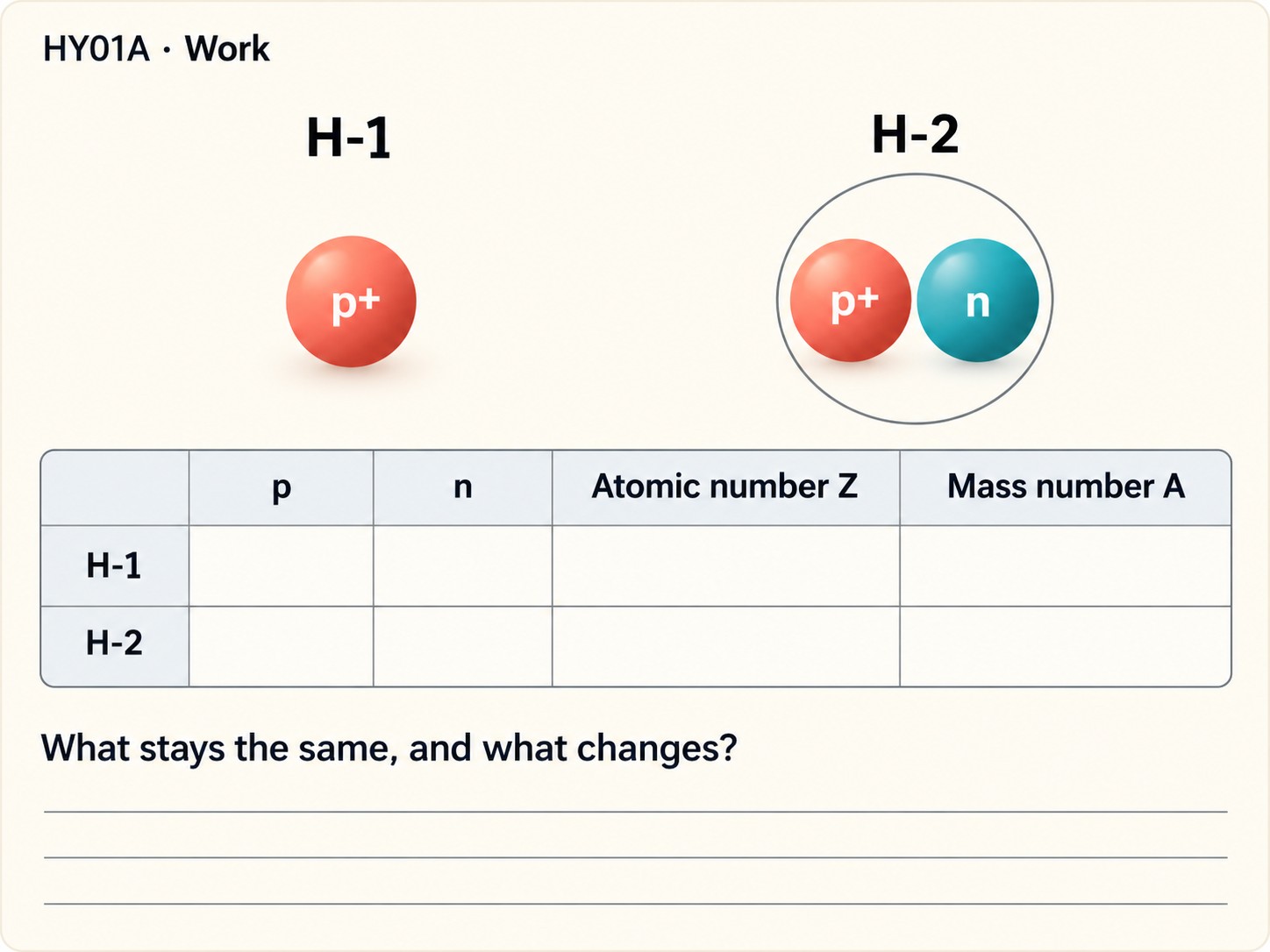
Now look at a second nuclear model in which one proton and one neutron are together. Compare it with the single-proton nucleus.
For each model, write down the number of protons, the number of neutrons, the atomic number Z and the mass number A. Decide whether you are looking at different elements or different versions of the same element.
Try your counts and explanation before viewing the completed models.
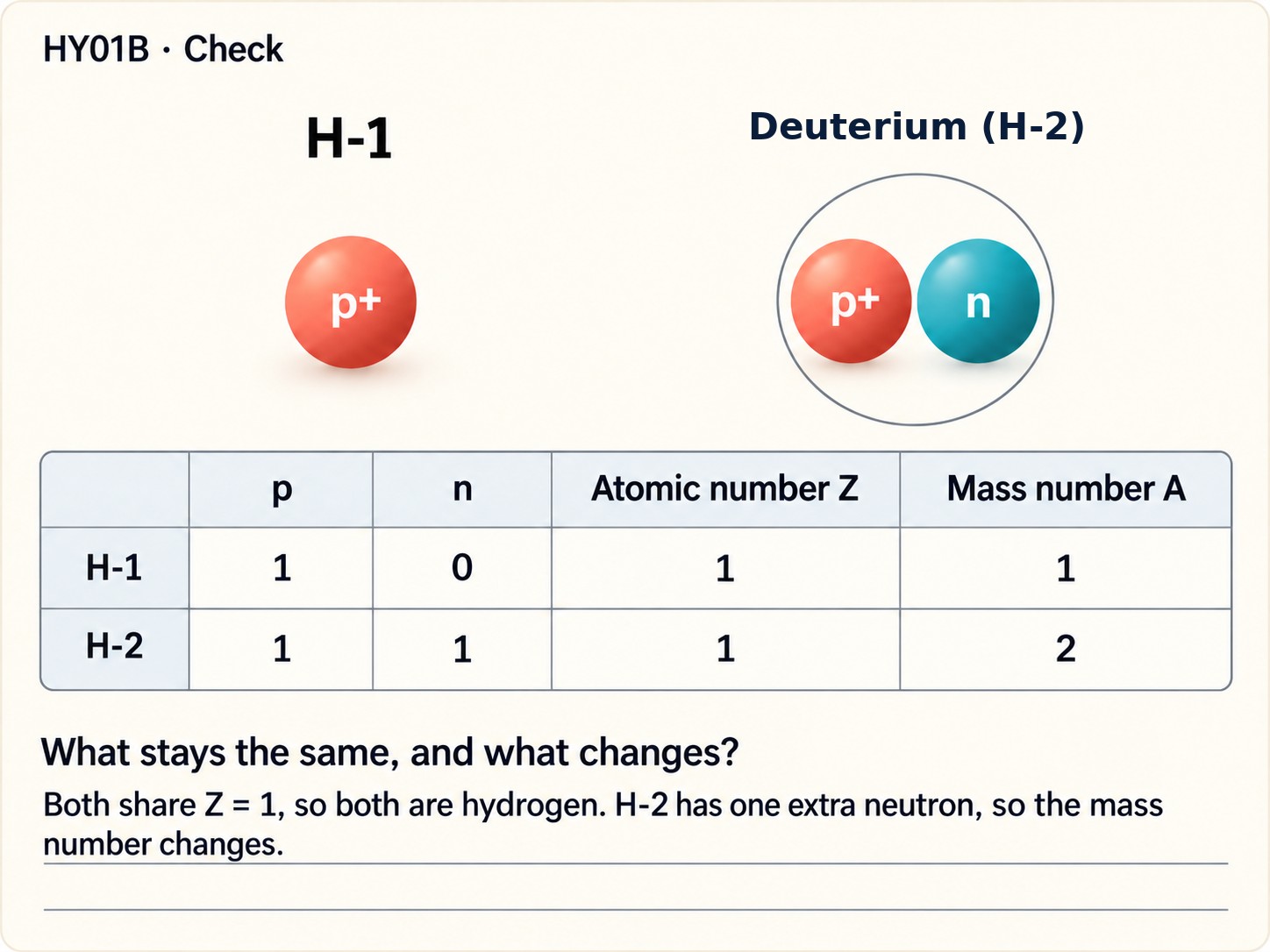
Deuterium
The second nucleus is called DEUTERIUM, or hydrogen-2. It contains one proton and one neutron.
Hydrogen-1 has Z = 1 and A = 1; hydrogen-2 has Z = 1 and A = 2. They are different isotopes of hydrogen because they contain the same number of protons and different numbers of neutrons.
Deuterium nuclei can form during primordial nucleosynthesis when protons and neutrons combine and the changing conditions allow some of the new light nuclei to survive. The ordinary hydrogen-1 nucleus does not have to undergo that joining step: it is a lone proton that existed beforehand.
What changed, and when?
1 of 2
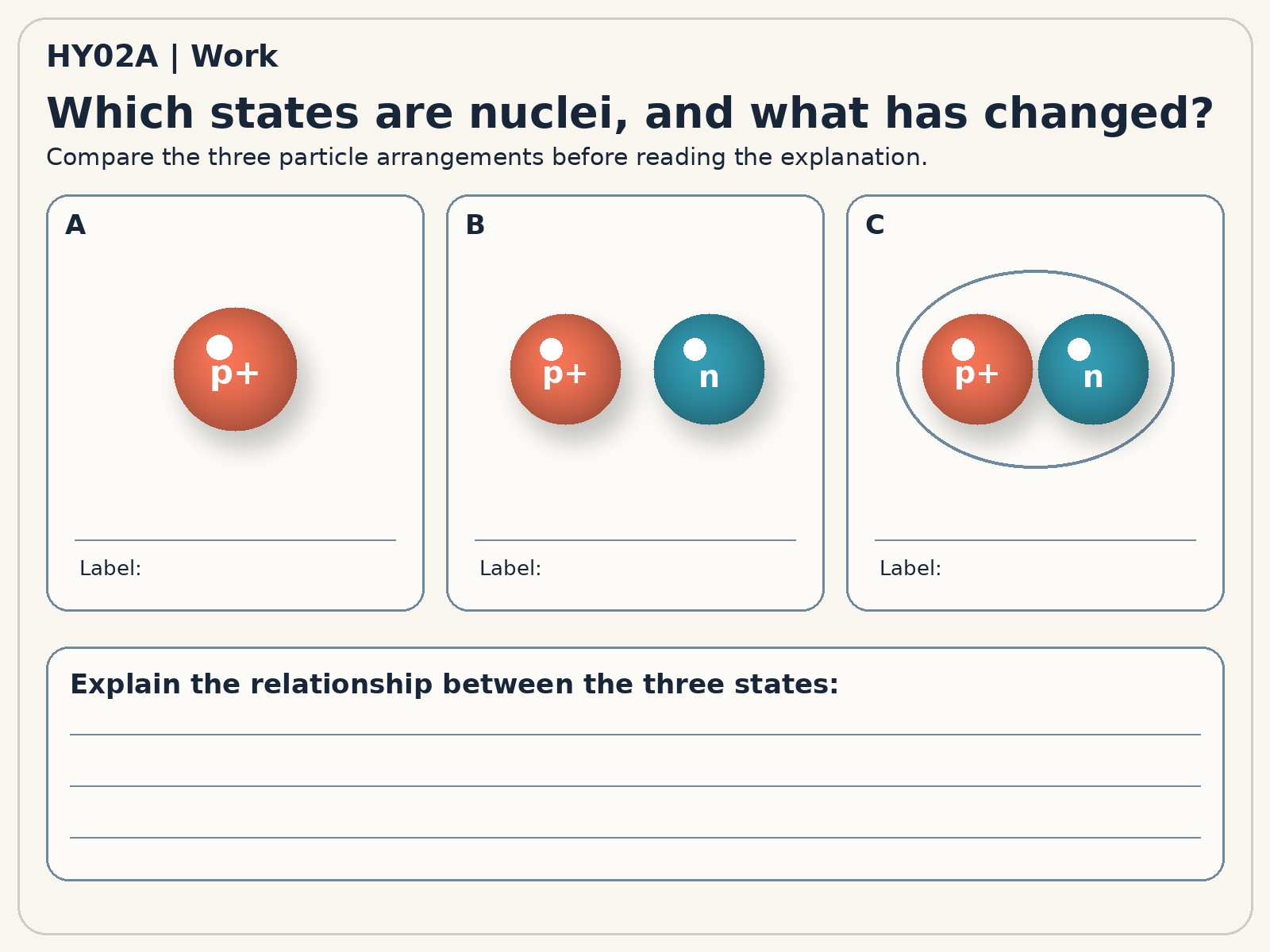
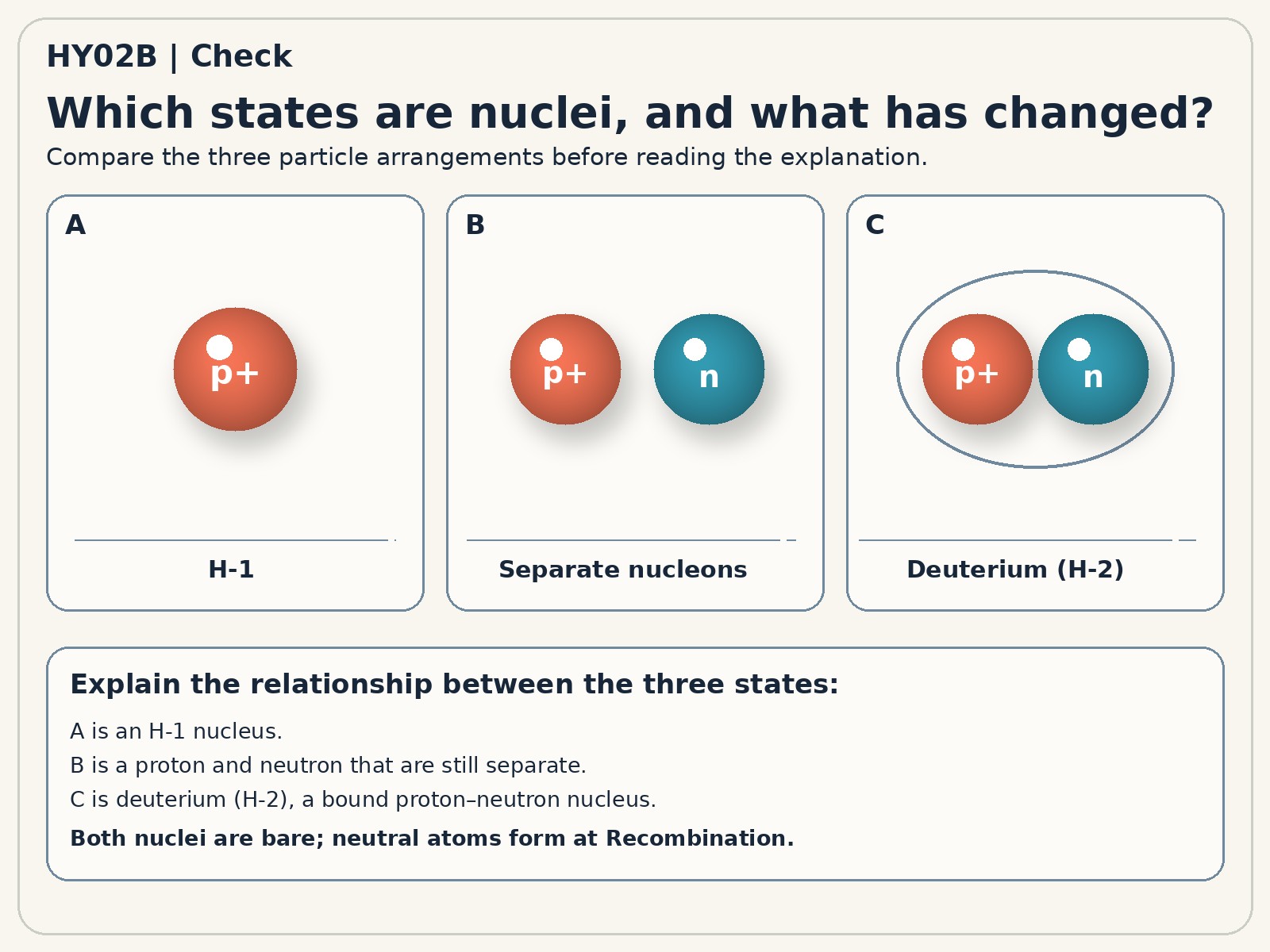
A new diagram shows three moments: an existing proton, a proton and neutron that are not bound together, and a proton-neutron nucleus.
Which picture is already a hydrogen-1 nucleus? Which picture shows a hydrogen-2 nucleus? Which one could form a NEW composite nucleus during the early reaction window?
Write one sentence explaining why adding a neutron did not change the chemical element, and one sentence explaining why neither nucleus needs to be a complete atom in this historical scene.
Try before checking.
GCSE knowledge coverage
This page uses your earlier GCSE nuclear-structure learning to compare hydrogen-1 and hydrogen-2: one proton identifies hydrogen, neutron count changes the mass number, and nuclei with equal proton number but differing neutrons can be different isotopes.
This is a historical APPLICATION of atomic number, mass number and nuclear isotope comparison. Their primary teaching is on the Atomic Number, Mass Number and Isotopes pages. The history of when deuterium formed is useful scientific context, not an additional GCSE requirement counted just because it appears here. Complete hydrogen atoms and their electron structures are taught later.