Helium Nuclei
How do helium nuclei use the same proton-number, mass-number and isotope rules?
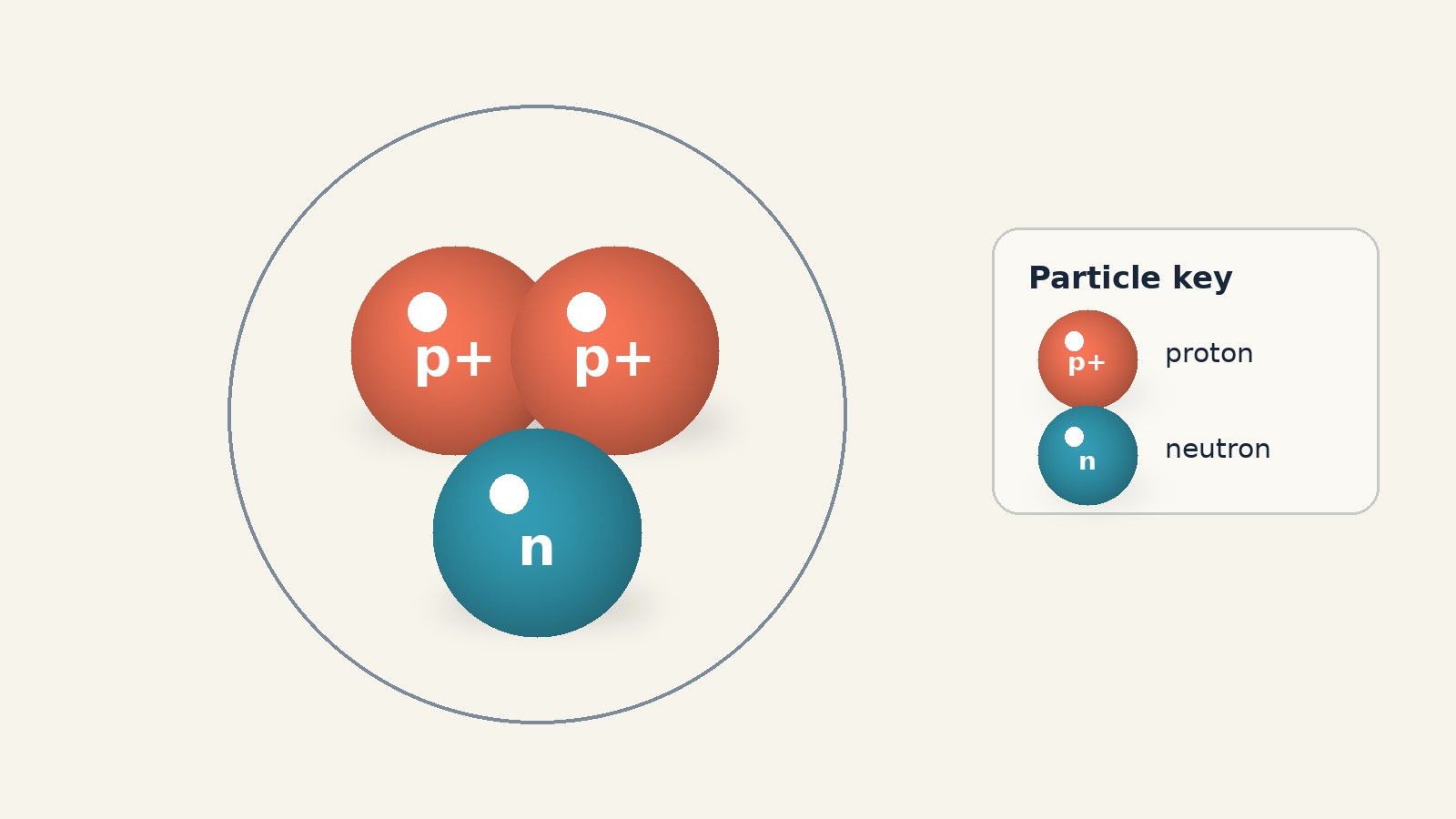
Helium Nuclei — Section 01 — A larger light nucleus
Not all of the early nuclear reactions ended with a single proton or a deuterium nucleus. Some led to other light nuclei containing more protons and neutrons.
One important result was helium. Helium nuclei have TWO protons. Their proton count is what makes them helium, whatever the neutron count of a particular helium isotope.
The most common form made during primordial nucleosynthesis was helium-4. Look at the next nuclear model before its particle counts are revealed.
Helium Nuclei — Section 02 — Build the description
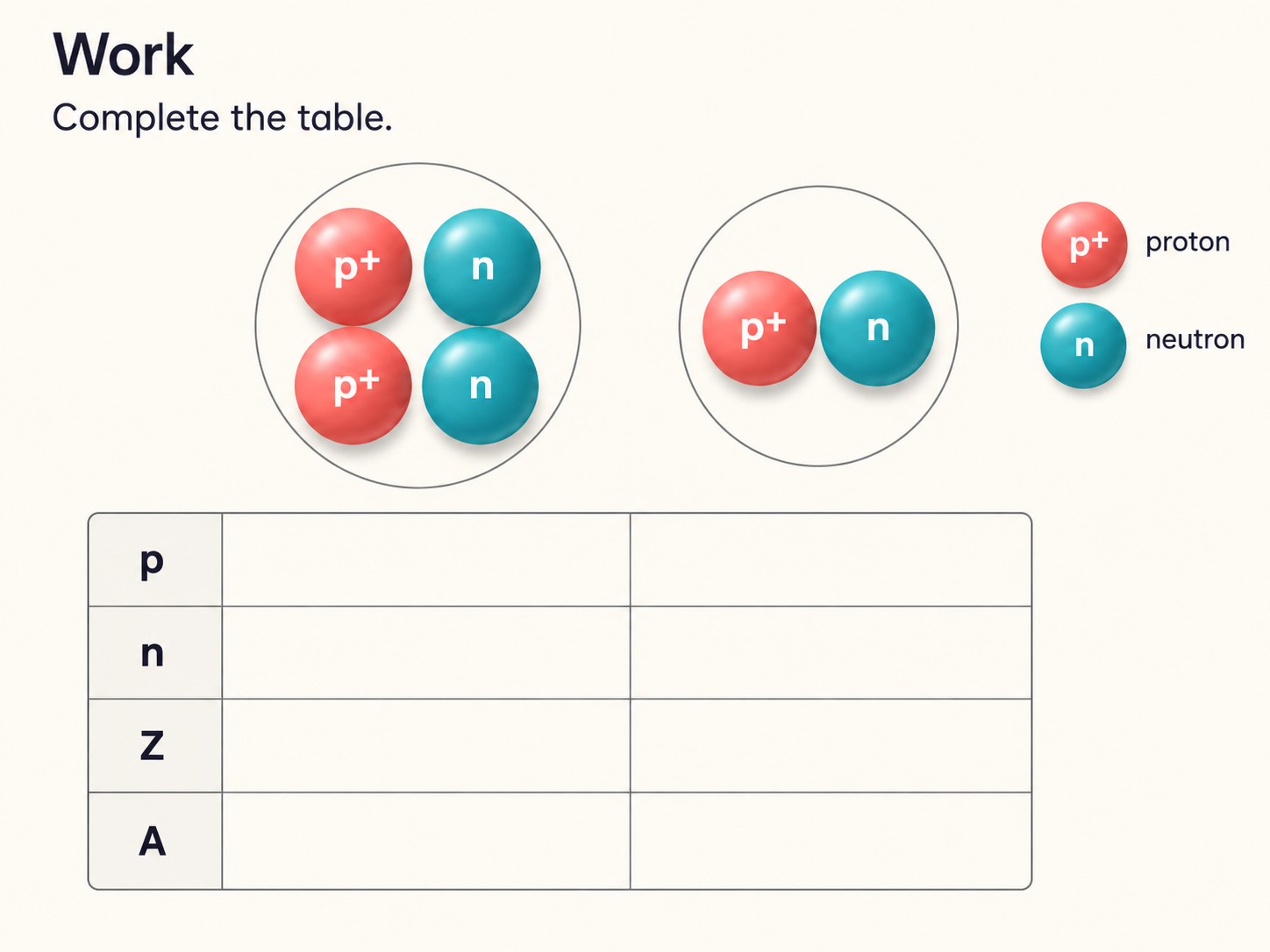
Count the protons and neutrons in the model. Record its atomic number Z and its mass number A. Explain which count tells you that the nucleus is helium and which tells you its total number of nucleons.
Now compare the model with deuterium: how many more protons does this helium nucleus have? How does the mass number compare?
Write your answers before checking.
1 of 2
Check your answers
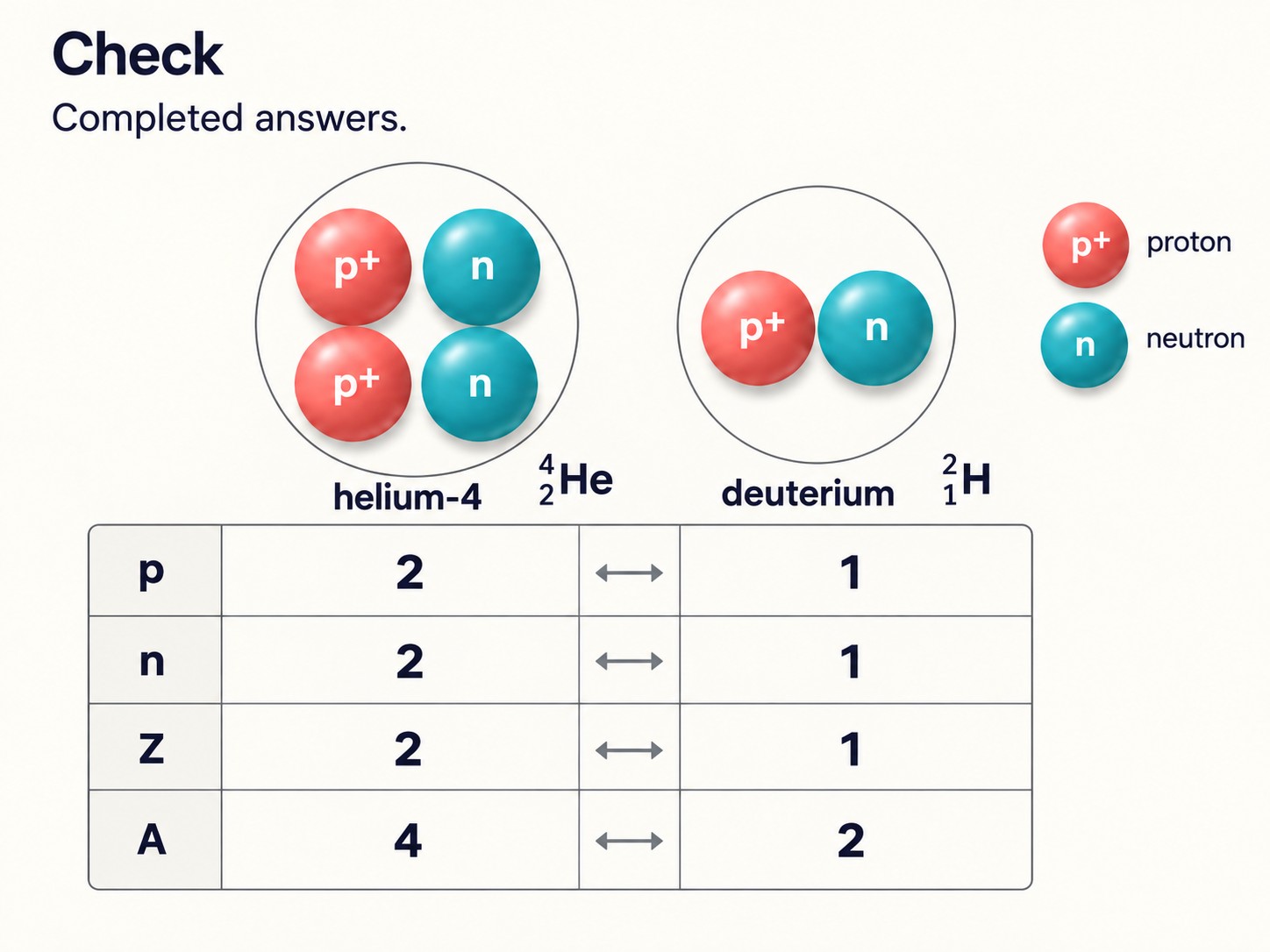
Helium-4 contains 2 protons and 2 neutrons, so Z = 2 and A = 4. Deuterium contains 1 proton and 1 neutron, so Z = 1 and A = 2. Proton number identifies the element; mass number counts all nucleons.
Helium Nuclei — Section 03 — Helium-4
This nucleus has two protons and two neutrons. That makes its atomic number 2 and its mass number 4. We call it helium-4; it can be written with 4 at the upper left of He and 2 at the lower left.
Deuterium has one proton and one neutron, so its atomic number is 1 and its mass number is 2. Helium-4 contains one more proton and one more neutron than deuterium; its total number of nucleons is twice as large.
Helium-4 is a common result of primordial nucleosynthesis. But even this nucleus in our historical scene is not yet a complete neutral helium atom: bound electrons belong to the later part of the story.
Helium Nuclei — Section 04 — Same element, different nucleus
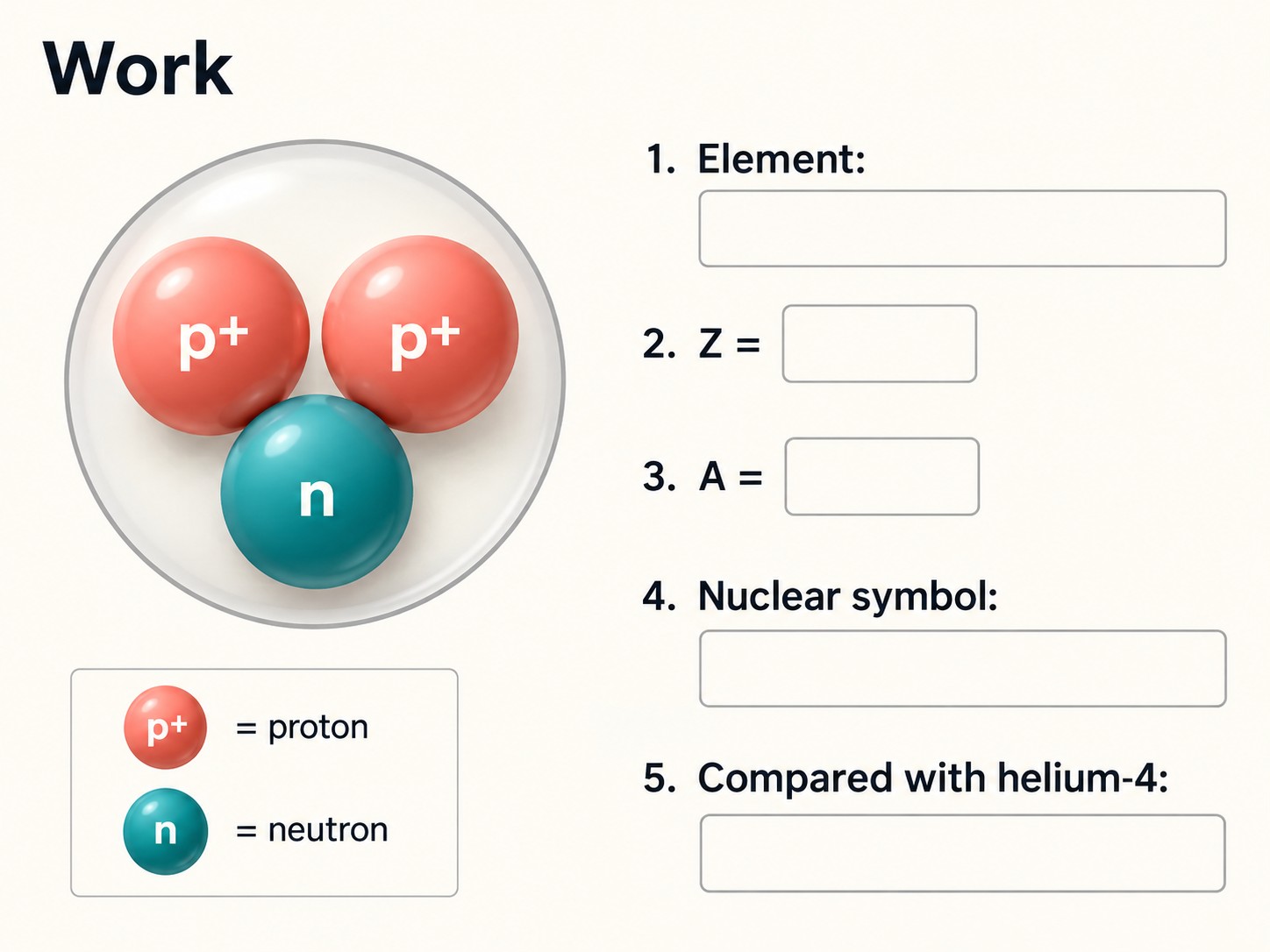
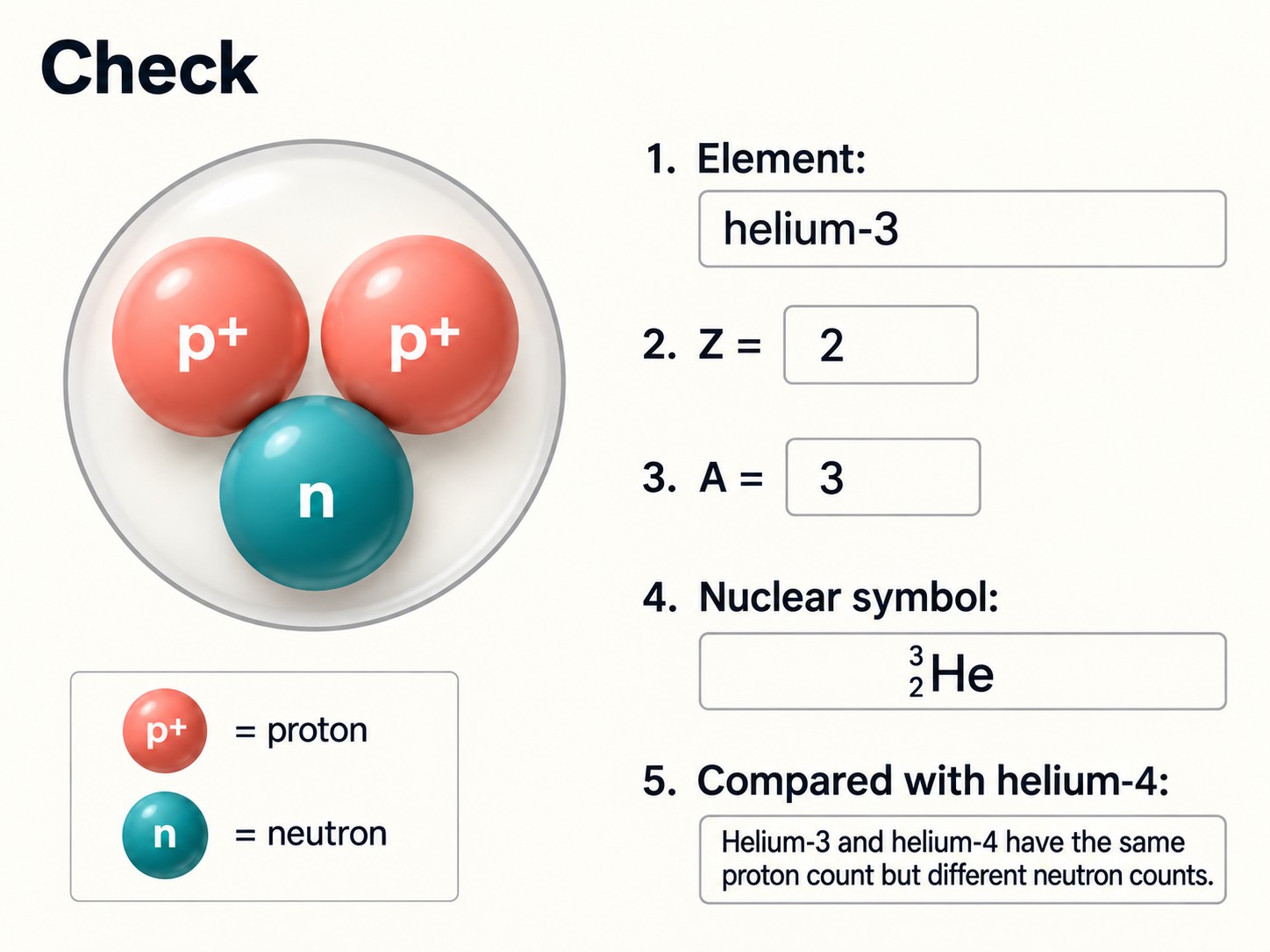
Here is another nucleus with two protons but only one neutron. What element is it? What are its proton number and mass number? Is it a different element from helium-4, or an isotope of the same element?
Write your reason using both proton and neutron numbers. Then check your answer.
1 of 2
Check your answers
The model with 2 protons and 1 neutron is helium-3: Z = 2, A = 3. It remains helium because its proton number is the same as helium-4; the differing neutron count makes it a different isotope.
Helium Nuclei — Section 05 — Remember this lesson
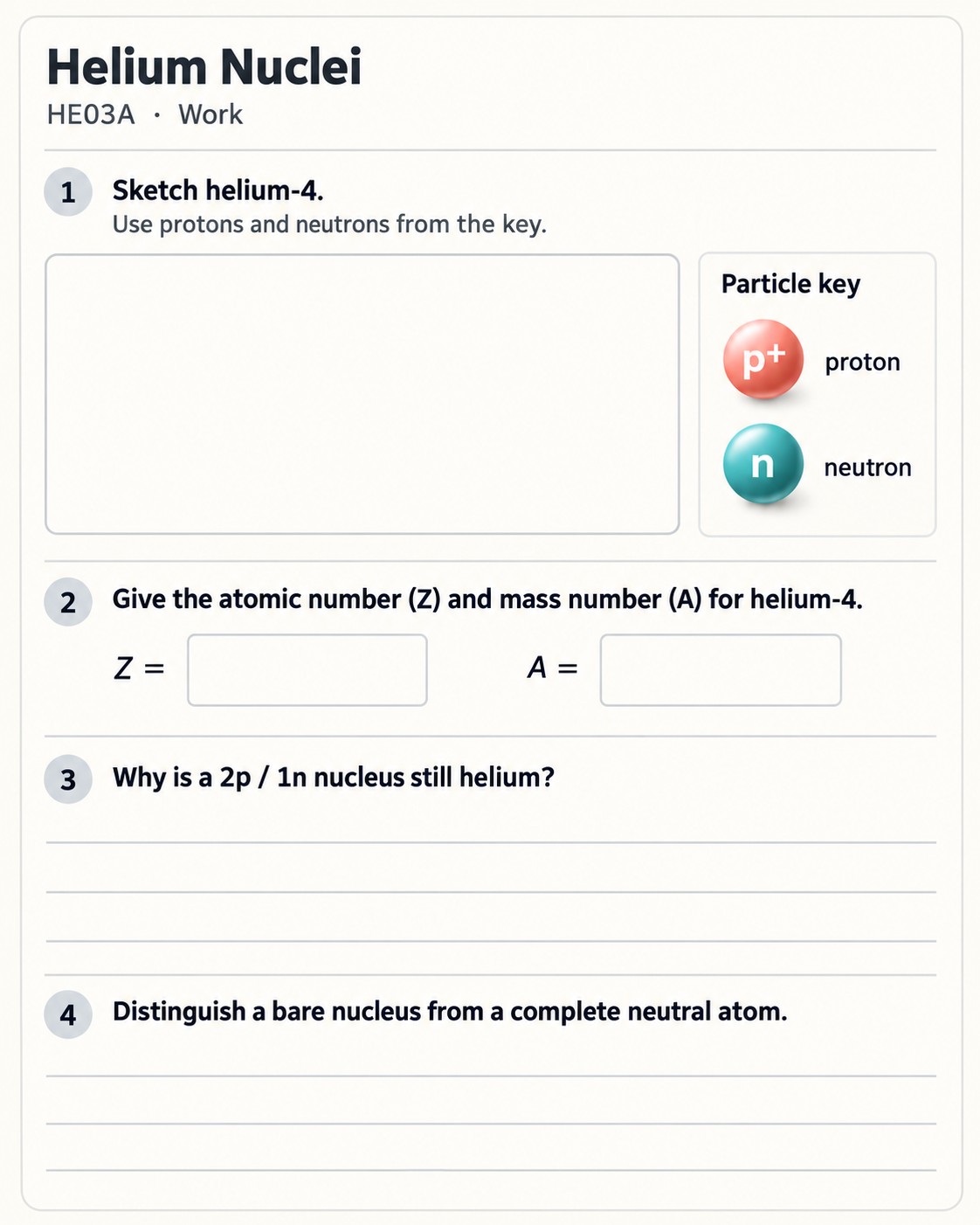
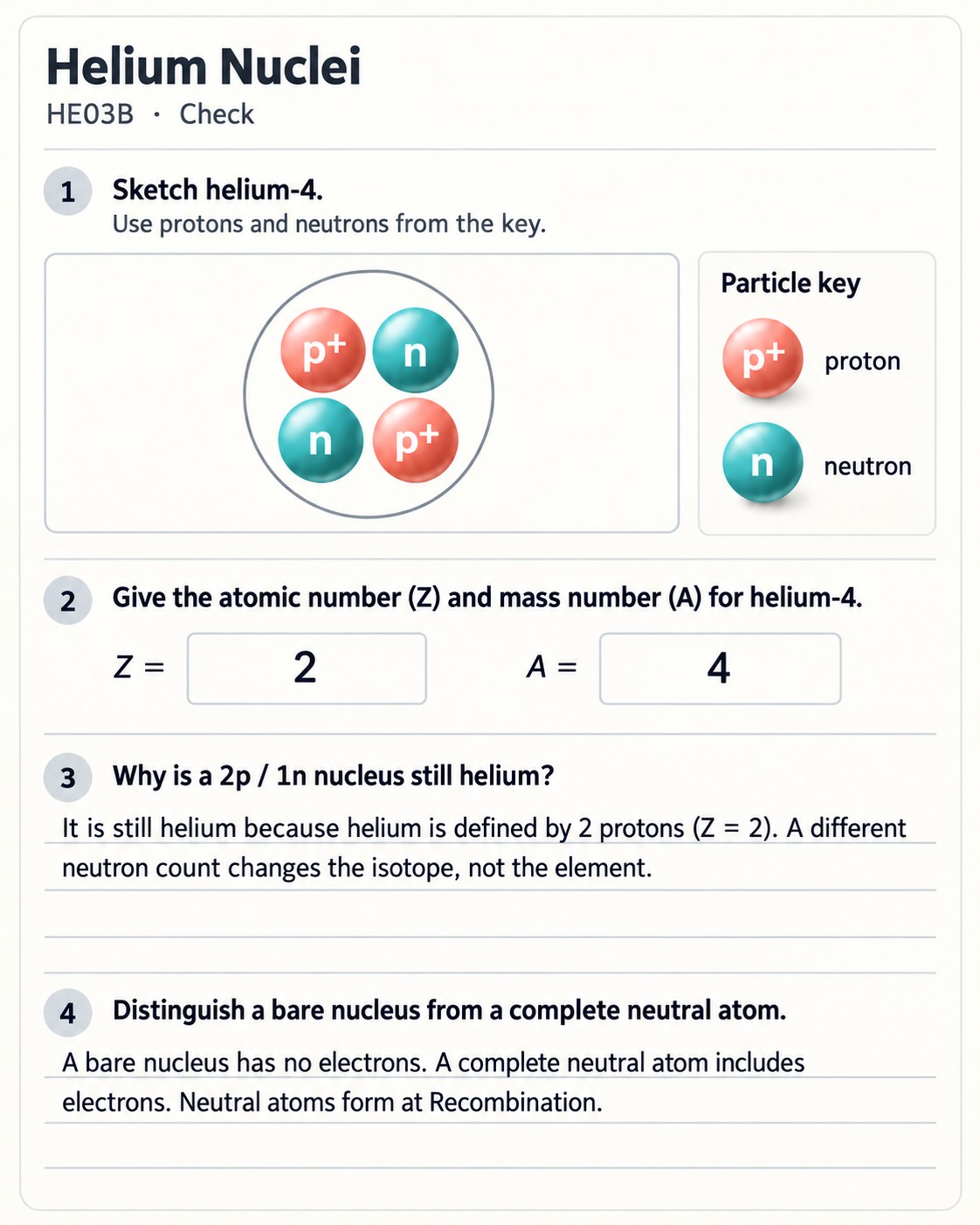
Without looking back, sketch an example of a helium-4 nucleus using a labelled proton-and-neutron key. Write its number of protons and neutrons, then state its atomic number and mass number.
Below the drawing, explain why the model represents a nucleus rather than a complete neutral atom in this part of the story, and why a nucleus containing two protons and one neutron still belongs to helium.
Check your diagram only after you have finished.
1 of 2
Check your answers
Helium-4 has 2 protons, 2 neutrons, Z = 2 and A = 4. It is a bare nucleus in this historical scene because a complete neutral atom with bound electrons has not yet formed. A 2p+1n nucleus is still helium because Z remains 2, but its mass number is 3.
Helium Nuclei — Section 06 — GCSE knowledge coverage
You have practised using the proton number to identify a helium nucleus and using the mass number to count all its protons and neutrons. You have also compared two helium nuclei that differ in their neutron counts.
These are applications and reinforcement of the GCSE nuclear concepts established on Atomic Number, Mass Number and Isotopes, rather than new first teaching on this page. The historical formation of helium-4 gives the calculation a real scientific context. The complete helium atom, its electron structure and its chemistry are later lessons.