Formation of the First Stellar Elements
Carbon and Oxygen Enter the Story — Read H, C and O.
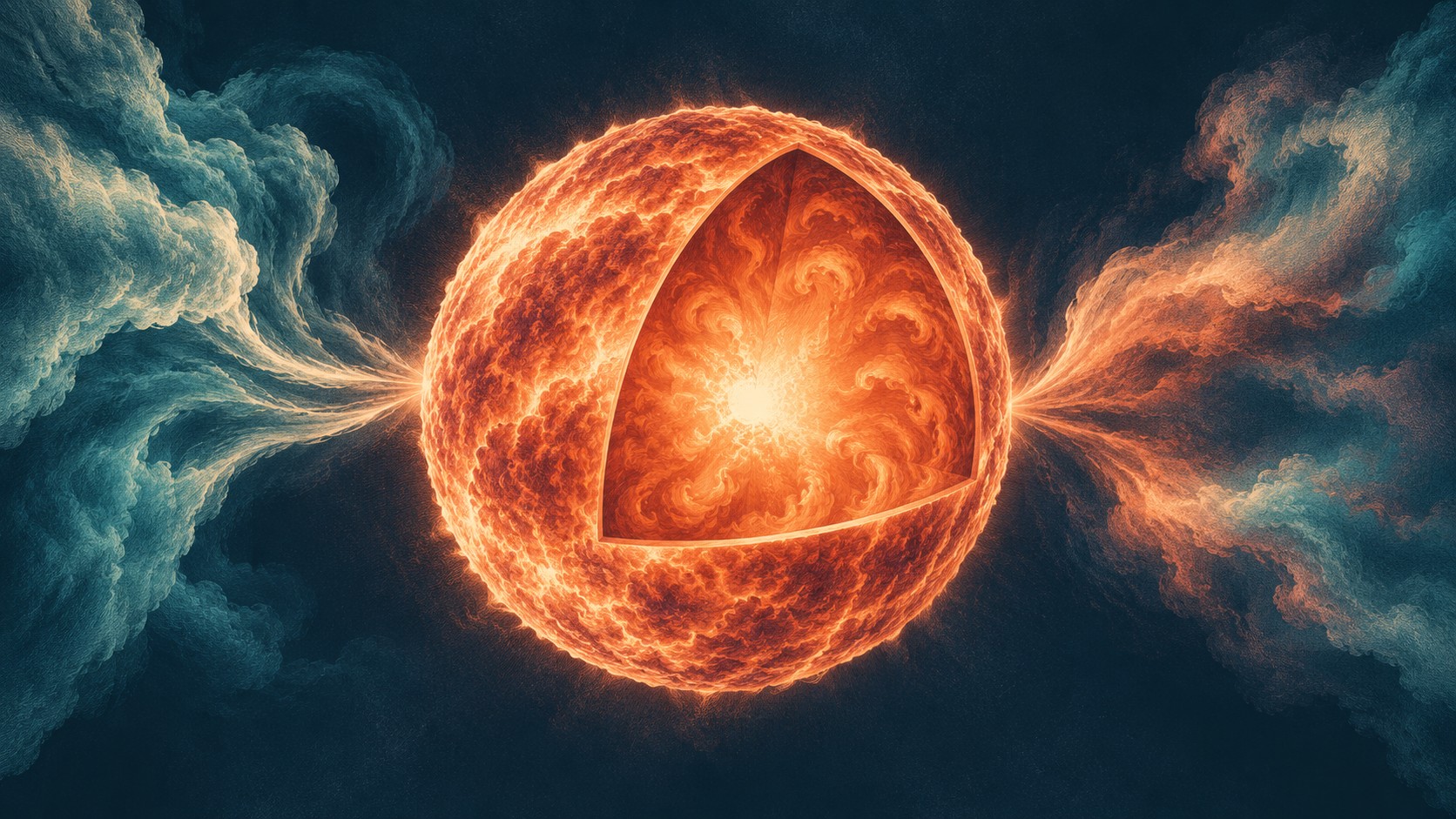
Something new inside the stars
Our story began with a universe whose ordinary matter was mostly hydrogen and helium. The first stars inherited that limited starting collection. In the preceding lesson you discovered that, under suitable conditions, nuclear reactions inside some stars could make carbon and oxygen nuclei.
That was a new possibility for the universe, but not yet the same thing as carbon and oxygen reaching every part of space. An element could be made inside a star without being released from it.
We will follow two of those elements closely. Not because other elements do not matter, but because these two, along with hydrogen, are the ones we must be able to recognise when we eventually read the chemistry of photosynthesis.
Three names to carry forward
You have already learned that proton number determines an element’s identity. Apply that rule to these three identity cards. These are a tiny reference selection, not the whole periodic table.
HYDROGEN — chemical symbol H — atomic number 1 — one proton in its nucleus.
CARBON — chemical symbol C — atomic number 6 — six protons in its nucleus.
OXYGEN — chemical symbol O — atomic number 8 — eight protons in its nucleus.
The modern periodic table assigns each chemical element a place according to atomic number. Hydrogen, carbon and oxygen have their own places because they have different proton numbers. The table is a later human way of describing nature; there was no periodic table inside an ancient star.
These descriptions apply to the element’s nuclei. A neutral atom also has electrons; in very hot stars, matter may be ionised rather than made of ordinary neutral atoms. The element identity still comes from its proton count.
Who is who?
Four models show nuclei. They are deliberately described by their particles rather than element names.
A: 6 protons and 6 neutrons. B: 8 protons and 8 neutrons. C: 6 protons and 7 neutrons. D: 1 proton and 0 neutrons.
For each model, write the element NAME and SYMBOL. Then answer: (1) Which two models belong to the same element? (2) Why do they belong to the same element even though they are not identical nuclei? (3) If a star changes a nucleus from six protons to eight, has its element identity changed? Explain.
Try the questions before opening Check your answers. You can write on paper; a saved answer field is not required for this self-check.
Check your answers
A = carbon, C; B = oxygen, O; C = carbon, C; D = hydrogen, H. A and C have six protons, so both are carbon; different neutron numbers make carbon isotopes. Changing six protons to eight gives a different element identity — oxygen — though a real nuclear reaction must account for other particles and energy, which is not the task here.
Three symbols, not three mysteries
Scientists use symbols to refer to elements. The capital H means hydrogen. C means carbon. O means oxygen. These are standard names written in a compact form, not secret codes chosen separately by each scientist.
An element symbol tells you WHICH element you are discussing. It does not, on its own, tell you how many atoms have joined, whether they are bonded or what substance they make together. To express those other ideas, chemistry uses formulae. We will learn that notation when the story reaches molecules.
Look again: carbon and oxygen are different because their nuclei contain different numbers of protons. C and O are different symbols because they name those distinct elements. A change of symbol is not itself a physical nuclear reaction; it is a change in our written description.
Read a chemical name
Answer without using the identity cards first, then check them if needed.
1. Write the symbol for carbon, oxygen and hydrogen, in that order.
2. A nucleus has eight protons. What symbol should we use when naming its element?
3. A learner says: “The letter O tells me exactly how many oxygen atoms are bonded in a molecule.” What is wrong with this claim?
4. Which piece of information tells you that carbon and oxygen are different elements: their proton counts, their colour in a drawing, or their position in this story? Explain why.
Check your answers
(1) C, O, H. (2) O. (3) The element symbol names oxygen; by itself it does not state how many oxygen atoms have joined or what molecule is present. (4) Proton counts, because each element is defined by its number of protons. The story’s chronology and colours in diagrams do not establish nuclear identity.
From a star to the space beyond it
Having a name for a newly made nucleus does not mean the rest of the universe can use it. First, some of the material made inside stars must leave those stars and mix with gas around them. Different stars follow different histories, and the enrichment of space is a long, uneven process.
With richer kinds of nuclei available outside stars, the story can later reach atoms, new molecules and substances. That does not happen all at once, and it is not yet the arrival of life. It is the opening of chemical possibilities that did not exist in the earliest gas.
Remember this lesson
Close the identity cards and answer from memory.
1. A nucleus contains six protons. Name its element, give its symbol and state what would have to change for the nucleus to belong to a different element.
2. Give the symbols and proton numbers for hydrogen, carbon and oxygen.
3. Explain why two nuclei with six protons but different numbers of neutrons still belong to the same element.
4. Explain why making carbon inside a star is different from carbon becoming available in gas outside the star.
5. What can a chemical symbol tell you, and what can it not yet tell you about a molecule?
Check your answers
(1) Carbon, C; it would need a change in proton number to become a different element. (2) H = 1 proton; C = 6; O = 8. (3) Neutron difference gives isotopes; six protons still means carbon. (4) Making changes the nuclear inventory inside the star; releasing moves matter outside so it can enrich surrounding gas. (5) A symbol identifies a chemical element; molecule identity, atom counts and bonding need further notation/knowledge.
The next question
Now we can recognise the elements H, C and O. We can tell them apart by their nuclei and read their names in the language of chemistry.
But the photosynthesis equation is not just three letters. It contains arrangements of those letters, and numbers beside and before them. What makes a collection of atoms into a molecule? What do those numbers actually count?
The next thread will answer those questions, beginning with matter that could leave stars and eventually take part in chemical bonding.