Formation of Earth
A Planet Without Life
Many chapters later
The first stars are now far behind us in time. Some could make new elements, and some could release them. Gas and dust were changed by many generations of stars. The universe did not move from one exploded first star directly to Earth.
Much later, one region of our galaxy contained a cloud of gas and dust rich enough to help form a new star and a collection of smaller worlds. One of those worlds became Earth.
A new star and a spinning disk
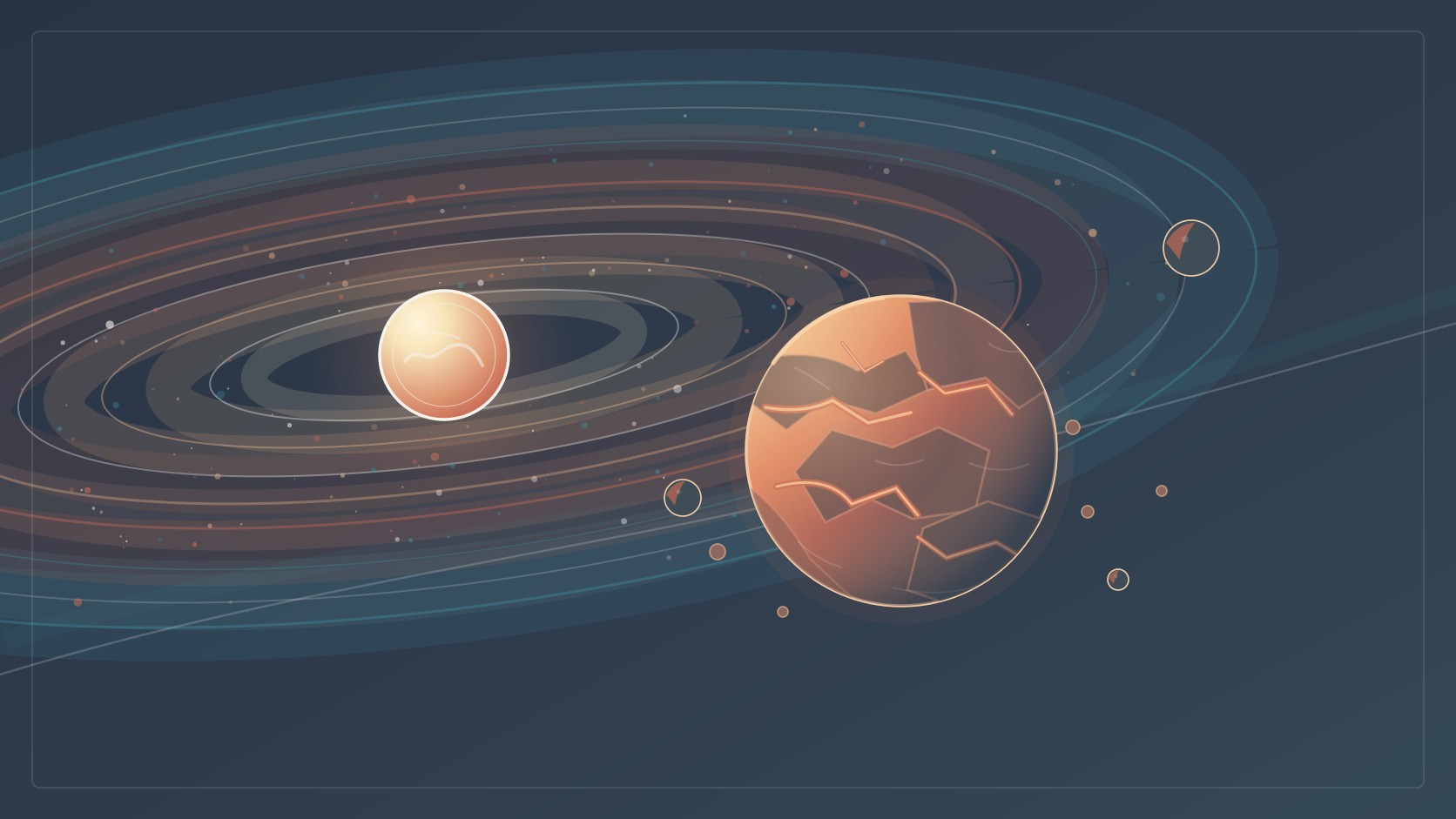
Our Solar System began forming about 4.6 billion years ago. A region of gas and dust contracted under gravity. Most matter moved towards the centre, where the young Sun formed. Around it, remaining material formed a rotating disk.
Inside that disk, small solid particles collided and gathered into larger pieces. Some developed into bodies large enough to attract still more matter. Astronomers call some of these building blocks planetesimals. Over many collisions and mergers, larger planetary embryos and then planets could form.
No scientist was there to watch our Solar System assemble. We infer its history from physics and evidence such as meteorites, the ages and structures of Solar System bodies, and observations of disks around young stars.
Reconstruct a planetary beginning
The following four cards are deliberately out of order. Put them into the most plausible chronological sequence, then explain what physical process links one step to the next.
CARD A — A rocky planet has grown through repeated collisions and gathering of matter.
CARD B — Small solid particles within a disk begin to stick and combine into larger bodies.
CARD C — A cloud rich in gas and dust begins collapsing under gravity.
CARD D — A young Sun forms near the centre, surrounded by a disk of material.
Questions: (1) Put A–D in order. (2) Why is gravity relevant at more than one stage? (3) Does the description require carbon or oxygen to have been invented inside this new Sun? Explain using the earlier enrichment story.
Try without reopening the lesson, then choose Check your answers.
Check your answers
C → D → B → A. Gravity causes collapse of the cloud and later helps larger bodies attract matter; collisions and aggregation build bigger solids/planetary embryos. Carbon and oxygen did not need to be invented by the newly forming Sun; earlier stars could have formed and released such elements into the gas/dust before our Solar System formed. No individual early stellar event is proven to have been the sole source.
A planet is not a finished home
Earth formed around 4.5 billion years ago, not as a ready-made ocean world, but through repeated impacts, heating and other changes. The young planet could experience regions of molten material and dramatic collisions. Its surface and interior evolved as matter moved, cooled and separated.
The presence of hydrogen, oxygen and carbon among the available elements did not automatically give Earth a breathable atmosphere, permanent oceans or living cells. Those are separate scientific questions. The original elements could appear in many different compounds and locations.
Imagine two statements. “The materials for water were available” is about possible chemistry. “There was liquid water on Earth’s surface” is about planetary conditions and evidence. The first statement alone does not prove the second.
What we can and cannot see
The oldest rocks and minerals offer clues to a past that nobody observed. Meteorites also preserve evidence from the formation of the Solar System. Physical models help us test whether a proposed history is possible.
But evidence has limits. Some ancient minerals have been interpreted as signs of liquid water near Earth’s surface as early as roughly 4.4 billion years ago. The conditions and extent of early oceans remain debated; later impacts could have reheated or vaporised water. We should not turn one mineral clue into a precise date when uninterrupted oceans began.
Nor should we imagine an oxygen-rich sky like today’s. A large rise in atmospheric free oxygen happened much later in Earth history, following a long biological and geological story. For now, we are investigating how a planet formed, not explaining photosynthesis before life exists.
Evidence, inference or too much certainty?
Label each sentence E (a plausible evidence-based statement), I (a reasonable inference from evidence and models), or O (an overstatement that goes beyond what we know). Explain each choice in one sentence.
A. Meteorites preserve materials that can help researchers investigate early Solar System history.
B. Gravity, a rotating disk and collisions offer a model for how rocky planets such as Earth formed.
C. Because Earth's matter included oxygen, oceans must have appeared the moment the planet formed.
D. A mineral grain may provide evidence of ancient water without proving the precise history of every ocean on Earth.
E. The first stars exploded and directly formed Earth a short time later.
Try the labels and reasons before selecting Check your answers.
Check your answers
A = E (meteorites are physical evidence that can be studied). B = I (a scientific physical reconstruction, not a recorded eyewitness account). C = O (chemical ingredients alone do not prove the timing or stability of liquid oceans). D = E/I acceptable with good explanation: mineral observations are evidence and their interpretation is an inference; they do not establish universal ocean persistence. E = O (first stars preceded Earth by billions of years and could not directly form Earth immediately). Distinguish evidence from model; do not demand an arbitrary single label when a sentence combines the two.
Remember the journey, not only the date
1. Why did Earth not form immediately after the first stars? Name the intervening kind of cosmic process that made new solar systems possible.
2. Explain how a collapsing cloud, disk, solid particles and collisions relate in a model for Earth’s formation.
3. What is the difference between the availability of hydrogen/oxygen atoms and evidence that a rocky planet has liquid water?
4. Explain why ancient minerals, meteorites and computer models can be useful even though nobody witnessed the Hadean Earth.
5. Why would a statement that early Earth had a modern oxygen-rich atmosphere be unsafe?
Check your answers
(1) Many generations of stars and changes to enriched gas preceded the much later Solar System, about 4.6 billion years ago. (2) Gravity contracts gas/dust, a rotating disk forms, solids aggregate and collide into ever larger bodies and a planet. (3) Chemical ingredients allow certain molecules in principle, but surface water depends on temperature, pressure, supply and the planet's history; separate evidence is required. (4) Ancient minerals and meteorites preserve information and models let us test physical possibilities, although details remain uncertain. (5) Modern abundant atmospheric O₂ came much later; early Earth's atmosphere was chemically different, and its exact composition is debated.
The next question belongs to this world
A planet has formed. That does not mean it already has oceans, a stable atmosphere or life.
We now have two more questions to follow in the original chronology. What gases surrounded early Earth, and how did they change? And what made liquid water possible, at least at some times and places? The next Pages will follow those questions before the story reaches living chemistry.