Element-Rich Interstellar Chemistry
When Elements Become Molecules — Read molecules and chemical formulae.
More kinds of matter are possible
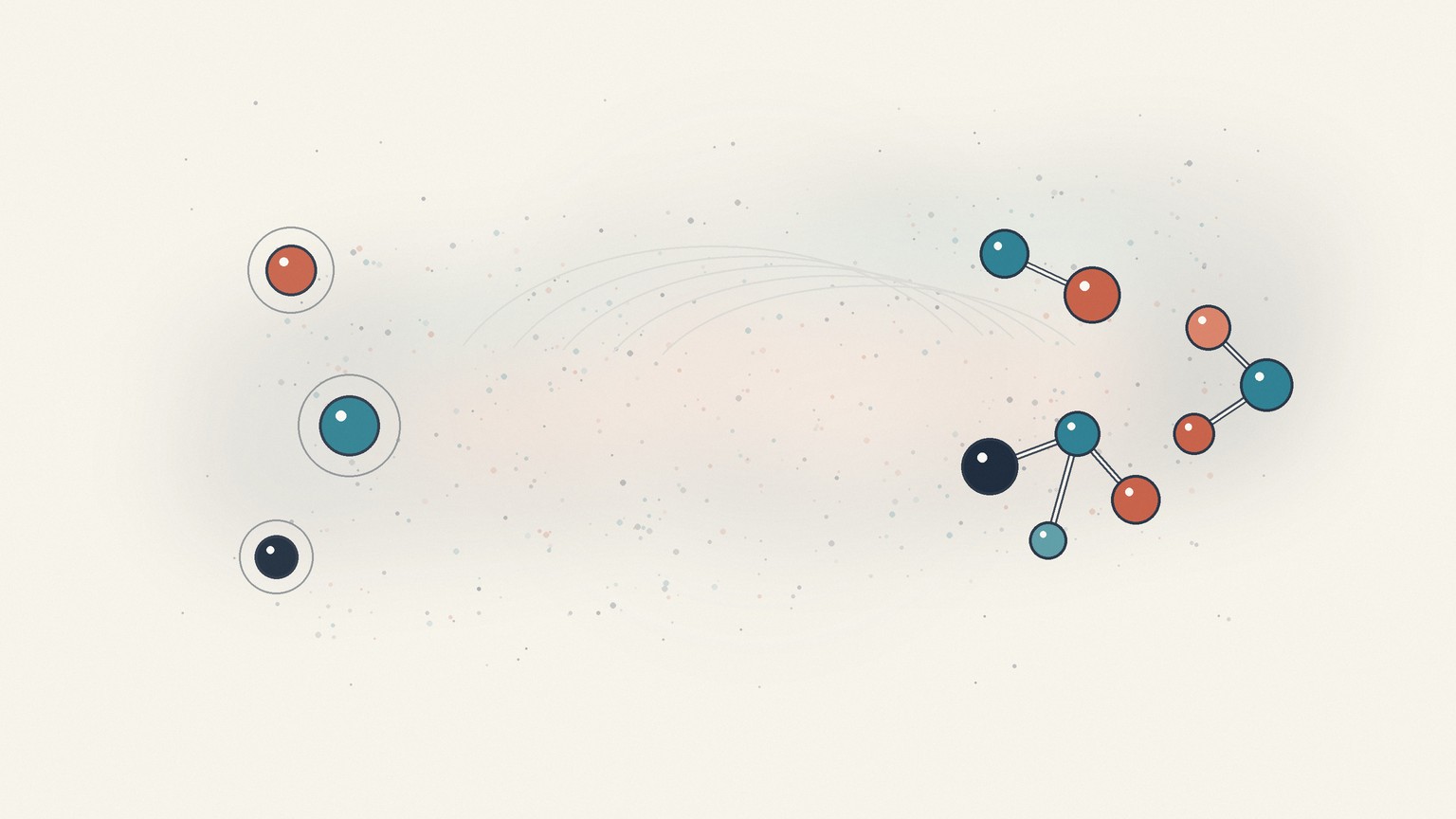
The first stars could make some nuclei that were missing from the universe’s original supply. Over time, material made inside stars could escape and enrich surrounding gas. Different things happened in different places; the first stars did not all release the same atoms at the same time.
Those extra elements opened up a larger range of chemical possibilities. But an oxygen atom is not automatically an oxygen molecule, and a carbon atom is not automatically carbon dioxide. For molecules to exist, atoms have to become bonded together.
You have already met hydrogen and the simple molecule H₂. We can now use the same idea with oxygen and with combinations involving different elements.
One atom, or several joined?
An atom is one particle of a chemical element. A molecule is a group of atoms joined by chemical bonds. For the molecules we will study here, the atoms are joined by covalent bonds: their electrons are involved in shared pairs.
One isolated oxygen atom has the element symbol O. A molecule made from TWO oxygen atoms joined together is written O₂. Both atoms are still oxygen atoms. Making a molecule changes the bonding between atoms; it does not change their nuclei into new elements.
The small ₂ matters. It tells us that this molecule contains two atoms of the element whose symbol comes just before it. Compare H₂: it contains two hydrogen atoms, not one atom called “H₂”.
How a formula counts atoms
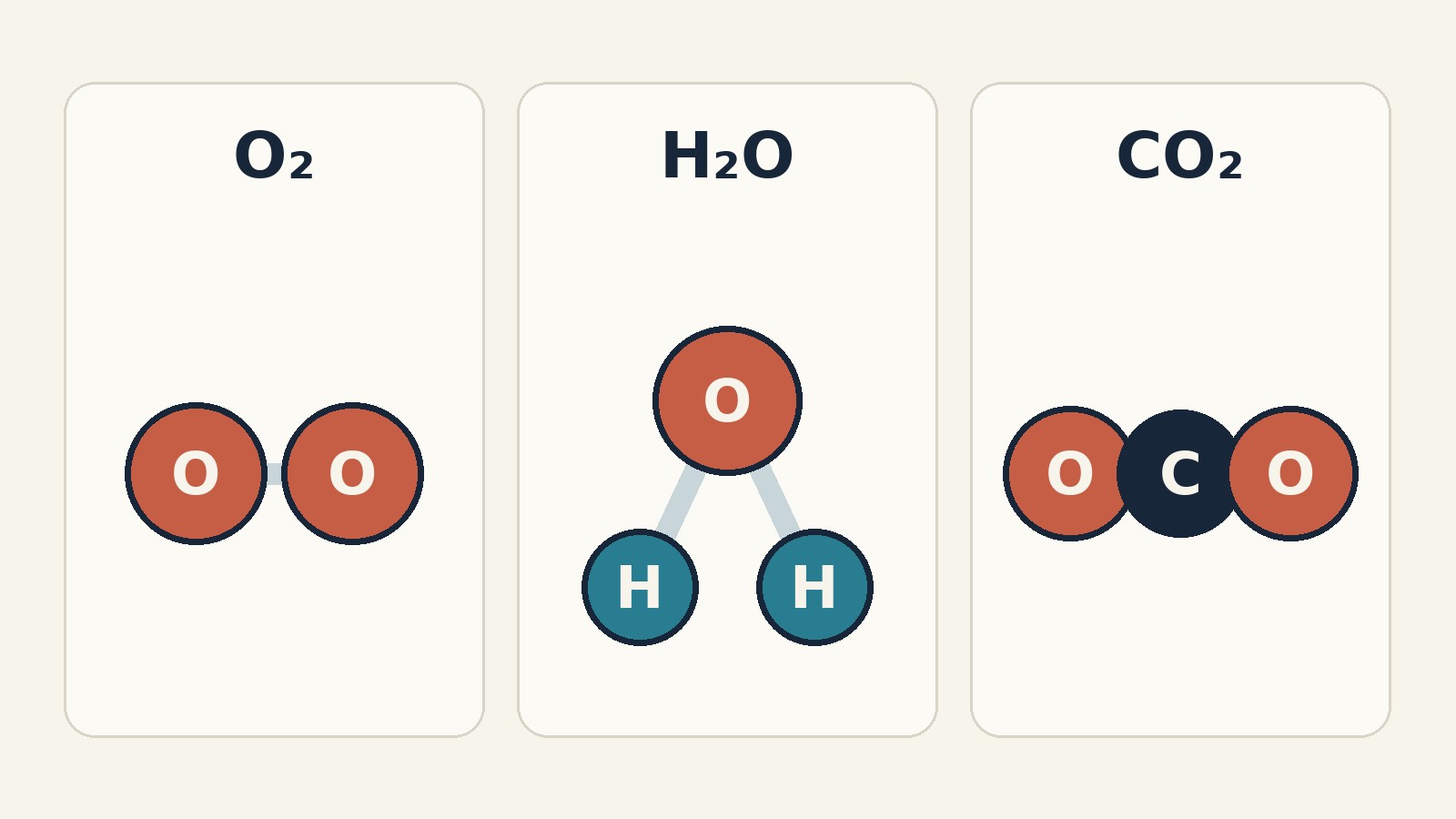
A chemical formula can tell you which elements are present in one molecule and how many atoms of each are represented.
O₂ means two oxygen atoms. H₂ means two hydrogen atoms.
H₂O means two hydrogen atoms and one oxygen atom. There is no small number after O, so in this formula its count is one.
CO₂ means one carbon atom and two oxygen atoms. The small ₂ applies to O, not to C.
In these examples, the small number to the lower right of a symbol is a SUBSCRIPT. The large number that might be written before a whole chemical formula is different; you will learn that coefficient when we move to equations.
A formula alone does not show the full three-dimensional shape or all the details of the bonds. Those are further questions. Here we are learning to read which atoms are represented and how many.
Count the atoms
Without looking back at the examples, fill in a four-column table: formula / number of H atoms / number of C atoms / number of O atoms. Use these formulas as separate rows: O₂, H₂O, CO₂, H₂.
Then answer: (1) Which formula contains one carbon and two oxygen atoms? (2) Which formula contains exactly three atoms in total but two different elements? (There may be more than one.) (3) Why is the ₂ in CO₂ not a count of carbon atoms?
Try your table and explanations before choosing Check your answers.
Check your answers
O₂ = H0, C0, O2; H₂O = H2, C0, O1; CO₂ = H0, C1, O2; H₂ = H2, C0, O0. (1) CO₂. (2) H₂O and CO₂ each have three atoms in total and two element types. (3) Subscript ₂ follows oxygen in CO₂; carbon has no subscript so its count is one.
Molecule, element, compound
There is a second difference to recognise. O₂ and H₂ are molecules formed from only ONE element each. In O₂, both atoms are oxygen. In H₂, both are hydrogen.
Water, H₂O, contains two DIFFERENT elements, hydrogen and oxygen, chemically joined in a molecule. Carbon dioxide, CO₂, also contains two different elements, carbon and oxygen, chemically joined. These are molecular COMPOUNDS.
A compound contains two or more different elements chemically joined. Not all compounds consist of separate molecules — some form extended ionic structures — but the water and carbon dioxide examples here are molecules as well as compounds.
Chemical bonding changes how atoms are arranged and related. A carbon atom remains carbon inside a carbon dioxide molecule. An oxygen atom remains oxygen inside oxygen gas or water. The symbols keep their meanings.
Which description is true?
For each case, say whether it is an isolated atom, a molecule of one element, or a molecular compound: A. O (one isolated oxygen atom). B. O₂. C. H₂. D. CO₂. E. H₂O.
Then correct this sentence: “O₂ must be a compound because it contains two atoms.”
Finally, a formula reads C₆H₁₂O₆. You do not need to know the name of the substance yet. How many C, H and O atoms does ONE represented molecule contain? How many atoms altogether?
Check your answers
A isolated oxygen atom; B oxygen molecule of a single element, not compound; C hydrogen molecule of a single element, not compound; D carbon dioxide molecule and compound; E water molecule and compound. Corrected statement: two atoms of the SAME element still form a molecule of one element, not a compound. C₆H₁₂O₆ contains 6 carbon, 12 hydrogen, 6 oxygen; total 24 atoms per represented molecule.
A chemical name is not an origin story
When we call something water or carbon dioxide, we are describing its chemical identity, not asserting that it appeared at the instant carbon or oxygen first formed inside a star.
To get from new stellar nuclei to the molecules important for life, there must be further events: release and mixing of material, atoms in suitable conditions, and chemical processes that form bonds. Later, chemistry on and around the young Earth leads to the setting in which living cells emerge.
The formula is a compact way to describe the atoms involved. It does not, by itself, tell us when the molecule was made, where it came from or what its history has been.
Remember this lesson
Close the examples and answer without support first. Check and correct afterwards.
1. Explain the difference between the element oxygen (O) and a molecule of oxygen gas (O₂).
2. Write the number of hydrogen, carbon and oxygen atoms in one H₂O molecule and one CO₂ molecule.
3. Why are H₂O and CO₂ compounds, while O₂ is not a compound?
4. A learner interprets H₂O as “two oxygen atoms and one hydrogen atom”. Identify and explain the mistake.
5. How many carbon, hydrogen and oxygen atoms are represented by C₆H₁₂O₆? You do not yet need to know what kind of substance it is.
6. Why does making an O₂ molecule not make a new element?
Check your answers
(1) O refers to oxygen’s element symbol (or one oxygen atom in an atom-counting context); O₂ represents two bonded oxygen atoms in one molecule. (2) H₂O = 2 H, 0 C, 1 O; CO₂ = 0 H, 1 C, 2 O. (3) A compound has atoms from different elements, whereas O₂ has only oxygen. (4) A subscript refers to the symbol immediately before it: in H₂O, ₂ counts H, and O without a subscript counts as one. (5) C6 H12 O6. (6) The nuclei of the oxygen atoms remain oxygen nuclei; only chemical bonding has changed.
We now have an alphabet and a grammar
H, C and O identify chemical elements. Their subscripts in H₂O, O₂, CO₂ and C₆H₁₂O₆ tell us how many atoms of those elements are represented by one formula unit or molecule in these examples.
One crucial question remains. When a chemical reaction turns one collection of molecules into another, where do the atoms go? We will need to follow both sides of an equation, and explain why the numbers must balance.