Carbohydrates
A Family of Useful Molecules — What makes carbohydrates a useful family of molecules to recognise?
A family, not one substance
You know that the chemistry of life includes many different molecules. Some take part in reactions that transfer energy; some become materials from which cells build other things. Scientists group related substances into families to make sense of this variety.
CARBOHYDRATES are one such family. Familiar carbohydrates include glucose, starch and cellulose. Many contain only carbon, hydrogen and oxygen. That description does not mean every molecule made of C, H and O is automatically a carbohydrate; how atoms are arranged also matters.
We are not going to catalogue every molecule. We will follow the part of this family that helps you understand glucose, the molecule named later in the photosynthesis equation.
What a classification can tell us
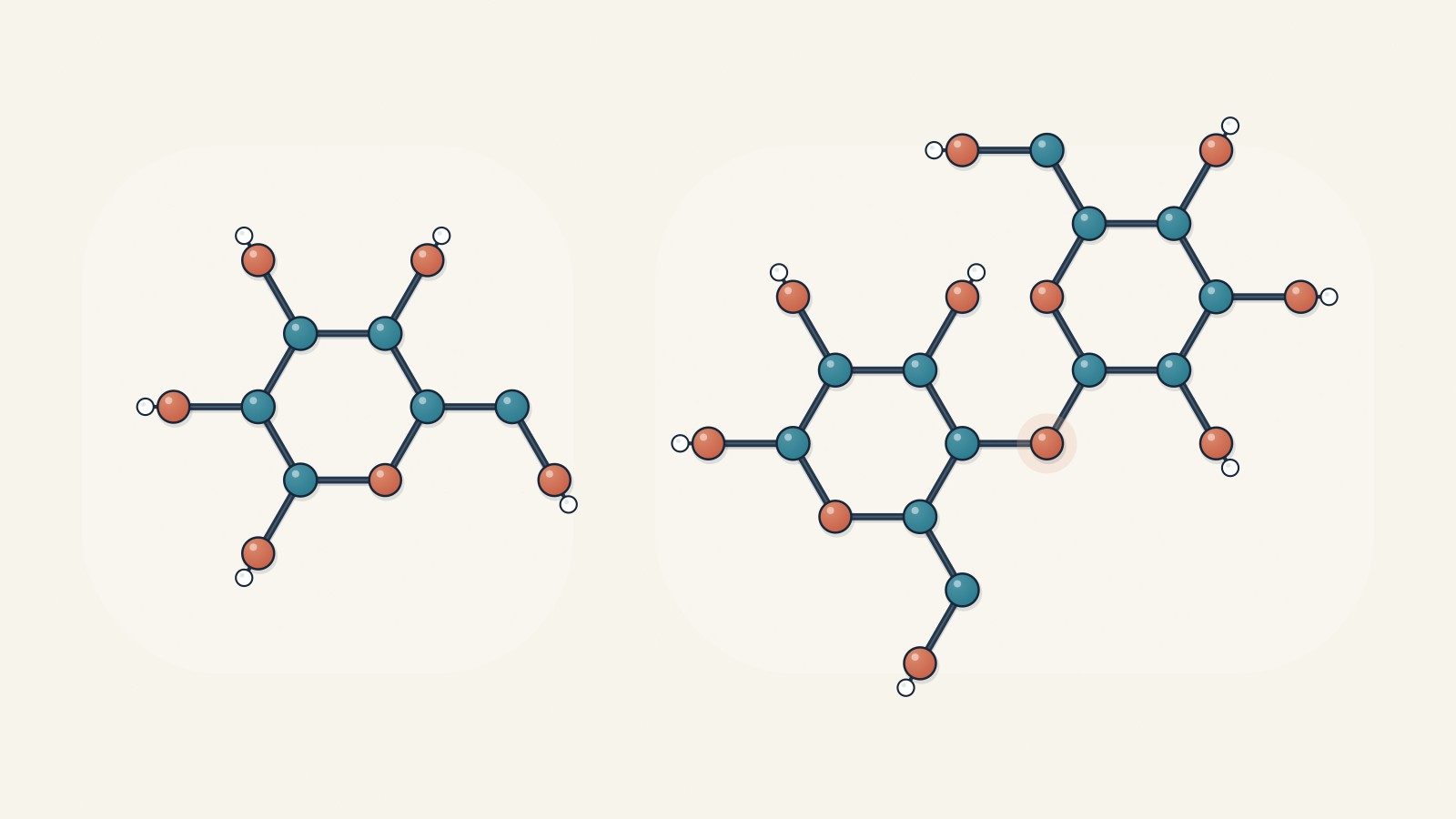
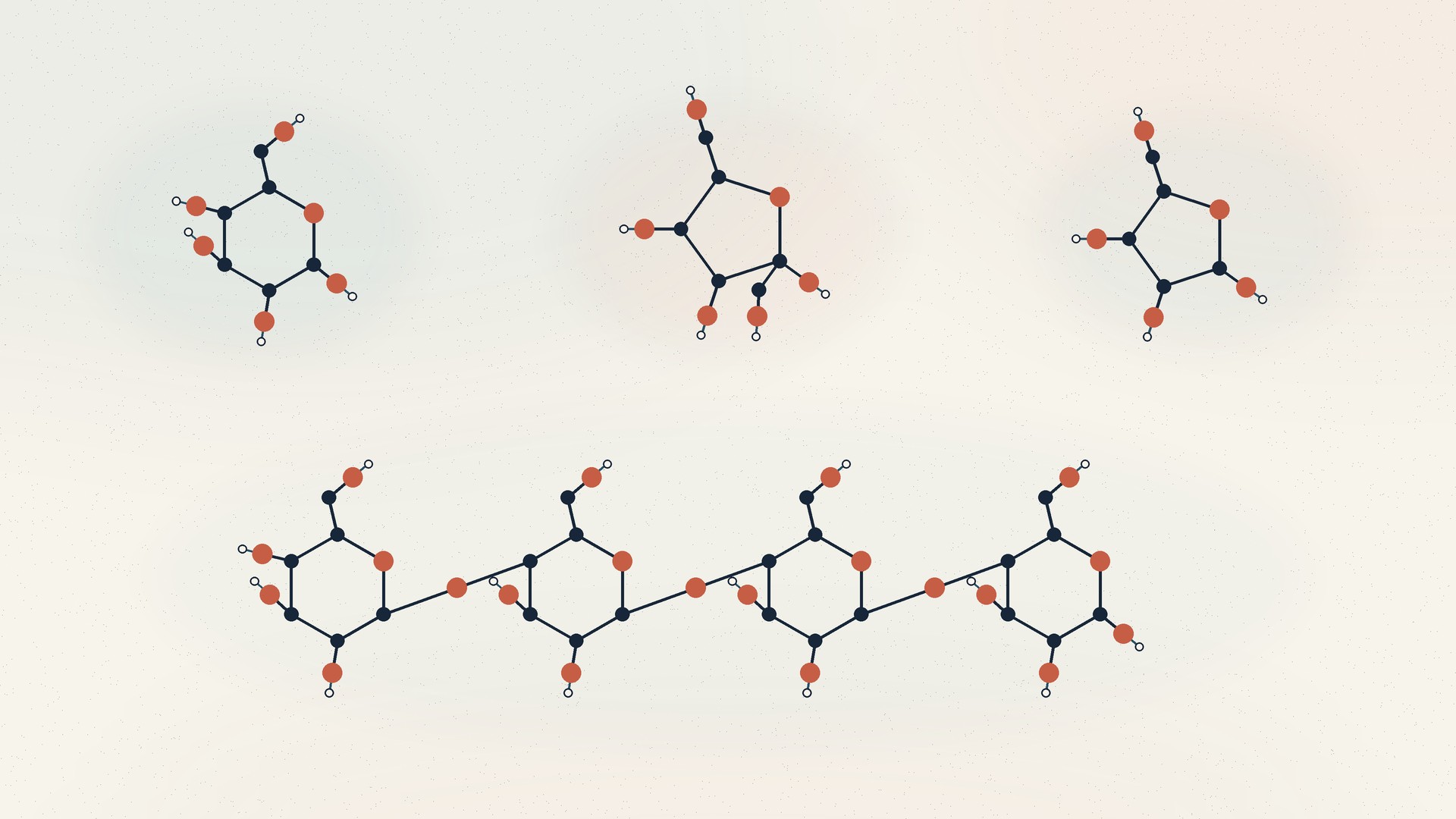
Some carbohydrates are small molecules called SUGARS. Glucose is one of these. Others are much larger, with many small sugar units joined into chains or networks. Starch and cellulose are two important examples in plants.
The family contains substances with different jobs. Some carbohydrates can be broken down and used in energy-transferring reactions. Others are suitable for storage or for building structures. Being in one chemical family does not mean all its members are interchangeable.
A family can contain smaller categories and individual substances. Glucose belongs among the sugars; starch belongs to the wider carbohydrate family but is not a simple sugar.
Sort the cabinet
A modern learner has five specimen cards: glucose, starch, cellulose, an ordinary protein and carbon dioxide. Which three belong to the carbohydrate family? For each of those three, give a different useful description: a small example of the family, a plant storage material, or a plant structural material. Why do the other two not become carbohydrates merely because organisms use them or because they contain carbon?
Choose two carbohydrate cards with contrasting biological roles. Explain why belonging to the same broad chemical family does not imply identical size, structure or use. Do not infer from modern plants which molecules the earliest organisms possessed.
Attempt the sort before opening the Check. No biological image should colour-code the correct answer in advance.
Check your answers
glucose, starch and cellulose belong to the carbohydrate family. Glucose is a small sugar example; starch is a storage carbohydrate; cellulose is structural material in plant cell walls. Protein belongs to a different family and carbon dioxide is not a carbohydrate: carbon content or biological importance does not establish identity. A valid contrast is glucose versus starch or cellulose, or starch versus cellulose; related substances may differ greatly in size, arrangement and biological function.
Where the family becomes useful
A plant can make glucose and later use its carbon-rich material in several ways. One route produces starch, a carbohydrate that plants use for storage. Another produces cellulose, an important material in plant cell walls. The chemistry of these transformations is a later question; for now, you need to see why naming a carbohydrate family does not specify just one job.
Even a molecule used in energy-transferring reactions is not itself 'energy' rather than matter. The atoms remain matter. Energy transfers occur through chemical and biological processes involving those molecules.
We are using familiar living systems as examples. These examples do not establish what carbohydrate molecules the first cells used, or when starch and cellulose first evolved.
A good inference or a guess?
For each statement, write SUPPORTABLE or NOT ESTABLISHED, with a reason.
A. Starch and glucose can both belong to the carbohydrate family, even though they differ greatly in size.
B. Every substance whose formula contains C, H and O is a carbohydrate.
C. If a molecule is a carbohydrate, it must serve exactly the same purpose in every organism.
D. Some carbohydrates form larger chains built from smaller sugar units.
E. Because plants use starch, the first organisms on Earth must have used starch.
Check your answers
A supportable; B not established (formula elements alone do not determine chemical identity); C not established (family contains different functional molecules); D supportable; E not established (modern plant pathways do not prove those pathways existed at life's beginning).
Remember and follow the next branch
1. What does it mean to call carbohydrates a chemical family? 2. Name one small member, one plant storage carbohydrate and one structural carbohydrate. 3. Why does belonging to that family not determine a molecule's job? 4. Why do element names alone not establish membership of the family? 5. Why does this classification tell us nothing certain about the chemistry of the first living cells?
Check your answers
(1) A family of related compounds rather than a single formula or purpose. (2) Glucose; starch; cellulose. (3) Its members have different structures and roles, including small molecules, storage and structural material. (4) Composition alone does not settle chemical structure or identity. (5) Modern classifications do not prove the molecular pathways of the earliest organisms.
The next smaller question
We now know where to look in the family. Next, we will distinguish different kinds of sugars. That will lead us to glucose as a particular substance, not merely a set of letters in a formula.