Beryllium Nuclei
Does every nucleus assembled in the early universe survive unchanged?
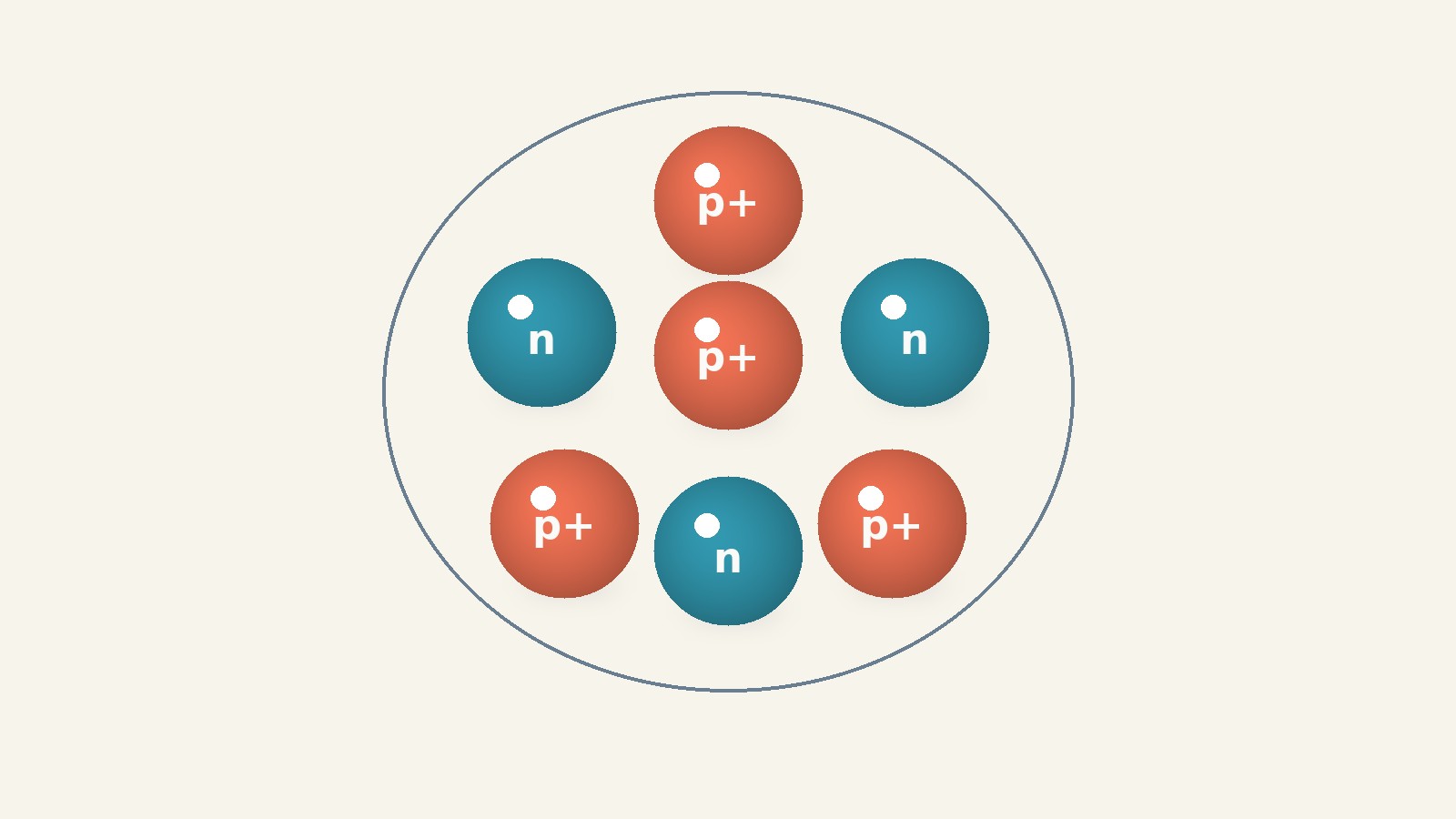
A produced nucleus is not a permanent supply
The story of a nucleus does not necessarily finish when it first forms.
An atomic nucleus may be unstable. That means it can change into another kind of nucleus through a nuclear process. So a reaction that makes a particular nucleus does not automatically mean that nucleus will remain unchanged indefinitely.
Beryllium-7 is an example from the early light-element story. Let us identify its nucleus first, then examine why its later fate matters.
Identify the nucleus
1 of 2
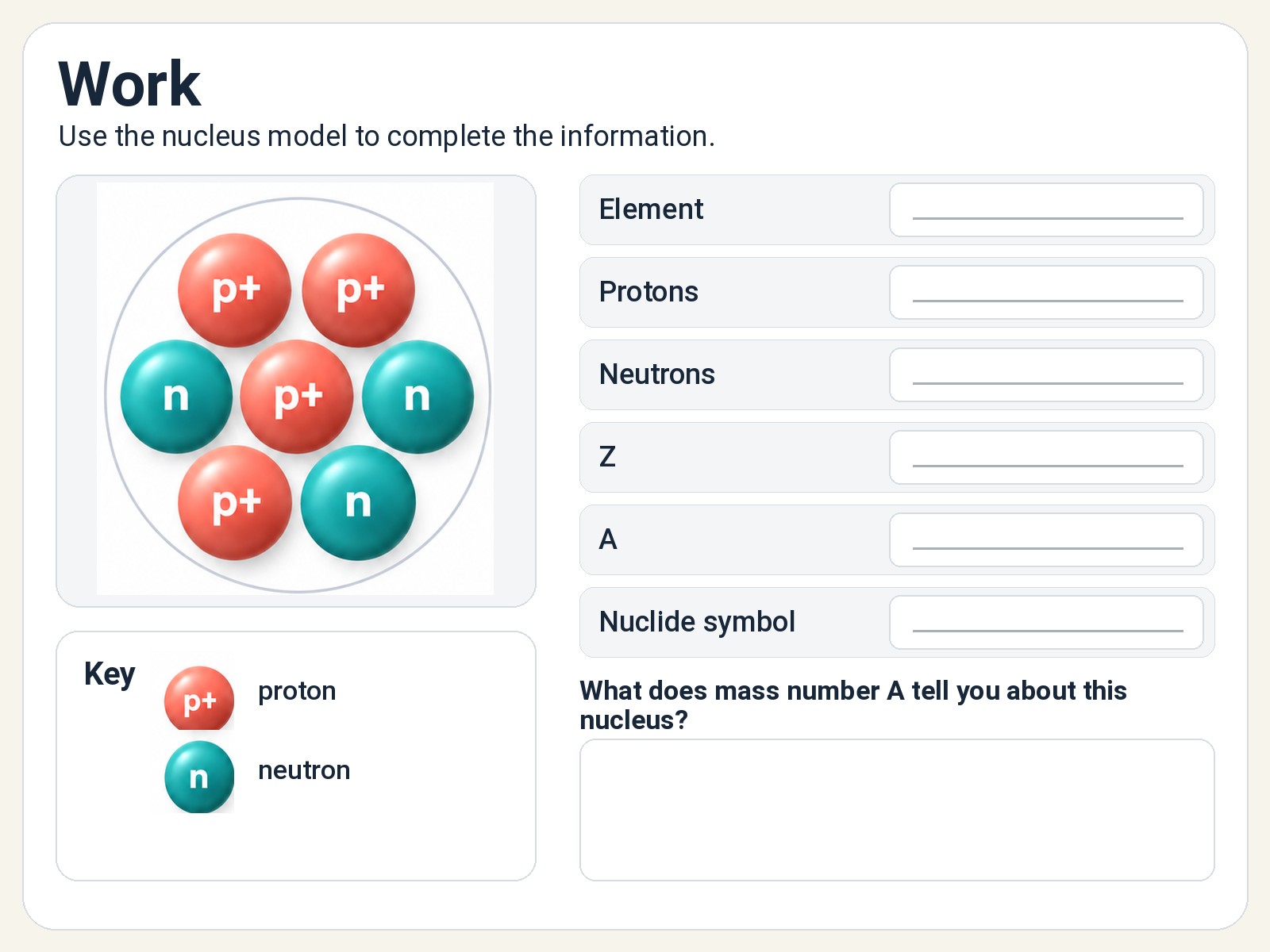
Look at the new nuclear model. Count its protons and neutrons. Write down its atomic number Z and mass number A.
Use the proton count to name the element. Then explain what its mass number tells you about this one nucleus.
Try before checking.
Beryllium-7
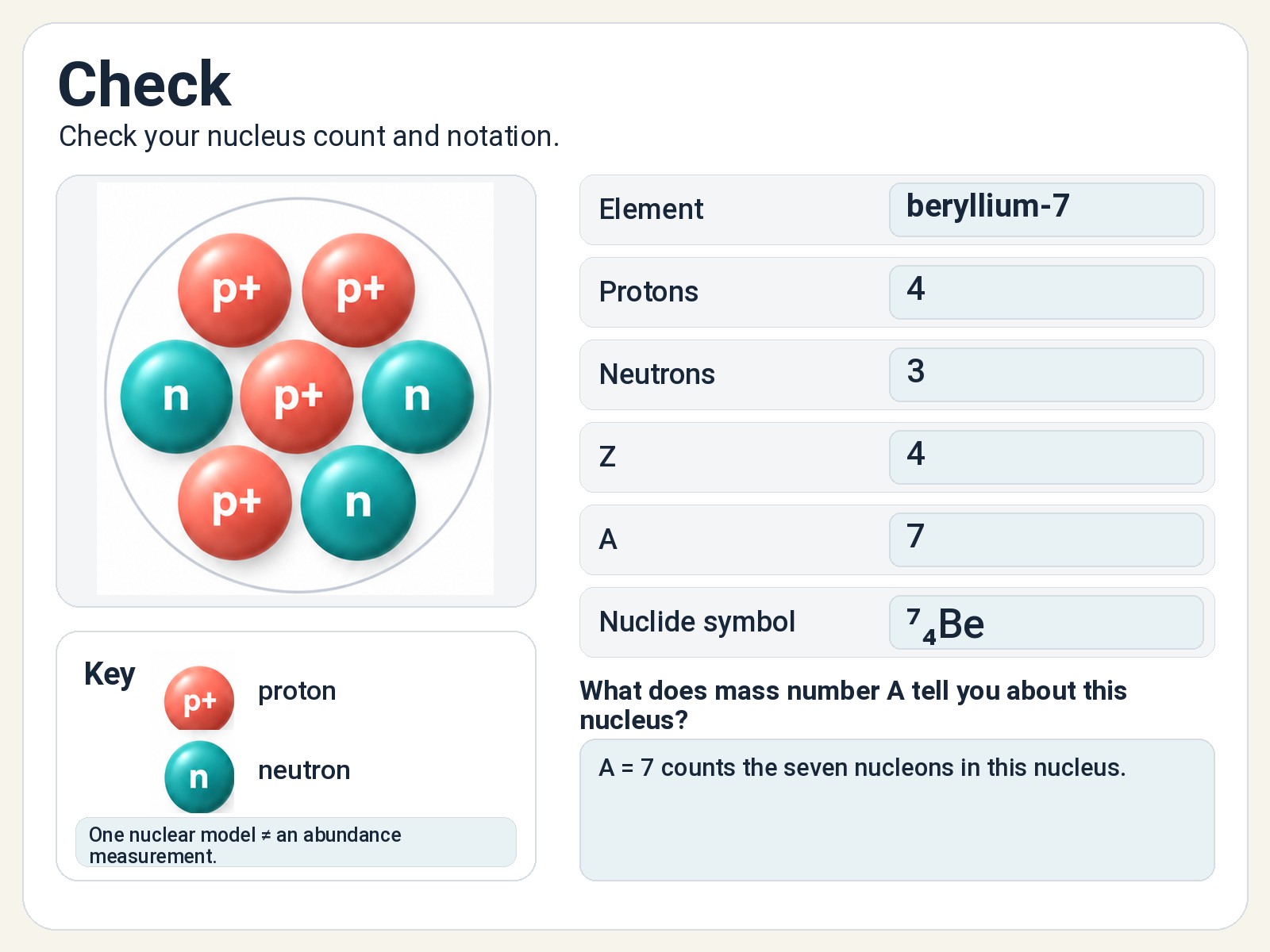
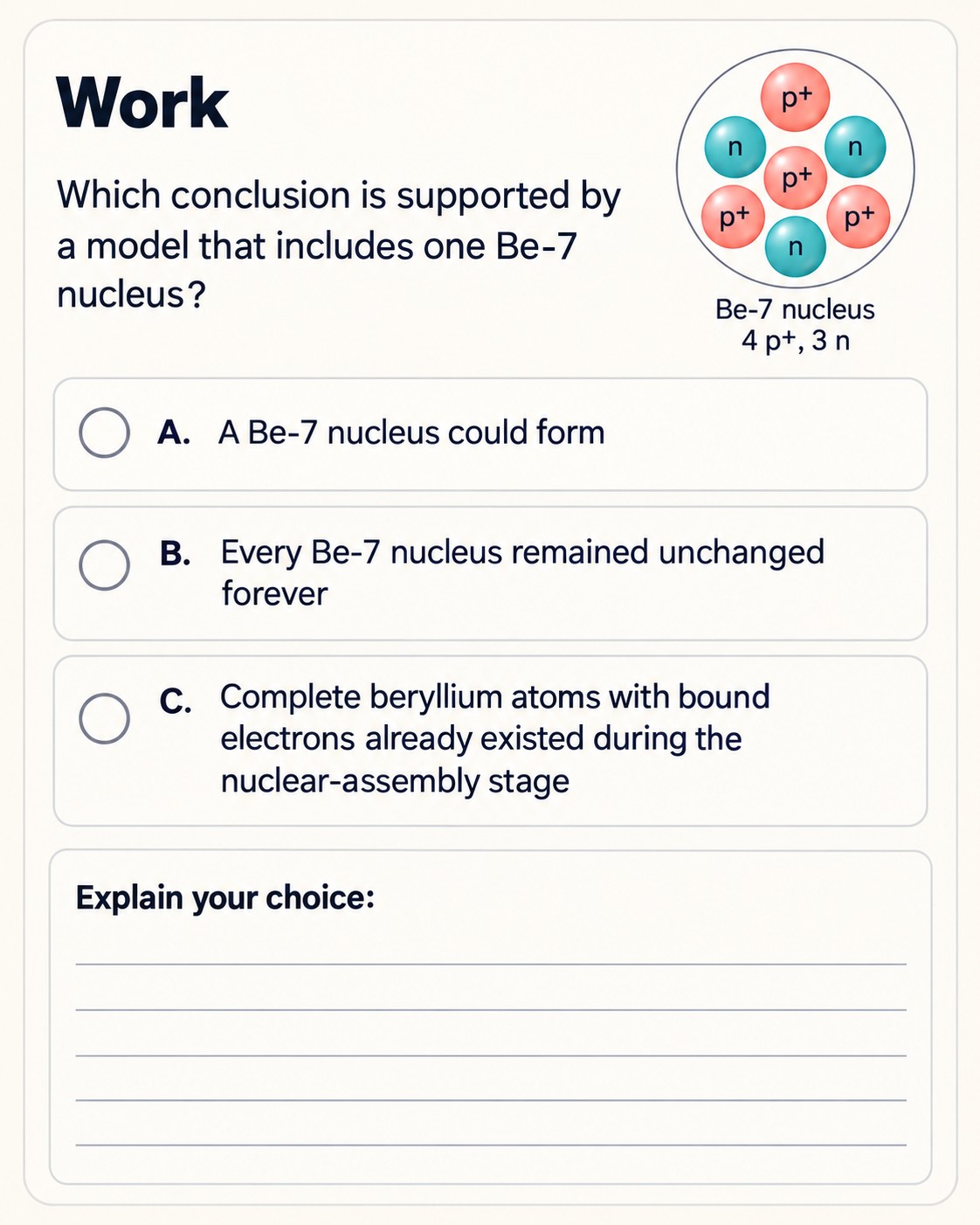
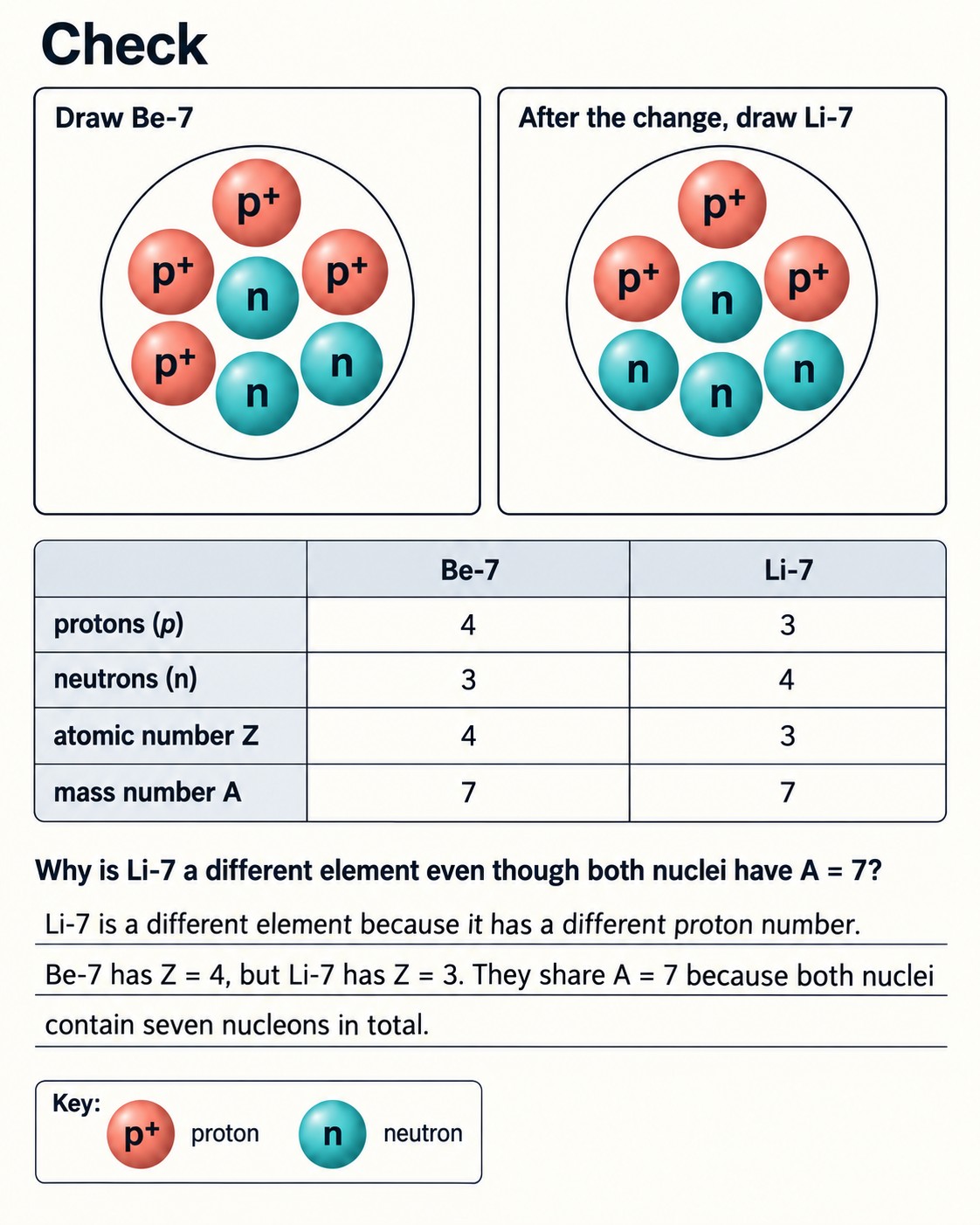
This model contains four protons and three neutrons. Its proton number is Z = 4, identifying beryllium. Its mass number is A = 7 because it has seven nucleons in total. We call the nucleus beryllium-7 and write 7 at the upper left of Be and 4 at the lower left.
That 7 counts the protons and neutrons in this nucleus. It is a property of the nucleus, not a count of separate nuclei.
What happens after formation?
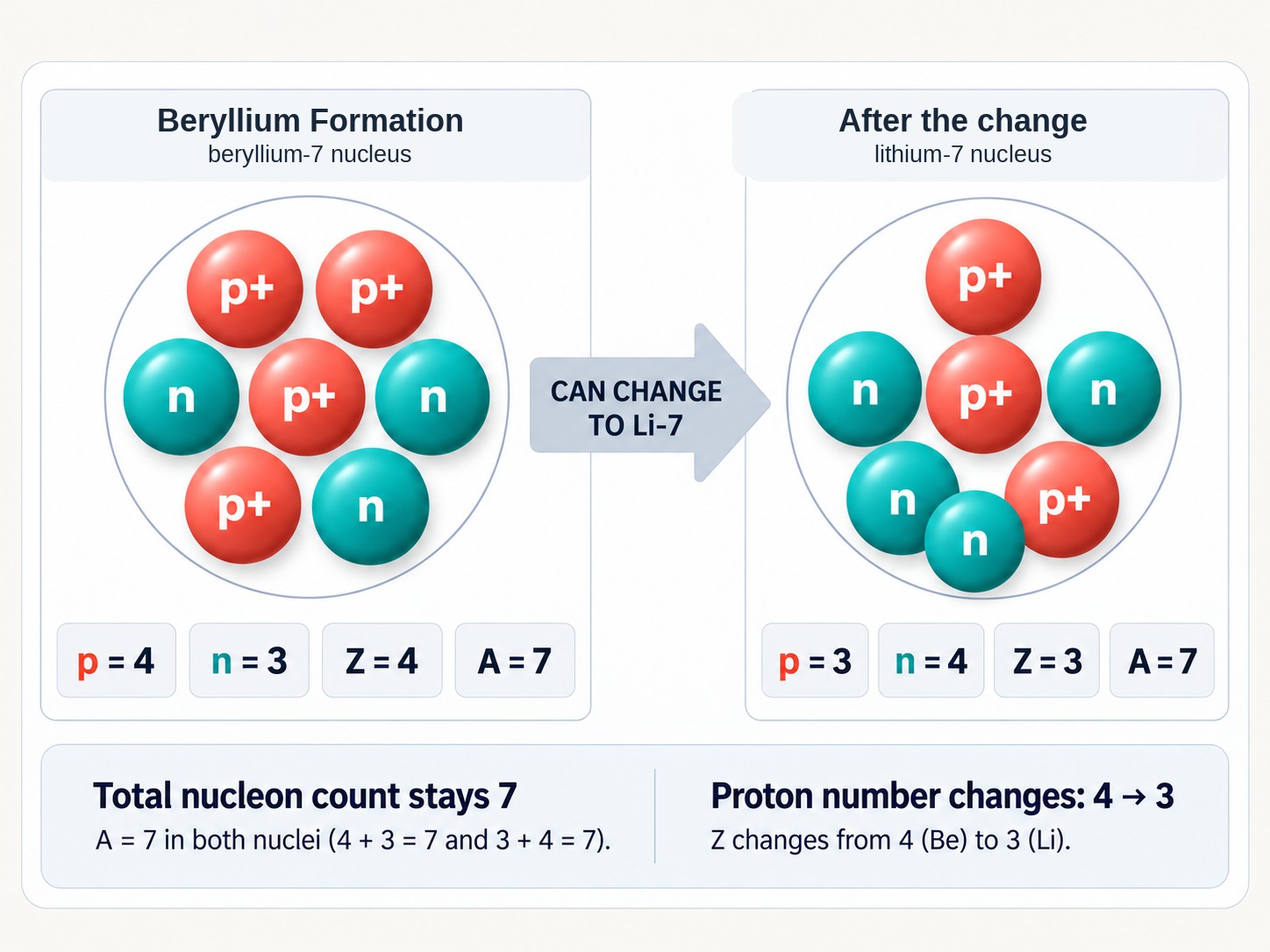
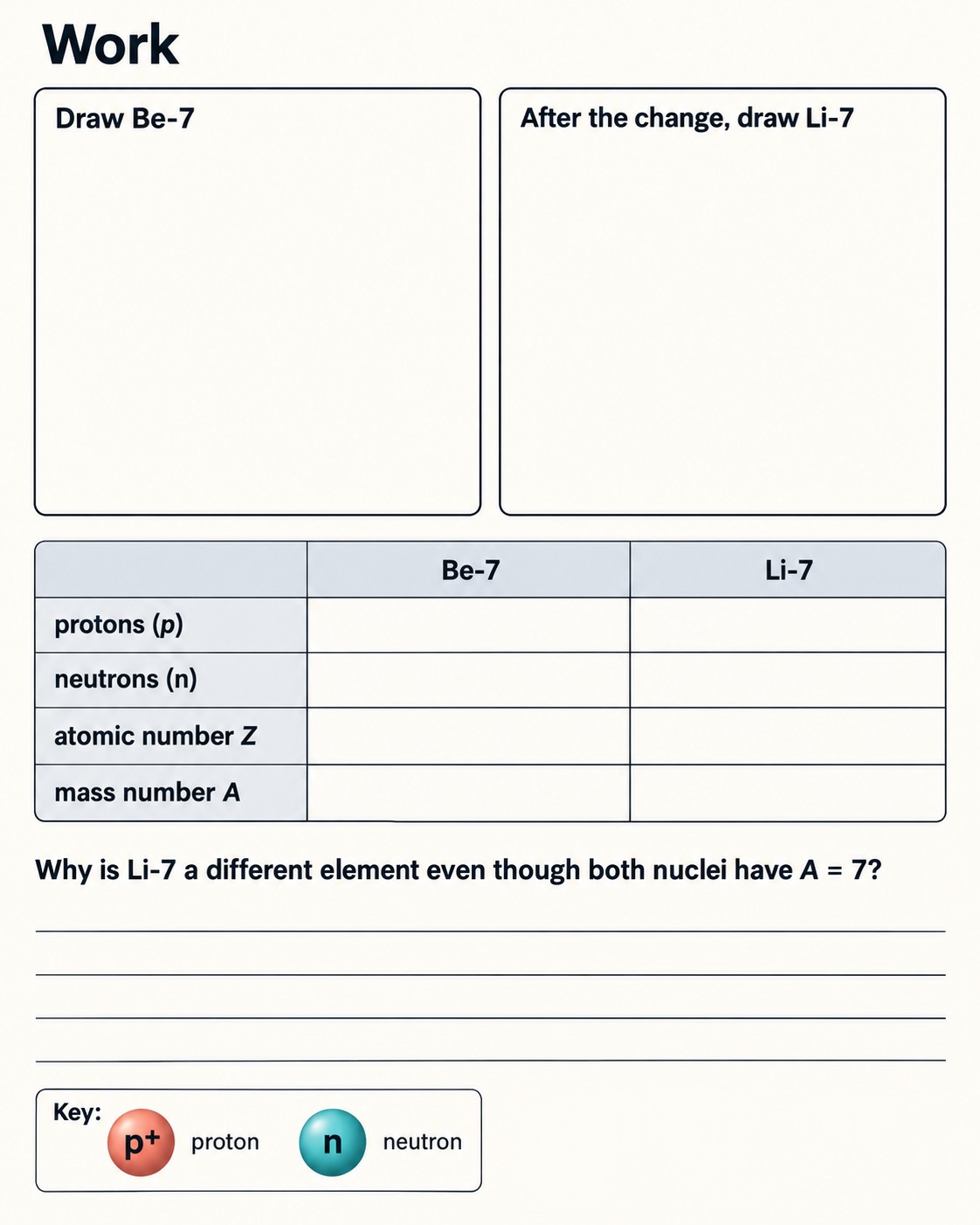
Beryllium-7 is radioactive. It can later change into lithium-7, which has three protons and four neutrons. Both nuclei have mass number 7, but they belong to different elements because their proton numbers differ.
The change is not something we should draw as happening automatically the instant beryllium-7 appears. In the early universe, nuclei were initially without stable bound electrons. The familiar way beryllium-7 changes into lithium-7 involves an electron, so the timing of that change depends on later conditions.
For this lesson, the important point is that a nucleus formed during the early reactions need not remain unchanged as the same element. The detailed nuclear-change mechanism belongs to a later lesson.
What does the evidence show?
1 of 2
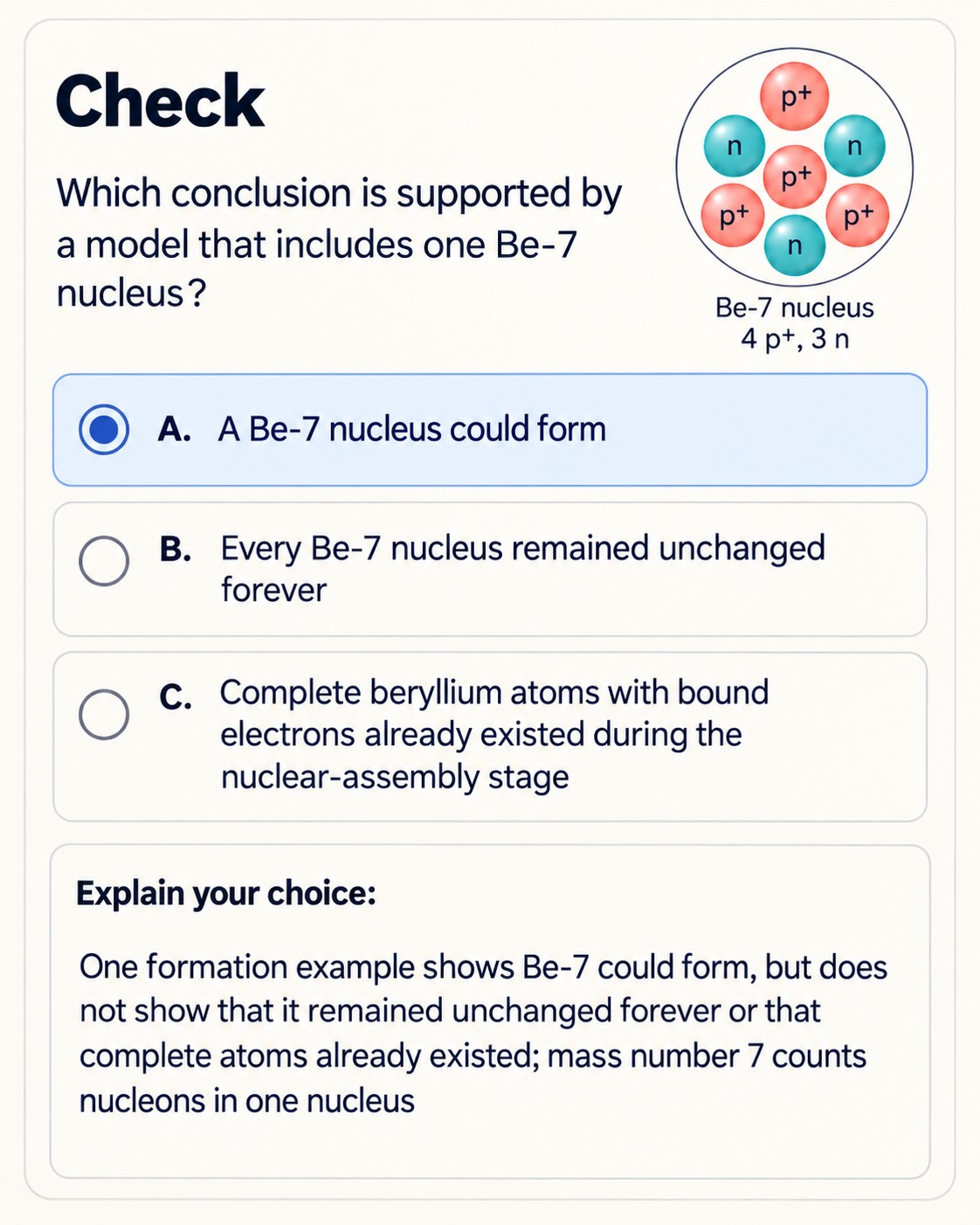
A scientist's model of an early nuclear reaction includes one beryllium-7 nucleus.
Which of these conclusions is supported by that model?
A. A beryllium-7 nucleus could form.
B. Every beryllium-7 nucleus remained unchanged forever.
C. Complete beryllium atoms with bound electrons already existed during the nuclear-assembly stage.
Choose your answer. Explain why the other conclusions are not supported, and what 'mass number 7' tells you about this one nucleus.
Try before checking.
Remember / transfer
1 of 2
Without looking back, draw a model of beryllium-7 using the proton-and-neutron key. Give its numbers of protons and neutrons, its atomic number and its mass number.
Then write one sentence explaining why beryllium-7 changing later into lithium-7 would change the element identity even though the mass number remains 7. You do not need to describe how the nuclear change happens.
When you have finished, compare with the checked model.
GCSE knowledge coverage
GCSE knowledge coverage
You have reinforced atomic number by identifying a beryllium nucleus from its four protons, and mass number by counting its four protons and three neutrons. You have also practised distinguishing the composition of one nucleus from the question of whether that nucleus later remains unchanged.
The nuclear-number skills were first taught on Atomic Number and Mass Number and are applied here. The existence and later history of primordial beryllium-7 are scientific context, not a new GCSE decay-mechanism requirement claimed by this page. Detailed radioactive-decay types and electron behaviour remain later curriculum topics.