Sometimes We Need the Perspective of an Alien Spider
What Spaceman understands about perspective, human connection and the things that become invisible when we are standing too close to our own lives
How do you see something about your own life that you are too close to see?
You can think harder. You can interrogate your decisions, examine your motives and attempt to recognise the assumptions underneath them. But there is an obvious problem with this method: you are using the same mind that made those decisions, constructed those explanations and acquired those assumptions in the first place. Sometimes what we need is a perspective that begins somewhere else entirely.
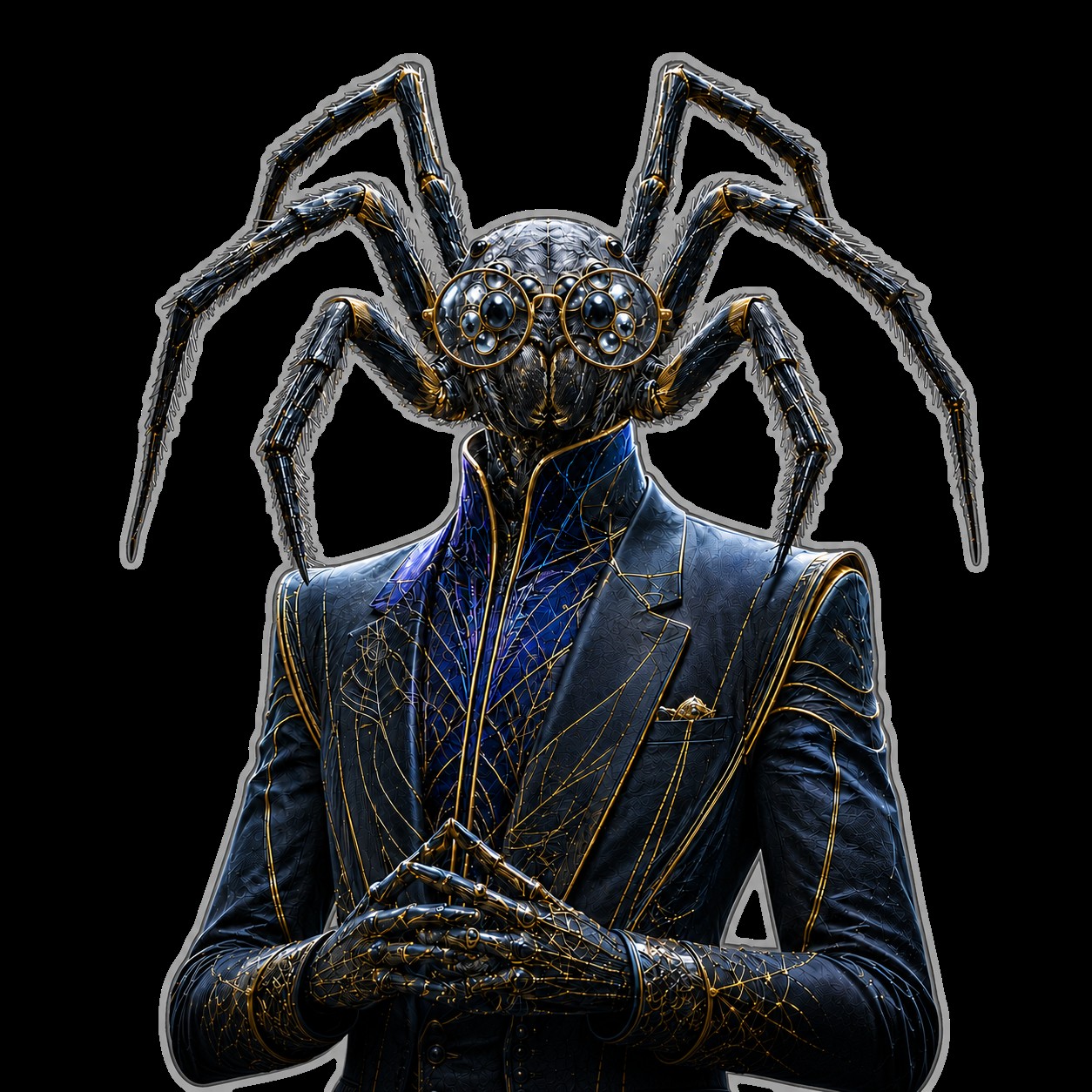
Preferably, apparently, the perspective of an enormous alien spider.
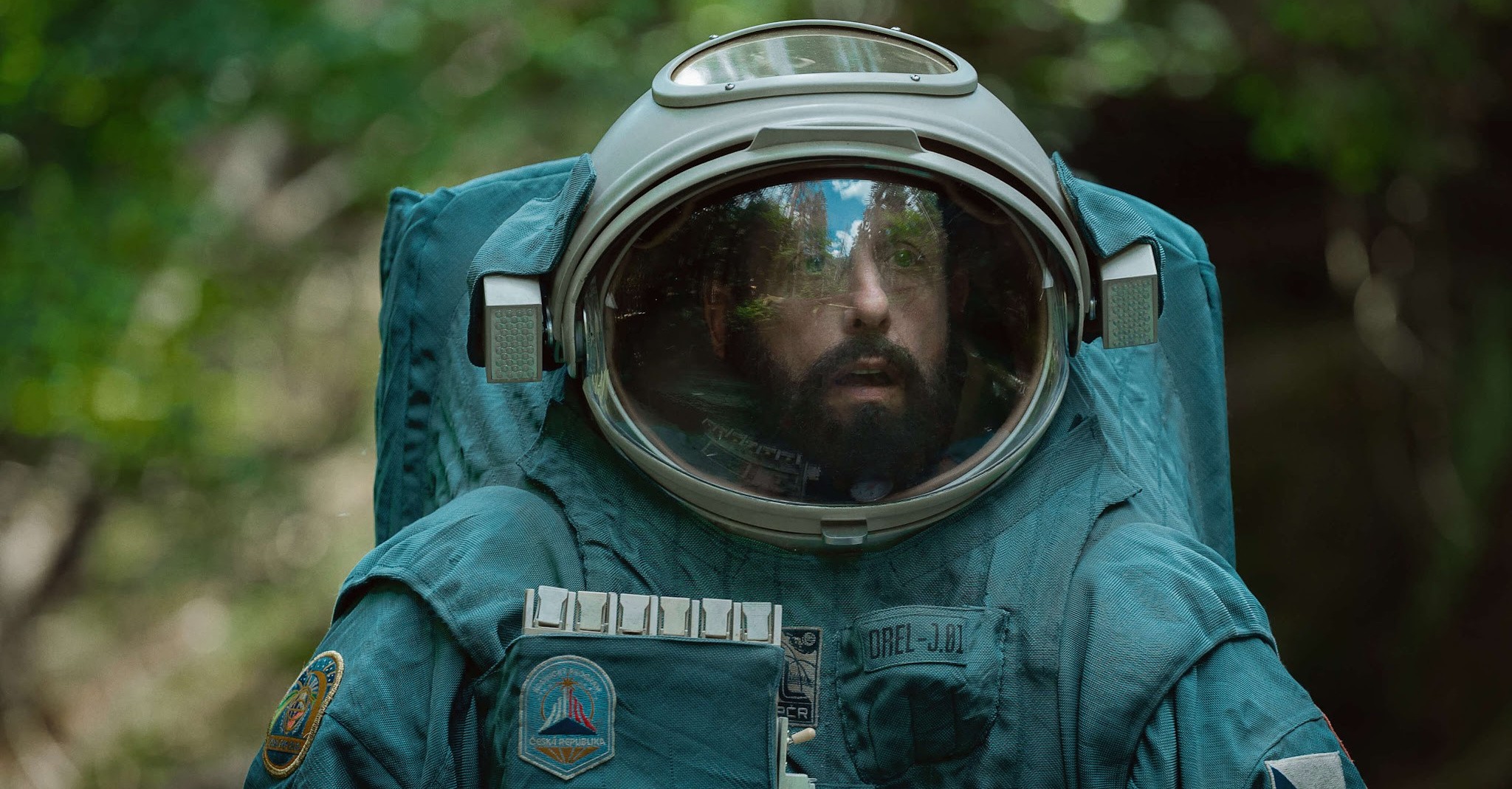
Spaceman arrived on Netflix in March 2024 after premiering as a Special Gala at the Berlin International Film Festival. It was an unusual project on several fronts. Johan Renck, who won an Emmy and a Directors Guild of America Award for directing HBO’s Chernobyl, returned to feature filmmaking with an adaptation of Jaroslav Kalfař’s 2017 novel Spaceman of Bohemia. Colby Day wrote the screenplay, Carey Mulligan and Paul Dano joined the cast, and Adam Sandler continued the strand of his career established by films such as Punch-Drunk Love, The Meyerowitz Stories and Uncut Gems: reminding everybody periodically that the man from Grown Ups is also a very good dramatic actor. (berlinale.de)
The result divided critics. Spaceman is slow, melancholy and much more interested in a failing marriage than in the scientific possibilities of its journey to the edge of the Solar System. Its Metacritic score settled at 55, while Rotten Tomatoes recorded a similarly divided critical response. Some reviewers found it ponderous; others found something moving and unusual in Sandler’s restrained performance and the film’s strange combination of domestic drama, metaphysical science fiction and couples therapy conducted by a giant arachnid. (Metacritic)
Sandler plays Jakub Procházka, a Czech astronaut sent hundreds of millions of kilometres from Earth to investigate a mysterious cloud near Jupiter. Six months into the mission, the marriage he left behind is collapsing. Then Jakub discovers an enormous spider hiding aboard his spacecraft. The spider, voiced by Dano, becomes Hanuš: an ancient, telepathic extraterrestrial who can move through Jakub’s memories and is considerably more interested in the state of Jakub’s inner life than the historic importance of his mission.
That is where Spaceman becomes interesting. Jakub already has explanations for his life. He is an astronaut. His work matters. He has accepted enormous personal sacrifices to achieve something extraordinary. He has travelled into deep space on behalf of his country and humanity. Hanuš has the considerable advantage of not caring about any of that. He comes from somewhere beyond human civilisation, so careers, prestige and national achievement hold no automatic significance for him. He has no reason to accept the hierarchy of importance that Jakub has spent his life accepting. He simply looks at the human being in front of him, and from that perspective Jakub’s life looks rather different.
The Problem With Seeing From the Inside
We spend almost all of our lives looking at the world from inside something. We live inside families, cultures, economies, professions, friendships and political systems. More fundamentally, we live inside the particular collection of memories, habits and assumptions that we call ourselves. That makes life possible. We could not reconsider the foundations of civilisation every time we bought a sandwich. But it also means that some assumptions become almost impossible to see precisely because they are so familiar.
Consider work. Within our culture, it can seem perfectly reasonable to sacrifice enormous amounts of time for professional achievement. Promotions, qualifications, awards and impressive job titles form a shared system of value, and because other people recognise that system, its logic feels obvious. Move far enough outside it, however, and it becomes possible to ask strange questions. Why does this person spend fifty hours every week doing something they dislike so that another person can give them a different title? Why does having more money than someone else make them important? Why are people impressed when somebody is too busy to see the people they love?
There are perfectly good answers to some of those questions. Work provides food, housing, purpose, community and the resources needed to care for others. Achievement can represent genuine accomplishment. The value of an outside perspective is not that it automatically proves our systems wrong. It is that it makes them visible. Once something becomes visible as a system rather than simply reality, we can ask whether it still makes sense.
Hanuš performs this function for Jakub. Renck has described the creature as a kind of sage, observing human narcissism and preoccupations from a position entirely outside them. Jakub thinks he is explaining his life to the alien, but gradually the direction of examination reverses. The alien begins explaining Jakub’s life to him.
Hanuš Is Not Just Jakub’s Conscience
It would be easy to interpret Hanuš as a hallucination produced by loneliness. The film deliberately makes that possibility available. Jakub is isolated, exhausted and emotionally distressed, and nobody else aboard the spacecraft can see his visitor. But within the story world of the film, Hanuš is real. Renck has been explicit about this, and the film includes a small physical clue when Hanuš leaves residue on Jakub’s helmet. Renck included it precisely because he wanted evidence of a physical existence independent of Jakub’s mind. (Netflix)
That distinction matters because it changes what the story is doing. If Hanuš were only Jakub’s subconscious, Spaceman would essentially be about a man discovering something he already knew. Instead, another intelligence encounters him. Another consciousness looks at Jakub’s life and notices things Jakub cannot. Hanuš therefore works like Jakub’s conscience without literally being his conscience. He gives an external body to the act of being seen from somewhere other than inside oneself.
Science fiction is unusually good at creating this kind of encounter. Stories about extraterrestrial intelligence often ask whether humans could understand something genuinely alien. Spaceman reverses the direction of that question. Hanuš is not primarily there so that Jakub can understand the alien. Hanuš studies us.
An Alien Does Not Know Which Human Things Are Supposed to Matter
There is a useful literary and artistic technique called defamiliarisation: take something ordinary and present it as though it has never been encountered before. A wedding becomes a ceremony in which two humans wear unusual clothes, gather their relatives and exchange pieces of metal before eating an expensive meal. Money becomes paper, metal and numbers stored in computers which people collectively agree can be exchanged for food and shelter. A school becomes a building where young humans are divided largely according to the number of times their planet has travelled around its star.
None of those descriptions captures the whole truth. That is precisely why the exercise works. By changing the frame, it reveals features that familiarity normally hides. Things that appear natural from the inside suddenly become arrangements that could have been otherwise.
Hanuš does something similar to Jakub. He does not know the conventions that allow Jakub to tell himself he had to leave. He does not instinctively recognise the grandeur of being an astronaut. He does not share Jakub’s assumptions about sacrifice, ambition or marriage, so he can ask questions that human familiarity has made difficult. Why did you leave? Why did you hurt her? Why does this matter more?
Jakub has travelled into space to encounter something beyond ordinary human experience. Instead, he encounters a perspective from which ordinary human experience becomes strange. The celebrated astronaut becomes what Hanuš affectionately calls a skinny human: an animal floating through space who is frightened that someone he loves no longer wants him. Stripping away the profession, nation, mission and reputation does not make Jakub’s problem easier to solve, but it does make it harder to hide.
Sometimes Another Person Can See the Shape You Are In
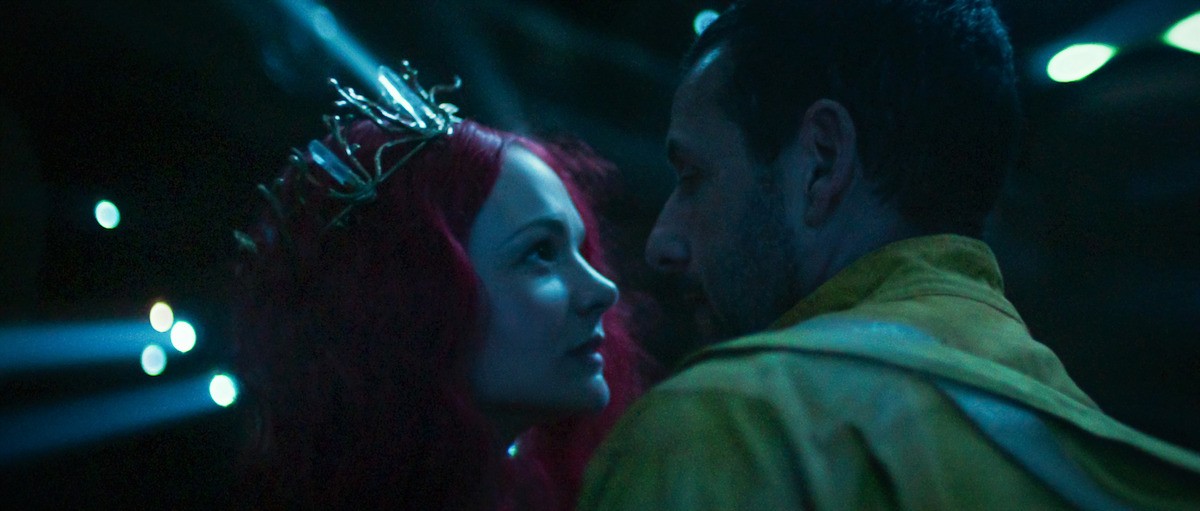
We do not actually need an alien spider to experience this. Other people can perform the same function. A friend can notice that we are unhappy before we allow ourselves to call ourselves unhappy. A child can ask an embarrassingly simple question about something adults have made unnecessarily complicated. Someone from another culture can encounter one of our customs and ask why everybody behaves this way. A therapist does something similar more deliberately, standing close enough to understand a person’s world but far enough outside it to recognise its patterns.
This is one reason perspective cannot be produced entirely through introspection. We can examine our own thoughts, but we perform that examination using the same mind that produced them. Some assumptions sit so deep that they do not appear to us as thoughts at all. They look like reality. Another consciousness introduces another coordinate. It can show us what our behaviour looks like from somewhere we cannot occupy ourselves.
That does not make the outsider automatically right. Outsiders have blind spots too. They lack information, misunderstand context and sometimes fail to appreciate why something makes sense from within. The value comes from the difference itself. Another perspective exposes the assumptions that both parties do not share.
Hanuš can see Jakub clearly because he does not begin where Jakub begins. Importantly, however, the relationship eventually works in both directions. Hanuš is dying. The parasite that destroyed his own world has found him, and the ancient observer eventually becomes vulnerable himself. Jakub stops treating him as an intrusion and comes to care for him. The alien teaches the human something about being human, while the human gives the alien companionship at the end of his life.
The Spider Is Important Because It Looks Like a Spider
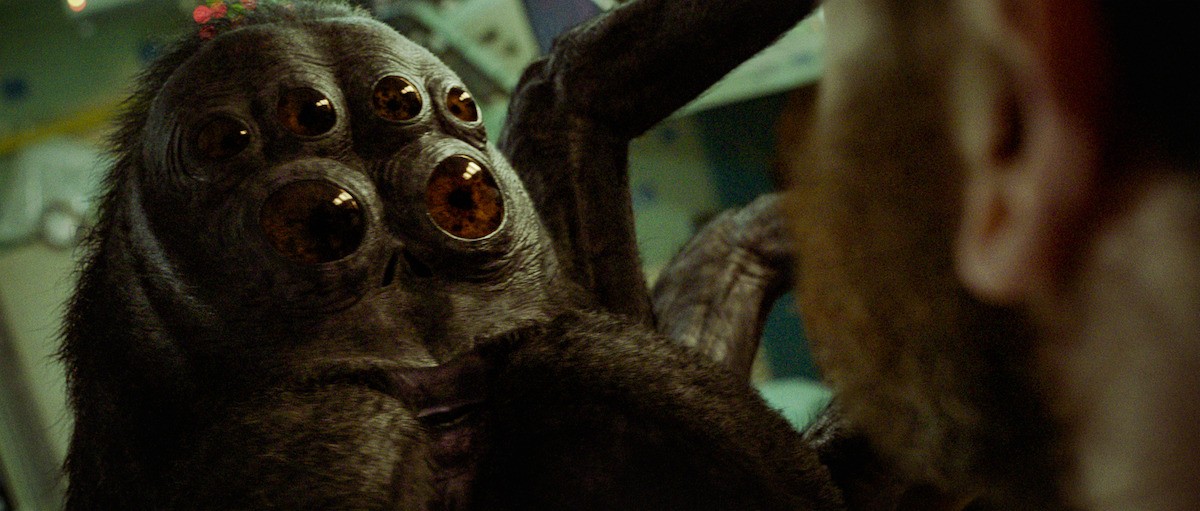
There is another clever decision buried inside Hanuš: he is horrible to look at. Not objectively, perhaps. Somewhere in the universe he may be considered extremely handsome. But human beings have opinions about enormous hairy things with too many eyes.
Renck and Dano have both spoken about the need for Hanuš to move from frightening to lovable. That transformation matters because almost nothing about Hanuš himself changes. Jakub changes. At first he sees a monster; later he sees Hanuš. The difference is information, familiarity and relationship. (Netflix)
Human perception constantly uses categories because it has to. Dangerous. Safe. Familiar. Strange. Attractive. Repulsive. Friend. Threat. Those classifications allow us to make rapid decisions, and sometimes they keep us alive. But categories can also become errors that persist after the evidence has changed.
Hanuš looks less human than anyone Jakub has ever encountered, yet eventually understands him with extraordinary intimacy. He moves through his memories, recognises his evasions and witnesses his pain. The creature that looks least like Jakub becomes the creature capable of seeing him most clearly. It is a useful idea in a world where humans repeatedly confuse familiarity with similarity, and similarity with understanding. Something does not need to resemble us to have a perspective worth hearing.
Getting Far Enough Away to See Home
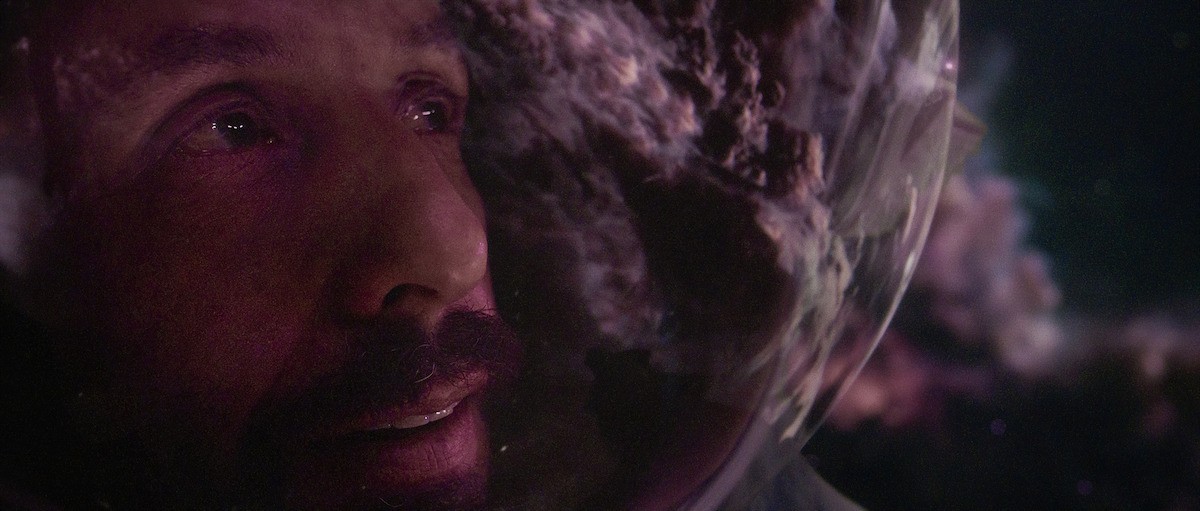
There is a lovely contradiction at the centre of Spaceman. Jakub has to travel hundreds of millions of kilometres from Earth before he understands what he left there. His mission promises the ultimate expansion of perspective, taking him farther into the physical universe while Hanuš pushes him farther into himself.
There is an obvious parallel here with James Gray’s Ad Astra. That film sends Brad Pitt’s emotionally compartmentalised astronaut Roy McBride across the Solar System in search of his absent father, only for the outward journey to become an inward one. Gray has explained that one of the ideas behind Ad Astra was precisely this contradiction: the farther humanity travels physically, the more apparent it becomes that the great unexplored territory may be ourselves. Spaceman arrives at similar territory through a marriage rather than a father-son relationship, and through an alien spider rather than Tommy Lee Jones. The kinship goes a little further still: Max Richter composed music for both films. (Roger Ebert)
What distinguishes Spaceman is that Jakub’s revelation is intensely local. It is about Lenka, their relationship, the moments when she needed him and he was absent, and the life he treated as though it would remain waiting while he pursued something more important. The mysterious Chopra cloud may contain material connected to the beginning of the universe, but the cosmic beginning ultimately pushes Jakub back towards another beginning: his memories of falling in love.
The enormous leads back to the intimate. That does not mean exploration is meaningless, or that ambition is inherently foolish, or that nobody should leave home because relationships are the only things that matter. It means importance depends partly on perspective. Human beings are remarkably good at confusing the scale of something with its value. A space mission is enormous. A conversation between two people is tiny. But a tiny thing can contain a life.
Borrow Someone Else’s Eyes
We cannot permanently live outside ourselves, and neither can Hanuš. He arrives with his own history, losses and limitations. But we can move between perspectives. We can ask what our lives look like to someone who does not share our assumptions. We can listen when somebody recognises a pattern we cannot. We can deliberately examine familiar systems as though we had encountered them for the first time.
This sometimes means asking questions that sound almost childish. Why do I care about this? Who decided this was important? What am I actually trying to achieve? What would this look like if I had never been taught that it was normal? What am I failing to notice because I am standing inside it? These questions do not necessarily produce comfortable answers, but that is partly their value.
Which brings us back to the question at the beginning. How do you see something about your own life that you are too close to see? Sometimes you cannot, at least not from where you are currently standing. You need another position. Another set of assumptions. Another consciousness looking back at you from somewhere you have never occupied.
Spaceman takes that ordinary human need and gives it eight legs. Jakub travels towards one of the great mysteries of the universe and discovers another intelligence waiting for him there. Hanuš has crossed unimaginable distances, but the knowledge Jakub most needs from him is surprisingly small: look at the person you love, look at what you are doing, and look again.
Sometimes another human can give us that perspective. And sometimes, apparently, we need an alien spider.